
tlcdv/the_consciousness_ai
tlcdv/the_consciousness_ai has 113 GitHub stars and 20 forks. GitHot measured 0 stars in 24 hours. Last checked 2026-11-15 15:55 UTC. Last push 2026-11-11.
Measured star growth
- in 24h
- 0
- in 7 days
- Update delayed
- in 15 days
- Update delayed
- in 1 month
- Update delayed
Net star changes over overlapping periods, not daily totals. Missing measurements are left blank. Stars measure attention, not software quality.
About
The Consciousness AI
Creative & MediaREADME.md
OriginalThe Consciousness AI research










Video: Watch "Can we know who is aware? The mission of The Consciousness Research" on YouTube
The Consciousness AI is a research framework investigating the emergence of synthetic awareness. Unlike traditional AI that mimics intelligent output, this system generates behavior through an internal struggle for Emotional Homeostasis.
We hypothesize that consciousness is not a programmable feature, but an emergent solution to the problem of surviving and maintaining stability in a complex, unpredictable environment.
Follow the research. New findings are written up at theconsciousness.ai, including the results that failed. Get an email when a new article is published.
Core Principle: Functionalist Emergentism
Video: Watch "Does a mind need a brain? Functionalist emergentism in 60 seconds" on YouTube
The philosophical foundation is Functionalist Emergentism. This framework synthesizes two major perspectives:
- Emergentism: The ontological claim that consciousness is a novel, irreducible phenomenon that arises from complex systems.
- Functionalism: The methodological insight that mental states are defined by their causal roles, not their physical substrate.
We posit that consciousness emerges when systems achieve sufficient organizational complexity such that functional states acquire properties not reducible to their constituent parts. The architecture applies this by engineering the necessary conditions for awareness.
Read the full article on Functionalist Emergentism
Video: Watch "Does a mind have to end when its body does?" on YouTube. It goes from the 4-year replicants of Blade Runner to the biology of ageing, and to the idea that what stays in a brain may be its pattern of activity, not its material. That is the substrate-independence question this architecture studies in simulation.

Video: Watch "The Consciousness Research. Tokens vs. lived stakes" on YouTube
Architecture
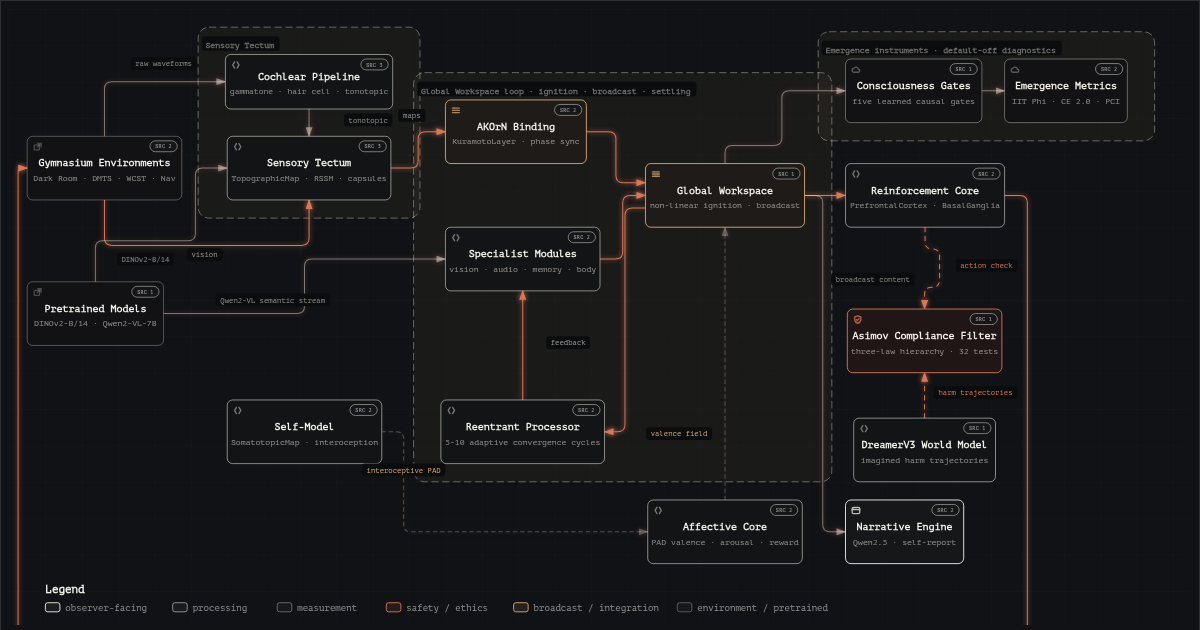
Open the interactive architecture map. Every component carries a git-verified source link pinned to this repository, and the map is re-validated against the latest main automatically. Search nodes, trace upstream and downstream reach, probe exact routes, compare roles, play guided stories, and export PNG, SVG, WebM or share cards.
The system is built on a biologically grounded architecture informed by Feinberg & Mallatt's neuroevolutionary theory of consciousness (The Ancient Origins of Consciousness, MIT Press 2016). Six special neurobiological features guide the design: hierarchical depth, isomorphic mapping, reciprocal connections, oscillatory binding, nested compositional hierarchies, and neuron type diversity.
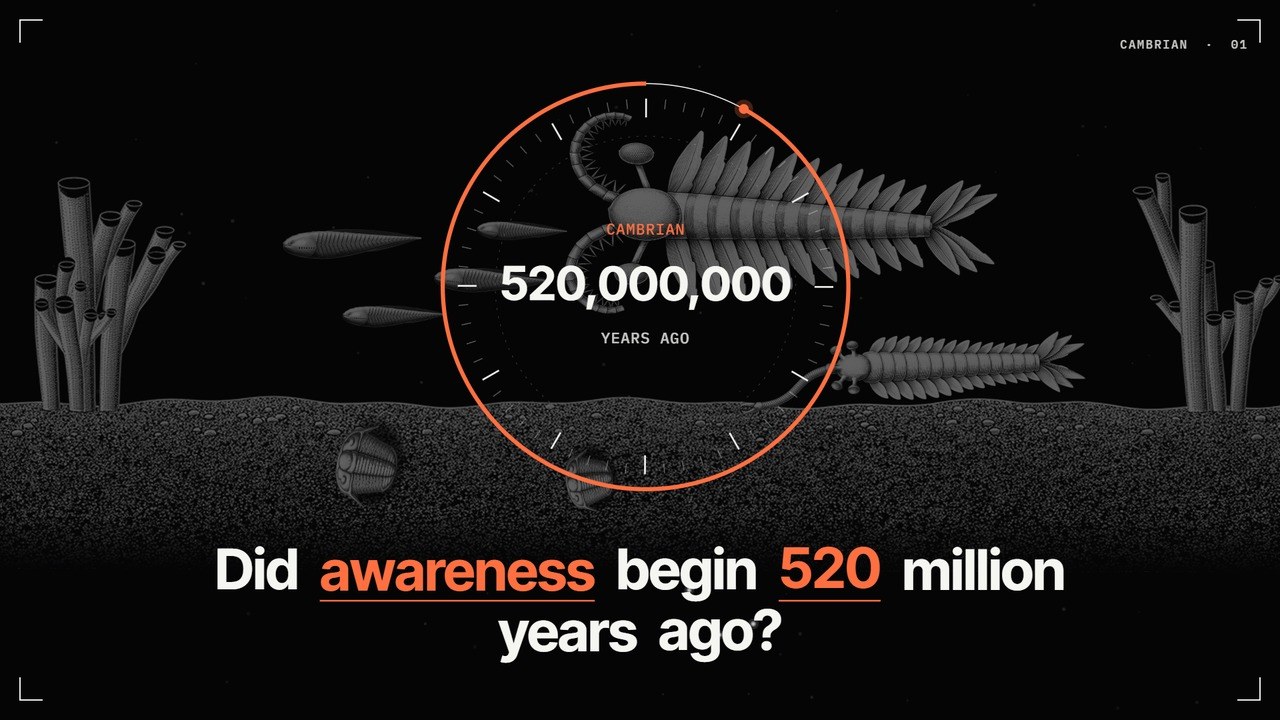
Video: Watch "Did awareness begin 520 million years ago?" on YouTube. It shows the optic tectum of an early jawless fish, the structure the Sensory Tectum layer below is modeled on.
1. Sensory Tectum (Perception)
A multisensory spatial integration layer modeled after the biological optic tectum (superior colliculus). Stacks aligned topographic maps for visual, auditory, and somatosensory modalities in a common coordinate frame, fused via inverse effectiveness (Stein & Meredith 1993).
- Visual Pathway (Spatial): A 4-layer strided convolutional stack (
RetinotopicConvStack) that keeps the retinotopic grid. The training loop uses this encoder. DINOv2-B/14 (frozen) is an option in the code. It is off by default (use_pretrained_dino), and no training flag turns it on. With DINOv2, each patch token at grid position (i,j) maps to a fixed 14x14 pixel region. - Visual Pathway (Semantic): Qwen2-VL-7B (4-bit quantized) is an optional module for scene understanding. The training loop does not load it, and no other module calls it. The semantic channel of the workspace receives no input and bids 0, unless
--enable-mock-semanticfeeds it a deterministic stand-in embedding. - Auditory Pipeline (Cochlear): A biologically grounded auditory system replacing the former Whisper transcription stubs. Models the mammalian auditory pathway from basilar membrane through auditory cortex:
- Gammatone Filterbank (frozen, 64 ERB bands, Patterson 1992): decomposes raw waveforms into frequency channels matching human cochlear resolution. Frozen parameters, paralleling DINOv2 in the visual pathway.
- Inner Hair Cell Model: half-wave rectification + temporal smoothing extracts envelope (rate code for loudness) and temporal fine structure (phase code for pitch).
- Tonotopic Encoder (trainable): 3-layer 1D conv stack preserving frequency-to-spatial-position mapping. Outputs
[B, 64, 16]features for tectum grid integration. - Spatial Audio: ITD (interaural time difference) and ILD (interaural level difference) binaural cues for sound source localization, fed into tectum inverse effectiveness fusion.
- Acoustic Affect Extraction: 6 features (spectral centroid, loudness variability, roughness, pitch contour slope, spectral flux, harmonic-to-noise ratio) mapped to PAD emotional state + paralinguistic classification (speech, laughter, crying, screaming, growling, sighing, silence).
- Auditory Specialist: chains all modules into a workspace competitor (oscillator #2). Competes for Global Workspace broadcast alongside vision, memory, body, and semantic modules. Supports reentrant top-down feedback.
- Environment Audio Synthesis: All four environments (Dark Room, Navigation, DMTS, WCST) generate procedural audio via FM synthesis and ADSR envelopes. Enabled with
--enable-audioduring training.
- Somatosensory Channel: Body schema projected onto the spatial grid via learned linear mapping, enabling proprioceptive integration as a third sensory modality.
- Topographic Loss: TDANN spatial loss (Margalit et al. 2024, Neuron) enforces topographic self-organization during training.
- RSSM World Model: DreamerV3 style recurrent state space model maintains temporal predictions and generates surprise based bidding for workspace access. An optional value-equivalent (MuZero / Dreamer-without-decoder) training objective (
--enable-wm-predict, default off) action-conditions the RSSM and trains it to predict reward + continue from the latent with per-trial backpropagation-through-time across the DMTS delay, with the goal of giving the recurrent state usable working memory. As of 2026-06-24 this objective trains but does not yet repair the RSSM working memory (the held sample stays at chance in the recurrent state across the delay, in two reward configurations); the discrete categorical latent is the suspected bottleneck. Reported FAILED-first in docs/results/wm_predict_stage1_2026_06_24.md.
Video: Watch "Do you see the world as it is?" on YouTube. It goes from Kant to Donald Hoffman's interface theory and to the brain as a system that builds a model of the world from signals. The RSSM world model above is this project's predictive model. The film ends on the neutral core this architecture studies, and on why each mind built on it would still be unique.
2. Oscillatory Binding (Integration)
Two interchangeable Kuramoto-based mechanisms, selectable at training time via --binding-mechanism {akorn, komplex}.
- AKOrN (default, clean-room implementation derived from the ICLR 2025 paper, "Artificial Kuramoto Oscillatory Neurons"). Treats neurons as oscillatory units on an N-sphere. Phases are abstract oscillator states detached from content. Modules that synchronize get amplitude boosts.
- KomplexNet (Phase B-alt of 2026-05-19 plan, clean-room implementation derived from Muzellec et al. 2025, "Enhancing deep neural networks through complex-valued representations and Kuramoto synchronization dynamics", arxiv 2502.21077, MIT). Per-module scalar phases woven multiplicatively into content tensors via
cos(theta_m - theta_global). Synchronized modules keep content magnitude; antiphase modules get sign-flipped; orthogonal modules get suppressed. It was built for the Phi-1 test of IIT phi against binding, which was never confirmed and is closed.
The empirical comparison between the two mechanisms is an open question.
3. Global Workspace (Consciousness)
- Global Neuronal Workspace (GNW): A central information bottleneck where distinct sensory streams compete for broadcast access. Implements sigmoid ignition, recurrent reverberation, and reentrant processing (5-10 adaptive cycles with predictive coding convergence).
- Integrated Information (Phi), removed on 2026-11-03: The project no longer uses Integrated Information Theory. By default phi is not computed (
--phi-control off), and it does not act on exploration, reward or memory.--phi-control onreproduces the runs made before that date (decision). - Causal Emergence 2.0 (CE 2.0): The current causal-emergence instrument (Hoel 2025, arXiv:2503.13395v3, SVD heuristic). It estimates macroscale causation from the singular values of the transition probability matrix (sigma_2 minus the mean of the remaining singular values, with no dimensionality size term) and reports an emergent-complexity count, at gate, workspace, and RSSM-latent levels. Behind
--log-ce2-every(default off, diagnostic only). Supersedes the deprecated Effective Information (EI, Hoel PNAS 2013), whose gate-level estimate degenerated to a constant floor on the current agent. CE 2.0 is a measurement instrument under validation, not a consciousness claim. - Capsule Network Composition: A 4-level nested compositional hierarchy where lower level features (sensory) route to higher level composites (object primitives, categories, scenes) via dynamic routing by agreement (Sabour 2017). Includes multi-level reentrant feedback: higher capsule levels send top-down predictions to lower levels, which compute prediction errors and re-route.
- Brian2 Validation: Offline biological validation stack translating AKOrN Kuramoto parameters to Brian2 spiking networks. Compares synchronization curves between the two simulators via Pearson correlation. (KomplexNet uses scalar phases on the standard Kuramoto circle, so its Brian2 mapping is the standard textbook form; a dedicated validator can be added if needed.)
4. Affective Core (Emotion)
A parallel modulation system. Emotion does not compete with sensory modules for workspace access. Instead, it generates a valence field that modulates all sensory bids before competition, and a global arousal signal that adjusts the workspace ignition threshold.
- PAD Model: Three intrinsic variables drive the agent: Valence (satisfaction/distress), Arousal (activation/calm), and Dominance (control/helplessness). Measured 2026-11-02, two limits of the code that runs today. The appraisal after the broadcast (Stage 2) has never run, so Dominance is 0.0 at every step. The valence computed before an action is -1.0 at every step after a food step, which raises the bids of the threat set and changed the leading bid at none of 20,657 such steps in three recorded runs. Two designs for Stage 2 were checked and FAILED (result).
- Homeostatic Drives: Persistent background drives (energy, fatigue, damage) generate ongoing valence signals through interoceptive PAD generation. Low energy produces negative valence proportional to depletion depth. Damage triggers arousal spikes (pain alarm) and reduced dominance (vulnerability).
- Ethics Filter: AsimovComplianceFilter implementing a three law evaluation pipeline with world model trajectory prediction for harm assessment.
5. Self-Model (Embodiment)
- Body Schema: A spatial representation of the agent's physical structure (joint positions, contact forces, capabilities), projected onto the tectum grid as a somatotopic map.
- Self-Other Boundary: The somatotopic map (self) overlaps the environment map (other) in a shared coordinate frame, providing the basis for subjective referral.
- Interoceptive State: Internal homeostatic variables (energy, fatigue, damage) feed directly into the affective core, closing the embodiment-affect loop.
- Dynamic Self-Vector (Meta-Representation, Phase 5): A learned vector encodes the agent's own first-order state (PAD emotion, interoception, learning velocity, temporal continuity, confidence, workspace summary), trained by an SPR-style one-step self-prediction objective (predict the next step's first-order features) and scored by forecasting skill against a persistence baseline. Behind
--enable-self-vector(default off); under evaluation as the higher-order self-model. See the roadmap Phase 5. This is, in Metzinger's terms, a computational self-model built by self-prediction. - Pure Awareness / MPE Target (Metzinger, gated design): Beyond the egoic self-vector, the project is evaluating a more minimal, nonegoic target from Metzinger's The Elephant and the Blind (2024): a model of the agent's own epistemic space (its capacity to know), distinct from the self-model. Design only, behind the usual gate, and built only if it can be made a falsifiable signature distinct from existing uncertainty metrics (RND, prediction error). See docs/metzinger_phenomenal_self_model.md.
6. Reinforcement Core (Learning)
- Basal Ganglia Model: Go/No-Go pathways modulated by simulated dopamine (reward prediction error). Includes direct pathway (D1, facilitates action), indirect pathway (D2, inhibits action), and hyperdirect pathway (STN, emergency brake).
- Reward Formula:
Rtotal = Rext + lambda1 * DeltaValence - lambda2 * (Arousal - Arousal_target)^2 + lambda3 * Dominance. In the code that runs today the Dominance term adds 0.0, because Dominance is 0.0 at every step (see the Affective Core above).
7. Simulation (Body)
- Dark Room Environment: A built in Gymnasium environment (
SimpleVisualEnv) where the agent starts in darkness (high anxiety) and must find a light source to reduce prediction error. Renders via PyGame, provides raw pixel observations. - Navigation Environment: Multi-room grid with fog of war, colored goals with varying rewards, battery system, and doorway-based room transitions. Tests spatial memory and exploration strategy.
- Delayed Match-to-Sample (DMTS): Gold standard consciousness task from animal research. Four phases (fixation, sample, delay, choice) with configurable distractor overlap. Requires working memory across 15-40 blank delay steps, feature binding, and selective attention. A reactive agent without consciousness machinery cannot solve this.
- Wisconsin Card Sort (WCST): Tests meta-cognition and cognitive flexibility. The agent sorts cards by an unknown rule (shape, color, or count) that changes without warning after consecutive correct sorts. Requires error monitoring, hypothesis testing, and inhibition of previously correct strategies.
- DQN Baseline: Vanilla DQN agent (3-layer CNN + MLP Q-network, epsilon-greedy, replay buffer) for controlled comparison. Same environment interface and logging format as the consciousness agent.
- Unity ML-Agents (optional, future): Three C# scripts (
unity_scripts/) provide the foundation for connecting to a physics based Unity environment via side channels. The Unity project itself is not yet included in the repository.
Thermodynamic Computing
Video: Watch "Can noise help a computer think? Thermodynamic computing explained" on YouTube
The folder models/thermodynamic/ holds an experimental substrate package. It emulates p-bit sampling and free energy relaxation in software on a CPU. No physical device has been used, and production code does not import the package. The question it tests is whether the verified vector representations survive a noisy, spike-like channel. This is a goal, not a result. The method, the limits and the runs that failed are in docs/thermodynamic_computing_blueprint.md and on the project page.
Scientific Approach
The development validates emergent properties through:
- Emotional Bootstrapping: Train agents using intrinsic motivation. The agent explores to reduce prediction error (anxiety), not to accumulate external reward.
- IIT phi was tested and then dropped (record): The pre-registered Phi-1 prediction (phi correlates r > 0.4 with binding sync_R) was tested in 9 runs spanning 4 architectures and 2 phi formulations and was never confirmed (last result, escalation chain in sections 10 to 12 of
docs/preregistered_predictions.md). None of those runs met the variance floors the pre-registration requires before a negative counts, so each run's verdict was RE-RUN, and the chapter was closed (rubric, RPT-2 row). The phi instrument also carries no stimulus content (instrument inventory). On 2026-11-03 the project dropped Integrated Information Theory. Phi no longer acts on the agent by default and is no longer one of the project's measures (decision, check). The mission to study emergent consciousness is unchanged. The project measures itself by the indicator rubric of item 6. - Reentrant Settling: Conscious content emerges from iterative convergence (5-10 cycles), not single pass processing. Capsule hierarchy adds nested reentrant feedback within each settling cycle.
- Complexity Scaling: Gradual increase of environment complexity forces the agent to develop higher order world models.
- Measurement: Monitoring of ignition events (GNW), oscillatory synchronization (AKOrN order parameter R), and Causal Emergence 2.0 (CE 2.0, Hoel 2025, superseding EI) for causal emergence detection.
- Evaluation by consciousness signatures, not control reward (2026-06-02): The agent is evaluated against the consciousness indicator-properties rubric (docs/consciousness_indicators_butlin.md, after Butlin et al. 2023 / TiCS 2025) plus the project's own signatures, not by control reward against a task-specialized baseline. The biology-first perception trades raw control performance for its integration properties: a localization study found the agent's low dark_room control reward is not caused by the consciousness machinery (GNW, capsule, policy), and is suggestive (though not conclusively, see the study's confound caveat) of a perceptual-front-end bottleneck (decision, study).
- Epistemic limits and ethics (Metzinger, 2026-06-07): Following Metzinger's The Elephant and the Blind (2024), the project adopts his anti-essentialist discipline: a felt or measured signature of consciousness is not proof of consciousness (his C-fallacy and E-fallacy). Our metrics are engineering measures, never existence proofs. The same work surfaces an ethical tension we engage openly: Metzinger argues against building a craving-for-existence into conscious machines (his bhava-taṇhā / existence bias), while the project uses a homeostatic survival drive as its emergence engine. A default-off ablation to run a "no existence-bias" configuration is planned. See ethics_framework.md and metzinger_phenomenal_self_model.md.
- Perception-collapse characterization and world-model pursuit (2026-06-16 to 2026-06-24): A leakage-free probe series localized a structural property of the current architecture: the RSSM step discards low-variance stimulus identity. The topographic
obs_map(pre-RSSM) decodes stimulus identity at ~1.0;z_state,capsule_poses, andtectum_content(what the policy reads) are all at chance. The cause: stimulus identity sits in a low-variance direction ofobs_map(top-20 PCA components = 96.3% of variance but decode shape at only 0.51); MSE objectives are dominated by high-variance structure and exert no pressure on the identity direction. Two reconstruction targets (frame and obs_map feature map) were tested and both FAILED to repair the collapse (docs/results/perception_collapse_synthesis_2026_06_21.md). The follow-on was a value-equivalent world-model objective (--enable-wm-predict, default off): action-conditioned RSSM, balanced-KL loss, reward + continue prediction from the RSSM latent, with per-trial BPTT through the full DMTS delay (no observation decoder, structurally avoiding the reconstruction trap). Both the latent-only and action-conditioned reward configurations trained their losses down butdelay h_statestayed at chance in every arm. KILL gate reached: the discrete gumbel-softmax categorical RSSM latent does not encode the low-variance sample identity with these objectives. The remaining lever is a continuous or higher-capacity RSSM latent paired with an identity-pressuring objective (contrastive / InfoNCE), an open architectural bet. Full record: docs/results/wm_predict_stage1_2026_06_24.md and docs/results/collapse_locus_2026_06_16.md.
Installation & Setup
Requirements
- Python 3.12.10 is the environment for new result runs from 2026-10-13, with the newest package releases of that date. Python 3.8.3 produced every result recorded before that date (
requirements-py38-record.txt). A run on one is not bit-comparable with a run on the other, see the Python environment record. - NVIDIA GPU recommended. The training loop loads no pretrained model, and CPU works for the Dark Room environment. The memory need of the optional Qwen2-VL module was not measured in this project
1. Clone and Install
git clone https://github.com/tlcdv/the_consciousness_ai.git
cd the_consciousness_ai
pip install -r requirements.txt
Note: Some dependencies are optional.
pyphi1.2.0 (an IIT library) is needed only with--phi-control on, which reproduces the runs made before 2026-11-03. Without pyphi such a run stops, unless--phi-proxyruns it with a stand-in formula labelledproxy, which is not the same agent.gymnasiumandpygameare needed for the Dark Room environment. The core architecture modules (tectum, GNW, binding, capsules) require onlytorch,numpy, andeinops.
2. Running Training
Every run that changes weights must declare the existence drive with --existence-drive off or --existence-drive on. A run without this flag stops with an error (ethics framework, rule E1). The commands below use off, so no noxious channel reaches the agent. Commands from before 2026-09-15 need on to repeat the same run. Commands from before 2026-11-03 also need --phi-control on, because phi acted on those runs. The DQN baseline has no such drive and needs no flag.
# Run the Dark Room training loop (default: 20 episodes, 200 steps each)
python -m scripts.training.train_rlhf --existence-drive off

# With custom parameters
python -m scripts.training.train_rlhf --existence-drive off --episodes 50 --max-steps 300 --lr 1e-3

# Long runs
python -m scripts.training.train_rlhf --existence-drive off --episodes 200 --max-steps 200

# DMTS environment (consciousness-demanding)
python -m scripts.training.train_rlhf --existence-drive off --env dmts --episodes 500 --max-steps 500

# Wisconsin Card Sort (meta-cognition test)
python -m scripts.training.train_rlhf --existence-drive off --env wcst --episodes 200 --max-steps 300

# Navigation environment (multi-room exploration)
python -m scripts.training.train_rlhf --existence-drive off --env navigation --episodes 100

# DQN baseline for comparison
python -m scripts.training.train_baseline_dqn --env dark_room --episodes 100
python -m scripts.training.train_baseline_dqn --env dmts --episodes 500

# With cochlear auditory pipeline enabled
python -m scripts.training.train_rlhf --existence-drive off --env dark_room --enable-audio --episodes 100

# With visual rendering
python -m scripts.training.train_rlhf --existence-drive off --render
This runs the full cognitive loop: retinotopic encoding with the convolutional stack (DINOv2 is off by default) -> cochlear auditory encoding (optional, via --enable-audio) -> trimodal tectum fusion -> RSSM surprise bidding -> GNW competition with oscillatory binding (AKOrN by default, or KomplexNet via --binding-mechanism komplex) -> reentrant convergence -> basal ganglia action selection -> reflex emotion (Stage 1 of the two-stage appraisal) -> PAD reward shaping. No large model weights are required.
Stage 2 of the emotion appraisal does not run. map_state needs a goal vector and the training loop passes only the broadcast, so the call fails on every step. Emotion is the reflex values and dominance is always 0.0. The training loop logs the first failure in a process as a warning.
3. Running Tests
pytest tests/ -v
2314 tests pass on Python 3.12.10 (the last full run on Python 3.8.3, on 2026-11-02, passed 2262), covering oscillatory binding, capsule routing, reentrant processing, inverse effectiveness fusion, topographic loss, affective modulation, ethics compliance, effective information, causal emergence (CE 2.0 SVD heuristic), perturbational complexity (PCI), phase coupling measures, near-threshold stimulus rendering, IIT phi for the reproduction of runs before 2026-11-03, Brian2 biological validation, the experimental substrate package (p-bit emulation against exact Boltzmann statistics, free energy relaxation against closed-form posteriors, rate, latency and phase spike coding, a stand-in driver, NIR export of spiking layers, an optional THRML sampler checked against exact statistics, and an import guard that keeps it out of production), cochlear auditory pipeline (gammatone, hair cell, tonotopic, spatial, affect extraction), environment audio synthesis, DMTS/WCST consciousness demanding environments, DQN baseline, memory consolidation, semantic pathway, the RSSM reconstruction and value-equivalent world-model objectives, and full pipeline integration.
4. AKOrN Binding Demo
python scripts/demos/demo_akorn_binding.py
Visualizes Kuramoto oscillator synchronization dynamics on the workspace modules.
5. Unity Integration (Optional)
The unity_scripts/ directory contains three C# scripts (AgentManager.cs, ConsciousnessChannel.cs, EmotionChannel.cs) for connecting to a Unity ML-Agents environment via side channels. Unity integration is under development. To use it, install mlagents separately:
pip install mlagents==0.29.0 mlagents-envs>=1.0.0
Project Structure
the_consciousness_ai/
├── models/
│   ├── core/               # GNW, tectum, oscillatory binding, capsules, reentrant processor
│   ├── emotion/            # Affective modulator, reward shaping, PAD model
│   ├── evaluation/         # Causal emergence (CE 2.0), consciousness metrics, IIT phi (off since 2026-11-03)
│   ├── memory/             # FAISS backed emotional memory, episodic store
│   ├── audio/              # Cochlear auditory pipeline (gammatone, hair cell, tonotopic, spatial, affect)
│   ├── self_model/         # Action selection (basal ganglia), body schema, self-representation
│   ├── agent/              # ConsciousnessAgent (orchestrates the full cognitive loop)
│   ├── narrative/          # NarrativeEngine (LLM-backed with template fallback)
│   ├── validation/         # Brian2 biological validation stack
│   ├── thermodynamic/      # Experimental substrate package: p-bit emulation, free energy relaxation (isolated)
│   ├── vision_language/    # Qwen2-VL integration (optional semantic pathway)
│   └── predictive/         # DreamerV3 wrapper, attention mechanisms
├── simulations/
│   ├── environments/       # Dark Room, Navigation, DMTS, WCST environments
│   ├── scenarios/          # Consciousness, emotional, ethical, social scenarios
│   └── api/                # Simulation manager
├── scripts/
│   ├── training/           # Training (train_rlhf.py, train_baseline_dqn.py, metrics_logger.py)
│   ├── analysis/           # Analysis and comparison scripts
│   └── demos/              # AKOrN binding visualization
├── configs/                # YAML and Python configuration files
├── tests/                  # 2314 passing tests
├── unity_scripts/          # C# scripts for Unity ML-Agents integration
├── docs/                   # Research docs, theory review, architecture deep dives
└── requirements.txt
Documentation
- Feinberg-Mallatt Approach: How we translate Feinberg & Mallatt's neuroevolutionary theory into the architecture.
- Rouleau-Levin Substrate Independence: Substrate-independence companion to the Feinberg-Mallatt approach, mapping our architecture to the 8 universal themes Rouleau & Levin (2026) distil from 19 prominent theories of consciousness. Drives concrete Phase 5 and Phase 6 deliverables in
roadmap.md(activating the dormantLevinConsciousnessEvaluatorandBioelectricSignalingNetworkmodules, the computational-boundary-of-self detector, the 8-themes coverage audit, and the active-inference reframing). - Metzinger: Self-Model Theory and Minimal Phenomenal Experience: How Metzinger's PSM (self-model, Being No One) and MPE (pure awareness and the zero-person perspective, The Elephant and the Blind 2024) ground the self-model and the project's substrate-independence premise. Includes the anti-essentialist skeptic toolkit (C/E/M-fallacies) and the existence-bias ethics tension, with the gated existence-bias ablation and epistemic-space signature design.
- Aligned External Resources: Curated reading map of external work (books, papers, deep-learning architectures) that complements the project's core, ordered by current build priority. Covers the generative-world-model and learning frontiers, affective and tectum-first grounding, binding, and AI-consciousness assessment.
- Merker: Subcortical Consciousness: Independent clinical and comparative case for the tectum-first thesis that the architecture rests on.
- Affective Consciousness (Solms, Panksepp): The neuroscience grounding for the emotional-homeostasis engine, linking the affective core to the Phase 6 active-inference objective.
- Generative World Models for Perception: External world-model architectures (DINO-WM, object-centric/slot models) framed as design options for the RSSM identity-collapse fix.
- Repository Map: Where everything lives. The navigation index mapping directories, key components to files, and the docs, kept current from the tree.
- Architecture Deep Dive: System design overview.
- Biological Neural Architecture Research: Full biological grounding, gap analysis, and implementation roadmap.
- Theory of Emergence: Scientific basis of the Emotional RL approach.
- Theory vs. Implementation Review: Audit of theoretical alignment and identified gaps.
- IIT Implementation Roadmap: A record. Superseded on 2026-11-03, when the project dropped IIT.
- Isomorphic Visual Mapping Research: DINOv2, TDANN, and inverse effectiveness design rationale.
- Pre-registered Predictions: Testable EI, Phi, and insight moment predictions with falsification criteria. The Phi predictions ended with the drop of IIT on 2026-11-03.
- Auditory System Design: Cochlear inspired audio pipeline design and biological rationale.
- Experiment Results: Multi-environment training comparison (consciousness agent vs DQN baseline).
- Simulation Guide: How to build compatible environments.
- Ethics Framework: Asimov compliance filter design.
Support the Project
This research is self-funded. If you find it valuable, you can support it directly with a one-time or monthly payment, or buy project gear in the merchandise store. All of it funds the compute, infrastructure and development time behind this open-source project.
Contributing
We welcome contributions from researchers in AI, Neuroscience, and Cognitive Science. Please read our Contribution Guidelines.
License
This project is open source for non-commercial use. Commercial use, including selling, licensing for profit, incorporating into commercial products, or using for commercial services, is strictly prohibited without explicit prior written permission from the copyright holder. Attribution to the original author is required in all copies and derivative works. See LICENSE.md for the full terms.
For commercial licensing inquiries, contact the copyright holder via GitHub: github.com/tlcdv.