
thc1006/qwen3.6-speculative-decoding-rtx3090
thc1006/qwen3.6-speculative-decoding-rtx3090 has 35 GitHub stars and 2 forks. GitHot measured 0 stars in 24 hours. Last checked 2026-11-11 14:47 UTC. Last push 2026-10-20.
llama.cpp speculative decoding measured on one RTX 3090, Qwen3.6-35B-A3B UD-Q4_K_XL, commit 3737e4137. Published figures are re-derived from the committed data by a checker that fails on drift, a coverage probe reports how many of them it actually covers, and ERRATA.md lists this study's own retracted claims.
Measured star growth
- in 24h
- 0
- in 7 days
- Update delayed
- in 15 days
- Update delayed
- in 1 month
- Update delayed
Net star changes over overlapping periods, not daily totals. Missing measurements are left blank. Stars measure attention, not software quality.
README.md
OriginalArchived and re-measured: llama.cpp speculative decoding for Qwen3.6-35B-A3B UD-Q4_K_XL on one RTX 3090

[!IMPORTANT] Audited 2026-08-25, extended through 2026-08-28. This repository now holds two tiers, and they must not be read as one body of evidence.
The archival tier is the published v1/v2/v3 runs, collected 2026-04-21 to 2026-05-07 at llama.cpp
97895129e,bcb5eeb64and PR-branch67cb0d507, one run per cell. It is a single-request decode microbenchmark for exactly the model files, commits, hardware, prompts and flags listed below. It is not a benchmark of all RTX 3090 systems, of all Qwen3.6 quantisations, of all speculative-decoding methods, or of end-to-end voice-agent latency.The controlled tier is runs A to W2, 3002 arm-runs in 74 directories, collected 2026-08-25 to 2026-08-31. Run A is the legacy
bcb5eeb64binary, kept as the comparison; every other run is post-merge master3737e4137. Each is repeated arm-runs with a matched no-speculation baseline inside each run, thinking suppression verified per request rather than assumed, concurrent client requests verified from request timestamps, full per-request text and token ids, and continuous GPU telemetry. Its findings are the ones to cite for llama.cpp3737e4137, under the model files, binary, hardware and workload recorded below, not for current master, which has moved and which carries open work on recurrent rollback, output row ordering and hybrid checkpoint invalidation that touches these paths directly (the upstream table). Two limits are stated up front rather than buried: the same configuration measured twelve times in one day spans 9.4 pp, clustered by run rather than scattered, on byte-identical output (A16), so quote the range and not the interval; and every thinking-off comparison that let the arms stop where they liked is confounded by output length (A17), which is enough to change one published sign. Run V's hard-cap half is the exception (it forces every request to the same token count), but its two halves were not interleaved, so it measures a difference it cannot attribute. The thinking-on results, which is everything in the table below, are unaffected by the second: 5770 requests recordedthinking_suppressedfalse and every one of them ran to the 300-token cap, as did the 134 in runs A and B, which predate the per-request field.The audit retracted this repository's headline mechanism. Earlier versions reported "100 % draft acceptance yet slower, therefore MoE expert-loading overhead". That 100 % is an artefact of how llama.cpp counts acceptance on this model class, not a measurement; see The "100 % acceptance" retraction. Three further defects turned up that no earlier version noticed: the draft model was never actually vocabulary-compatible, three quarters of the v1 requests returned truncated thinking rather than answers, and
llama-serverplus a draft model aborts on this model atbcb5eeb64. Every corrected item, with the evidence that settles it, is inERRATA.md; the queue that closes what is still open isRETEST_TODO.md.The negative observation survives for the methods v1 tested, and only for those. With an external draft model, speculation still loses badly here, and batching widens the gap rather than closing it. With the target's own layers as the drafter, DFlash and the model's built-in multi-token-prediction head, it wins at short draft windows and one request at a time. How much it wins by depends on which invocation you measure, and the width of that band is not rounding: the same DFlash configuration was measured twelve times on 2026-08-26 and spans +17.3 % to +26.7 %, on byte-identical output and identical draft counts, while the no-speculation reference beside it holds to a CV of 0.42 %. The values cluster by run, and only this one arm moves between the clusters (ERRATA A16). "Speculative decoding loses on this hardware" was a statement about a regime this repository had not separated.
Contents
- Reproduction
- Data map
- The rest of the evidence
- Upstream status: checked 2026-08-25, open items re-checked 2026-09-01
- Related reading
- Licence
- Citation
- Author
The result
On one RTX 3090, at llama.cpp commit
97895129e5f2bde94d13dc01ca41ee79e9b629f2, with
Qwen3.6-35B-A3B-UD-Q4_K_XL, greedy decoding, and the ten committed prompts,
every tested condition that recorded speculative activity had lower
request-mean and lower pooled decode throughput than its matched
no-speculation reference.
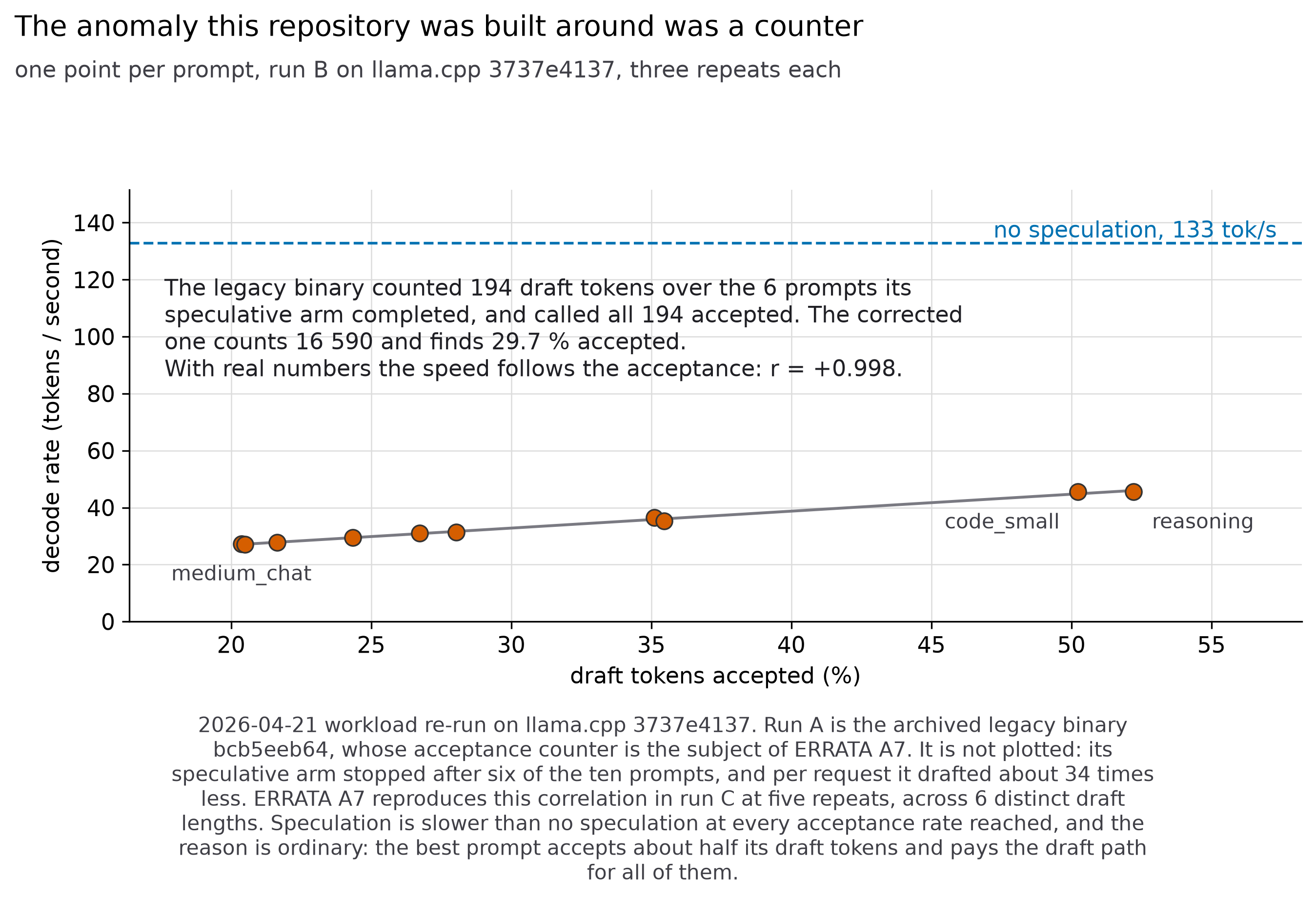
The direction holds for the conditions v1 tested. The explanation published alongside it does not. Re-run on a binary where llama.cpp counts acceptance correctly, real acceptance and decode rate correlate at r = +0.998 across the ten prompts: the slowdown tracks low acceptance and draft-path cost, which is ordinary speculative-decoding economics. The "100 % acceptance yet slower, therefore an MoE pathology" anomaly this repository was built around does not exist.
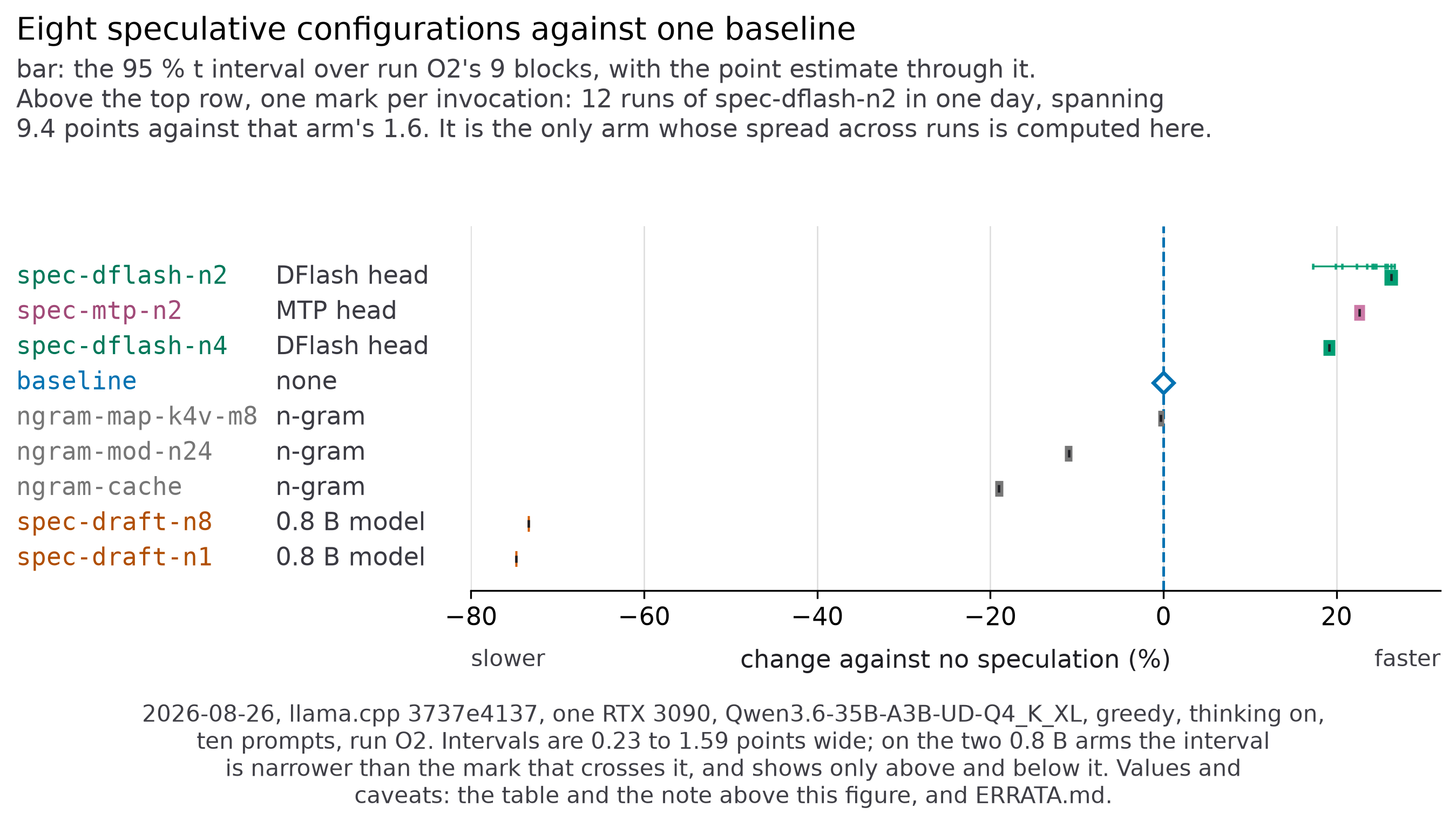
And the direction is not universal. On 2026-08-26, eight speculative
configurations and a no-speculation baseline were measured on this card in one
matrix under one memory policy, as a Latin square balanced for position:
nine blocks, each arm appearing exactly once per block and visiting every
position exactly once, verified from the execution log rather than from the
design. It is not balanced for carryover, and analysis/carryover.py refuses to
report a predecessor contrast for it. Run W is the design that balances both.
Its analysis plan was finalised at 360 of run W's 500 arm-runs and before the
completed dataset was committed
(v4_audit_2026_08_25/PROSPECTIVE_ANALYSIS_PLAN_W.md, which says so itself and
declines the word preregistration). Run W2's plan is the one that is an
ancestor of the commit carrying its data. Each change below is
paired against the baseline measured inside the same block, and the interval
is over blocks, which is the unit of replication and of resampling.
analysis/paired_blocks.py computes two of them: a percentile bootstrap that
resamples whole blocks, and a Student-t interval on the log ratios. The column
below is the t interval, which is the wider of the two on every row here. The
bootstrap can only ever resample the nine values it has, so at this block count
it under-covers, and quoting the narrower one would be the wrong direction to
err in. Both are in each run's paired_blocks.json.
[!IMPORTANT] Read that interval as within-invocation, because that is all it covers. The nine blocks are nine sequential blocks of one invocation of the driver, in one fixed rotation, in whatever performance regime that invocation was in. The headline arm measured twelve times in one day spans +17.3 % to +26.7 %, on byte-identical output and identical draft counts, and A16 could not find a recorded field that distinguishes the regimes. So the honest headline for
spec-dflash-n2is:
across repeated invocations +17 % to +27 % run O2, point estimate +26.3 % run O2, t interval over its own nine blocks [+25.5 %, +27.1 %] The twelve runs are not twelve independent measurements of the configuration either (they mix the stock and instrumented builds, two-, three- and nine-arm matrices, and different neighbouring treatments), so the range is a bound on what was observed, not a confidence interval. Pooling their 43 blocks would not fix that: the blocks are nested inside invocations, and the invocation is the level the variation lives at. A design that identifies it needs the invocation as the resampling unit, the build stratified, and the preceding treatment recorded; the fixed rotation used here balances position but not first-order carryover, since each arm's predecessor is nearly always the same arm.
| arm | pooled tok/s | change | 95 % CI (t, blocks within this invocation) | draft/gen ‡ | acceptance † |
|---|---|---|---|---|---|
spec-dflash-n2 |
146.2 | +26.3 % | [+25.5 %, +27.1 %] | 0.81 | 72.3 % |
spec-mtp-n2 |
141.9 | +22.7 % | [+22.1 %, +23.3 %] | 0.77 | 78.4 % |
spec-dflash-n4 |
137.9 | +19.2 % | [+18.5 %, +19.9 %] | 1.24 | 55.2 % |
| no speculation | 115.7 | — | — | 0.00 | — |
ngram-map-k4v-m8 |
115.4 | −0.3 % | [−0.6 %, +0.0 %] | 0.01 | 50.0 % |
ngram-mod-n24 |
103.1 | −10.9 % | [−11.4 %, −10.5 %] | 0.19 | 5.0 % |
ngram-cache |
93.7 | −19.0 % | [−19.4 %, −18.6 %] | 0.17 | 5.2 % |
spec-draft-n8 |
30.9 | −73.3 % | [−73.5 %, −73.2 %] | 1.86 | 29.5 % |
spec-draft-n1 |
29.2 | −74.8 % | [−74.9 %, −74.7 %] | 0.50 | 69.7 % |
‡ Draft tokens proposed per token generated. It is the column that makes the
acceptance column readable, and it is why ngram-map-k4v-m8 is not the
half-accepted success its 50.0 % suggests: it drafted 216 tokens across 27 000
generated, one per 125, so its acceptance rate is 108 of 216 and it neither
helps nor hurts because it almost never fires. ngram-mod-n24 and ngram-cache
are the opposite: they draft on a sixth to a fifth of tokens, 0.17 and 0.19 per
token generated, and have almost all of it rejected, which is what a 10–19 %
loss is made of.
Reproduction
The historical scripts and raw files are all here, and every host-specific path is now an environment variable with a documented default. They remain audit artefacts rather than a one-command reproducer: the v1 warm-up is short, there is one run per cell, and D5 records a provenance gap in v2.
Build the exact v1 revision, not current master:
git clone https://github.com/ggml-org/llama.cpp.git
cd llama.cpp
git checkout 97895129e5f2bde94d13dc01ca41ee79e9b629f2
git submodule update --init --recursive

CUDACXX=/usr/local/cuda-12.6/bin/nvcc cmake -S . -B build \
    -DGGML_CUDA=ON \
    -DCMAKE_CUDA_ARCHITECTURES=86 \
    -DLLAMA_CURL=OFF \
    -DBUILD_SHARED_LIBS=OFF \
    -DCMAKE_BUILD_TYPE=Release
cmake --build build --parallel --target llama-server llama-bench
Fetch the artefacts and verify them before benchmarking:
hf download unsloth/Qwen3.6-35B-A3B-GGUF Qwen3.6-35B-A3B-UD-Q4_K_XL.gguf --local-dir models
hf download unsloth/Qwen3.5-0.8B-GGUF --include '*Q4_K_M*' --local-dir models
sha256sum -c SHA256SUMS
Run the matrix and the analysis:
export LLAMA_SERVER_BIN=$PWD/llama.cpp/build/bin/llama-server
export MODEL_TARGET=$PWD/models/Qwen3.6-35B-A3B-UD-Q4_K_XL.gguf
export MODEL_DRAFT=$PWD/models/Qwen3.5-0.8B-Q4_K_M.gguf
export BENCH_GPU=1                      # CUDA_VISIBLE_DEVICES for the server

bash run_matrix.sh          # baseline + ngram-cache + ngram-mod n=24 + 0.6B control
bash run_p0_matrix.sh       # classic-draft sweep + 1000-token variants + N sweep + kv-fp16

pip install -r requirements.txt
python analysis/plot.py
python analysis/verbose_accounting.py
A corrected harness for new, controlled runs, with one pinned binary for every
arm, ABBA ordering, N repeats, a manifest that hashes the binary and both
models, and per-request capture of the generated text, the reasoning channel,
the stop reason, the full timings block, and token IDs via logprobs — is
bench/retest_runner.py. It is what produced the
audit measurements above. Note that llama.cpp renamed the speculative arguments
after bcb5eeb64 (--draft-max → --spec-draft-n-max) and that --spec-type
now defaults to none, so -md alone loads a draft model and never
speculates; the runner's BENCH_FLAVOR switch handles both spellings.
Reproducing the 2026-08-26 runs
Every setting below is recorded in the corresponding manifest.json, so this
recipe is checkable against the committed data rather than trusted.
git clone https://github.com/ggml-org/llama.cpp.git && cd llama.cpp
git checkout 3737e41370da1830a44c663f9929a0f27591ffa6      # the audit binary
cmake -S . -B build -DGGML_CUDA=ON -DCMAKE_CUDA_ARCHITECTURES=86 && cmake --build build -j

export LLAMA_SERVER_BIN=$PWD/build/bin/llama-server
export MODEL_TARGET=.../Qwen3.6-35B-A3B-UD-Q4_K_XL.gguf
export MODEL_DRAFT=.../Qwen3.5-0.8B-Q4_K_M.gguf
export BENCH_FLAVOR=master BENCH_GPU=0 BENCH_MAX_TOKENS=300

# run I - concurrency. Client requests in flight are read back from timestamps;
# --parallel alone allocates slots that an unmodified client never uses.
for C in 1 4 8; do
  BENCH_CONCURRENCY=$C BENCH_REPEATS=3 BENCH_THINK=on \
  BENCH_ARMS=baseline,spec-draft-n8 BENCH_OUT=out/I_conc$C python bench/retest_runner.py
done

# runs J / K / L / M - speculation methods. -fit on is REQUIRED: the BF16
# drafters only load with -ngl unset, and it is applied to every arm including
# the baseline so placement policy never differs between an arm and its control.
BENCH_FIT=on BENCH_CTX=8192 BENCH_FIT_TARGET=2048 BENCH_REPEATS=3 \
MODEL_DFLASH=.../qwen36-dflash-master.gguf \
BENCH_ARMS=baseline,spec-dflash-n1,spec-dflash-n2,spec-dflash-n4,spec-dflash-n8 \
BENCH_OUT=out/K1 python bench/retest_runner.py
The two drafters that are not off-the-shelf downloads:
# DFlash - the archived v3 GGUF lacks `target_layers` and master rejects it
bash bench/convert_dflash.sh

# MTP - export the target's own multi-token-prediction head as a drafter.
# Stock llama.cpp: `supports_mtp_export` is already True for this architecture
# and LLM_ARCH_QWEN35MOE already declares the NEXTN tensors. The staging step
# exists only because conversion/base.py's AWQ guard dispatches on config.json's
# quant_method rather than on the tensors being exported, and every tensor in
# the --mtp export set is unquantised. The script verifies that and refuses if
# it is ever untrue.
python bench/stage_mtp_source.py
python convert_hf_to_gguf.py ~/models/qwen36-mtp-src --mtp --outtype bf16 \
       --outfile qwen36-mtp-bf16.gguf
./build/bin/llama-quantize qwen36-mtp-bf16.gguf qwen36-mtp-q8_0.gguf Q8_0
Then check the numbers against the documents:
python analysis/verify_claims.py     # re-derives every quoted figure, exits non-zero on drift
python analysis/check_links.py       # relative links and heading anchors
python analysis/matrix_report.py v4_audit_2026_08_25/data/matrix_*
python analysis/thermal_report.py v4_audit_2026_08_25/data/gpu_telemetry_*.csv
python analysis/plot_v4_runs.py
Data map
| Path | Contents |
|---|---|
ERRATA.md |
every corrected claim, with evidence |
results/, results/verify/ |
v1 raw per-request JSON, 19 run labels |
analysis/summary.csv |
v1 flat per-request table |
analysis/summary_by_config.csv |
v1 aggregate: request-mean, pooled, median, min–max, activation |
analysis/plot.py |
aggregation and charts |
analysis/verbose_accounting.py |
reconstructs the acceptance-counter artefact from a -v log |
v2_3090_followup/SUMMARY.md |
v2 methodology and tables |
v2_3090_followup/v2_*/ |
60 v2 raw llama-cli logs + one --verbose trace |
v2_3090_followup/exp2_codejson_n3/ |
Exp 2 aggregates and script |
v3_dflash_2026_05_07/ |
DFlash logs, tables, script |
BENCHMARK_ENV.md |
hardware, software, commits, hashes for v1/v2/v3, and the v4 memory-policy table |
The 2026-08-25/26 controlled runs
| Path | Contents |
|---|---|
v4_audit_2026_08_25/README.md |
what each run asked, what it measured, and every control |
v4_audit_2026_08_25/PREREGISTERED_PREDICTION.md |
predictions committed to git before the data existed |
v4_audit_2026_08_25/data/A_*, B_* |
bcb5eeb64 against post-merge master; 30 requests an arm on B, and 12 on A's two speculative arms, which abort |
v4_audit_2026_08_25/data/C_*, D_* |
the thirteen-arm matrix, thinking on and verifiably off |
v4_audit_2026_08_25/data/E_*, H_* |
past the MoESD coverage threshold; the p_min sweep |
v4_audit_2026_08_25/data/matrix_I2_conc{1,4,8}_* |
concurrency, with the client requests in flight recorded |
v4_audit_2026_08_25/data/matrix_J2_* |
DFlash off vs on, one binary |
v4_audit_2026_08_25/data/matrix_K* |
the draft-length sweep and the winner under batching |
v4_audit_2026_08_25/data/matrix_L_think{on,off}_* |
the same arms under both workloads |
v4_audit_2026_08_25/data/gpu_telemetry_*.csv |
continuous 5 s GPU traces covering every run |
v4_audit_2026_08_25/data/smoke_* |
the gate runs that decide a matrix is safe to start |
Each run directory holds one manifest.json (hashing the binary and every
model, and recording the full BENCH_* configuration) and one
<arm>__rep<N>.json per arm-run with full per-request capture. The harness
also writes an all_results.json concatenating the same content. It is not
committed, as of 2026-09-01. This sentence used to call it "the same content"
and nothing checked that: 119 MB across 53 directories, read by no analyser,
assertion or workflow, and in matrix_O2_latin_20260826_153711, the run the
headline table comes from, all 81 of its records disagreed with the arm-run
files, which had been backfilled with the server's build and commit while the
concatenation had not. A derived copy nothing reads is a second place for the
truth to be, and it was already wrong in the one that mattered.
Tooling
| Path | Contents |
|---|---|
bench/retest_runner.py |
the controlled harness; it produced every v4 measurement |
bench/convert_dflash.sh |
re-converts the DFlash drafter with post-merge master |
bench/stage_mtp_source.py |
stages the checkpoint so --mtp can export the MTP head, and verifies the export set is unquantised before doing so |
analysis/verify_claims.py |
re-derives every quoted figure from committed data and greps the documents for it; exits non-zero on any drift |
analysis/check_links.py |
relative links and heading anchors |
analysis/matrix_report.py |
per-arm request-mean, pooled, repeat SD, acceptance, drift, activation |
analysis/thermal_report.py |
throttle flags and clock drift from a telemetry trace |
analysis/plot_v4_runs.py |
the batching, draft-length, acceptance-threshold, head-to-head and two-level charts, and plot_data.json, which --check compares against the data |
The rest of the evidence
The argument for the headline, and every table behind it, is in
v4_audit_2026_08_25/README.md.
It was in this file until 2026-09-01 and was moved rather than shortened: the
sections are unchanged and nothing was dropped.
| Section | What is in it |
|---|---|
| What supports that result, and what limits it | the replication, the twelve measurements, the ten prompts, the designed follow-up |
| Metric definitions | what each column means, and what its interval is over |
| What the v1 data support | the three findings v1 can carry |
| What the v1 data do not support | and the four it cannot |
| The "100 % acceptance" retraction | the counter artefact, and what the counters actually say |
| Where the time goes, measured, and not MoE-specific | the profile, and why the shape is not this architecture's |
| What the audit measured on 2026-08-25 and 2026-08-26 | the controlled runs, arm by arm |
| v1 representative results | the 2026-04-21 matrix |
| Experiment registry | every run, what it asked and what it answered |
| v1 hardware, software, and artefacts | the v1 environment |
| Follow-up experiment caveats | what the follow-ups do and do not establish |
Upstream status: checked 2026-08-25, open items re-checked 2026-09-01
Checked against the GitHub API on 2026-08-25.
| PR | Status |
|---|---|
| #19493 server: speculative checkpointing | merged 2026-04-19 |
| #22227 speculative-simple: checkpoint support | merged 2026-04-22 |
| #20075 fix: speculative decoding broken on hybrid SSM/MoE | closed without merge 2026-04-25 |
| #22105 DFlash support | merged 2026-06-28 |
bcb5eeb64 was master on 2026-04-22 and is described here as a dated snapshot,
not as "current master". Future edits should keep using exact tested SHAs.
And 3737e4137 is one too. Master has moved, and four open items touch the
paths measured here. None is a code dependency of this repository; every one is
a reason its findings are bounded to the tested snapshot. Statuses re-checked
against the GitHub API on 2026-09-01.
| Open upstream | Status | What it would change here |
|---|---|---|
| #25004 recurrent: equal splits for recurrent-state rollback | open, last touched 2026-08-08 | Changes concurrent recurrent-rollback batching. The discussion also reports a single-stream regression and proposes a smaller one-slot design, so the upstream answer has not converged. The batching results in run I/I2/M2 are the ones at risk |
| #27705 fix: output reorder index space | open, last touched 2026-08-28 | Token-row versus output-row permutation and a post-decode layout mode flip, with regression tests. It does not claim to fix #27572. If it lands, A11 and the DFlash and MTP output and throughput figures all need a minimal replication |
#27572 draft-mtp acceptance collapses to 0.0 under -np N |
open | Backend- and workload-dependent, on HIP with long prompts. The discussion has retracted its own first two explanations, so the issue title is not a settled mechanism. The CUDA control on this RTX 3090 does not reproduce the zero acceptance |
| #24055 context checkpoints always invalidated on hybrid/recurrent models | open | The checkpoint machinery A12 times |
If any of them lands, the minimum re-measurement is the O3 headline subset, run V under a controlled mode order, the run T checkpoint subset, and a long-prompt concurrent MTP smoke test.
Related reading
- MoESD: Unveil Speculative Decoding's Potential for Accelerating Sparse MoE (arXiv 2505.19645)
- Utility-Driven Speculative Decoding for Mixture-of-Experts (arXiv 2506.20675)
- MoE-SpeQ (arXiv 2511.14102)
- llama.cpp docs/speculative.md
- llama.cpp Issue #20039 — original feature request
- HF discussion #14 on
unsloth/Qwen3.6-35B-A3B-GGUF— the thread that prompted v2 - vLLM Issue #38182 — Qwen3.5-35B-A3B MTP × prefix-cache interaction
- llama.cpp PR #18039, comment 3755925892 — the maintainer's SGLang cross-check of gpt-oss-120b + EAGLE3 on DGX Spark: 0.46–0.71× baseline at batch 1. Different engine, hardware, model and method; same direction. The strongest independent corroboration of this repository's negative finding, and it predates the audit. Its author also names batching, not draft length, as the lever.
- llama.cpp PR #22105 (DFlash) — states the expert-activation effect for MoE targets and the extra target forward per rejected step on hybrid targets, with target-side deferred commit proposed to remove replay
Open upstream issues in the same territory
Found during the audit. The pre-audit "validation timeline" cited papers and
unrelated issues; these are the same-class implementation reports, and several
concern this exact model family. The left column quotes each report's own
title, so the figures in it are theirs; every figure in the right column is
this repository's and is re-derived by analysis/verify_claims.py.
| Issue | Why it matters here |
|---|---|
| #24055 — context checkpoints always invalidated on hybrid/recurrent models | The checkpoint machinery this audit measured: 1639 checkpoints of 82.079 MiB in one n_max 1 arm-run of ten 300-token requests, 163.9 per request. This row read 101.3 MiB until 2026-08-26, which is 82.079 + 19.266 — the draft component added a second time to a total that already contains it (A12) |
| #25004 — recurrent: support equal splits for recurrent-state rollback | The rollback path behind A1 and A6 |
| #24670 — draft-mtp not activating on Turing with a hybrid SSM+attention Qwen3.6-35B-A3B | This repository's exact target model |
| #25117 — DFlash regression on AMD APU with a quantized MoE target, ~2× slower than baseline | An independent report of v3's direction, on different hardware |
#27572 — draft-mtp acceptance collapses to 0.0 under -np N |
A known concurrency failure mode; any batching measurement must check acceptance did not collapse rather than assume it |
| #27569 — cap the draft context batch instead of inheriting the target's | Bears on long-draft configurations such as the n_max 128 arm |
thc1006/qwen3.6-vllm-2x3090— sibling repository, different engine and hardware topology
Licence
- Code and documentation: MIT, see
LICENSE. - Benchmark data: CC0-1.0, scoped by
DATA_LICENSE, full text inLICENSES/CC0-1.0.txt.
Citation
Machine-readable metadata is in CITATION.cff. Cite the DOI
above for the archived release, and state which version you are citing:
pre-audit releases (v1.0 – v3.0) contain the claims retracted in
ERRATA.md.
Author
Hsiu-Chi Tsai (thc1006) · [email protected] ·
github.com/thc1006
Explore related projects
affaan-m/ECC
The agent harness performance optimization system. Skills, instincts, memory, security, and research-first development for Claude Code, Codex, Opencode, Cursor and beyond.
301,496 starsNousResearch/hermes-agent
The agent that grows with you
262,778 starsmultica-ai/andrej-karpathy-skills
A single CLAUDE.md file to improve Claude Code behavior, derived from Andrej Karpathy's observations on LLM coding pitfalls.
232,276 starsfirecrawl/firecrawl
Supercharge your AI agents with data from the web and beyond. Building the library for superintelligence. 🔥
200,932 stars