
thalha-a9/helix
thalha-a9/helix has 40 GitHub stars and 6 forks. GitHot measured +3 stars in 24 hours. Last checked 2026-11-09 20:08 UTC. Last push 2026-11-05.
Username OSINT across 11,663 sites, each checked once. Every hit re-checked live against made-up usernames, with identity confidence and sealed evidence. pipx install helix-osint
Measured star growth
- in 24h
- +3
- in 7 days
- Update delayed
- in 15 days
- Update delayed
- in 1 month
- Update delayed
Net star changes over overlapping periods, not daily totals. Missing measurements are left blank. Stars measure attention, not software quality.
README.md
Original ██╗ ██╗███████╗██╗ ██╗██╗ ██╗
██║ ██║██╔════╝██║ ██║╚██╗██╔╝
███████║█████╗ ██║ ██║ ╚███╔╝
██╔══██║██╔══╝ ██║ ██║ ██╔██╗
██║ ██║███████╗███████╗██║██╔╝ ██╗
╚═╝ ╚═╝╚══════╝╚══════╝╚═╝╚═╝ ╚═╝
Decode the digital DNA of any identity





Helix is an open-source username checker for OSINT. It checks a username
across 11,663 sites (the Sherlock, WhatsMyName and Maigret databases plus 3,679 fediverse servers, each site checked once)
and re-checks every hit live before reporting it: a made-up username comes back with 0 accounts.
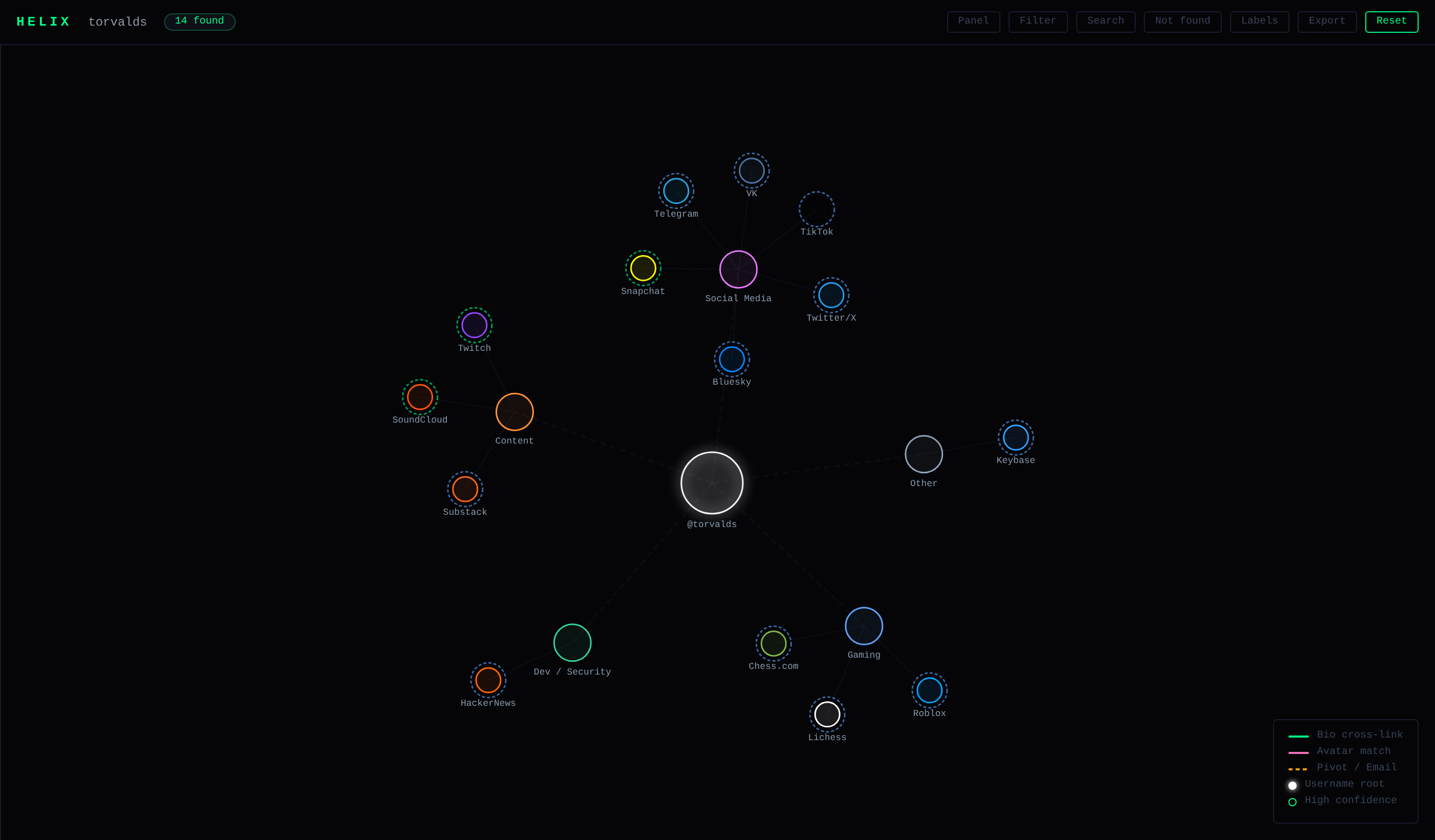
Then it shows which accounts belong to the same person, in an interactive graph you can explore and export.
"Finding accounts is easy. Proving them is the job."
Thalha Ahmed, creator of Helix | @thalha-a9
Quick Start | Features | Modules | Graph | Install
Why Helix?
Most username checkers answer one question, "Does this username exist on Platform X?", and leave you to sort the real hits from the false ones.
Helix answers it across about 11,700 sites with every hit verified, then answers the harder one: "Which of these accounts belong to the same person?"
It extracts cross-platform links the account holders declare, matches identical profile pictures by perceptual hash, infers timezone from commit patterns, discovers domains via certificate transparency, and plots every relationship as a glowing edge in a browser-based network graph, all in a single command.
pipx install helix-osint
helix-osint -u johndoe --all                    # 11,663 sites, every hit verified
helix-osint -u johndoe --phash --pivot --crt    # plus avatar matching, pivoting and domains
What Makes Helix Different
Helix builds on Sherlock, WhatsMyName and Maigret. With --all it scans
their site databases together with 3,683 Mastodon, Misskey, Lemmy and PeerTube
servers: 11,663 sites on 4 Nov 2026, each checked once, with adult sites and
search pages left out (--nsfw adds adult sites back). Until 3.6.3 the count
was 11,988 because a profile address that two databases both list was counted
(and checked) twice. What it adds is what happens after a
site says "found":
| What Helix does | Why it matters | |
|---|---|---|
| Live verification of every hit | Each hit is re-fetched, and two usernames that cannot exist are requested from the same site at the same moment. The hit is kept only if it reproduces and both impossible names get the same clear "no such user" | Login walls, catch-all pages and changed markup are caught automatically, on every site, with no per-site tuning |
| A measured, reproducible false-positive rate | 0 false positives on made-up names across the whole database, in sealed rehearsals anyone can verify (8,305 sites before the fediverse servers, 11,988 after) and in every earlier full run, with the harness and run records in bench/. One reader's run found 1 (Olx.pl, a page that matched any id-shaped name); fixed in 3.6.1. A reviewer showed that a site accepting any short name could fool the made-up names, which were all longer; since 3.6.2 a short name also gets one of its own length, and the benchmark includes such sites |
A number anyone can re-run, not a promise |
| Identity confidence per finding | HIGH / MEDIUM / LOW from independent evidence: avatar match, declared cross-link, email, real name, location. A username match alone is never above LOW | "The account exists" and "the account is your subject" are reported separately |
| Perceptual avatar matching | The identical picture on two accounts links them (--phash); platform defaults and site-wide images are ignored |
Corroboration that does not depend on the username |
| Declared-only relationships | Employers, organisations and family taken only from what the subject's corroborated accounts state, each with its source and quote | Nothing inferred from shared surnames or followers |
| Approved-subject gate | Breach and dark-web lookups only send identifiers the analyst supplied or that come from corroborated accounts | Third parties never receive a stranger's data |
| Proof of every page | --save-pages keeps the exact response behind each reported account, hashed and timestamped, and the evidence file seals the list |
An editor or a court can see what the profile said when it was found |
| One standalone graph file | Accounts, cross-links, avatar matches, breaches and relationships in a single HTML file, no server | Hand it to someone and it opens |
Where other tools are stronger: SpiderFoot has far more data-source modules and a web UI built for long investigations. Maigret extracts more profile fields per site and searches recursively on the IDs it finds. Maltego has commercial data feeds and a mature graph workspace. Helix is the one to reach for when a wrong account in the report is the expensive mistake.
Intelligence Modules
Always On
- Local Heuristic Verifier: Zero-dependency false-positive engine. Scores every result across 8 signals (WAF pages, generic titles, login redirects, homepage redirects). Runs before anything else, every single scan.
Core Flags
| Flag | What it does |
|---|---|
--wmn |
Loads WhatsMyName database at runtime: ~590 platforms after unsafe entries are filtered out |
--maigret |
Loads Maigret database at runtime: sophisticated detection with presenceStrs/absenceStrs, 24h cached |
--fediverse |
3,925 Mastodon, Misskey, Lemmy and PeerTube servers, each its own website with its own users. Every server on the list passed a live test (an account that exists there was found, two made-up names were not) and had at least one active user a month. Checked through each server's standard user lookup; servers another database already lists are skipped, and 14 adult servers are only checked with --nsfw (reviewed by name, so report any we missed). tools/update_fediverse.py rebuilds the list |
--all |
Full coverage in one flag: builtin + WhatsMyName + Sherlock + Maigret databases + fediverse servers (11,663 sites on 4 Nov 2026, each profile address once, adult sites and search pages excluded; the databases grow), every hit checked by the control probe |
--concurrency N |
Probes in flight at once (default 20 to 60, scaled to the scan size; max 1,000). Raise it only on a fast, direct link: live, 250 in flight made 1,302 healthy sites time out on an ordinary connection. Sites that time out get one calm retry either way, and the end of every scan says how many sites answered |
--save-pages |
Keeps the exact page received for every reported account: the raw bytes, response headers, the URL it ended on and the UTC time, each hashed with SHA-256, in <name>_pages/ with a browsable index.html. Proof of what a profile showed at that moment, even if it is deleted later. Pages are saved as text so they cannot run scripts. For sites checked through an official API, the saved page is the API's answer. --verify-pages DIR re-checks every file |
--record-attempt |
Writes sealed evidence of the scan, for a witnessed test, an audit or a published result: UTC start and finish, the exact site database and its SHA-256, the outcome for every site, and a fingerprint of the whole file, printed at the end so a screen recording can show it. An email scan (-e) gets its own record next to the username one. --verify-evidence FILE [SITES] checks it |
--maigret-engine |
Runs the installed Maigret engine (pip install maigret) as a lead source: every hit is re-fetched and verified by Helix before it is reported. --maigret-top N sets how many sites it checks (default 500) |
--sherlock |
Loads Sherlock's database at runtime: ~440 platforms, cached 24h locally |
--pivot |
Recursive alias pivot: follows handles the account holder declares (Keybase proofs, profile links) and scans them, up to 4 hops deep. Pivot results are leads about the alias, verified like any scan |
--phash |
Perceptual avatar hash: matches the same picture used on two accounts (a different photo of the same person will not match). Platform defaults, site-wide share cards and blank images are ignored |
--wayback |
Wayback Machine: when each found profile was first and last archived, in how many months, and the bio of the earliest capture (emails / @handles in it listed as leads; a username can change hands) |
--crt |
Certificate Transparency: domains on certificates that list the subject's email, plus domains named exactly after the username (leads only; anyone can register a name). crt.sh outages are reported as not checked |
--paste |
Paste Intelligence: public Gists of github.com/<username>. Pastebin text search has had no free source since psbdmp.ws shut down (2026); Pastebin accounts are covered by --sherlock, --maigret and --all. Unreachable sources are reported as not checked |
--breach |
Breach sweep: every confirmed email against XposedOrNot and LeakCheck (powered by LeakCheck, which is sent a SHA-256 hash of the address, never the address), plus Have I Been Pwned when HIBP_API_KEY is set. It runs after the accounts are found and graded and never changes them. Per-email verdict: which breaches, what was exposed, date range, which sources were checked and when (e.g. "x@y appears in 7 breaches (2012 to 2024), passwords exposed in 5"). A source that could not be reached is reported as not checked, never as clean. Metadata only, no credentials |
--darkweb / --robin |
Robin dark-web leads: Ahmia .onion search for the username, confirmed emails and (when corroborated) real name; only hits that contain the exact term are kept. Includes the breach sweep. With --ai, the results go to the model as numbered sources and only statements that cite them are kept |
--holehe |
Deep email scan: which of ~120 sites the address is registered on (holehe). Modules that would send the target a password-recovery email are skipped. Rate-limited sites are reported as not checked, never as "not registered". With --email-permute, accounts found for guessed addresses are listed as leads and never count as email confirmation |
--ai |
AI false-positive filter: second verification pass via Claude, OpenRouter (free), or NVIDIA NIM (free) |
--providers |
Lists which --ai providers are set up (their API keys found) and exits |
--controls N |
How many made-up names every hit is checked against (default 3, at least 3). A short username always gets one of its own length. Raise it when a result must be defended; each extra name is one more request per hit |
--permutations |
Generates about 45 variants of the username (john_doe, johndoe1, realjohndoe, johndoe.dev and so on), asks before scanning, then checks each one on every selected site, control probe included. With --all that is about 45 full scans, so use it with the built-in sites or one database |
--nsfw |
Includes adult sites, which are left out by default everywhere: the adult entries of WhatsMyName, Sherlock and Maigret, 14 adult fediverse servers, and holehe's adult-site email checks |
--wmn-timeout / --sherlock-timeout / --maigret-timeout |
Seconds to wait while downloading each site database (default 30). Raise them on a slow link: a download that fails or times out leaves that database out of the scan. Sherlock and Maigret are cached for 24 hours, so a second scan the same day does not download them again |
--output DIR |
Where results are written (default results/<name>). Must be inside the current folder |
--no-browser |
Don't open the interactive graph in a browser when the scan ends |
Auto-Triggered
- Relationship map: built from what the subject's own accounts declare: employers and former employers ("engineer at Globex", "ex-Initech", GitHub company field), organisations (public GitHub orgs, "maintainer of ..."), family members named by handle ("my wife @...") and accounts the bio mentions. Never inferred from shared surnames, followers or co-occurrence. Only accounts corroborated as the subject's (identity MEDIUM/HIGH) are read: a bio on an account that merely shares the handle may be a stranger's, so those declarations are counted but not mapped. Each edge carries its source, quote and a confidence that can never exceed the declaring account's; two independent accounts are needed for HIGH. Shown in the console, graph, report, JSON, CSV and TXT
- Approved-subject gate: breach and dark-web lookups send identifiers to third parties, so only analyst-supplied identifiers (
-u,-e) and those from accounts corroborated as the subject's (identity MEDIUM/HIGH) are queried. Anything held back is listed with the reason - GitHub Deep Recon: runs automatically when a GitHub profile is found, and is labelled with that account's identity grade: until it is corroborated, the facts may describe someone else who has the same handle. Extracts real emails from public commits (filters noreply), org memberships, language stats, npm packages, and infers timezone from commit timestamp distribution (requires >=15 commits for confidence)
The Graph
The HTML output is a standalone zero-dependency interactive network, no server needed, just open in a browser.
White pulsing node        Username root
Amber pulsing node        Email root
Amber/orange nodes        Pivot-discovered aliases
Green solid edges         Cross-links the account holder declared (Keybase proofs, profile links)
Pink dashed edges         The same picture on both accounts (perceptual hash)
Red / violet nodes        Breach exposure / dark-web leads (leads, not proof)
Amber dashed edges        Email-matched platforms
Green ring on node        High confidence (OG meta validated)
Blue ring on node         Medium confidence
Controls: drag nodes | scroll to zoom | click node to open profile | hover for tooltip (confidence, og:title, cross-link partners, bio-extracted alias details) | search | not-found overlay | labels | SVG export | filter by confidence
Quick Start
pipx install helix-osint          # or: pip install helix-osint
helix-osint -u johndoe
From source:
git clone https://github.com/thalha-a9/helix.git
cd helix
pip install -r requirements.txt
python helix.py -u johndoe
The command is installed as both helix-osint and helix. Use helix-osint
where the Helix text editor is also installed (it owns helix on Arch Linux).
Installation
Required
pip install aiohttp
Optional extras
pip install curl-cffi        # WAF bypass for Twitter, Instagram, TikTok, Patreon
pip install imagehash Pillow # Perceptual avatar hash matching (--phash)
pip install holehe            # Deep email scanning 120+ platforms (--holehe)
                              #   Kali/Debian: if the build fails with "install_layout",
                              #   use: pip install --use-pep517 holehe
pip install "httpx[socks]"    # holehe over --tor / SOCKS proxies
pip install weasyprint        # PDF output for --report
pip install anthropic         # Claude AI verification (--ai claude)
pip install openai            # OpenRouter / NVIDIA AI verification (--ai openrouter)
Or install everything at once
pip install "helix-osint[full]"
Or run it with Docker (every module included, nothing to install; Linux, macOS and Windows, Intel and ARM)
docker run --rm -v "$PWD:/data" ghcr.io/thalha-a9/helix -u johndoe
Reports land in ./results. Add --user "$(id -u):$(id -g)" if the files should belong to your
user. Tor running on your machine: on Linux add --network host and use --tor; on macOS and
Windows use --proxy socks5h://host.docker.internal:9050.
Set GITHUB_TOKEN for 5000 req/hr on GitHub API (optional, default is 60/hr):
export GITHUB_TOKEN=ghp_yourtoken
Usage
# Basic scan: opens interactive graph automatically
python helix.py -u johndoe

# Full power: all intelligence modules
python helix.py -u johndoe --wayback --crt --paste --pivot --phash

# Username + email: two root nodes, cross-matched in graph
python helix.py -u johndoe -e [email protected] --breach --holehe

# Dark-web leads + breach sweep, analysed by an LLM with cited sources only
export HIBP_API_KEY=...        # optional: adds Have I Been Pwned to the breach sweep
python helix.py -u johndoe -e [email protected] --darkweb --ai claude

# Bigger scan: ~1,080 platforms
python helix.py -u johndoe --wmn --sherlock

# AI-verified scan (free, no API key cost)
python helix.py -u johndoe --ai openrouter

# Recursive pivot: auto-scan aliases up to 4 hops deep
python helix.py -u johndoe --pivot --pivot-depth 4

# Permutations: scan johndoe1, john.doe, realjohndoe, etc.
python helix.py -u johndoe --permutations

# Full database (about 11,700 sites), with sealed evidence of the run
python helix.py -u johndoe --all --record-attempt --no-browser
python helix.py --verify-evidence results/johndoe/johndoe_evidence.json results/johndoe/johndoe_sites.json

# Everything, saved to custom dir, no browser
python helix.py -u johndoe -e [email protected] \
  --wmn --sherlock --wayback --crt --paste \
  --pivot --phash --breach --holehe \
  --ai openrouter --format all --no-browser --output ~/Desktop/report

# Check which AI providers are configured
python helix.py --providers
Operational Security
By default every probe leaves from your real IP. A scan opens dozens of near-simultaneous connections to the same username across many platforms: a distinctive, easily-logged pattern. A subject who monitors their own profile access logs, or who runs a honeypot account on a self-hosted instance, can see and attribute the reconnaissance directly to you. Route your traffic before scanning anyone real.
# Route every probe over a local Tor SOCKS port
python helix.py -u johndoe --tor

# Any HTTP/HTTPS/SOCKS4/SOCKS5 proxy
python helix.py -u johndoe --proxy socks5://127.0.0.1:1080
python helix.py -u johndoe --proxy http://user:[email protected]:3128

# HTTP_PROXY / HTTPS_PROXY environment variables are honoured as a fallback
HTTPS_PROXY=http://10.0.0.5:3128 python helix.py -u johndoe
SOCKS proxies need aiohttp-socks:
pip install aiohttp-socks
The proxy covers the whole engine: the username checker, the email checker, avatar hashing, every intelligence module, and the Sherlock / WhatsMyName / Maigret / holehe adapters. Helix prints its egress on every run, and warns when traffic is going out direct. Proxy credentials are redacted from all output and never written to a report.
Known subject location
When you already know where the subject is, pass it. Candidate profiles that state a conflicting location are flagged loudly before you confirm them: the single most common source of mistaken-identity findings.
python helix.py -u johndoe --location "Wellington, New Zealand"
Location is optional and never required. A profile with no stated location is never penalised, and a conflicting profile is flagged rather than discarded: the judgement stays yours.
AI Verification
Helix has a two-layer false-positive filter:
Layer 1: Local heuristic verifier (always on, zero cost)
Scores every result across 8 signals. A single generic title (e.g. "Pinterest" instead of a username) instantly purges the result. WAF/Cloudflare pages scored separately at 80 points. Threshold: 60 for normal results, 85 for OG-validated high-confidence results.
Layer 2: AI verifier (--ai, optional)
Sends uncertain results to an LLM with a strict system prompt. Three providers:
| Provider | Flag | Cost | Setup |
|---|---|---|---|
| Claude Sonnet 5.5 | --ai claude |
Paid | export ANTHROPIC_API_KEY=... |
| Nemotron 3.5 Super on OpenRouter | --ai openrouter |
Free tier | export OPENROUTER_API_KEY=..., key from openrouter.ai |
| Nemotron 3.5 Super on NVIDIA NIM | --ai nvidia |
Free tier | export NVIDIA_API_KEY=..., key from build.nvidia.com |
Every result the AI sees has already passed the control probe, so it may only
remove pages whose title is a login wall, an error or a bot check; it never
overrules the probe on a generic title. If a model is busy, retired or gives
no usable answer, Helix tries the provider's next model, and
export HELIX_AI_MODEL=<model id> picks one yourself.
Architecture
helix/
|-- helix.py                         # CLI entry point + orchestrator
|-- pyproject.toml                   # pip installable (helix-osint)
|-- osint/
|   |-- checker.py                   # Async engine (aiohttp + optional curl_cffi)
|   |-- platforms.py                 # 56 platform definitions with OG/API detection
|   |-- verifier.py                  # Local heuristic false-positive engine
|   |-- graph.py                     # D3.js relational graph generator
|   |-- report.py                    # JSON / CSV / TXT exporters
|   |-- permutations.py              # Username variation generator
|   |-- pivot.py                     # Concurrent BFS alias pivot engine
|   |-- phash.py                     # Perceptual avatar hash matcher
|   |-- relationships.py             # Declared-only relationship map
|   |-- subject.py                   # Approved-subject identifier gate
|   `-- modules/
|       |-- wayback.py               # Archive.org CDX API + archived HTML parser
|       |-- github_deep.py           # GitHub API deep recon + timezone inference
|       |-- crt.py                   # Certificate transparency (crt.sh)
|       |-- paste.py                 # GitHub Gist intelligence
|       `-- robin.py                 # Dark-web leads (Ahmia) + cited AI analysis
|   `-- adapters/
|       |-- sherlock_adapter.py      # Sherlock data.json loader (24h cached)
|       |-- wmn_adapter.py           # WhatsMyName loader
|       |-- holehe_adapter.py        # holehe email scanner wrapper
|       |-- breachdb.py              # Breach sweep (XposedOrNot, Have I Been Pwned)
|       `-- ai_verifier.py           # Multi-provider async AI verification
|-- bench/                           # Reproducible benchmarks: mock web, precision/recall, records
`-- results/                         # Output (git-ignored)
    `-- username/
        |-- username_graph.html      # Interactive D3.js network graph
        |-- username_TIMESTAMP.json  # Full structured report
        |-- username_TIMESTAMP.csv
        `-- username_TIMESTAMP.txt
How False Positive Prevention Works
Every hit must survive a live cross-check before it is reported. At the moment of checking, Helix re-requests the profile and two usernames that cannot exist. A hit is kept only if the profile is found again (twice) and both made-up names get the same clear "no such user" answer. A site that "finds" a made-up name is a catch-all, and is dropped. A made-up name that only gets a rate limit, challenge or gateway error proves nothing, so that hit is dropped as unverifiable. Pages judged by status code or by the absence of a not-found message must also name the exact user, so a rate-limit page, a sign-in redirect or a search result listing jackie cannot pass for jack.
Measured live (Oct 2026) on the --all database as it was then (6,158 sites; 8,305 in 3.5.0, see the rehearsals under Benchmarks), default settings:
- 0 false positives in each of 12 scans of fresh made-up usernames since these checks were added (the last 5 on the current code; 8 per scan before them).
- Precision on real names: every sampled hit was a real account when checked against the live page (40 of 40,
--all, usernamejack; every built-in hit forjack,torvalds,max,Gargron). - Cross-links: all cross-links found on 16 real usernames were genuine: Keybase cryptographic proofs and profile links set by the account holder.
- Avatar matches: all 5 matches on the same 16 usernames were the identical personal photo, checked by eye; no defaults or look-alikes.
- Email: made-up addresses (
@example.com) get 0 accounts from Gravatar and from holehe's 118 sites.
What "no false positive" means here: a reported account exists. Whether it belongs to your subject is a separate question, and that is what the identity grade below answers, and a username match alone is only ever LOW.
Helix uses the right detection method per platform instead of naive HTTP 200 checks:
| Platform | Method | Why |
|---|---|---|
reddit.com/user/{u}/about.json, the "is_employee" field |
JSON API; field only exists for valid users | |
| Bluesky | AT Protocol API | SPA: static HTML is useless |
| Chess.com | api.chess.com/pub/player/{u} |
Official public API |
| Lichess | lichess.org/api/user/{u} |
Official public API |
| GitHub | og:title parsed + validated against known error strings |
Server-side rendered, reliable |
| Medium | og:title rejects homepage redirect string |
Catches "Where good ideas find you" |
| Twitter/X | not-found text + the page must name the user (curl_cffi) |
Skipped gracefully without curl_cffi |
profile og:title "Name (@user)" |
Logged out, anything else is a wall | |
| TikTok | embedded user record "uniqueId":"user" |
Unknown names get statusCode 10221 |
| Keybase | public lookup API | Pages lost og:title; the API also gives cryptographic proofs |
| Facebook, Threads | never reported | Logged out they show the same wall for every name |
Control Probe
Measured live on 29 Oct 2026, the full database at the time (8,381 sites), a username nobody has: 72 accounts "found" with the control probe off, 0 with it on.
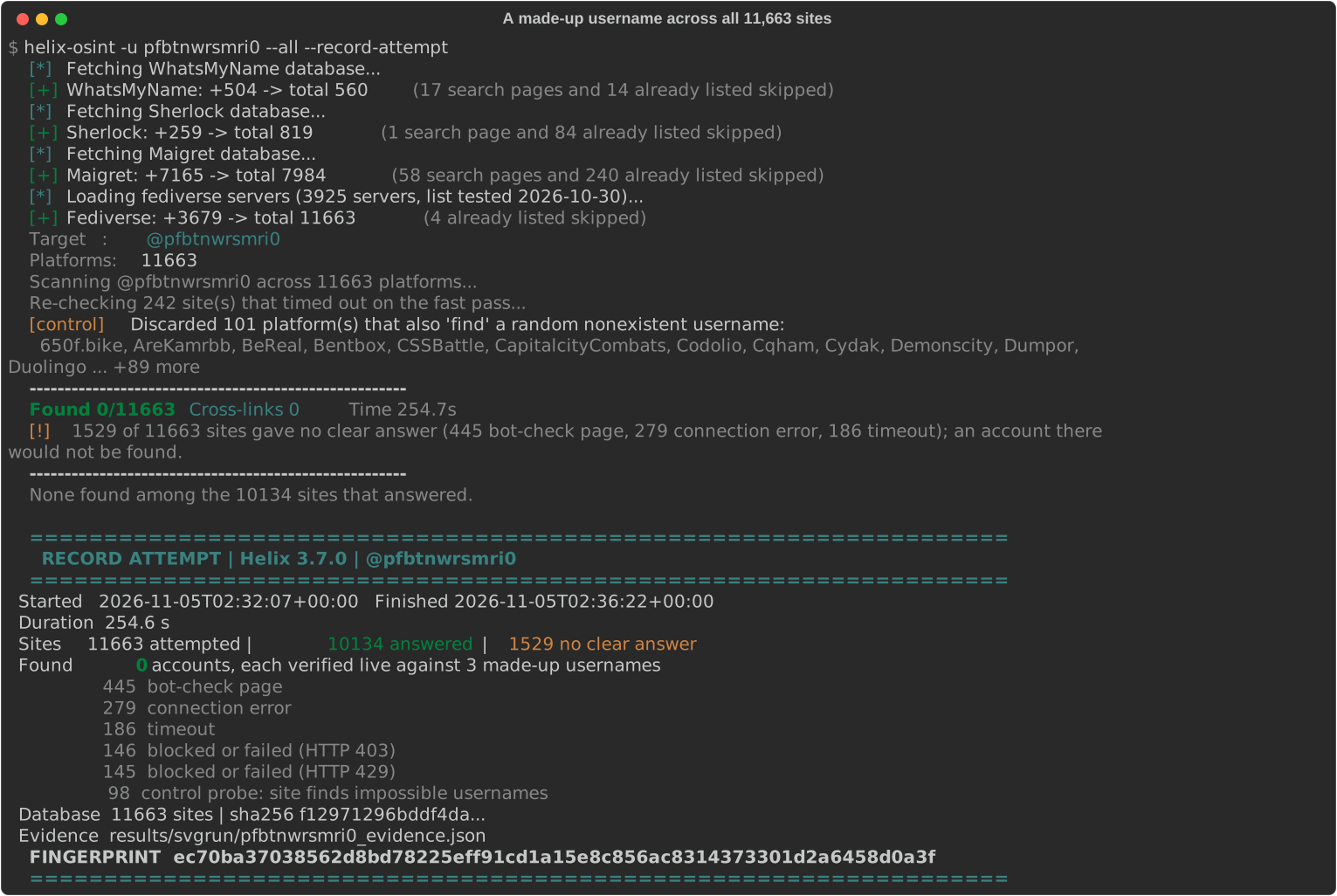
Big username databases are full of sites that answer "found" for any name: login walls (Facebook and Instagram when logged out), catch-all pages, sites whose markup changed since the database entry was written. A single site like that puts a fake account in every report.
So every hit is re-checked, at the same moment, against made-up usernames that
cannot exist: at least three (--controls N for more), two shaped like the
name and, for a short name, one of exactly its length, because some sites
accept any short name and refuse longer ones. The hit survives only if it is
found again (twice) and every made-up name gets a clear "no such user" answer.
When only the one of the same length is "found", the hit is reported as
unconfirmed, with the reason, instead of as an account. A site that "finds" a
random name is a catch-all; a random name that only gets a rate limit,
challenge or gateway error proves nothing, so that hit is dropped as
unverifiable. No per-site tuning: it holds across the whole database. Sites seen
answering unknown names at random are blocked outright.
Leads from the Maigret engine get the same treatment by URL: the page must name
the user, the made-up names must all get the same clear answer, and a lead
whose URL cannot be rebuilt for another name is not kept. --no-control turns
the probe off (faster, not covered by the no-false-positive measurements).
Database entries are also validated before they are scanned: a URL that is not a real web address, an unfilled template, or a detection rule with no evidence (which would match every page) is skipped and counted.
Identity Confidence
Finding an account proves the account exists. It does not prove it belongs to your subject. Every finding gets a separate identity grade built only from independent evidence that agrees:
| Selector | Evidence |
|---|---|
| username | same username: every finding has this, so on its own it is weak |
| avatar | perceptual-hash match with another found profile (--phash) |
| cross_link | the profile's bio links to another found profile, or vice versa |
the same platform was also confirmed from the subject's email (-e ... --holehe) |
|
| real_name | the page names the real name extracted from a different profile |
| location | the stated location agrees with --location |
- LOW: username only. Treat as a lead, not a finding.
- MEDIUM: two selectors.
- HIGH: three selectors, or two where one is avatar, cross-link or email.
A single selector is never HIGH, status-code-only detection caps at MEDIUM, and a location conflict caps at LOW. The supporting evidence is listed next to every grade in the console and in all reports.
Output Formats
| Format | Contents |
|---|---|
.html |
Standalone interactive D3.js graph: no server needed |
_report.html / .pdf |
Investigation report (--report; PDF needs weasyprint) |
.json |
Full structured report including intel bundle (wayback, GitHub deep, CRT, paste) |
.csv |
Spreadsheet-friendly, all platforms |
.txt |
Clean terminal-style summary |
Benchmarks
Every number Helix publishes comes from bench/ and can be re-run by anyone:
python -m bench.benchmark --sites 6000 --concurrency 300 --repeat 3 --json bench/results/my_run.json
The harness serves 6,000 fake platforms from a separate process, 2 % of them catch-alls that answer "found" for any name, and scores the full pipeline (scan, control probe, then verifier) against exact ground truth.
| 29 Oct 2026, 6,000 sites, control probe on | sites/s | precision | recall | false positives |
|---|---|---|---|---|
| default concurrency (60) | 260.9 | 1.000 | 1.000 | 0 |
--concurrency 300 |
387.0 | 1.000 | 1.000 | 0 |
Live, sealed record rehearsal (29 Oct 2026, final 3.5.0 code, --all --record-attempt --save-pages --concurrency 250):
| username | sites | clear answers | accounts reported | wall |
|---|---|---|---|---|
| made up at random just before the run | 8,305 | 6,918 | 0 | 167.1 s |
jack (789 pages saved and hashed) |
8,305 | 6,791 | 789 | 265.8 s |
The made-up-name evidence is published in bench/results/ and verifies with
helix-osint --verify-evidence.
That run was on a fast data-centre link. The same check on a laptop over a mobile hotspot (30 Oct 2026, Kali, 4 threads), 8,305 sites each time:
--concurrency |
clear answers | accounts reported (made-up name) | wall |
|---|---|---|---|
| 100 | 6,971 | 0 | 516.7 s |
| 150 | 7,032 | 0 | 419.6 s |
| 250 | 7,022 | 0 | 445.8 s |
So expect a few minutes for --all on a fast connection and 7 to 9 minutes on
a slow one. The best --concurrency depends on the link: 250 was fastest on
the data-centre link, but on the hotspot it overloaded the connection (about
2,350 probes timed out on the first pass, against 580 at 150) and the re-check
pass made it slower. Start at 150 and compare the clear-answer count.
Metric definitions, the record files and the live method are in bench/README.md.
Contributing
Pull requests and issues are welcome, and Helix is actively maintained. See CONTRIBUTING.md for setup, how to add or fix a site, and what a pull request needs. Found an account Helix reported that doesn't exist? Use the False positive issue form: it's the most useful report you can send. Security problems go through SECURITY.md, privately.
Legal & Ethics
Helix is built for security research, bug bounty reconnaissance, and OSINT education. All data sources used are publicly accessible. Always ensure you have proper authorization before running reconnaissance on any target. The author is not responsible for misuse.
Related Projects
- esp32-iot-audit: ESP32 IoT security scanner
- esp-pentest-toolkit: Wireless ESP32/8266 pentest toolkit
Built by Thalha Ahmed | @thalha-a9
If Helix helped you: drop a star and share it with your security community.
Explore related projects
trimstray/the-book-of-secret-knowledge
A collection of inspiring lists, manuals, cheatsheets, blogs, hacks, one-liners, cli/web tools and more.
257,250 starsHack-with-Github/Awesome-Hacking
A collection of various awesome lists for hackers, pentesters and security researchers
125,103 starsswisskyrepo/PayloadsAllTheThings
A list of useful payloads and bypass for Web Application Security and Pentest/CTF
82,542 starscaddyserver/caddy
Fast and extensible multi-platform HTTP/1-2-3 web server with automatic HTTPS
78,935 stars