
telepresenceio/telepresence
telepresenceio/telepresence has 7,333 GitHub stars and 585 forks. GitHot measured +2 stars in 24 hours and +7 in 7 days. Last checked 2026-11-12 14:09 UTC. Last push 2026-11-06.
Local development against a remote Kubernetes or OpenShift cluster
What you can do
- Cluster access - Your workstation reaches cluster Services and Pods as if it were inside the cluster: cluster DNS, cluster IPs, no port-forwards.
- Four attachment modes - Replace the remote container, intercept a service port, wiretap a copy of the traffic, or ingest just the environment and volumes.
- Traffic filtering - Intercept only your own requests, selected by HTTP header or path, so a whole team can share one cluster without collisions.
- Sidecar or node-agent - The traffic-agent is either injected as a sidecar (the default), or runs as a node-hosted pod that attaches to workloads without modifying them: no injection, no pod restarts.
Measured star growth
- in 24h
- +2
- in 7 days
- +7
- in 15 days
- Update delayed
- in 1 month
- Update delayed
Net star changes over overlapping periods, not daily totals. Missing measurements are left blank. Stars measure attention, not software quality.
README.md
OriginalTelepresence: Fast, Local Development for Kubernetes



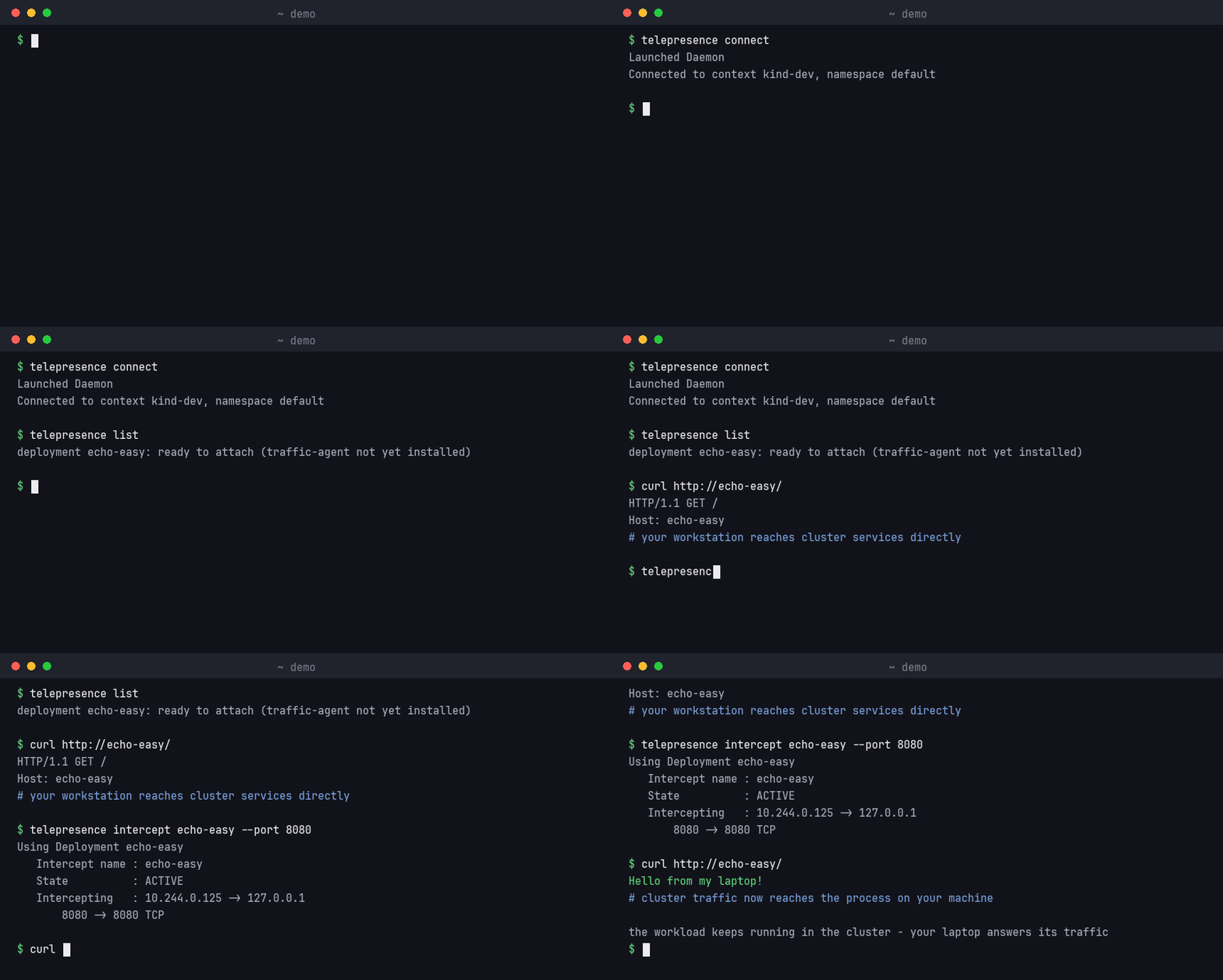
Telepresence is a CNCF project that connects your workstation to a Kubernetes cluster. Code and debug a service locally — with your own IDE, debugger, and hot reload — while it receives real traffic from the cluster, without the container build/push/deploy cycle.
Key Features
- Cluster access - Your workstation reaches cluster Services and Pods as if it were inside the cluster: cluster DNS, cluster IPs, no port-forwards.
- Four attachment modes - Replace the remote container, intercept a service port, wiretap a copy of the traffic, or ingest just the environment and volumes.
- Traffic filtering - Intercept only your own requests, selected by HTTP header or path, so a whole team can share one cluster without collisions.
- Sidecar or node-agent - The traffic-agent is either injected as a sidecar (the default), or runs as a node-hosted pod that attaches to workloads without modifying them: no injection, no pod restarts.
- Remote environment, local process - Run with the remote container's environment variables and volume mounts, so the code behaves like it does in the cluster.
Getting Started
- Quick Start Guide - Get up and running in minutes
- Installation - Install the Telepresence client
- Documentation - Full documentation
How It Works
When Telepresence connects, it creates a virtual network interface on your workstation and routes cluster traffic through a traffic-manager deployed in the cluster. Attaching to a workload adds a traffic-agent — a sidecar or a node-agent — that hands the workload's traffic, environment, and volumes over to your machine. See the architecture overview for the full picture.
Community
- GitHub Discussions - Ask questions, share ideas, and help shape the roadmap
- CNCF Slack - Join #telepresence-oss
- Troubleshooting - Common issues and solutions
Sponsors
Telepresence is free and open source, and is kept that way by its sponsors. Sponsorship pays for fast issue responses, prompt security fixes, and new features. If your team relies on Telepresence, please consider sponsoring the project, or get in touch about a corporate sponsorship.
Thank you to our past sponsors:
Contributing
See AGENTS.md for build instructions, architecture overview, and development guidelines.
Code signing policy
The Windows binaries and installers are Authenticode-signed and distributed by Tada AB, a Swedish company founded by the lead maintainer of the Telepresence open source project, using Azure Artifact Signing.
- Committers and reviewers: telepresence-maintainers (@thallgren, @bgruszka, @njayp, @breland-openai)
- Approvers: administrators (@khussey, @thallgren)
- Privacy policy: PRIVACY.md
License
Telepresence is licensed under the Apache License 2.0.
Explore related projects
codecrafters-io/build-your-own-x
Master programming by recreating your favorite technologies from scratch.
562,239 starspublic-apis/public-apis
A collective list of free APIs
498,645 starsmorluto/rea
Reverse engineer anything with agents, from app behavior down to native binaries.
456,467 starsopenclaw/openclaw
The AI that really does things. Any OS. Any Platform. The lobster way. 🦞
394,424 stars