
taherfattahi/ppo-rocket-landing
taherfattahi/ppo-rocket-landing has 244 GitHub stars and 46 forks. GitHot measured 0 stars in 24 hours. Last checked 2026-11-20 21:01 UTC. Last push 2024-11-02.
What you can do
- Custom Rocket Environment: Simulates rocket physics for hovering and landing tasks.
- PPO Algorithm Implementation: Utilizes both actor and critic neural networks for policy optimization.
- Continuous and Discrete Actions: Supports environments with continuous or discrete action spaces.
- Real-time Plotting: Visualizes training progress with moving average and variability shading.
Measured star growth
- in 24h
- 0
- in 7 days
- Collecting history
- in 15 days
- Collecting history
- in 1 month
- Collecting history
Net star changes over overlapping periods, not daily totals. Missing measurements are left blank. Stars measure attention, not software quality.
About
Proximal Policy Optimization (PPO) algorithm using PyTorch to train an agent for a rocket landing task in a custom environment
Machine LearningREADME.md
OriginalProximal Policy Optimization (PPO) for Rocket Landing
The goal is to train a reinforcement learning agent to control a rocket to either hover or land safely using the PPO algorithm. The environment simulates physics for the rocket, and the agent learns to make decisions based on the state observations to achieve the task.
https://github.com/user-attachments/assets/2bc71416-0043-4e8d-8f00-cd0d85a834ec
Actions
The rocket can take different actions, each defined by a thrust force and nozzle angular velocity. The available actions are:
Thrust Levels: Controls the rocket’s thrust, with options:
- 0.2 × g
- 1.0 × g
- 2.0 × g
Nozzle Angular Velocities: Controls the rotation of the rocket nozzle, with options:
- 0 (No rotation)
- +30°/s
- -30°/s
These combinations result in a set of 9 actions:
| Action | Thrust | Nozzle Angular Velocity |
|---|---|---|
| 0 | 0.2 g | 0 |
| 1 | 0.2 g | +30°/s |
| 2 | 0.2 g | -30°/s |
| 3 | 1.0 g | 0 |
| 4 | 1.0 g | +30°/s |
| 5 | 1.0 g | -30°/s |
| 6 | 2.0 g | 0 |
| 7 | 2.0 g | +30°/s |
| 8 | 2.0 g | -30°/s |
States
The state of the rocket environment is represented by an 8-dimensional vector, capturing essential details for controlling the rocket. Each component of the state vector is normalized:
- x: Horizontal position (m)
- y: Vertical position (m)
- vx: Horizontal velocity (m/s)
- vy: Vertical velocity (m/s)
- θ (theta): Rocket’s angle relative to the vertical (radians)
- vθ (vtheta): Angular velocity of the rocket (radians/s)
- t: Simulation time (steps)
- φ (phi): Nozzle angle (radians)
These states provide the necessary information for the agent to understand the rocket's position, orientation, and dynamics, which are essential for executing successful hovering or landing maneuvers.
Features
- Custom Rocket Environment: Simulates rocket physics for hovering and landing tasks.
- PPO Algorithm Implementation: Utilizes both actor and critic neural networks for policy optimization.
- Continuous and Discrete Actions: Supports environments with continuous or discrete action spaces.
- Real-time Plotting: Visualizes training progress with moving average and variability shading.
- Logging and Checkpointing: Logs training metrics and saves model checkpoints for later use.
- Testing Script: Includes a
test.pyscript for evaluating the trained agent.
Requirements
- Python 3.6 or higher
- PyTorch
- NumPy
- Matplotlib
Installation
Clone the Repository
git clone https://github.com/taherfattahi/ppo-rocket-landing.git
cd ppo-rocket-landing
Create a Virtual Environment (Optional)
python -m venv venv
source venv/bin/activate  # On Windows use venv\Scripts\activate
Install Dependencies
pip install torch numpy matplotlibEnsure CUDA Availability (Optional)
If you have a CUDA-compatible GPU and want to utilize it:
Install the appropriate CUDA toolkit version compatible with your PyTorch installation.
Verify CUDA availability in PyTorch:
import torch
torch.cuda.is_available()
Usage
Training
Run Training
python train.pyMonitor Training
- Training progress will be displayed in the console.
- A real-time plot will show the moving average reward and variability.
- Logs will be saved in the
PPO_logsdirectory. - Model checkpoints will be saved in the
PPO_preTraineddirectory.
Adjust Hyperparameters
- Modify hyperparameters in
train.pyto experiment with different settings. - Key hyperparameters include learning rates, discount factor, and PPO-specific parameters.
- Modify hyperparameters in
Testing
Ensure a Trained Model is Available
Make sure you have a trained model saved in the
PPO_preTrained/RocketLanding/directory.Run Testing
python test.pyObserve Agent Behavior
- The agent will interact with the environment using the trained policy.
- The environment will render the rocket's behavior in real-time.
- Testing results will be printed to the console.
Project Structure
- PPO.py: Contains the implementation of the PPO algorithm.
- train.py: Script to train the PPO agent in the Rocket environment.
- test.py: Script to test the trained PPO agent.
- rocket.py: Should contain the custom Rocket environment class.
- utils.py: May contain utility functions for the environment or agent.
- PPO_logs/: Directory where training logs are stored.
- PPO_preTrained/: Directory where model checkpoints are saved.
Mathematical Background
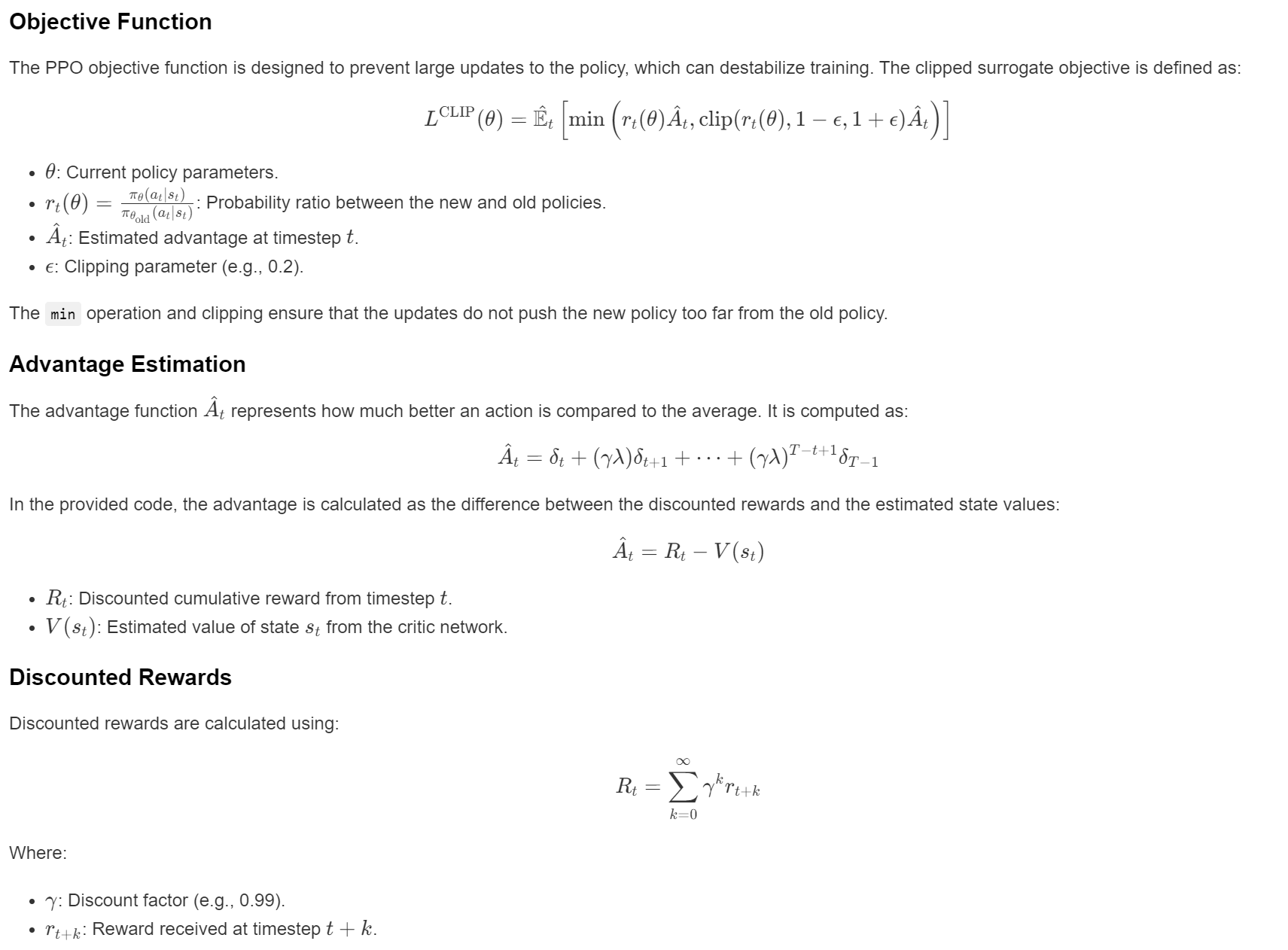
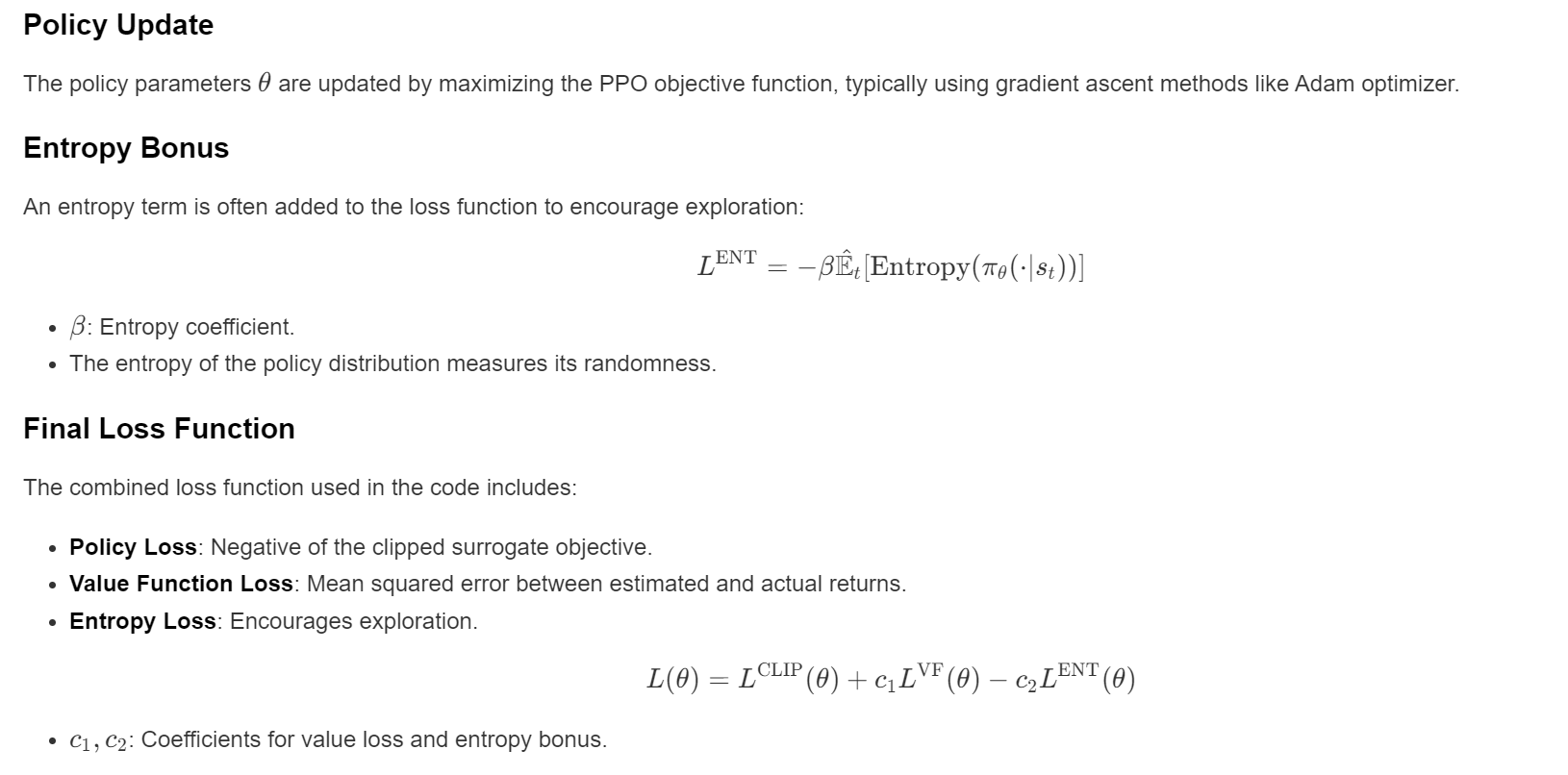
Proximal Policy Optimization (PPO)
PPO is a policy gradient method for reinforcement learning, which alternates between sampling data through interaction with the environment and optimizing a "surrogate" objective function using stochastic gradient ascent.
Neural Network Architecture
Actor Network
- Takes state ( s_t ) as input.
- Outputs action probabilities (discrete actions) or action means (continuous actions).
- For discrete action spaces, applies a Softmax activation to output probabilities.
Critic Network
- Takes state ( s_t ) as input.
- Outputs a single value estimate ( V(s_t) ).
Action Selection
- Discrete Actions: Sampled from a Categorical distribution based on action probabilities.
- Continuous Actions: Sampled from a Multivariate Normal distribution with mean and variance from the actor network.
Gradient Computation
- Gradients are computed with respect to the loss function.
- The optimizer updates the network parameters to minimize the loss.
Hyperparameters
The default hyperparameters are set in train.py and test.py. Key parameters include:
Environment Parameters:
env_name: Name of the environment.task: Task type ('hover' or 'landing').max_ep_len: Maximum timesteps per episode.max_training_timesteps: Total training timesteps.
PPO Parameters:
update_timestep: Timesteps between policy updates.K_epochs: Number of epochs for each PPO update.eps_clip: Clipping parameter for PPO.gamma: Discount factor.lr_actor: Learning rate for the actor network.lr_critic: Learning rate for the critic network.
Logging Parameters:
print_freq: Frequency of printing average reward.log_freq: Frequency of logging average reward.save_model_freq: Frequency of saving the model.
Results
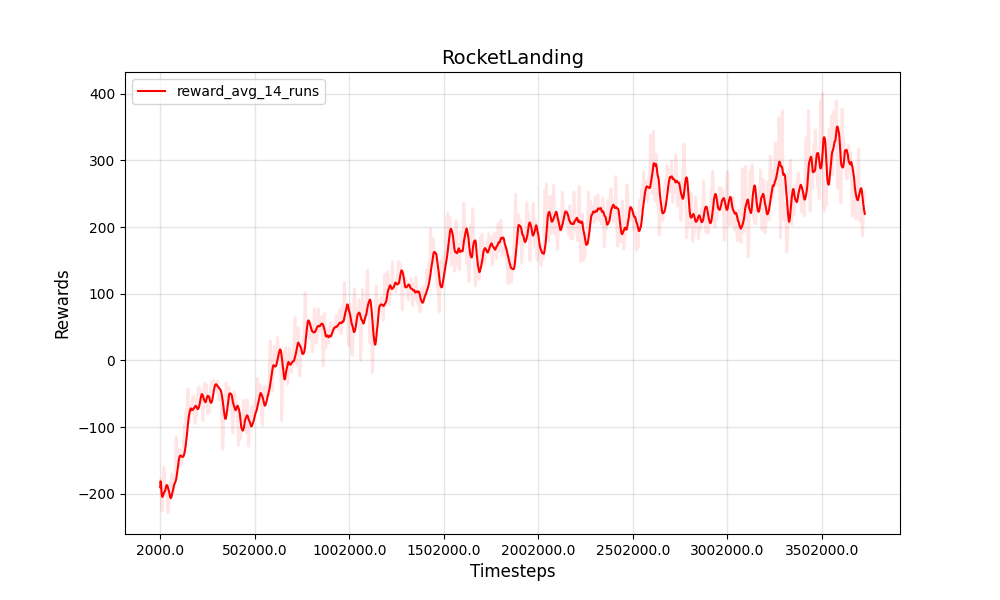
During training, the agent learns to control the rocket to achieve the specified task. The real-time plot shows the agent's performance improving over time, with the moving average reward increasing and variability decreasing.
Resources
- The PPO implementation is based on the original paper by Schulman et al., Proximal Policy Optimization Algorithms.
- Minimal implementation of clipped objective Proximal Policy Optimization (PPO) in PyTorch
- Rocket-recycling with Reinforcement Learning
Contact
For questions or feedback, please contact:
Email: [email protected]