
squall01337/abyssal-ocean
squall01337/abyssal-ocean has 57 GitHub stars and 10 forks. GitHot measured 0 stars in 24 hours. Last checked 2026-11-18 13:10 UTC. Last push 2026-08-18.
Measured star growth
- in 24h
- 0
- in 7 days
- Collecting history
- in 15 days
- Collecting history
- in 1 month
- Collecting history
Net star changes over overlapping periods, not daily totals. Missing measurements are left blank. Stars measure attention, not software quality.
About
Real-time spectral FFT ocean in a single HTML file — WebGL2 + three.js, JONSWAP/TMA spectrum, 3 cascades, physical foam, caustics and underwater. No build step.
Creative & MediaREADME.md
OriginalABYSSAL — spectral FFT ocean
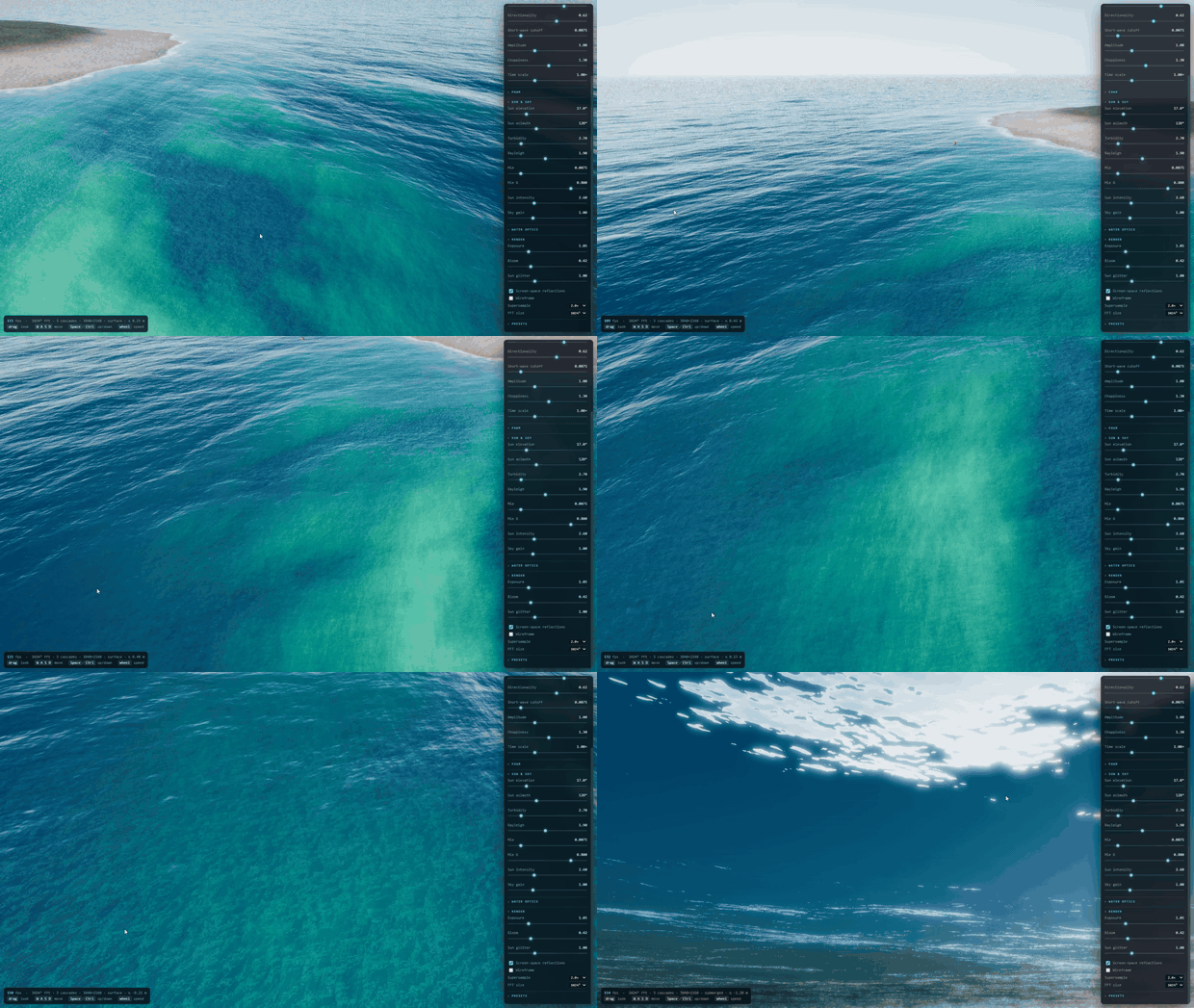
A real-time, physically-based ocean in one HTML file. WebGL2 + three.js, no build step, no npm install — open it in a browser and you are sailing.
What it actually does
The water is not a scrolling normal map. It is an oceanographic wave spectrum, inverse-transformed on the GPU every frame:
- JONSWAP spectrum with the TMA shallow-water correction and Donelan–Banner directional spreading. Wind speed, fetch and sea depth are real inputs — the significant wave height matches the Hasselmann fetch-limited law to within ~2%.
- 3 spectral cascades (768 m / 121 m / 19 m tiles) that partition k-space with no overlap, so you get swell out to the horizon and centimetre chop under the camera, with no visible tiling.
- 512² inverse FFT per cascade, per frame, as a Cooley–Tukey butterfly with a precomputed twiddle/index texture. Two MRT slots carry four complex fields through the same butterfly pass, so one transform yields displacement, slope and the horizontal-displacement Jacobian at once.
- Foam from physics, not from noise: where the Jacobian of the Tessendorf displacement goes negative the surface folds — that is a breaking wave. Foam is injected there and then accumulated, diffused and decayed in a ping-pong buffer, so wakes persist and drift instead of popping.
And the rest of the frame
- Preetham analytic sky, evaluated per pixel and shared by the sky dome, the water reflection and the ambient term on the island — turbidity and sun angle stay consistent everywhere.
- Screen-space reflections over a roughness-blurred sky fallback, GGX sun glitter widened by the solar disc.
- Refraction with Beer–Lambert absorption and in-scattering, plus subsurface scattering that lights up the back of the crests when the sun is low.
- Caustics on the seabed derived from the inverse Jacobian of the refracted-ray mapping through the actual FFT surface — they move with the waves because they are the waves.
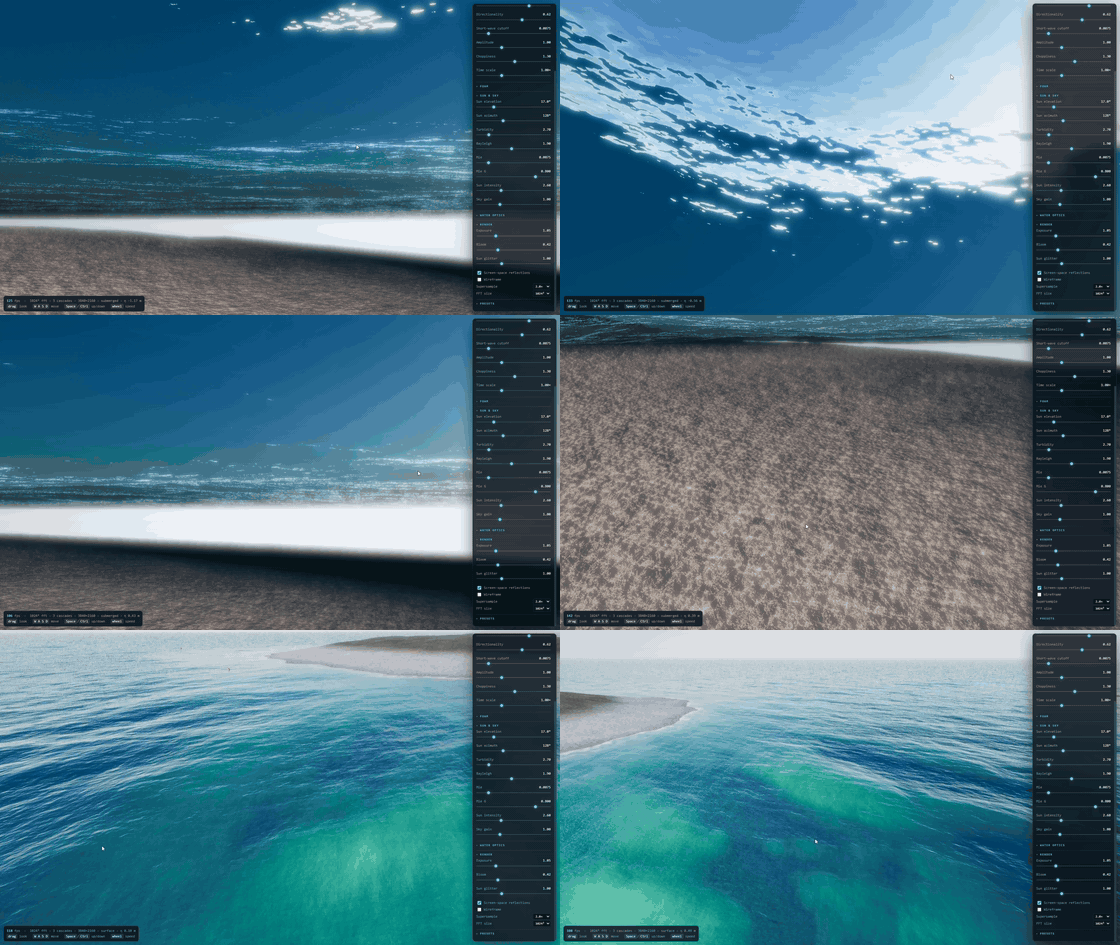
- Underwater is a real state: a 1×1 GPU probe reads the wave height beneath the camera each frame, and going under gives you Snell's window, total internal reflection and volumetric fog.
- Buoys with GPU buoyancy — anchored, displaced and tilted by the wave field via an inverse-displacement solve.
- Camera-centred exponential radial grid (480 rings × 720 segments, 1.5 m → 24 km) so the mesh is crack-free all the way to the horizon.
- ACES tonemapping, 5-level bloom, up to 2× supersampling.
Below the surface
Controls
drag |
look |
W A S D / Z Q S D / arrows |
move |
Space / Ctrl |
up / down |
wheel |
movement speed |
On a phone the parameter panel is a bottom sheet (side column in landscape). Tap hide to put it away; a tools chip brings it back. On-screen look / move / heave arrows drive the camera.
Everything on the panel is live: spectrum, foam, sun & sky, water optics, render. Four presets to start from — Tropical calm, Golden hour, Open storm, Glass morning.
Running it
git clone https://github.com/squall01337/abyssal-ocean
cd abyssal-ocean
python -m http.server 8000   # any static server; needed for the ES module import
Then open http://localhost:8000.
FFT resolution can be forced with a query string: ?n=128, 256, 512 (default) or 1024.
Requires a browser with WebGL2 and EXT_color_buffer_float (Chrome, Edge, Firefox, Safari 15+, including iOS Safari). It leans on the GPU — phones default to 256² FFT and 1.0× supersample; drop Supersample to 1.0× and the FFT to 256² on a laptop if needed.
Why is it one file?
Because it can be. The whole thing is ~1600 lines: the GLSL lives in template literals next to the JavaScript that drives it, three.js comes from a CDN through an import map, and there is nothing to bundle, transpile or install. You can read the ocean from spectrum to pixel in a single scroll, drop the file in any folder, and it runs.
If you want to lift a piece into your own project, the file is cut into labelled sections (CONFIGURATION, SHARED GLSL, PASS 1…6, OCEAN, POST PROCESSING) — the FFT chain in particular is self-contained and only needs the butterfly texture and six fullscreen passes.
References
- Tessendorf, Simulating Ocean Water (2001)
- Hasselmann et al., JONSWAP (1973) · Bouws et al., TMA (1985)
- Donelan, Hamilton & Hui, directional spreading (1985)
- Preetham, Shirley & Smits, A Practical Analytic Model for Daylight (1999)
License
MIT — see LICENSE.