
skyzh/type-exercise-in-rust
skyzh/type-exercise-in-rust has 1,519 GitHub stars and 68 forks. GitHot measured 0 stars in 24 hours. Last checked 2026-11-08 04:28 UTC. Last push 2026-10-06.
Learn advanced Rust by building a type-safe, auto-vectorized database expression engine
Measured star growth
- in 24h
- 0
- in 7 days
- Update delayed
- in 15 days
- Update delayed
- in 1 month
- Update delayed
Net star changes over overlapping periods, not daily totals. Missing measurements are left blank. Stars measure attention, not software quality.
README.md
Original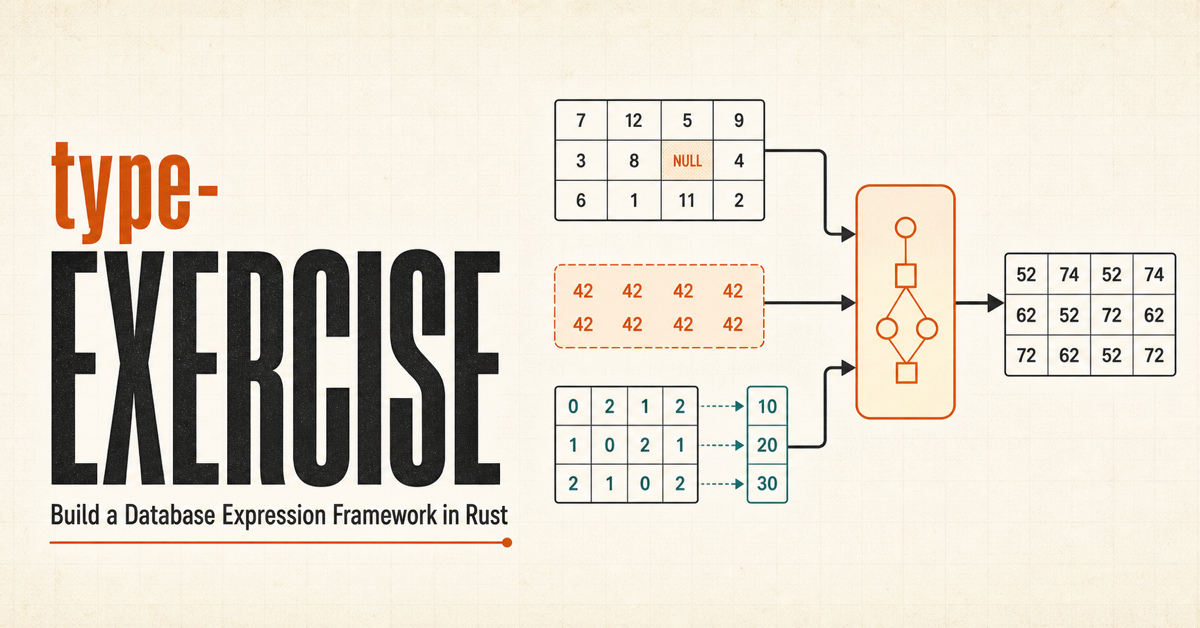
Build a Typed Database Expression Engine in Rust
A hand-written loop for one integer function is easy. A database expression engine also has to borrow strings without copying, preserve nulls, read several column representations, coerce types, and select functions at runtime.
This course builds the type families and checked boundaries that move those decisions out of each row loop. The result is a small auto-vectorized expression engine: authors write one scalar operation, while generic unary, binary, and ternary adapters reuse the checked batch path.
Read the course
The complete published course contains five modules and ten cumulative, independently testable checkpoints. Work through them in order; each extends the same starter and keeps the earlier supplied tests green. Plan roughly half a day for each checkpoint. An experienced Rust learner can finish in about five working days, while newer learners should expect to take longer.
What you will build
The five modules follow the engine from physical values to its outer async boundary:
- Type families and nullable views (Checkpoints 1–2): connect owned and borrowed scalars, arrays, builders, logical types, and checked Array, Constant, Indexed, and typed-null views.
- Shared evaluation and transactional strings (Checkpoints 3–4): lift scalar operations over batches and publish variable-width rows without exposing partial writes.
- Shape specialization and binary semantics (Checkpoints 5–6): specialize common column shapes while preserving fallback behavior, then separate total, fallible, and nullable-aware binary evaluation.
- Runtime erasure and the physical catalog (Checkpoints 7–8): erase whole typed expressions behind a checked batch boundary and build a discoverable catalog of concrete operations.
- Logical binding, one-level Lists, and batch async (Checkpoints 9–10): bind logical calls to physical expressions, add checked nullable List storage, and defer one complete batch in a borrowing future.
The course deliberately stops short of Decimal arithmetic, casts and rounding, lossy coercions, nested or list-producing functions, exhaustive fast paths, an aggregate engine, and per-row futures.
Start the exercises
You should know ordinary Cargo use, enums, traits, references, and Option. Follow the
environment setup, then work only in
type-exercise-starter:
git fetch origin
git switch --create course-work --track origin/main
cargo check -p type-exercise-starter-expr --lib --locked
Choose another branch name if course-work already exists. The starter baseline should compile.
Do not inspect type-exercise/ or archived/ while solving an exercise.
How chapter tests work
Copy the cumulative supplied contract when you are ready to start a chapter:
cargo x copy-test --chapter 1
cargo test -p type-exercise-starter-supplied-tests chapter_1 --locked
The first focused run should fail because the new behavior is missing. Read the copied destination
under type-exercise-starter/supplied-tests/src/, implement the named API in other starter files, and rerun
the same command until it passes. Never edit copied tests or supplied-tests/src/lib.rs; keep all earlier copied
chapters green.
Checkpoint 10 is the terminal unit. After completing it, cargo x copy-test --chapter 10 copies
the complete cumulative supplied contract.
Questions and feedback
Join skyzh's Discord server for discussion. For a concrete bug or improvement, open an issue or pull request.
License
The source code is licensed under Apache 2.0. See LICENSE. The mdBook text is © 2022-2026 Alex Chi Z and licensed under CC BY-NC-SA 4.0.
Explore related projects
Asabeneh/30-Days-Of-Python
The 30 Days of Python programming challenge is a step-by-step guide to learn the Python programming language in 30 days. This challenge may take more than 100 days. Follow your own pace. These videos may help too: https://www.youtube.com/channel/UC7PNRuno1rzYPb1xLa4yktw
78,370 starsgrafana/grafana
The open and composable observability and data visualization platform. Visualize metrics, logs, and traces from multiple sources like Prometheus, Loki, Elasticsearch, InfluxDB, Postgres and many more.
77,763 starsredis/redis
For developers, who are building real-time data-driven applications, Redis is the preferred, fastest, and most feature-rich cache, data structure server, and document and vector query engine.
77,288 starsapache/superset
Apache Superset is a Data Visualization and Data Exploration Platform
75,453 stars