
sigpanic/goink
sigpanic/goink has 512 GitHub stars and 85 forks. GitHot measured +3 stars in 24 hours and +8 in 7 days. Last checked 2026-11-09 21:58 UTC. Last push 2026-11-02.
Goink 桌面 AI 小说创作助手,对话式写作 + 自动状态追踪 + 本地语义搜索。跨平台开箱即用。AI Agent Novel Generator.
Measured star growth
- in 24h
- +3
- in 7 days
- +8
- in 15 days
- Collecting history
- in 1 month
- Collecting history
Net star changes over overlapping periods, not daily totals. Missing measurements are left blank. Stars measure attention, not software quality.
README_EN.md
Original


Desktop AI Novel-Writing System
Agent Real-Time Decisions × Structured Memory × Post-Writing Self-Check









If Goink helps you, please consider donating; a Star is also a great encouragement.
中文版 | English Version
Anyone who has tried to write a novel with a general-purpose AI knows the pain—by chapter five it forgets the protagonist's name. By chapter thirty you're manually flipping through earlier chapters hunting for that one foreshadowing line. After finishing a chapter you have to remind it yourself to "update character status" and "check arc progress." Goink doesn't have these problems. It's a desktop AI writing system with structured memory—character profiles, foreshadowing states, arc progress, location relationships, reader knowledge—the system remembers, and the Agent looks it up, edits it, and maintains it on its own.
What Makes It Different From General AI Chat
| General AI Chat | Goink | |
|---|---|---|
| Creative context | Re-explain everything in every conversation | Full structured tracking: characters, relationships, foreshadowing, arcs, locations, reader knowledge |
| Editing | Outputs text directly; no idea what changed | Diff preview + line-by-line comparison + approve before writing |
| Finding past content | Manual searching, flipping through chapters | Local semantic search—"that pendant" finds every relevant passage |
| Post-writing maintenance | Doesn't care unless you remind it | Auto-triggers character updates, foreshadowing resolution, arc progression, reader knowledge refresh after writing |
| Writing style | Prompt-based brute force | 8 built-in methodologies + custom Skill hot-reload, three-layer override |
| Version history | None | Built-in Git, auto-commit every conversation, rollback anytime |
| Dependencies | Often needs Python/GPU | Single installer, ready to go |
The AI Looks It Up, Edits It, and Maintains It—Not a Pipeline, an Agent
31 structured tools. The LLM autonomously decides which to call, what parameters to pass, and what to do next. Not a "finish a chapter, hand off to the next stage" pipeline—the Agent calls tools within the current conversation to check characters, check foreshadowing, read and write content, and update state, all the way to completion.
After a chapter is written, the system automatically injects maintenance reminders telling the Agent exactly what to check: have characters changed, has pending foreshadowing been resolved, do arc nodes need to advance, does reader knowledge need updating. The Agent won't "forget maintenance"—it's forced to self-check item by item.
If that's still not enough, you can launch the Review Sub-Agent—an independent Agent that audits the chapter content against system state from scratch, flags any inconsistencies straight into the conversation, and lets the main Agent fix them on the spot.
Finding One Sentence Across Hundreds Of Thousands Of Words: Local Semantic Search
On chapter fifty, wondering "where exactly did the protagonist first see that pendant?"—no need to flip through every chapter. Tell the AI a sentence, and it finds the relevant passages across the entire book.
Not keyword matching—meaning-based search. Ask "clues about the pendant" and it finds paragraphs that never mention the word "pendant" but clearly allude to it. The Agent can also proactively search earlier content when writing new chapters to maintain consistency.
The entire engine runs locally—BGE Chinese semantic model via ONNX local inference, sqlite-vec vector index, MMR de-duplication re-ranking. Background incremental indexing after each chapter. No network, no extra configuration.
Not Just Memory—Structured Creative State
Characters: Relationships Have History
Character profiles include personality, abilities, and background. Character relationships form a directed graph—"Zhang San towards Li Si: mentor but secretly wary," "Li Si towards Zhang San: respectful but withholding"—two independent records. Old relationship records are preserved when things change, so you can review the evolution.
Foreshadowing: No More Loose Threads
Every foreshadowing entry records a target resolution chapter and importance level. System alerts near resolution points; overdue unresolved items are flagged as anomalies. Chapter plans have three tiers—next chapter, near-term, far-term—to manage creative pacing.
Arcs: Cross-Chapter Narrative Threads
Arcs consist of node chains, each node associated with a target chapter. Nodes auto-advance when a chapter is completed. A story typically tracks 3–5 parallel arcs simultaneously.
Worldbuilding: Locations Are a Graph, Not a List
Track hierarchy (Kingdom → Palace → Great Hall) and spatial connections (A and B connected by a mountain path). The AI can query details, sub-locations, connections, or the full map.
Reader Knowledge: Control Information Release
Track what the reader knows, what answers they're waiting for, and what they've misunderstood. Precisely control suspense timing and reveal moments.
Writing Preferences: Say It Once
Two-tier management: global preferences and per-novel preferences. By chapter thirty-seven, "keep dialogue cold and restrained" still takes effect.
Frontend Visualized State


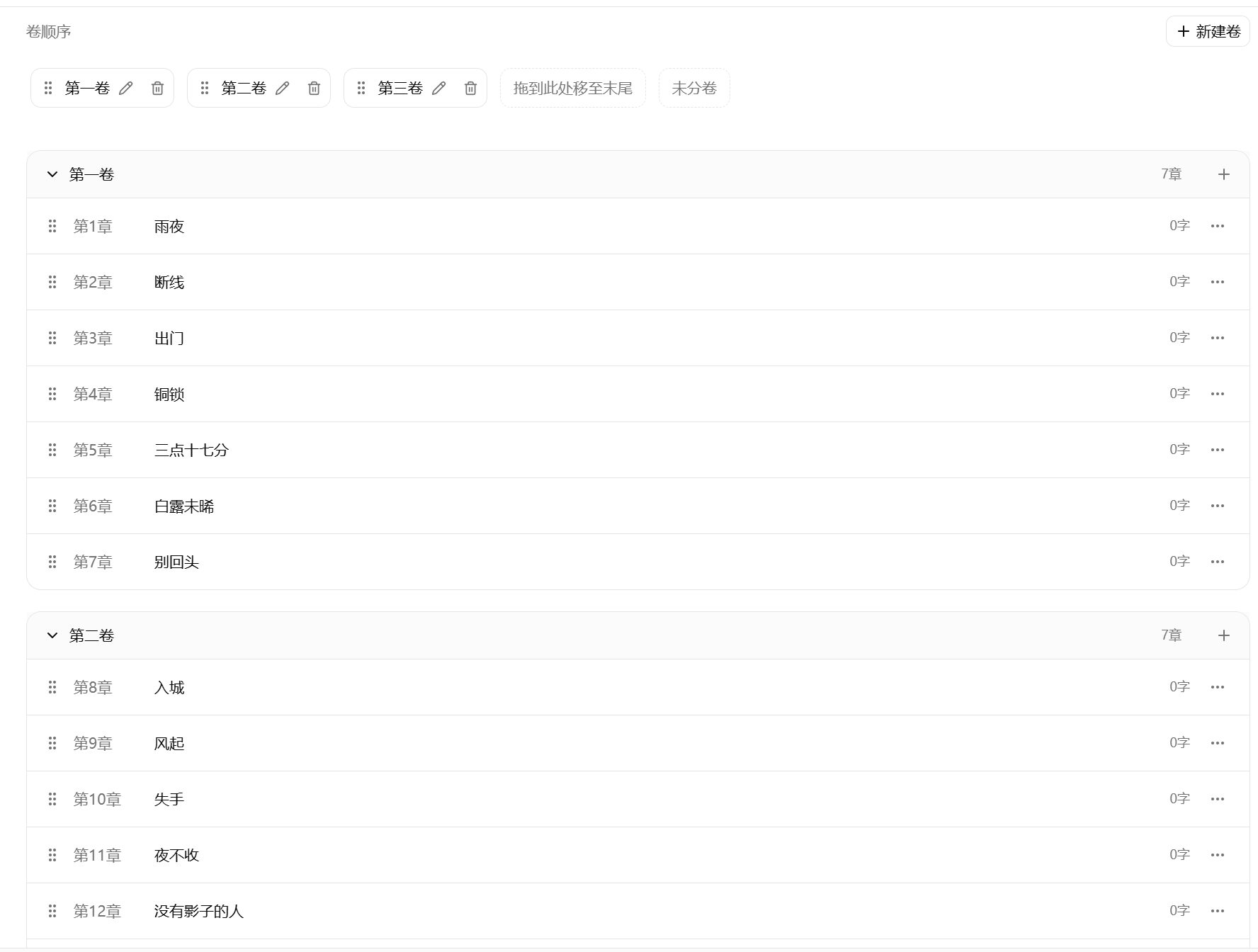
Volumes & Chapters: Drag to Reorder
Long novels need volumes. Goink treats a volume as a first-class structure — create, rename, delete, and reorder volumes by dragging. Chapters can be dragged across volumes or reordered within one; drop to apply, and chapter numbers are automatically re-numbered in the new reading order — no manual renumbering. Unassigned chapters sit in an "Unassigned" bucket, ready to be dragged into any volume.
Each volume collapses and expands, showing its chapter count and word count in real time; a volume can also carry its own "volume outline", managed separately from the book-wide outline.
Skill System: 3 Layers × 3 Modes
[!TIP] Contribute your own Skill! Turn your writing methodology into a
.mdfile and submit a PR to share it.
Skills are Goink's creative methodology modules. Each Skill is defined by a single .md file with YAML frontmatter metadata and markdown body. 3 layers × 3 modes = 9 strategic dimensions — precise control over what content, at what scope, with what activation model.
Three Layers
Same-name Skills override by priority: Novel > User > Built-in. Changes hot-reload instantly — no restart needed.
| Layer | Storage | Scope | Editable |
|---|---|---|---|
| Built-in | Read-only bundled | All novels | No |
| User | ~/.goink/skills/ |
All novels | Yes |
| Novel | {novel}/skills/ |
Current novel | Yes |
Three Modes
| Mode | AI auto-invoke | User / trigger |
Injected at session start | Listed in catalog |
|---|---|---|---|---|
Smart auto |
Yes | Yes | — | Yes |
Command manual |
— | Yes | — | — |
Always-on always |
Yes | Yes | Yes (full body) | — |
3×3 Capability Matrix
| Smart auto | Command manual | Always-on always | |
|---|---|---|---|
| Built-in | Scene Beats, Dialogue Subtext, Pacing Control, Suspense Hooks, Character Design, Revision Polish, De-AI-ify, Co-Creation Brainstorm | review / memory / collect / next | — |
| User | Reusable cross-novel workflows | Personal quick commands | Global style rules |
| Novel | Novel-specific workflows | Novel quick commands | Novel always-on rules |
Create a .md file and it becomes a new Skill:
---
name: My Writing Process
description: Custom personal creative workflow
category: Custom
mode: auto
---
# Content...
Zero-code extensibility. Changes take effect instantly. Deletion works the same way.

Style Distillation: One Sample → One Imitation Skill
Want to write like a certain author? Paste a sample text. The AI analyzes it across six dimensions — sentence structure, word choice, rhetorical devices, pacing, narrative distance, tone & atmosphere — and generates a complete imitation Skill. This is pattern extraction, not keyword substitution.
The generated Skill appears in your list instantly. Load it with /stylename and all subsequent output follows that style. Open the editor to fine-tune if needed.

Triple Assurance: Maintenance Never Gets Missed
Layer 1—System Prompt • Agent's core instructions hard-code the maintenance workflow. "Perform state maintenance immediately after creative completion. This is not optional."
Layer 2—Dynamic Injection • After the AI writes a long piece, the system auto-injects check items—character changes, foreshadowing status, arc nodes, reader knowledge.
Layer 3—Review Sub-Agent • An independent sub-agent compares the chapter against system state and reports any issues immediately.
Your Approval, Every Time
The AI doesn't modify the manuscript directly. Every edit generates a Diff first, then waits for your approval before writing. Approve, reject, or give feedback for the AI to revise on the spot. You can also switch to auto mode for continuous multi-round free-writing.
Every change has Git history. Roll back to any state at any time.


The AI Can't Touch Files It Shouldn't
Dual-layer sandbox security isolation—regex whitelist only allows legitimate paths like chapters/, outlines/, goink.md; SafePath prevents path traversal. Files are re-read and compared before writing to prevent overwriting your manual edits.
Installation
Download the installer for your platform from Releases:
- Windows — Run the installer
- macOS — Open DMG, drag to Applications
- Linux — Run the AppImage
Requires an LLM API Key (built-in DeepSeek, GLM, MiMo templates; compatible with OpenAI format). Installer < 60MB. No Python, Node.js, database, or GPU required. Windows SmartScreen may show a warning (unsigned)—click "More info" → "Run anyway."
Poor network? Download from cloud drive: https://wwayx.lanzouu.com/b0kp2iyoj Password: 1111
Build From Source
sudo apt install libsqlite3-dev libgtk-3-dev libwebkit2gtk-4.1-dev gcc
git clone https://github.com/sigpanic/goink
cd goink
make deps
make build   # production build
make dev     # dev mode (hot reload)
Tech Stack
| Layer | Technology |
|---|---|
| Agent Engine | Custom ReAct loop (Go, SSE streaming + 31 Function Calling tools + nested sub-agents) |
| Desktop Framework | Wails v2 (Go + WebView) |
| Editor | Monaco Editor |
| Database | SQLite + GORM (ACID transactions + operation log rollback) |
| Vector Search | sqlite-vec + ONNX Runtime (bge-small-zh-v1.5 int8 quantized) |
| Version Control | Built-in Git (auto commit / Diff / Revert) |
| Security | Regex whitelist + SafePath dual sandbox + approval flow |
| Frontend | React 19 + TypeScript + Tailwind CSS 4 + shadcn/ui |
License
Goink is licensed under the GNU Affero General Public License v3.0 (AGPL-3.0). See LICENSE for the full text and NOTICE for additional terms under AGPLv3 Section 7.
Star History
Donate
Goink development relies on several AI services (including subscription costs). If Goink helps you, donations are welcome—they go toward covering the AI subscription costs during development. If convenient, please note your GitHub username—it will appear in the thank-you list by default.




Thanks to everyone who has donated. Full list: THANKS.md.
Explore related projects
affaan-m/ECC
The agent harness performance optimization system. Skills, instincts, memory, security, and research-first development for Claude Code, Codex, Opencode, Cursor and beyond.
300,197 starsNousResearch/hermes-agent
The agent that grows with you
262,052 starsmultica-ai/andrej-karpathy-skills
A single CLAUDE.md file to improve Claude Code behavior, derived from Andrej Karpathy's observations on LLM coding pitfalls.
231,329 starsfirecrawl/firecrawl
Supercharge your AI agents with data from the web and beyond. Building the library for superintelligence. 🔥
199,847 stars