
shawn-tangsc/MacroBay
shawn-tangsc/MacroBay has 80 GitHub stars and 7 forks. GitHot measured +5 stars in 24 hours. Last checked 2026-11-16 04:22 UTC. Last push 2026-11-11.
Measured star growth
- in 24h
- +5
- in 7 days
- Update delayed
- in 15 days
- Update delayed
- in 1 month
- Update delayed
Net star changes over overlapping periods, not daily totals. Missing measurements are left blank. Stars measure attention, not software quality.
About
Crypto market intelligence with receipts: funding, flows, sentiment and the macro that moves price, in one desktop dashboard — with an AI analyst that cites its source and cutoff time.
AIREADME.md
Original

MacroBay
Crypto market intelligence with receipts.


Quick start · What's on the desk · Why crypto · Data sources · Roadmap · Docs · License
Local-first. No bundled market data, no bundled API keys, no hosted account. Not affiliated with any venue or data provider.
MacroBay is a desktop intelligence desk for crypto. One screen holds what actually moves the market — perpetual funding and positioning, stablecoin supply and ETF flows, risk appetite, cross-asset moves, and the macro prints that reprice everything. The analyst agent reads the same evidence and explains what changed, with the source and the cutoff time attached to every number.
A claim that cannot be traced to a source record and a timestamp is supposed to be reported as a gap. That is the whole product: not a paragraph you have to take on faith.
The daily briefing
One page a morning, about three minutes: what the market is pricing, what changed overnight, and what to watch today. Every number carries its source and its cutoff time, so you can check it yourself — and whatever could not be collected is reported as a gap instead of being quietly filled in.
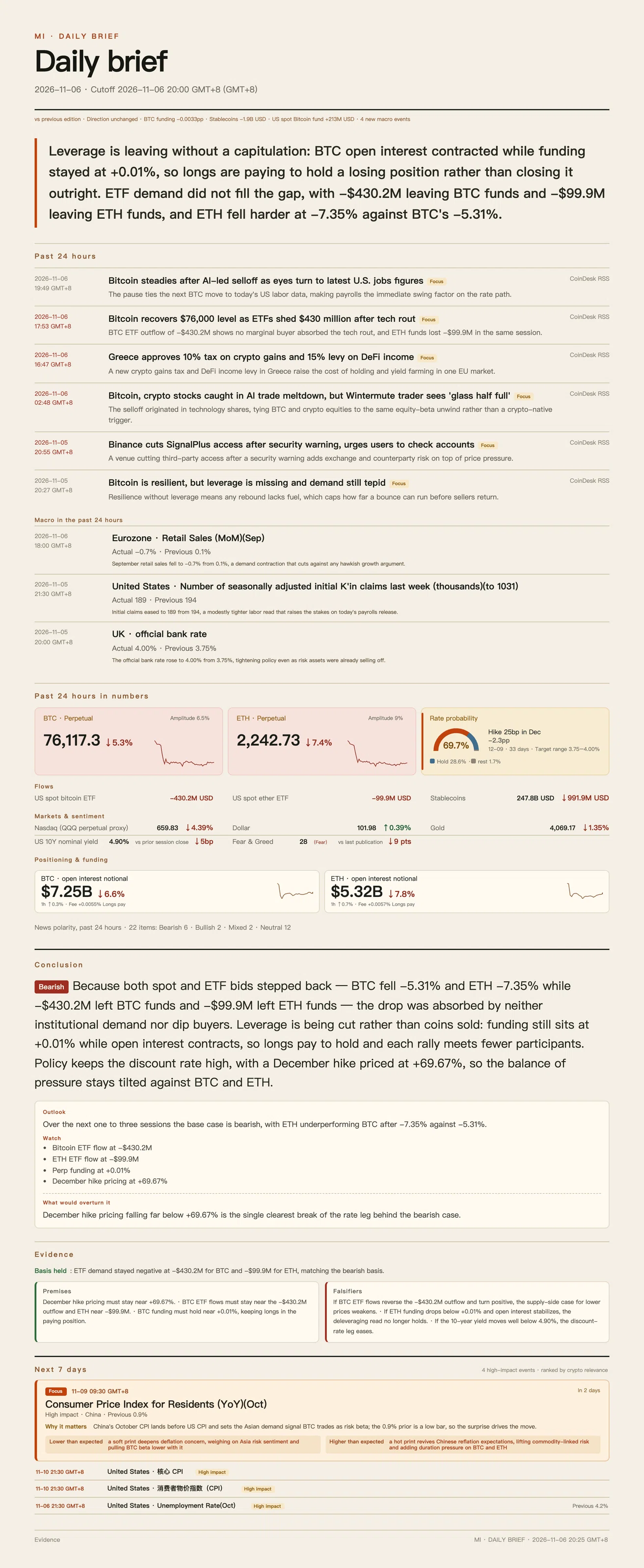
One page a morning, the whole page — every item, its source and its cutoff.
Why you can trust it
- Every number points back. A claim carries its source record and the cutoff it was read at, so you can go and check it instead of taking the paragraph on faith.
- A gap is reported as a gap. What could not be collected is named and grouped, never filled with a neutral value that reads like data.
- The data lands before the analysis. Sources are collected into a local store, frozen into a snapshot, and only that snapshot is analysed — so a conclusion has a record behind it, and the numbers stay on your machine.
Download
macOS · Apple Silicon (.dmg) · macOS · Intel (.dmg) · Windows · x64 (.exe) · All releases
This build is not code-signed and not notarized, so the first launch takes two steps:
- macOS — drag the app into Applications, then right-click (Control-click) the app → Open
and confirm Open in the dialog. Double-clicking is blocked by Gatekeeper. If macOS still
refuses, run
xattr -dr com.apple.quarantine /Applications/MacroBay.appin Terminal and open it again. - Windows — run the installer. When SmartScreen says Windows protected your PC, click More info → Run anyway.
Every update you download repeats those same two steps, until a signed build ships.
The Intel build is MacroBay-x64.dmg: built, but not yet verified on Intel hardware. The Apple
Silicon download link above is unchanged, and latest-mac.yml is produced only by the arm64 job.
⭐ If this is useful to you, a star keeps it going
One person builds MacroBay, in the open. A star is the only signal I can see that someone is actually using it — and it decides whether the next person who needs this ever finds it.
→ Star the repo · it takes two seconds.
Built for people whose read has to survive a follow-up question — whether that is your first cycle or your fourth.
Who it is for
- Trading for a living → — one screen instead of five, and a conclusion that survives "how do you know?".
- Still learning the market → — the same screen, except it explains the plumbing while you read it.
Why crypto first
Crypto is the hardest place to fake a market read, which makes it the right place to build one.
- The market never closes. Funding flips at 00:00 UTC, a listing lands at 3am, CPI prints mid-session. There is no closing bell that consolidates the story, so the timestamp and the source are the analysis.
- The signal is scattered. Exchange announcements and API changes, status incidents, stablecoin supply, ETF flows, funding, sentiment, macro releases — no single feed tells you what changed.
- Revisions are quiet. A number you read yesterday may be restated today. A tool that overwrites the old reading removes the only way to learn from being wrong.
So the desk is built around three habits: read the whole picture on one screen, keep the observation time on every reading, and make the AI show its work.
What's on the desk
The desk is where a briefing's evidence lives. Open any claim on the page and you land here: the same reading, its window, its source and its cutoff — plus the panels the brief draws from.
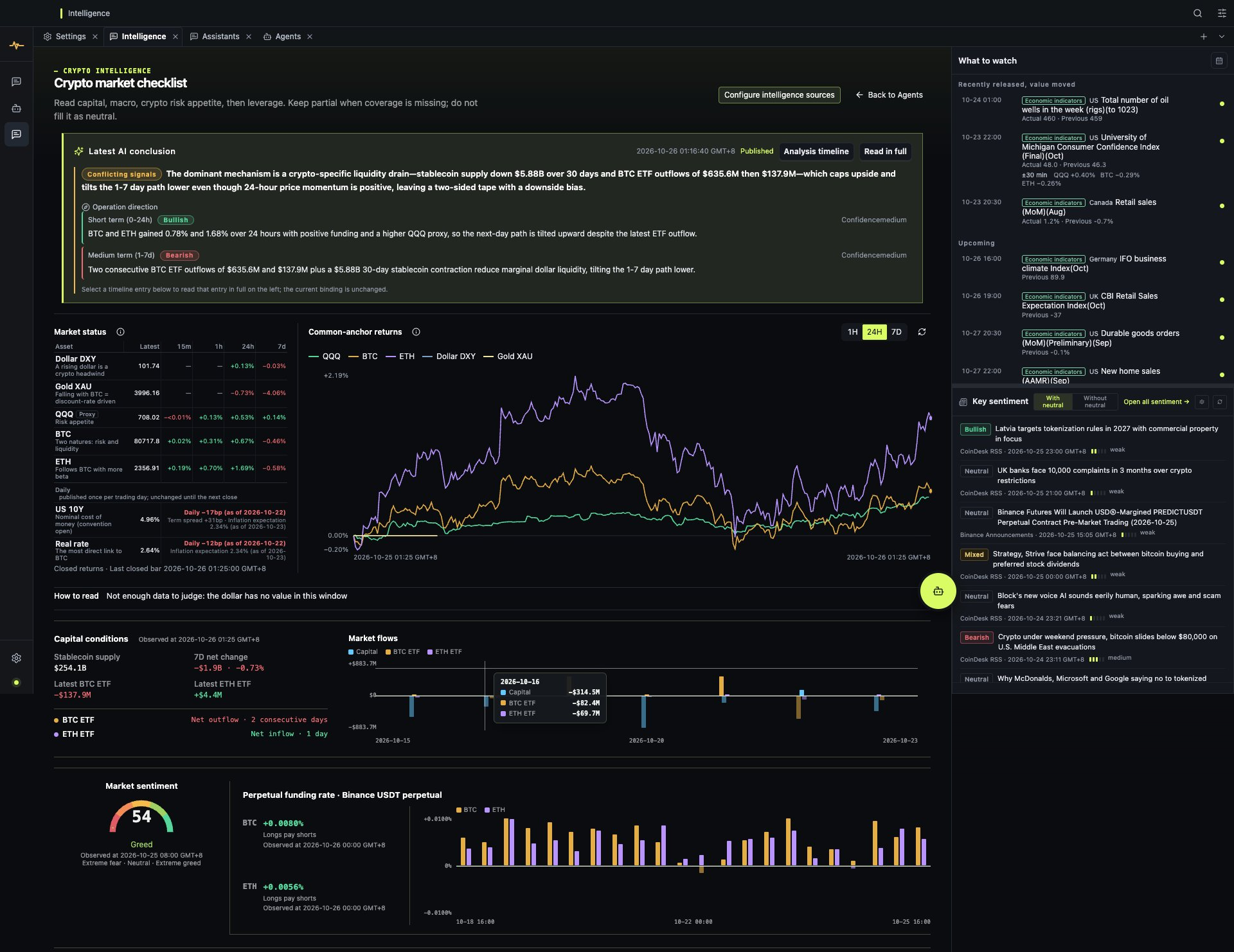
The desk behind the page — conclusion, market status, cross-asset returns, capital conditions, sentiment and funding, with the policy path, calendar and sentiment in the right column..
- Funding and positioning. BTC and ETH perpetual funding, who pays whom, and the history behind today's print instead of a single number.
- Capital and flows. Stablecoin supply and ETF net flows — the liquidity that has to be somewhere.
- Risk appetite. The Fear & Greed index read as evidence, with its observation time and bucket, not as a verdict.
- Cross-asset, one scale. DXY, gold, QQQ, US10Y, BTC and ETH normalized on a single chart.
- A calendar that does not rewrite history. Scheduled, observed, and later-revised values are separate records — FOMC, CPI, PCE and payrolls with their official release values.
- Venue and chain events. Binance and OKX announcements and API changes, plus Coinbase, Kraken and Solana status.
- An analyst with a visible trace. It reads the same evidence, separates facts from assumptions, asks a structured question when a choice changes the answer, and shows the tools it ran.
Reading it teaches you the market
Most crypto tools assume you already know why funding matters. Here the explanation sits next to the number: the key readings carry a plain-language note about what they mean, and every conclusion spells out the causal chain, the conditions that would break it, and the gaps.
That is the part a newcomer usually has to assemble from ten threads and a group chat: what moved price, through which channel, and what would prove it wrong. Read a few of those and the market stops being a black box — you are no longer memorising indicators, you are watching cause and effect with the receipts attached. One reading gives you a number; the next tells you the channel it works through — after a few, you can explain the move yourself.
It is not a course, and it is not advice. It is a desk that lays out its reasoning every time you open it.
How a complete answer looks
Every analysis separates five things, or it is incomplete:
| Element | What it means |
|---|---|
| Facts | Observed values, each tied to a source record |
| Assumptions | What the interpretation takes for granted |
| Conditions | What would invalidate the conclusion |
| Gaps | What the available evidence does not answer |
| Time boundary | The observation time, and the asOf cutoff the query used |
A later revision is not folded back into an earlier answer. Reading the market at 09:00 and reading it at 21:00 should produce two different, defensible answers — not one answer silently rewritten.
What it is not
- Not a signal service. No buy or sell calls, no return promises, no "alpha" for sale.
- Not a charting or entry-timing tool. No candles, no price targets, no buy/sell levels, no chip distribution, no order flow. It does not replace the chart you already read — it tells you what happened behind it.
- Not a trading bot. No order execution, no position management, no brokerage connection.
- Not a hosted account. No MacroBay server holds your data or your keys; there is nothing to sign up for and nothing to cancel.
- Not a data bundle. No bundled feeds and no bundled credentials — you enable the sources you have access to.
Data sources
Curated sources across crypto-native, market data, news and the macro layer, chosen because crypto is where free and low-cost data is actually good enough: exchange announcements and API changes (Binance, OKX), venue, chain status and release feeds (Coinbase, Kraken, Solana, GitHub releases), market data (Binance spot and futures, CoinGecko, DeFiLlama stablecoins and TVL, ETF flows, Fear & Greed), news (mainstream industry media and project official blogs, each enabled in settings as needed), and the macro layer that sets the regime (FRED, SEC, CFTC, Federal Reserve, plus the official BLS, BEA and Fed release schedules behind the calendar).
Some sources need your own account, key, or network access, and coverage varies by source. Anything you have not enabled appears as an explicit gap — never as a neutral placeholder value.
Quick start
Prefer a build? Grab a release. To run from
source you need Node.js 22+ and pnpm 10; to build the package yourself, use pnpm dist:mac
(see Packaging).
pnpm install
pnpm dev
Full walkthrough: Quick start.
- Settings → Model Service: add a provider and API key, enable it, and choose the default model for agents.
- Settings → Intelligence Sources: enable the sources you have access to and add any required credentials.
- Open Intelligence in the sidebar: it lands on the crypto dashboard.
- Ask the analyst: What changed in the last macro release, and which assets does it affect?
The answer should show what is known, what is missing, where the evidence came from, and the time boundary it used.
Status
MacroBay is alpha (0.4.3). macOS is the verified platform. Panels still need your own provider
credentials; anything that cannot be read is reported as a gap. The macOS .dmg is unsigned;
Windows installers build in CI and on Windows 11 x64 hardware, but the installed app is not verified
there yet, and Linux has no packaging. See Status and limitations.
Roadmap
Crypto depth comes first: more venues and derivatives coverage, ETF and flow history, on-chain signals, and event-driven alerts. Review and replay make a decision inspectable after the fact. The runtime stays model- and agent-replaceable so the desk can deepen without becoming a monolith. See ROADMAP.md.
Documentation
| Start | Understand the product | Build on it |
|---|---|---|
| Quick start | Product overview | Architecture |
| Installation | Analysis workflow | Development setup |
| First run | Traceability | Adding a product |
| Model service | Analyst agent | Platform and products |
| Status and limitations | — | — |
Chinese documentation: docs/README.zh-CN.md
Data and privacy
MacroBay is a client for providers you configure. The MIT license covers the code, not the data. There is no MacroBay-hosted data service, no resale, and no proxy: your data stays on your machine and credentials stay in the local secret store. You are responsible for provider terms, keys, rate limits, and any commercial use.
Feedback
Questions about setup, data sources or proxies belong in Q&A: ask there rather than in an issue. Bugs and concrete feature requests go through the issue templates.
Early feedback shapes the roadmap directly: what gets added, and what gets dropped.
Contributing
Electron 41 · React 19 · TypeScript 5.8 · pnpm 10. Local AI development notes may live in
AGENTS.md; that file is not part of the public repository.
License
MIT © 2026 MacroBay contributors