
redai-studio/Relax has 679 GitHub stars and 209 forks. GitHot measured 0 stars in 24 hours and +3 in 7 days. Last checked 2026-11-24 13:53 UTC. Last push 2026-11-23.
What you can do
- 🌐 Full Omni-Modal Training — One unified framework for text, vision, and audio RL — one of the few systems capable of end-to-end Omni model (Qwen3-Omni) post-training
- ⚙️ Service-Oriented Six-Layer Architecture — Every role is an independent Ray Serve deployment, with native service-level elastic scheduling and fault recovery
- ⚡ Fully Async via TransferQueue — Rollout, Actor, ActorFwd, Reference, and Advantages run on independent GPU clusters with streaming data exchange and configurable staleness
- 🔁 Hybrid Mode — Separate Actor/Rollout placement groups with TransferQueue streaming, while ref / actor_fwd / advantages run in-process on the actor — pairs --balance-data with sub-batched forward to minimize GPU waste
Measured star growth
- in 24h
- 0
- in 7 days
- +3
- in 15 days
- Collecting history
- in 1 month
- Collecting history
Net star changes over overlapping periods, not daily totals. Missing measurements are left blank. Stars measure attention, not software quality.
About
An Asynchronous Reinforcement Learning Engine for Omni-Modal Post-Training at Scale
LearningREADME.md
OriginalRelax: An Asynchronous Reinforcement Learning Engine for Omni-Modal Post-Training at Scale
Towards Async, Omni-Modal RL at Scale, Just Relax.





Relax (Reinforcement Engine Leveraging Agentic X-modality) is a high-performance reinforcement learning post-training framework open-sourced by the Xiaohongshu AI Infra Team for multimodal large language models. Built on Ray Serve with a service-oriented architecture, Relax uses Megatron-LM as the training backend and SGLang as the inference engine. Through the TransferQueue data transfer system, it achieves complete decoupling of training and inference, supporting end-to-end multimodal RL training from text to images, videos, and audio.
✨ Highlights
- 🌐 Full Omni-Modal Training — One unified framework for text, vision, and audio RL — one of the few systems capable of end-to-end Omni model (Qwen3-Omni) post-training
- ⚙️ Service-Oriented Six-Layer Architecture — Every role is an independent Ray Serve deployment, with native service-level elastic scheduling and fault recovery
- ⚡ Fully Async via TransferQueue — Rollout, Actor, ActorFwd, Reference, and Advantages run on independent GPU clusters with streaming data exchange and configurable staleness
- 🔁 Hybrid Mode — Separate Actor/Rollout placement groups with TransferQueue streaming, while ref / actor_fwd / advantages run in-process on the actor — pairs
--balance-datawith sub-batched forward to minimize GPU waste - 🤖 Agentic RL — Multi-turn interaction, loss masking, flexible termination, and VLM multimodal context carry-over for closed-loop "execute → observe → decide" training
- 🔀 Elastic Rollout Scaling — Dynamically grow/shrink inference engines mid-training via HTTP REST API, with same-cluster (
ray_native) and cross-cluster (external) federation modes - 🧠 Rich Algorithm Suite — PPO, GRPO, M2PO, RLOO, REINFORCE++ variants, GSPO, SAPO, CISPO, and On-Policy Distillation out of the box, with pluggable rewards and built-in GenRM (LLM-as-judge) mode
- 🚀 Megatron + SGLang Backends — Megatron-LM (TP/PP/CP/EP) for MoE and deep models, SGLang for high-throughput inference, DCS for NCCL-broadcast weight sync
- 📦 Production-Ready Ops — HealthManager auto-recovery, centralized Metrics Service (WandB / TensorBoard / ClearML), and Apprise real-time notifications
📢 News
| 📣 Updates |
|---|
| [08/20/2026] 🧠 Added M2PO, RLOO, and two REINFORCE++ variants, with runnable RLOO and REINFORCE++ recipes plus an Algorithm Reference covering all four. |
| [08/19/2026] 🤖 Added multi-agent training with multi-context trajectory export and a Search-R1 reference recipe. |
| [08/18/2026] 🪶 LoRA RL now supports MoE models in both adapter and merge workflows. See the LoRA Training Guide. |
[05/26/2026] 🔁 New Hybrid execution mode — streaming data + in-process ref/actor_fwd, with --balance-data support. See the Hybrid Training Guide. |
| [05/11/2026] 🚀 Support for Qwen3.6 series models (text + VLM)! |
| [04/15/2026] 🎉 Relax is now open-source! |
🏗️ Architecture
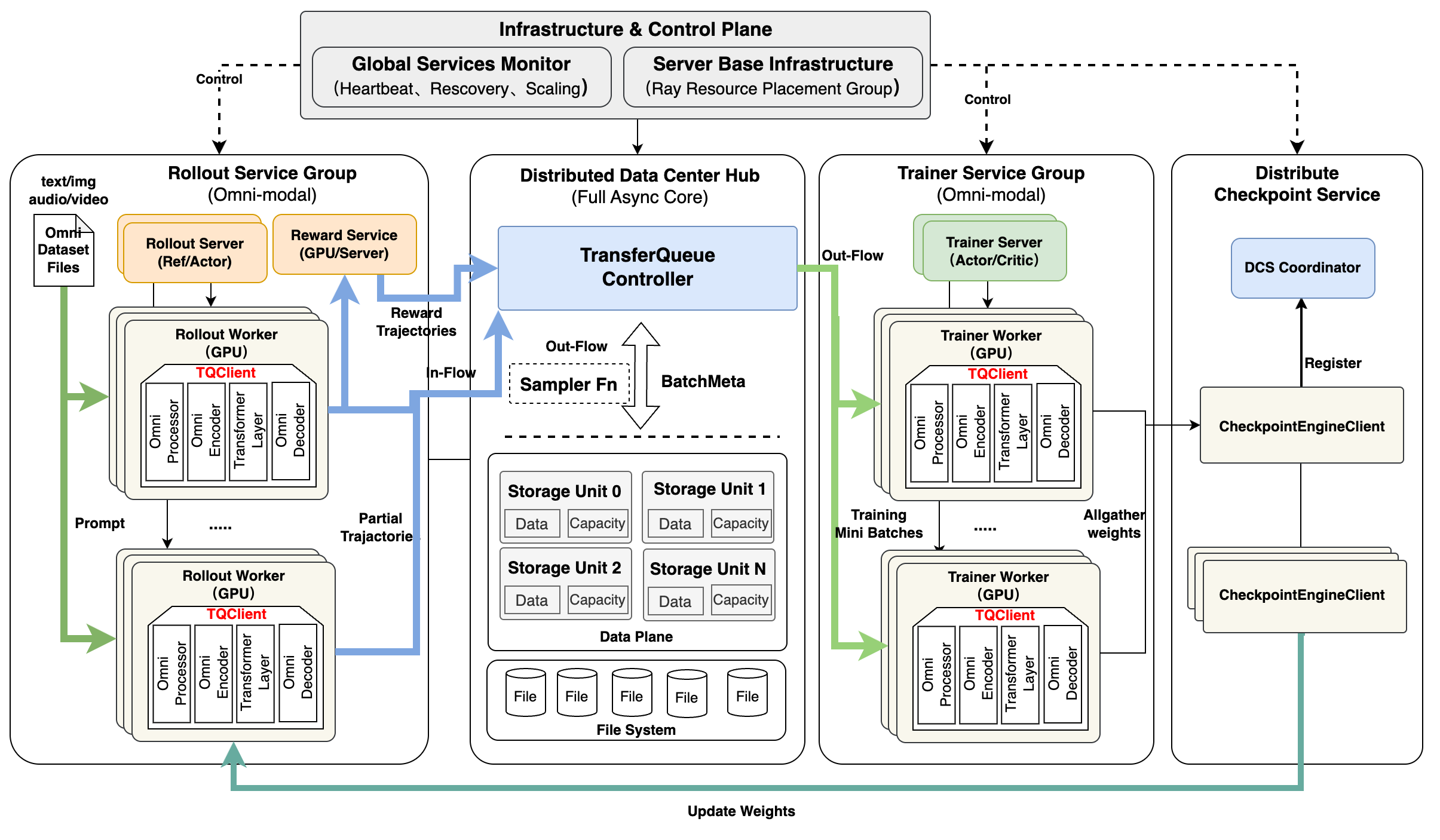
Relax adopts a six-layer service-oriented architecture where every role is deployed as an independent Ray Serve deployment, cleanly separating orchestration, components, engines, backends, and distributed capabilities:
| Layer | Responsibility |
|---|---|
| Entrypoints | train.py — signal handling, CLI parsing, Ray cluster connection, Controller launch |
| Orchestration | Controller (training loop, global restart), Service (placement groups, lifecycle), Registry (role & algorithm mapping) |
| Components | Ray Serve deployments: Actor, Rollout, Critic, ActorFwd, Advantages, GenRM |
| Engine | SGLang rollout engine, pluggable reward functions, request router, data filters |
| Backends | Megatron-LM training backend (TP/PP/CP/EP) and SGLang inference engine |
| Distributed | Ray Actor groups (RolloutManager / GenRMManager) and DCS (Distributed Checkpoint Service) for NCCL/GLOO weight sync |
Three execution modes are supported:
- Colocate (Sync) — Actor and Rollout time-share the same GPUs; Rollout writes a full batch to TransferQueue, then yields GPUs for training. Memory-efficient for constrained hardware and strict on-policy (
max_staleness=0). - Fully Async — Actor, Rollout, ActorFwd, Reference, and Advantages run on independent GPU clusters in parallel, exchanging data through TransferQueue and syncing weights asynchronously through DCS for maximum throughput with configurable staleness.
- Hybrid — Actor and Rollout sit on separate GPU placement groups (like Fully Async) and exchange data via TransferQueue with configurable staleness, but ref / actor_fwd / advantages run in-process on the actor's own GPUs via
TensorBackuper+_switch_model(like Colocate). Enables streaming pipelines plus--balance-datawithout paying for standalone ref/actor_fwd services.
📖 Learn more: Architecture Guide · Fully Async Training · Hybrid Training · Elastic Rollout Scaling
🧠 Supported Algorithms
| Algorithm | Type | Description |
|---|---|---|
| PPO | Actor-Critic | Proximal Policy Optimization |
| GRPO | Policy Optimization | Group Relative Policy Optimization |
| M2PO | Policy Optimization | Second-Moment Trust Policy Optimization |
| RLOO | Policy Optimization | REINFORCE Leave-One-Out |
| REINFORCE++ | Policy Optimization | Token KL-to-go with global normalization |
| REINFORCE++-baseline | Policy Optimization | Group-baseline REINFORCE++ variant |
| GSPO | Policy Optimization | Group-wise Sequence-level Policy Optimization |
| SAPO | Policy Optimization | Soft Adaptive Policy Optimization |
| CISPO | Policy Optimization | Clipped Importance-ratio Soft Policy Optimization |
| On-Policy Distillation | Knowledge Transfer | Teacher-student KL penalty distillation |
📖 See the Algorithm Reference for objectives, recipes, and execution-mode constraints.
🤖 Supported Models
Relax is designed for omni-modal RL training — text, vision, and audio in one unified framework. Multimodal data is configured via the --multimodal-keys flag, with complete image/video/audio processing pipelines under relax/utils/multimodal/ for fine-grained control over image token counts, video frame sampling, and audio sample rates.
| Model Family | Sizes | Modality | Typical Tasks | Backend |
|---|---|---|---|---|
| Qwen3 | 4B, 30B-A3B (MoE) | Text | Math reasoning, code, multi-turn dialogue, tool use | Megatron |
| Qwen3-VL | 4B, 30B-A3B | Vision + Language | Visual QA, image understanding, multimodal reasoning | Megatron |
| Qwen3.5 | 4B, 9B, 27B, 35B-A3B, 122B-A10B, 397B-A17B | Text + Vision | Reasoning, SFT, visual QA, multimodal reasoning | Megatron |
| Qwen3-Omni | 30B-A3B | Text + Vision + Audio | Audio-visual QA, omni-modal understanding | Megatron |
| Qwen3.6 | 27B, 35B-A3B | Text + Vision | Reasoning, visual QA, multimodal reasoning | Megatron |
| Qwen3.8 | 27B | Text + Vision | Reasoning, SFT, visual QA, multimodal reasoning | Megatron |
| GLM5 | 744B-A40B (MoE) | Text | Math reasoning, code, multi-turn dialogue | Megatron |
| Kimi K2.6 | ~1T-A32B (MoE) | Vision + Language | Visual QA, multimodal reasoning; INT4 QAT training | Megatron |
| Kimi K3 | ~2.78T (MoE) | Vision + Language | Full-parameter / LoRA SFT, GRPO, HF export | Megatron |
| dots.mocr | 3B | Vision + Language | OCR, document understanding, multimodal reasoning | Megatron |
📖 New architectures are integrated through Megatron Bridge; see the External Model Integration Guide for the rollout, training, and weight-conversion hooks.
📦 Installation
The recommended way to run Relax is via the official Docker image, which ships with all CUDA, PyTorch, Megatron-LM, SGLang, and Ray dependencies pre-installed and version-matched.
# Pull the official image
docker pull ghcr.io/redai-studio/relaxrl:latest

# Launch a container with GPUs, shared memory, and your workspace mounted
docker run -it --gpus all --ipc=host --network=host \
  -v /path/to/your/workspace:/root \
  ghcr.io/redai-studio/relaxrl:latest bash

# Inside the container
git clone https://github.com/redai-studio/Relax.git /root/Relax
cd /root/Relax && pip install -e .
📖 For GPU driver requirements, multi-node setup, and persistent storage mounts, see the Installation Guide.
🚀 Quick Start
Three end-to-end tasks cover text, vision-language, and omni-modal training. Each task downloads a public HuggingFace dataset and model, then launches training with a single script. Set EXP_DIR=/root (or wherever your models and datasets live) and the scripts will locate them automatically.
Task 1 — DAPO Math (Text, 8 GPUs)
Train Qwen3-4B on dapo-math-17k with GRPO. Reward is rule-based answer extraction plus symbolic math verification.
hf download --repo-type dataset zhuzilin/dapo-math-17k --local-dir /root/dapo-math-17k
hf download Qwen/Qwen3-4B --local-dir /root/Qwen3-4B

cd /root/Relax && export EXP_DIR=/root
bash scripts/training/text/run-qwen3-4B-8xgpu.sh
Task 2 — Open-R1 (Vision-Language, 8 GPUs)
Train Qwen3-VL-4B on multimodal-open-r1-8k-verified with GRPO using the openr1mm reward.
hf download --repo-type dataset lmms-lab/multimodal-open-r1-8k-verified \
  --local-dir /root/multimodal-open-r1-8k-verified
hf download Qwen/Qwen3-VL-4B-Instruct --local-dir /root/Qwen3-VL-4B-Instruct

cd /root/Relax && export EXP_DIR=/root
bash scripts/training/multimodal/run-qwen3-vl-4B-8xgpu.sh
Task 3 — AVQA (Omni-Modal: Image + Audio, 16 GPUs / 2 nodes)
Train Qwen3-Omni-30B-A3B on AVQA-R1-6K with GRPO and a multiple-choice reward.
hf download --repo-type dataset harryhsing/AVQA-R1-6K --local-dir /root/AVQA-R1-6K
hf download Qwen/Qwen3-Omni-30B-A3B-Instruct --local-dir /root/Qwen3-Omni-30B-A3B-Instruct

cd /root/Relax && export EXP_DIR=/root
bash -x scripts/entrypoint/spmd-multinode.sh \
  scripts/training/multimodal/run-qwen3-30B-A3B-omni-16xgpu.sh
Once running, you should see logs like:
Finish rollout 0/200
training step 0/200
Checkpoints are saved in Megatron DCP format; convert them to HuggingFace weights with scripts/tools/convert_torch_dist_to_hf_bridge.py.
📖 Full walkthrough: Quick Start Guide · Customize Training · Configuration Guide
⚡ Key Features
Fully Async Training via TransferQueue
In fully-async mode, Rollout, Actor, ActorFwd, Reference, and Advantages run on independent GPU clusters in parallel. Three mechanisms make this efficient:
- StreamingDataLoader — Actor begins consuming samples as Rollout incrementally writes them to TransferQueue, eliminating GPU idle time between phases.
- Configurable staleness —
--max-stalenessprecisely controls how off-policy training data can drift, flexibly balancing on-policy accuracy and throughput. - DCS weight sync — After each training step, weights are NCCL-broadcast from Actor to Rollout/ActorFwd/Reference via the Distributed Checkpoint Service, overlapped with the next training computation.
Agentic RL
Relax provides first-class support for multi-turn, closed-loop "execute → observe → decide" training:
- Multi-turn sampling with loss masking — model outputs (mask=1) are cleanly separated from environment observations (mask=0) so only model actions participate in training.
- Environment / Rollout decoupling — a standard
BaseInteractionEnvinterface (reset,step,format_observation) lets environments evolve independently of the sampler. - VLM multimodal context carry-over —
image_dataon the Rollout side andmultimodal_train_inputson the training side are incrementally merged each turn so visual observations concatenate correctly. - Flexible termination — combine
max_turns, token-budget exhaustion, and env-signalleddone. The DeepEyes example demonstrates Agentic multi-turn GRPO with Qwen3-VL-30B-A3B.
Elastic Rollout Scaling
Since 60–70% of RL training time is spent in the Rollout phase, Relax exposes HTTP REST APIs to dynamically add or remove inference engines mid-training without interrupting the training loop:
ray_nativemode — specify a target engine count; Relax allocates resources and launches new SGLang engines inside the current Ray cluster.externalmode — register SGLang engines already deployed in other clusters for cross-cluster federated inference on preemptible or idle resources.
Scaling is asynchronous, idempotent, mutually exclusive, and supports graceful drain-and-remove plus cancellation with rollback. Engines from startup parameters are protected; only dynamically added engines can be scaled in.
Megatron Training Backend & SGLang Inference
Training uses Megatron-LM with full Tensor / Pipeline / Context / Expert parallelism for MoE and ultra-deep models. Inference uses SGLang with process-lifecycle management. New model architectures plug in through Megatron Bridge for automatic HF ↔ Megatron weight conversion.
Pluggable Reward Hub
Built-in rewards for math (DeepScaler, DAPO), GPQA, F1, IFBench, multiple-choice, multimodal Open-R1, and GenRM (generative LLM-as-judge). Add a custom reward by dropping a single file into relax/engine/rewards/.
Production Operations
- HealthManager — heartbeat monitoring with two-tier auto-recovery (in-place restart first, global restart as fallback).
- Metrics Service — centralized Ray Serve deployment that fans out to TensorBoard, WandB, and ClearML.
- Notifications — real-time training alerts via Apprise (Slack, WeChat, email, and more).
📚 Documentation
Full bilingual documentation is available at redai-studio.github.io/Relax.
🧪 Examples
| Example | Description |
|---|---|
| Algorithm Recipes | RLOO, REINFORCE++, CISPO, and related policy optimizers |
| DeepEyes | Multi-modal vision-language RL with Qwen3-VL |
| Search-R1 | Search-augmented single-agent and multi-agent RL |
| Mini-SWE-Agent | Agentic RL for software-engineering tasks |
| NeMo Gym Agentic | Agentic environment integrations and runnable recipes |
| On-Policy Distillation | Teacher-student knowledge distillation via KL penalty |
🧩 Projects Built upon Relax
| Project | Description |
|---|---|
| HyperEyes | A parallel multimodal search agent that uses Relax for efficient RL training, combining visual grounding and retrieval to search across multiple entities concurrently. |
| Iris | An open-weight search agent family post-trained with Relax from Qwen3.5/3.6, designed for long-horizon search, iterative evidence gathering, and context management. |
🤝 Contributing
We welcome contributions of all kinds! Please read our Contributing Guide to get started.
🛠️ AI Coding Skills
Relax ships a set of Claude Code slash-command skills under skills/ to accelerate development and operations. Invoke them in Claude Code with /skill-name.
| Skill | Description |
|---|---|
/code-review |
Expert review of git changes — SOLID violations, security risks, ML/distributed training issues |
/debug-hang |
Automatically diagnose Ray distributed training hangs — collects call stacks and actor states |
/dev |
Develop and debug Relax code; submit and monitor jobs on a remote Ray cluster |
/doc-writer |
Write and maintain bilingual (English + Chinese) VitePress documentation |
/git-commit |
Create Conventional Commits with rich markdown body and auto-run pre-commit hooks |
/model-integration |
Step-by-step guide for integrating new model architectures into the training pipeline |
/perf-doctor |
Audit training launch scripts for performance and GPU memory misconfiguration |
/ssh-ray-cluster |
SSH into a remote Ray cluster head node to inspect status, logs, and debug jobs |
/verl-to-relax |
Migrate RL recipes from verl to Relax (rewards, tool envs, launch scripts) |
/creating-skills |
Guide for authoring new Claude Code skills following Anthropic best practices |
📝 Citation
If you find Relax useful in your research, please cite:
@software{relax2026,
  title  = {Relax: An Asynchronous Reinforcement Learning Engine for Omni-Modal Post-Training at Scale},
  author = {Relax Contributors},
  url    = {https://arxiv.org/abs/2604.11554},
  year   = {2026}
}
📜 License
This project is licensed under the Apache License 2.0.
🙏 Acknowledgements
Relax is built upon the shoulders of excellent open-source projects:
- Slime — Scalable training and inference framework for reinforcement learning
- SGLang — Fast serving framework for large language models
- Megatron-LM & Megatron-Bridge — Large-scale distributed training framework and HF ↔ Megatron weight conversion bridge, with sincere thanks to the entire NVIDIA team
- TransferQueue — High-performance distributed data transfer queue
- Ray — Distributed computing framework
- HuggingFace Transformers — State-of-the-art model hub
We sincerely thank all contributors and the open-source community for making this project possible.
Explore related projects
Loading…