
ranahanocka/point2mesh
ranahanocka/point2mesh has 1,250 GitHub stars and 136 forks. GitHot measured 0 stars in 24 hours, 0 in 7 days, and +2 in 15 days. Last checked 2026-11-11 17:06 UTC. Last push 2023-11-03.
Reconstruct Watertight Meshes from Point Clouds [SIGGRAPH 2020]
Measured star growth
- in 24h
- 0
- in 7 days
- 0
- in 15 days
- +2
- in 1 month
- Collecting history
Net star changes over overlapping periods, not daily totals. Missing measurements are left blank. Stars measure attention, not software quality.
README.md
Original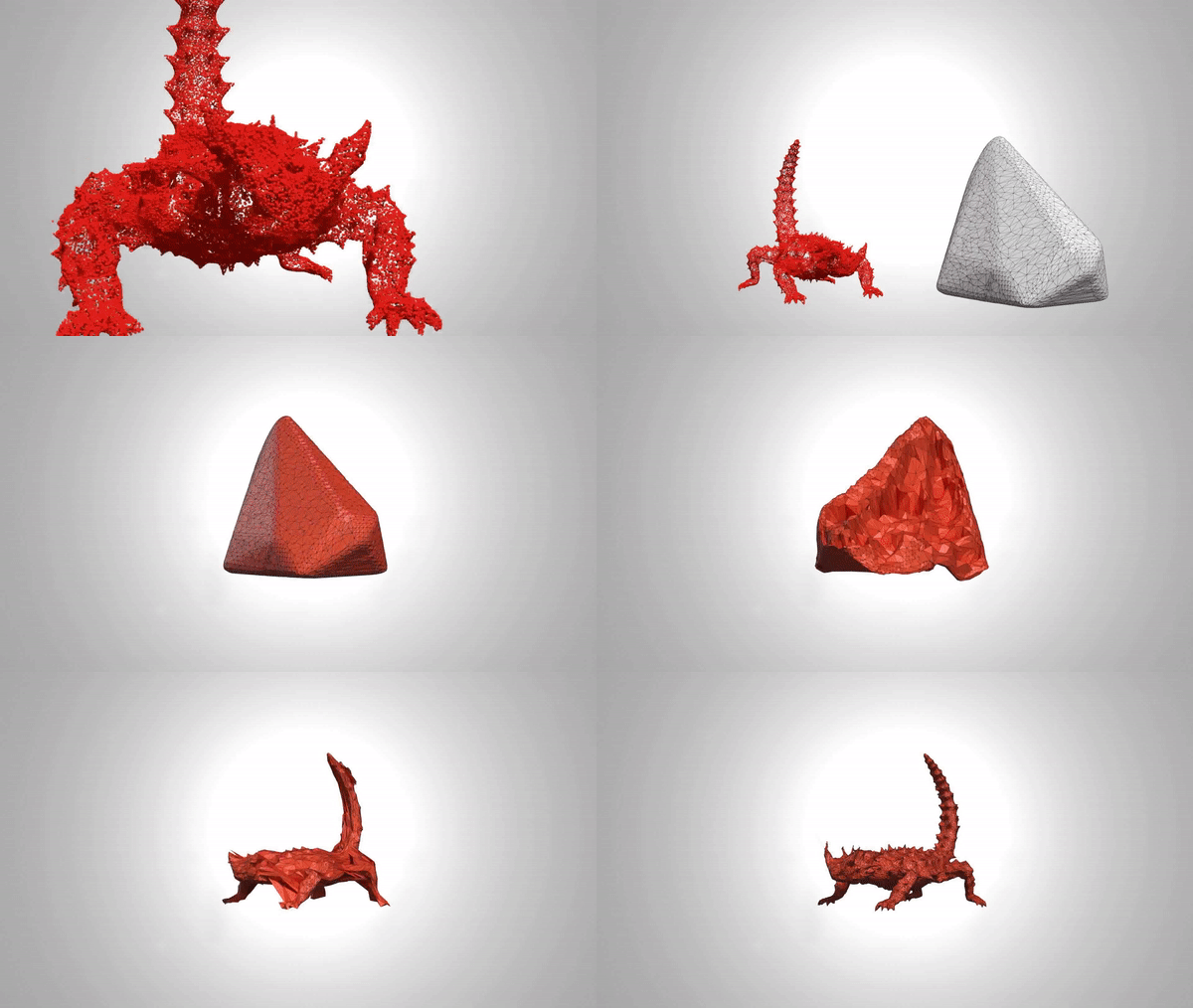
Point2Mesh in PyTorch
SIGGRAPH 2020 [Paper] [Project Page]
Point2Mesh is a technique for reconstructing a surface mesh from an input point cloud. This approach "learns" from a single object, by optimizing the weights of a CNN to deform some initial mesh to shrink-wrap the input point cloud. The argument for going this route is: since the (local) convolutional kernels are optimized globally across the entire shape, this encourages local-scale geometric self-similarity across the reconstructed shape surface.
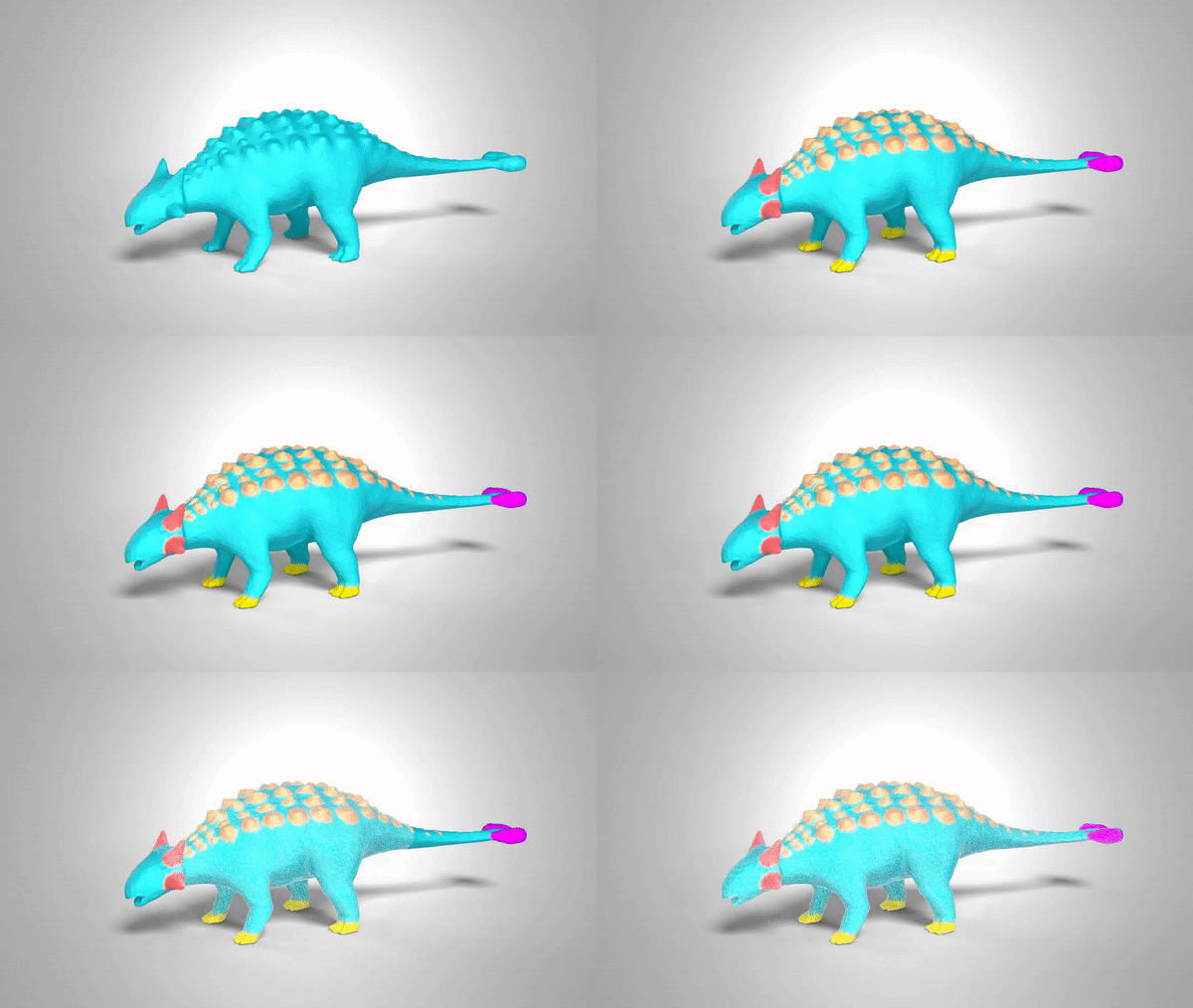
The code was written by Rana Hanocka and Gal Metzer.
Getting Started
Installation
- Clone this repo:
git clone https://github.com/ranahanocka/point2mesh.git
cd point2mesh
Setup Conda Environment
- Relies on PyTorch version 1.4 (or 1.5) and PyTorch3D version 0.2.0.
Install via conda environmentconda env create -f environment.yml(creates an environment called point2mesh)
Install "Manifold" Software
This code relies on the Robust Watertight Manifold Software.
First cd into the location you wish to install the software. For example, we used cd ~/code.
Then follow the installation instructions in the Watertight README.
If you installed Manifold in a different path than ~/code/Manifold/build, please update options.py accordingly (see this line)
Running Examples
Get Data
Download our example data
bash ./scripts/get_data.sh
Running Reconstruction
First, if using conda env first activate env e.g. source activate point2mesh.
All the scripts can be found in ./scripts/examples.
Here are a few examples:
Giraffe
bash ./scripts/examples/giraffe.sh
Bull
bash ./scripts/examples/bull.sh
Tiki
bash ./scripts/examples/tiki.sh
Noisy Guitar
bash ./scripts/examples/noisy_guitar.sh
... and more.
All the examples
To run all the examples in this repo:
bash ./scripts/run_all_examples.sh
Running different Examples
You should provide an initial mesh file. If the shape has genus 0, you can use the convex hull script provided in ./scripts/process_data/convex_hull.py
Citation
If you find this code useful, please consider citing our paper
@article{Hanocka2020p2m,
  title = {Point2Mesh: A Self-Prior for Deformable Meshes},
  author = {Hanocka, Rana and Metzer, Gal and Giryes, Raja and Cohen-Or, Daniel},
  year = {2020},
  issue_date = {July 2020},
  publisher = {Association for Computing Machinery},
  volume = {39},
  number = {4},
  issn = {0730-0301},
  url = {https://doi.org/10.1145/3386569.3392415},
  doi = {10.1145/3386569.3392415},
  journal = {ACM Trans. Graph.},
}
Questions / Issues
If you have questions or issues running this code, please open an issue.
Explore related projects
tensorflow/tensorflow
An Open Source Machine Learning Framework for Everyone
201,505 starshuggingface/transformers
🤗 Transformers: the model-definition framework for state-of-the-art machine learning models in text, vision, audio, and multimodal models, for both inference and training.
168,815 starsAUTOMATIC1111/stable-diffusion-webui
Stable Diffusion web UI
165,289 starsComfy-Org/ComfyUI
The most powerful and modular diffusion model GUI, api and backend with a graph/nodes interface. The fastest local inference engine in the world.
146,271 stars