
raimbekovm/cs231n-2025-notes
raimbekovm/cs231n-2025-notes has 43 GitHub stars and 5 forks. GitHot measured 0 stars in 24 hours and +1 in 7 days. Last checked 2026-11-11 03:33 UTC. Last push 2026-10-15.
CS231n notes, CS231n lecture notes — Stanford CS231n 2025: deep learning for computer vision notes
Measured star growth
- in 24h
- 0
- in 7 days
- +1
- in 15 days
- Update delayed
- in 1 month
- Update delayed
Net star changes over overlapping periods, not daily totals. Missing measurements are left blank. Stars measure attention, not software quality.
README.md
Original
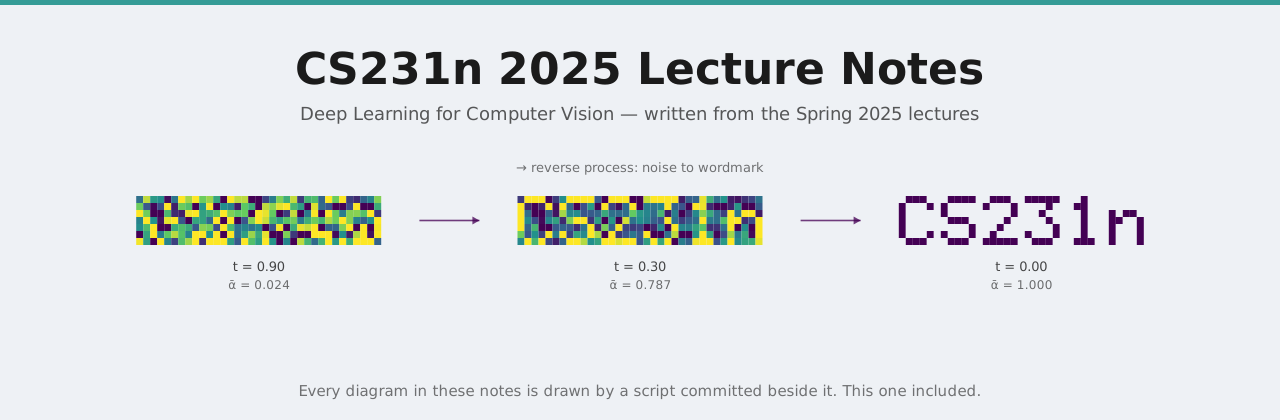
CS231n 2025 Lecture Notes
Free, in-depth lecture notes for Stanford CS231n: Deep Learning for Computer Vision (Spring 2025).
CNNs, RNNs, Transformers, object detection and segmentation — written to be read, not skimmed.
Read the notes online · Download the PDF · Start with Lecture 1



Lectures
| # | Lecture | What it covers |
|---|---|---|
| 1 | Introduction | Why vision is hard, Hubel and Wiesel, features and benchmarks, ImageNet and AlexNet in 2012 |
| 2 | Image Classification with Linear Classifiers | The semantic gap, k-nearest neighbours, validation, linear classifiers, softmax and multiclass SVM loss |
| 3 | Regularization and Optimization | L1 and L2 regularization, gradient descent, SGD, momentum, Adam and AdamW, learning-rate schedules |
| 4 | Neural Networks and Backpropagation | What a hidden layer buys you, activation functions, the chain rule on a computational graph, Jacobians |
| 5 | Convolutional Networks | The convolution layer, padding and stride arithmetic, receptive fields, pooling, equivariance |
| 6 | CNN Architectures | Batch normalization, dropout, VGG, ResNet and residual connections, initialization, transfer learning |
| 7 | Recurrent Neural Networks | Recurrence, backpropagation through time, character-level language models, vanishing gradients, LSTM |
| 8 | Attention and Transformers | Seq2seq attention, self-attention, multi-head attention, the transformer block, LLMs, Vision Transformers |
| 9 | Object Detection and Segmentation | Semantic segmentation, U-Net, R-CNN to Faster R-CNN to YOLO to DETR, Mask R-CNN, saliency maps and CAM |
| 10 | Video Understanding | Clip training, late and early fusion, 3D convolution, optical flow and two-stream nets, non-local blocks, I3D |
| 11 | Large-Scale Distributed Training | GPU and cluster hardware, data parallelism and FSDP, activation checkpointing, MFU, tensor, context and pipeline parallelism |
| 12 | Self-Supervised Learning | Pretext tasks, inpainting and colourisation, masked autoencoders, InfoNCE, SimCLR and MoCo, CPC, DINO |
| 13 | Generative Models I | Generative versus discriminative, maximum likelihood and the KL direction, autoregressive models and PixelRNN, autoencoders, the VAE and its ELBO |
| 14 | Generative Models II | GANs and the minimax game, rectified flow, classifier-free guidance, latent diffusion and DiT, the score and SDE views |
| 15 | 3D Vision | Explicit and implicit geometry, signed distance functions, MVCNN, voxels and octrees, PointNet, Chamfer and EMD, DeepSDF, NeRF, Gaussian splatting |
| 16 | Vision and Language | CLIP and zero-shot transfer, prompt ensembling, robustness under distribution shift, CoCa, bag-of-words limits, LLaVA and Flamingo, Molmo, SAM, visual programming |
| 17 | Robot Learning | Closed-loop control against open-loop recognition, credit assignment, compounding error and DAgger, learned dynamics and particle graphs, multimodal action distributions, vision-language-action models |
| 18 | Human-Centered AI | What the field is for, the contingency table under fairness and diagnosis, the impossibility of simultaneous fairness criteria, base rates and alarm burden, ambient intelligence and privacy-preserving optics |
That is the whole 2025 syllabus, start to finish.
Every lecture is also in the single-file PDF, and the site has full-text search, a dark theme, and numbered sections you can link to directly.
About these notes
Stanford's CS231n is the course a lot of people learned computer vision from, and its official notes stopped being updated in 2017 — before Vision Transformers, contrastive pretraining, latent diffusion and vision–language models.
These notes are written from the Spring 2025 lectures, not summarised from the old ones. Each chapter is self-contained prose with the derivations written out, so you do not need the video open in another tab, and every result links to the paper it came from.
This is an unofficial resource, not affiliated with Stanford University. For official course materials see cs231n.stanford.edu and the 2025 lecture videos.
Companion notes
CS229 2018 Lecture Notes — the same treatment for Stanford's Machine Learning course with Andrew Ng, Autumn 2018: linear models, SVMs and kernels, learning theory, EM, PCA and ICA, and reinforcement learning. A good place to start if you want the foundations these lectures assume.
Found a mistake?
Corrections are genuinely welcome. Every page has an Edit this page link at the bottom that opens a pull request from your browser; for anything larger, open an issue. CONTRIBUTING.md has the style guide.
Licence
The writing and the diagrams made for this project are MIT-licensed. Figures from research papers and lecture slides remain their authors' — per-figure provenance is in figures/SOURCES.md, and NOTICE.md has the full picture.
Build the site locally
The notes are a Quarto book: one .qmd per lecture in
lectures/, figures generated by scripts in figures/, and CI renders the site
and the PDF on every push to main.
quarto preview           # live-reloading site at localhost:4321
quarto render            # full build into _site/ (site + PDF; PDF needs LaTeX)
quarto render --to html  # site only — no LaTeX needed
To redraw a chapter's figures:
python3 figures/09-detection-segmentation/make_diagrams.py
Explore related projects
tensorflow/tensorflow
An Open Source Machine Learning Framework for Everyone
201,505 starshuggingface/transformers
🤗 Transformers: the model-definition framework for state-of-the-art machine learning models in text, vision, audio, and multimodal models, for both inference and training.
168,815 starsAUTOMATIC1111/stable-diffusion-webui
Stable Diffusion web UI
165,289 starsComfy-Org/ComfyUI
The most powerful and modular diffusion model GUI, api and backend with a graph/nodes interface. The fastest local inference engine in the world.
146,271 stars