
qsumm/TestOPS
qsumm/TestOPS has 32 GitHub stars and 0 forks. GitHot measured 0 stars in 24 hours. Last checked 2026-11-15 02:28 UTC. Last push 2026-11-12.
Measured star growth
- in 24h
- 0
- in 7 days
- Collecting history
- in 15 days
- Collecting history
- in 1 month
- Collecting history
Net star changes over overlapping periods, not daily totals. Missing measurements are left blank. Stars measure attention, not software quality.
About
TestOPS一站式AI运维平台 · By 一鸣(公众号:一鸣AI编程)
AIREADME.en.md
OriginalTestOPS · AI-Powered Ops Monitoring Platform
The alert fired. The AI already finished investigating. Here is the evidence chain.
An open-source, self-hosted AI ops monitoring platform: a pull-based Agent takes over host and service monitoring (zero inbound ports on monitored machines), alerts are converged into incidents, and a diagnosis Agent with an evidence chain investigates autonomously; remediation runs only from a fixed action allowlist and only after passing nine guardrails — the AI establishes the facts, the human keeps the decision.


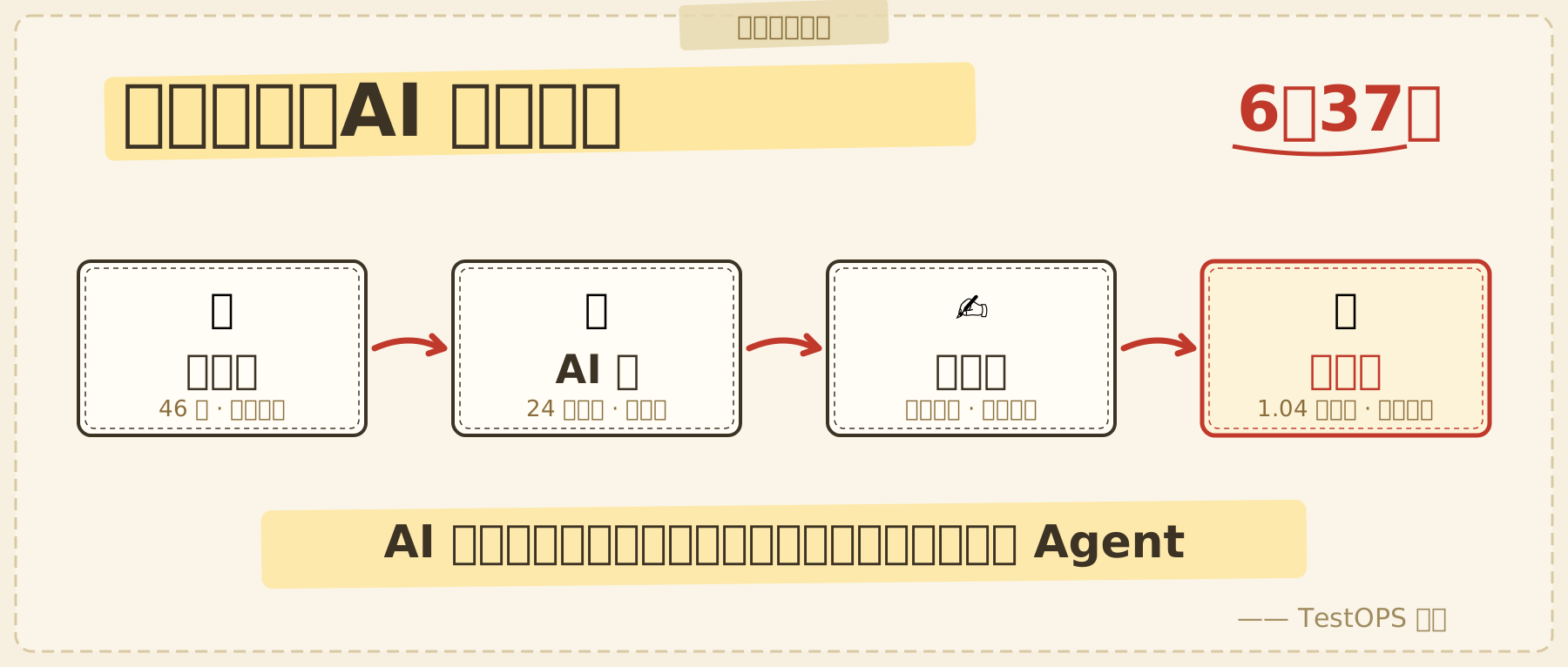
| 82 s | 10 min | 0 |
|---|---|---|
| alert refresh (3 probe types) | evidence-backed root cause report | inbound ports (pull-based Agent) |
All numbers above come from a real incident run, including the CONFIRMED verdict and the full audit trail.
git clone https://github.com/qsumm/TestOPS.git && cd TestOPS
cp backend/.env.example .env   # replace JWT_SECRET / KEY_STORE_SECRET / DB_PASSWORD with random values!
docker compose --env-file .env -f deploy/docker-compose.yaml up -d --build
First build takes about 2–4 minutes (heavy ML deps were removed from the base image; on a slow mirror it can still take much longer — see the build-acceleration guide shipped in
docs/04-交付与运营/自建部署加速指引.md). If GitHub is slow, use a clone accelerator — see Deployment.
Why this exists
Ever had that night: an alert fires, you SSH in, dig through logs, inspect processes, guess the cause — and half an hour later you realize you restarted a service that was never broken.
This platform hands that whole procedure to an AI — but not by letting the AI loose on your production box. The philosophy is written into the code:
The hard part of remediation is not "executing", it is "daring not to execute".
Core features
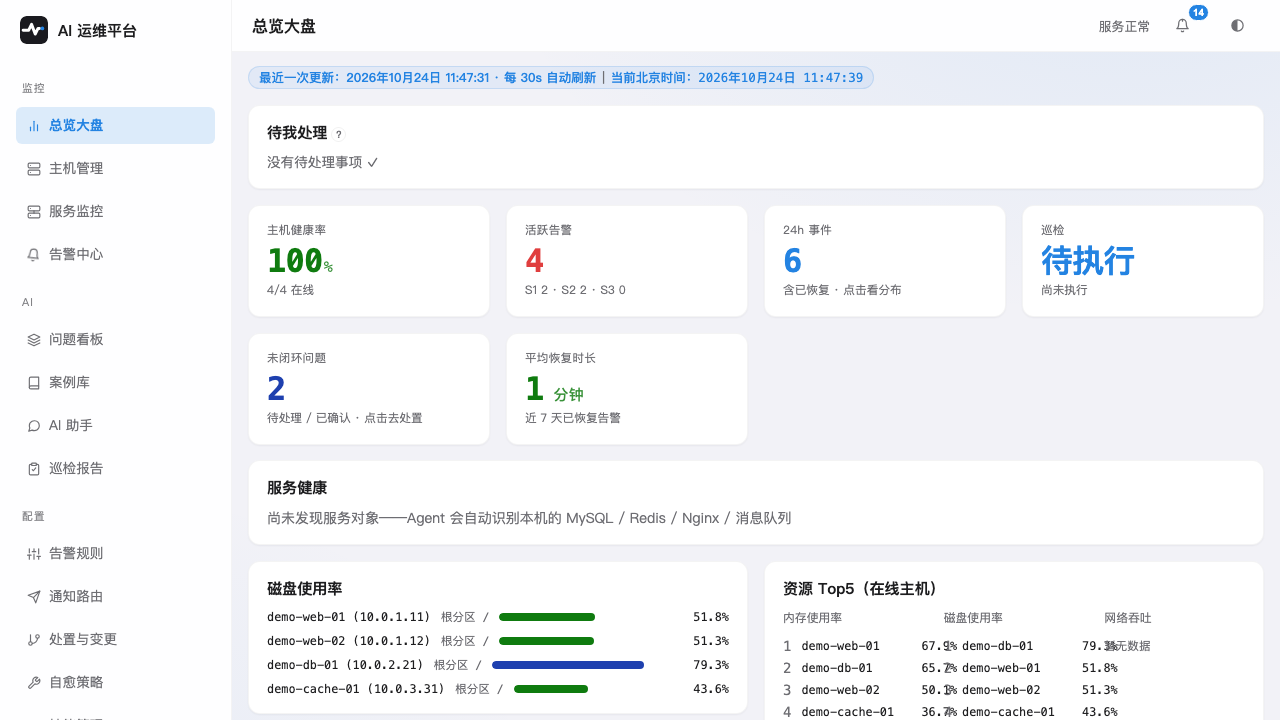
Monitoring — pull-based Agent onboarding (zero inbound ports on monitored hosts, no firewall / NAT / security-group changes) · four probe types (process / TCP / HTTP / certificate expiry) · multi-dimensional metric queries on demand · Prometheus data source · host and service health overview
Alerting — threshold / 3σ / isolation-forest algorithms · fingerprint deduplication (one fault becomes one incident, no alert storms) · silencing chains and maintenance windows · multi-channel notification (email / Webhook / voice call broadcast) · an immediate directional hint on every trigger
AI diagnosis — multi-step ReAct investigation (what to check next is decided by the previous result, every step recorded and replayable frame by frame) · conclusions must cite evidence (each claim links back to the step that produced it) · three confidence levels ("could not find out" is a legitimate conclusion) · explicit not_checked section · pluggable diagnosis skills (SKILL.md plugins, auto-loaded by alert, only pre-authorized read-only commands are executed)
Remediation — an allowlist of just 4 actions (restart service / restart container / reconnect pool / rotate logs) · nine guardrails for admission (read-only classification → denylist → allowlist → rate limit & circuit breaker → release-window mutual exclusion → refuse self-healing when upstream is unhealthy → human approval) · three execution modes (suggest only / manual confirm / allowlist auto) · mandatory post-check after execution, failures trip the circuit breaker · versioned change requests and a full operation audit trail
Accumulation & evaluation — closing an incident automatically distills a vectorized case card, so the next similar failure recalls "how we fixed it last time" · scheduled inspections produce daily health reports and open incidents for anomalies · a diagnosis evaluation loop: fault recording → replay, root-cause agreement / conflict / calibration scoring, version fingerprinting
Extensibility — full REST API + MCP integration, embeddable in your own toolchain
Six core design decisions
| Design | One line | |
|---|---|---|
 |
AI diagnosis with an evidence chain | Up to 30 steps, every thought / tool call / return recorded; conclusions must cite evidence — "could not find out" is a legitimate conclusion |
 |
Nine guardrails decide admission | Action allowlist (no free-text commands), rate limits, circuit breaker, release-window exclusion, refuse self-healing when upstream is unhealthy… fail any one and nothing may move |
 |
Pull-based channel punches through NAT | The Agent pulls outbound from the host, which opens no inbound port — works behind firewalls, NAT and cloud security groups with zero changes |
 |
Diagnosis skills are pluggable | A skill is just a SKILL.md file — auto-loaded when an alert matches, and the Agent may only run the read-only commands the skill pre-authorizes; one-click import from GitHub, with hit and adoption counts |
 |
The case library gets smarter with use | Every diagnosis is distilled into a vectorized case, so the next similar failure recalls "how we fixed it last time" |
 |
5-minute deployment | One compose command; vector search is built into the database — no extra Milvus / Pinecone |
What it does / does not do
Does: host and service monitoring, proactive alerting (multi-channel notification + voice broadcast), AI root-cause diagnosis (with an evidence chain), automatic skill routing for diagnosis (read-only authorized commands), allowlisted remediation actions (restart / reconnect / rotate logs), scheduled inspections, multi-dimensional metric queries, case accumulation.
Does not: replace your Prometheus (it sits behind it), unattended autonomy (the default execution mode requires human confirmation), or run any command outside the allowlist (an AI-proposed rm -rf is blocked at the very first guardrail).
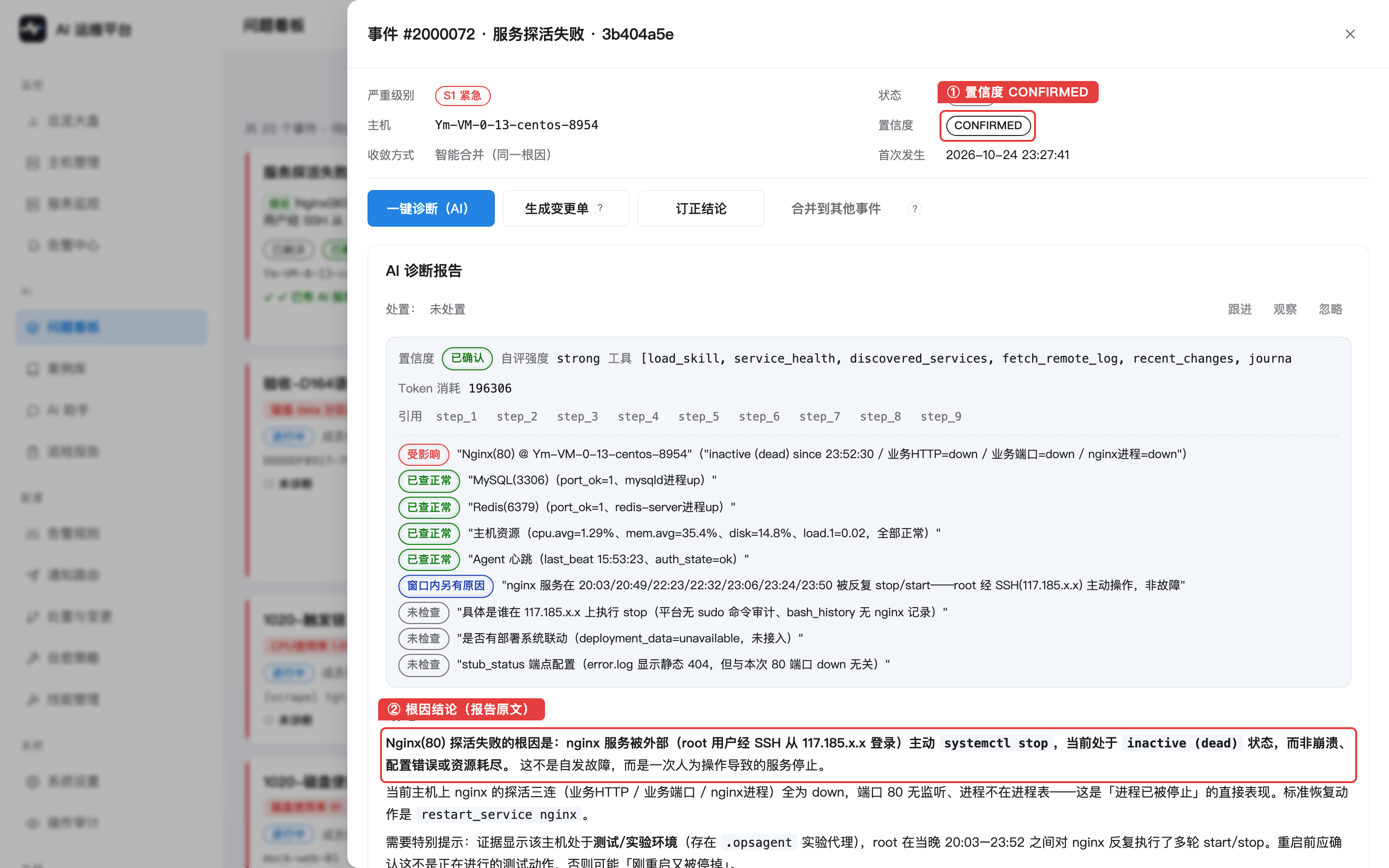
What a diagnosis report looks like
Every conclusion carries a step reference you can click back to the raw evidence, and anything it could not determine is listed explicitly in not_checked — "could not find out" is a legitimate conclusion:
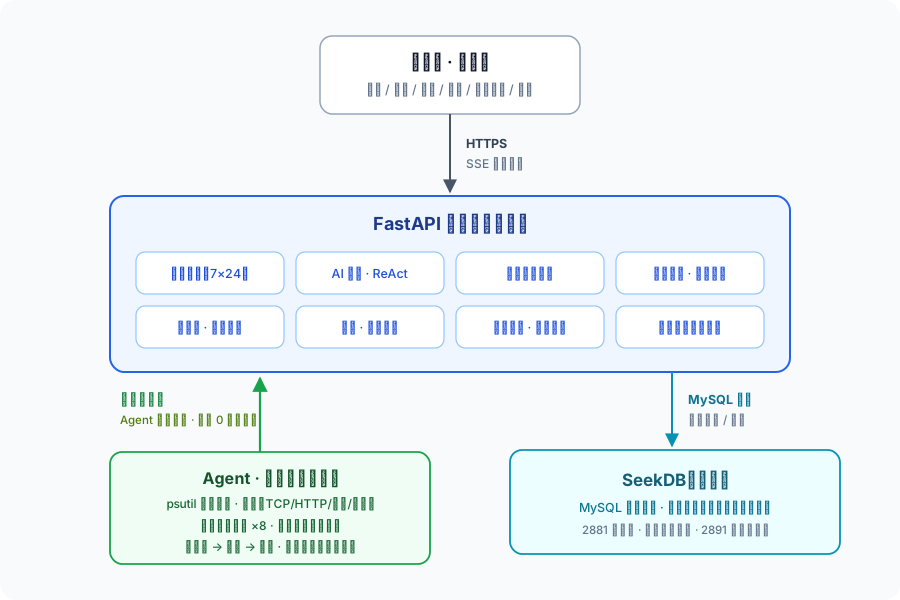
Architecture at a glance
The diagnosis loop (every step recorded end to end, replayable):
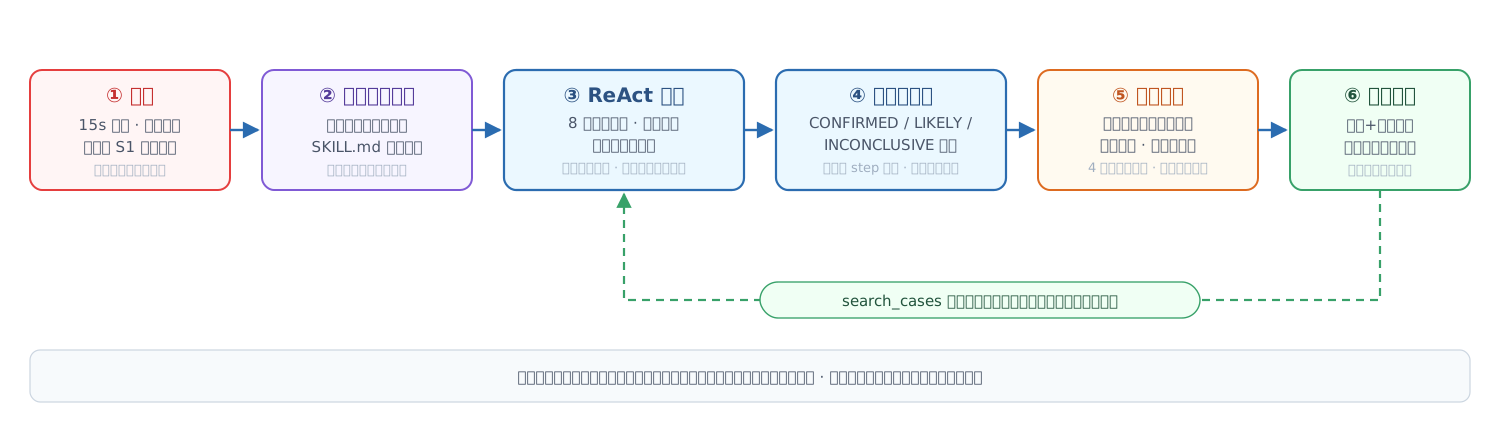
Deployment
Prerequisites
| Item | Requirement | Notes |
|---|---|---|
| Docker + Compose | Docker 20.10+, docker compose v2 |
docker compose version should print a version |
| Memory | 4GB recommended | Platform + database + two simulated hosts run together; 2GB gets OOM-killed |
| Disk | 10GB recommended | 820MB database image plus dependency layers |
| Ports | 8848 (platform), 2891 (database) | Change the ports mapping in deploy/docker-compose.yaml if taken |
| Network | The first build needs access to the image registry and pypi | China-friendly mirrors are the default; no VPN needed |
Deploy in three steps
git clone https://github.com/qsumm/TestOPS.git && cd TestOPS
cp backend/.env.example .env   # ① copy the env template
docker compose --env-file .env -f deploy/docker-compose.yaml up -d --build   # ② build and start
③ Generate and fill in three secrets (replace change-me-in-env and the empty DB_PASSWORD in .env):
python3 -c "import secrets;print(secrets.token_urlsafe(48))" # run three times: JWT_SECRET / KEY_STORE_SECRET / DB_PASSWORD
JWT_SECRET/KEY_STORE_SECRET: must be changed for any public deployment. The first signs login tokens; the second encrypts the LLM API keys you enter in the settings page before they hit the database — shipping the defaults is like hanging the key on the doorDB_PASSWORD: may stay empty for a local trial; required for public or multi-user use
After editing .env, run docker compose --env-file .env -f deploy/docker-compose.yaml up -d to apply.
Verify it works
curl http://127.0.0.1:8848/api/health      # expect {"code":0,...,"status":"up"}
docker ps                                   # all 4 containers should be Up / healthy
docker logs aiops-platform | grep -i "admin"   # the generated admin account is printed here on first start
Open http://127.0.0.1:8848 and log in with the account printed in the logs (change the password on first login). The platform is running at this point, but AI features still have no model — go to "Settings → LLM Configuration" and fill in an OpenAI-compatible endpoint (Base URL / API Key / model name). Monitoring, alerting, probing and inspection work without a model.
See it work right away
# seed 7 days of demo data (metrics + rules + historical incidents + case cards)
docker compose --env-file .env -f deploy/docker-compose.yaml exec platform \
    python scripts/seed_demo.py --days 7

# trigger a real fault (5 kinds: probe failure / CPU / disk / memory / process hang — one command each, auto recovery)
bash deploy/faults/cpu_spike.sh
Common issues
| Symptom | Cause and fix |
|---|---|
git clone times out / end of file |
GitHub access from mainland China is flaky; use an accelerator: git clone https://gh-proxy.com/https://github.com/qsumm/TestOPS.git |
Build hangs at apt-get |
Base image and pip already default to China mirrors; if it still hangs, switch APT_MIRROR / PIP_INDEX_URL in the Dockerfile back to the upstream sources |
Container keeps restarting (Restarting) |
Out of memory (4GB+ required), or the database is still initializing; check docker logs aiops-platform |
| Login says "invalid install token" | First-boot Agents need a one-time install token: generate one under "Hosts → Onboard a new host", put it in .env as AIOPS_INSTALL_TOKEN_1/_2, then docker compose ... up -d to recreate the agent containers |
| AI diagnosis says "model not configured" | "Settings → LLM Configuration" is empty or disabled; fill it in, then trigger a diagnosis |
| Port already in use | Change the 8848 / 2891 port mappings in deploy/docker-compose.yaml |
Data and teardown
docker compose --env-file .env -f deploy/docker-compose.yaml down      # stop services, keep data
docker compose --env-file .env -f deploy/docker-compose.yaml down -v   # also delete the data volume (irreversible)
Data lives in the Docker volume aiops-demo_seekdb-data (time-series metrics + incidents + cases); backing up means exporting that volume.
The full operation manual is not in this repository: follow the WeChat account「一鸣AI编程」and share the article to get it.
Comparison with open-source peers
| # | Capability | TestOPS (this project) | Nightingale | Keep | k8sgpt | HolmesGPT |
|---|---|---|---|---|---|---|
| 1 | Unified Agent collection (metrics + probes + resumable upload) | ✅ pull-based, 0 inbound ports | ✅ Categraf (push) | ❌ | ❌ | ❌ |
| 2 | Alert engine (fingerprint dedup + silencing chains + active windows) | ✅ | ✅ strong point | ◐ alert aggregation | ❌ | ❌ |
| 3 | Tiered notification + voice broadcast + routing | ✅ incl. tested voice calls | ◐ many channels | ✅ 100+ integrations | ❌ | ❌ |
| 4 | Two-level convergence into incidents (LLM causal merging) | ✅ | ◐ suppression / distribution | ✅ strong AI alert correlation | ❌ | ◐ single-alert analysis |
| 5 | AI root-cause diagnosis (ReAct evidence chain + skill routing) | ✅ | ◐ AI summaries (verified in source), RCA via ecosystem | ◐ AI enrichment / summaries | ✅ K8s objects only | ✅ strong point |
| 6 | Fixes validated before being recommended | ✅ | ❌ | ◐ workflows can self-validate | ◐ suggestions, not enforced | ◐ iterative, not normative |
| 7 | Allowlisted remediation + nine guardrails + three execution modes | ✅ one-time approval | ◐ self-heal scripts, no admission layer | ◐ workflow automation, no guardrails | ◐ K8s-layer auto repair | ❌ |
| 8 | Vector recall of past cases | ✅ built-in vector search | ❌ | ❌ | ❌ | ◐ history in commercial edition |
| 9 | Scheduled inspection + health digest + auto incident creation | ✅ | ❌ | ◐ assemble via workflows | ❌ | ❌ |
| 10 | Service-level monitoring + log forensics (time-window anchored to the alert) | ✅ | ◐ log data sources | ❌ | ❌ | ◐ can query log sources |
| 11 | Deep in-cluster K8s support (operator / auto repair / custom analyzers) | ❌ | ◐ cloud-native integration | ◐ | ✅ | ✅ |
| 12 | Declarative automation workflows (YAML) | ◐ 4 allowlisted actions + heal policies, no general orchestration | ◐ scripted self-healing | ✅ strong point | ◐ | ◐ structured runbooks |
| 13 | Full incident-management lifecycle (on-call rota / escalation / ticketing) | ❌ | ◐ | ✅ strong point | ❌ | ❌ |
Security
- LLM API keys are stored AES-GCM encrypted; the API only ever returns the last few characters
- Remediation actions are an enumerated allowlist (4 of them), and each action declares a mandatory post-check
- All API endpoints were self-tested with a five-vector attack matrix (unauthenticated / privilege escalation / path mutation / parameter mutation / body mutation); the tool is open-sourced in
tools/attack_matrix.py - Report vulnerabilities privately via GitHub Security Advisories
🤝 Contributing
Issues and pull requests are welcome. What this project needs most is not "a feature request" but "fix the bug you hit on a real machine" — every real failure, every false alarm, every guardrail that misfired is the most valuable contribution.
Issues: for bugs, include "environment + reproduction steps + expected vs actual + relevant logs" (platform logs via docker logs aiops-platform; Agent logs come from the agent output on the target machine). Search before opening a feature request.
Pull requests:
git clone https://github.com/qsumm/TestOPS.git && cd TestOPS
# dev environment: FastAPI backend with SQLite or SeekDB, build-free frontend
./.venv/bin/python -m pytest backend/tests -q     # the full suite must be green
A few hard rules:
- The frontend is build-free:
static/js/pages/*.jsis loaded as native ES modules — edit, refresh, done. Do not introduce a bundler - Frontend changes must pass the syntax gate:
./.venv/bin/python -m pytest backend/tests/test_d3_frontend_assets.py -q(one missing bracket breaks the whole module graph and the page goes blank with no error) - Backend changes need tests: name them
test_d<number>_<topic>.pyunderbackend/tests/ - Never commit real assets: real IPs, real hostnames, API keys, alert screenshots and internal documents stay out of the repo; demo data always uses
demo-*names - Run the sensitive-data scan before committing:
python tools/oss_export.pyrefuses to export a package that trips the sensitive-word check — run it locally first
Security vulnerabilities must not be opened as public issues; report them privately through GitHub Security Advisories.
Everything else: feature ideas, documentation improvements, translations and sample datasets are all welcome — a short comment on an issue first saves a lot of wasted PRs.
License
Author
Yiming · WeChat official account「一鸣AI编程」
The full journey of this platform — from the first line of code to the AI diagnosis engine — every design trade-off and every pitfall, serialized in the account.
WeChat account「一鸣AI编程」: production incident post-mortems, hands-on AI coding, and the making of this platform.
If it helps you, a Star ⭐ is the best support.