
qiauil/torchfsm
qiauil/torchfsm has 62 GitHub stars and 4 forks. GitHot measured 0 stars in 24 hours. Last checked 2026-11-15 06:05 UTC. Last push 2026-09-14.
Measured star growth
- in 24h
- 0
- in 7 days
- Collecting history
- in 15 days
- Collecting history
- in 1 month
- Collecting history
Net star changes over overlapping periods, not daily totals. Missing measurements are left blank. Stars measure attention, not software quality.
About
TorchFSM: Fourier Spectral Method with PyTorch
Machine LearningREADME.md
Original

TorchFSM
Fourier Spectral Method with PyTorch


TL;DR
TorchFSM is a PyTorch-based library for solving PDEs using Fourier spectral method. It is designed for physics-based deep learning and differentiable simulations.
Simple Example
Build a Burger equation with provided operators (the Burgers equation is also available at torchfsm.pde):
from torchfsm.operator import Operator, Convection, Laplacian

def Burgers(nu:float) -> Operator:
    return nu*Laplacian()-Convection()
burgers=Burgers(0.01)
Simulate the Burgers equation at 1D mesh:
from torchfsm.mesh import MeshGrid
from torchfsm.plot import plot_traj
from torchfsm.traj_recorder import AutoRecorder
import torch

device='cuda' if torch.cuda.is_available() else 'cpu'
L=1.0; N=128;
mesh=MeshGrid([(0,L,N)],device=device)
x=mesh.bc_mesh_grid()
u_0=torch.sin(2*torch.pi*x/L)+0.5

traj=burgers.integrate(u_0=u_0,mesh=mesh,
    dt=0.01,step=200,
    trajectory_recorder=AutoRecorder(),
)
plot_traj(traj,animation=False)
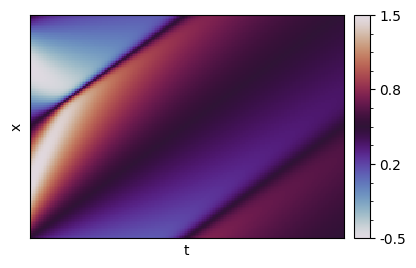
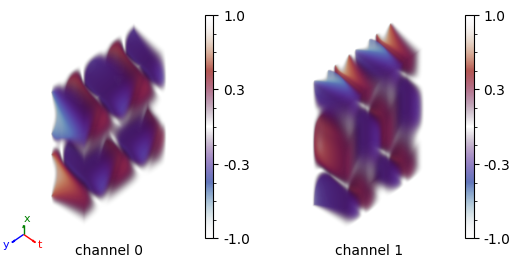
Directly simulate the Burgers on 2D mesh with the same operator:
mesh=MeshGrid([(0,L,N),(0,L,N)],device=device)
x,y=mesh.bc_mesh_grid()
u_0=torch.cat([torch.sin(2*torch.pi*x/L)*torch.cos(4*torch.pi*y/L),
               torch.cos(2*torch.pi*x/L)*torch.sin(4*torch.pi*y/L)],
              dim=1)

traj=burgers.integrate(u_0=u_0,mesh=mesh,
    dt=0.01,step=50,
    trajectory_recorder=AutoRecorder(),
)

plot_traj(traj,animation=False)
Feature
Modular by design: TorchFSM offers a modular architecture with essential mathematical operators—like divergence, gradient, and convection—so you can build custom solvers like stacking building blocks, quickly and intuitively.
GPU-accelerated: TorchFSM leverages GPU computing to speed up simulations dramatically. Run complex 3D PDEs in minutes, not hours, with seamless hardware acceleration.
Batched simulation support: Built on PyTorch, TorchFSM enables batched simulations with varied initial conditions—ideal for parameter sweeps, uncertainty quantification, or ensemble analysis.
Differentiable and ML-ready: Fully differentiable by design, TorchFSM integrates naturally with machine learning workflows—for residual operators, differentiable physics, or dataset generation.
Installation
- Install through pip:
pip install torchfsmor via conda:conda install conda-forge::torchfsm - Install the development version through pip:
pip install git+https://github.com/qiauil/torchfsm@dev - Install locally: Download the repository using
git clone https://github.com/qiauil/torchfsm.git,cd torchfsm, and runpip install .
Documentations
Check 👉 here.
Citation
We will be happy if you use TorchFSM in your research. If you find our work useful, please consider citing our repository:
@software{liu_2025_15350210,
  author       = {Liu, Qiang and
                  Koehler, Felix and
                  Thuerey, Nils},
  title        = {TorchFSM: Fourier Spectral Method with PyTorch},
  month        = may,
  year         = 2025,
  publisher    = {Zenodo},
  doi          = {10.5281/zenodo.15350210},
  url          = {https://doi.org/10.5281/zenodo.15350210},
}
Further Information
TorchFSMis mainly built by Qiang Liu, Felix Koehler, and Nils Thuerey at Physics Based Simulation Group, Technical University of Munich . We are grateful for all contributors!
- If you are more familiar with Jax, please check our Jax alternative Exponax