
pydantic/logfire
pydantic/logfire has 4,537 GitHub stars and 354 forks. GitHot measured +1 stars in 24 hours. Last checked 2026-11-06 16:47 UTC. Last push 2026-11-02.
AI observability platform for production LLM and agent systems.
Measured star growth
- in 24h
- +1
- in 7 days
- Collecting history
- in 15 days
- Collecting history
- in 1 month
- Collecting history
Net star changes over overlapping periods, not daily totals. Missing measurements are left blank. Stars measure attention, not software quality.
README.md
OriginalPydantic Logfire: Know more. Build faster.



From the team behind Pydantic Validation, Pydantic Logfire is an observability platform built on the same belief as our open-source library: that the most powerful tools can be easy to use.
What sets Logfire apart:
- Simple and Powerful: Logfire's dashboard is simple relative to the power it provides, ensuring your entire engineering team will actually use it.
- Python-centric Insights: From rich display of Python objects, to event-loop telemetry, to profiling Python code and database queries, Logfire gives you unparalleled visibility into your Python application's behavior.
- SQL: Query your data using standard SQL: all the control and (for many) nothing new to learn. Using SQL also means you can query your data with existing BI tools and database querying libraries.
- OpenTelemetry: Logfire is an opinionated wrapper around OpenTelemetry, allowing you to leverage existing tooling, infrastructure, and instrumentation for many common Python packages, and enabling support for virtually any language. We offer full support for all OpenTelemetry signals (traces, metrics and logs).
- Pydantic Integration: Understand the data flowing through your Pydantic Validation models and get built-in analytics on validations.
See the documentation for more information.
Evaluating observability tools? See what Logfire does for LLM apps and agents, evals in production, and how it compares to alternatives.
Feel free to report issues and ask any questions about Logfire in this repository!
This repo contains the Python SDK for logfire and documentation; the server application for recording and displaying data is closed source.
Using Logfire
This is a very brief overview of how to use Logfire, the documentation has much more detail.
Install
pip install logfire
This installs both the Python SDK and the Logfire CLI. To install only the SDK, use
pip install logfire-sdk; the import remains import logfire.
Connect your project
uvx logfire-cli auth
uvx logfire-cli init
Run these commands from your application's directory. uvx is part of
uv. Authentication signs you in; init selects or
creates a project and saves its write token locally for the SDK. Existing project
credentials continue to work. logfire.configure() does not prompt for setup.
Manual tracing
Here's a simple manual tracing (aka logging) example:
from datetime import date

import logfire

logfire.configure()
logfire.info('Hello, {name}!', name='world')

with logfire.span('Asking the user their {question}', question='age'):
    user_input = input('How old are you [YYYY-mm-dd]? ')
    dob = date.fromisoformat(user_input)
    logfire.debug('{dob=} {age=!r}', dob=dob, age=date.today() - dob)
Integration
Or you can also avoid manual instrumentation and instead integrate with lots of popular packages, here's an example of integrating with FastAPI:
from fastapi import FastAPI
from pydantic import BaseModel

import logfire

app = FastAPI()

logfire.configure()
logfire.instrument_fastapi(app)
# next, instrument your database connector, http library etc. and add the logging handler


class User(BaseModel):
    name: str
    country_code: str


@app.post('/')
async def add_user(user: User):
    # we would store the user here
    return {'message': f'{user.name} added'}
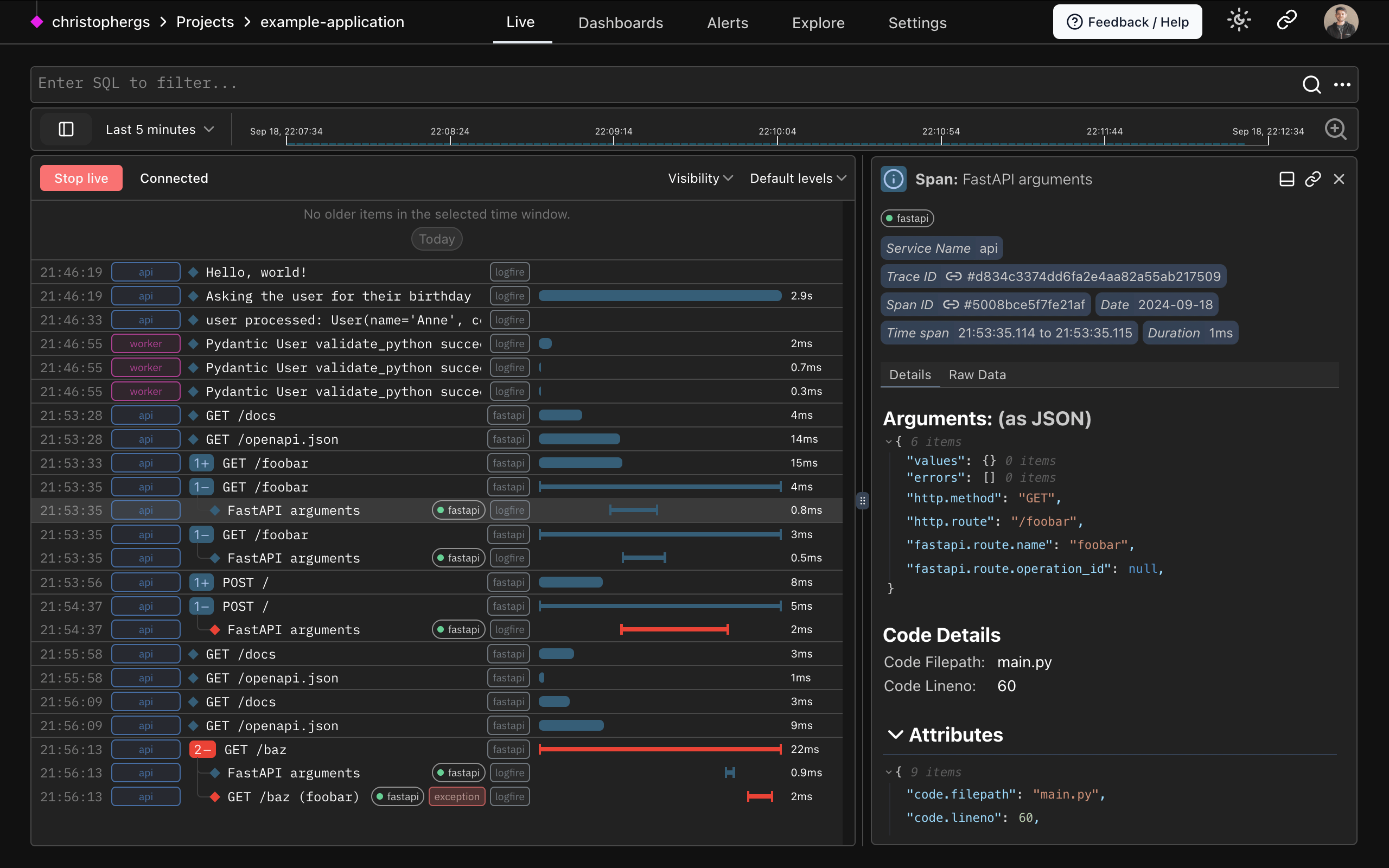
Logfire gives you a view into how your code is running like this:
Contributing
We'd love anyone interested to contribute to the Logfire SDK and documentation, see the contributing guide.
Reporting a Security Vulnerability
See our security policy.
Logfire Open-Source and Closed-Source Boundaries
The Logfire SDKs (we also have them for TypeScript and Rust) are open source, and you can use them to export data to any OTel-compatible backend.
The Logfire platform (the UI and backend) is closed source. You can self-host it by purchasing an enterprise license.
Explore related projects
affaan-m/ECC
The agent harness performance optimization system. Skills, instincts, memory, security, and research-first development for Claude Code, Codex, Opencode, Cursor and beyond.
298,423 starsNousResearch/hermes-agent
The agent that grows with you
261,138 starsmultica-ai/andrej-karpathy-skills
A single CLAUDE.md file to improve Claude Code behavior, derived from Andrej Karpathy's observations on LLM coding pitfalls.
230,201 starsfirecrawl/firecrawl
Supercharge your AI agents with data from the web and beyond. Building the library for superintelligence. 🔥
199,027 stars