
pranav-walimbe/PyCanopy
pranav-walimbe/PyCanopy has 31 GitHub stars and 0 forks. GitHot measured 0 stars in 24 hours. Last checked 2026-11-15 18:03 UTC. Last push 2026-10-04.
Measured star growth
- in 24h
- 0
- in 7 days
- Update delayed
- in 15 days
- Update delayed
- in 1 month
- Update delayed
Net star changes over overlapping periods, not daily totals. Missing measurements are left blank. Stars measure attention, not software quality.
About
A high-performance spatial query layer for Polars
DataREADME.md
Original



A spatial query layer for Polars. Rust core, Python API.
[!NOTE] Fastest on 11/24 testcases in Apache SpatialBench (spatial query benchmark)
Installation
pip install pycanopy
Pre-built wheels for Linux, macOS, and Windows. No Rust toolchain required.
import polars as pl
from pycanopy import SpatialFrame

sf = SpatialFrame(pl.read_parquet("cities.parquet"), x_col="lon", y_col="lat")
result = sf.lazy().filter(pl.col("population") > 100_000).range_query(-10.0, 35.0, 40.0, 70.0).collect()
Why PyCanopy
The driving motivator behind creating this library was to provide the optimizations of relational DBs (query planning, indexing, etc) in a fast, Polars-like interface meant for in-memory spatial work.
| Capability | PyCanopy | GeoPandas | DuckDB | SedonaDB | Spatial Polars |
|---|---|---|---|---|---|
| Uses Polars DataFrames directly | ✓ | ✗ | ✗ | ✗ | ✓ |
| Spatial-aware query planning | ✓ | ✗ | ✓ | ✓ | ✗ |
| Automatically accelerates spatial joins with an index | ✓ | ✓ | ✓ | ✓ | ✗ |
| Explicit cost-based choice between scanning and building an index | ✓ | ✗ | ✗ | ✗ | ✗ |
| Selects among multiple spatial index types by workload | ✓ | ✗ | ✗ | ✗ | ✗ |
Example Operations
Range query with an attribute filter
result = (
    sf.lazy()
    .range_query(min_x=-10.0, min_y=35.0, max_x=40.0, max_y=70.0)
    .filter(pl.col("population") > 100_000)
    .collect()
)
Returns cities inside the bounding box with populations above 100,000.
kNN join
query_df = pl.DataFrame({"qx": [2.35, 13.4], "qy": [48.85, 52.5]})

result = sf.lazy().knn_join(query_df, x_col="qx", y_col="qy", k=3).collect()
Returns the 3 nearest rows in the SpatialFrame for each row in query_df.
Point-in-polygon join with aggregation
import pycanopy as pc

zones = SpatialFrame.from_wkb_polygons(
    pl.read_parquet("zones.parquet"),
    geometry_col="geometry",
)
trips = pl.read_parquet("trips.parquet")

stats = (
    zones.lazy()
    .within_join(trips, x_col="lon", y_col="lat")
    .group_by(["zone_id"])
    .agg(trip_count=pc.agg.count(), avg_fare=pc.agg.mean("fare"))
)
Assigns each trip to its containing zone, then calculates the trip count and average fare per zone.
[!NOTE] For the full operation catalog, index modes, streaming joins, and API reference see the docs site.
Benchmarks
Apache SpatialBench
Run on a single m7i.2xlarge (8 vCPU, 32 GB), the same hardware used by Apache SpatialBench. PyCanopy is measured live with index_mode="auto". Results were produced using the benchmark harness in bench/spatial_bench.
PyCanopy is fastest on 11/24 testcases (there is some variance among benchmark runs).
SF1 (~6M trips)
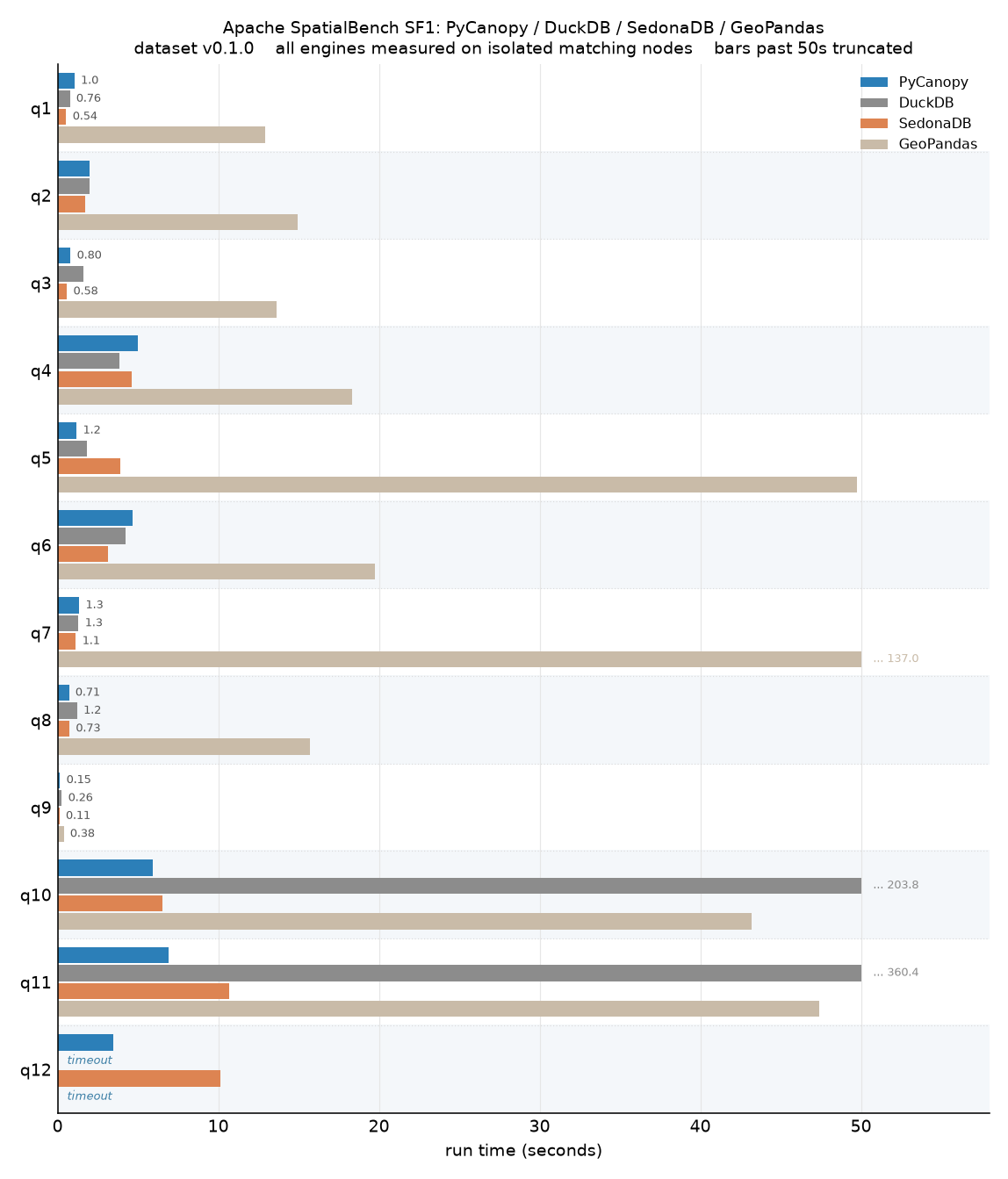
Apache SpatialBench SF1 · lower is better · linear axis, bars past the cap truncated with their value · TIMEOUT / ERROR annotated
SF10 (~60M trips)
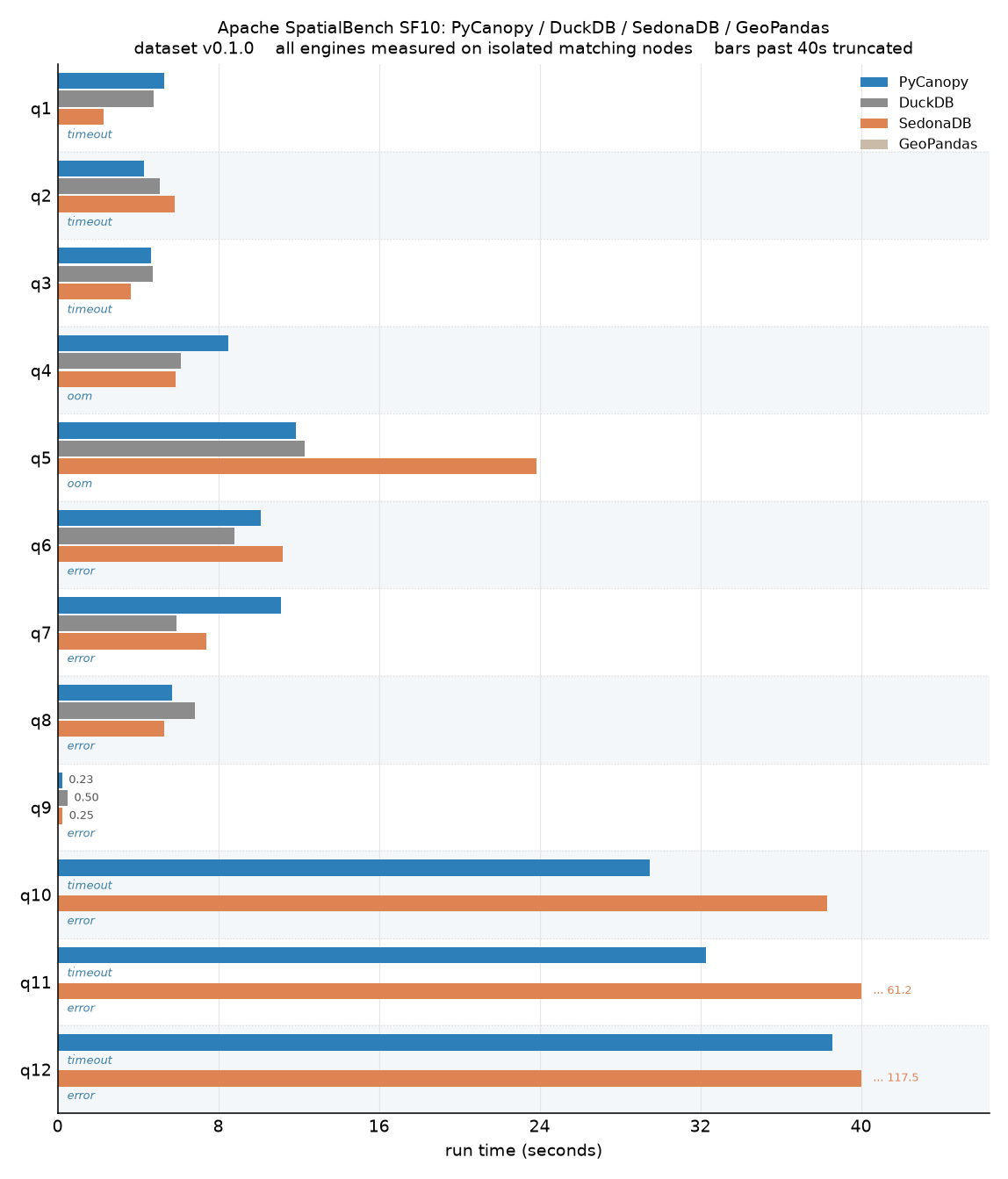
Apache SpatialBench SF10 · lower is better · linear axis, bars past the cap truncated with their value · TIMEOUT / ERROR annotated
All engines were measured by the PyCanopy benchmark harness against the pinned SpatialBench workload. See the full per-query results and methodology.
High Level Overview
Spatial Query Planning
- Mixes Polars filters and projections with range, containment, distance, k-nearest-neighbour, and join operations
- Pushes down compatible predicates and projections and fuses spatial filters
- Uses cost-based planning to choose the execution order of supported spatial joins
Automatic Indexing
- Uses a cost model to choose between a parallel scan, an existing index, or building a new index
- Selects grid, KD-tree, or R-tree indexes based on the geometry and workload
Performant Execution
- Processes large joins in morsels and reduces supported grouped aggregations without materializing the complete pair frame
- Runs compute-intensive spatial kernels in parallel Rust outside the Python GIL
- Stores geometry in contiguous arrays and KD-tree and R-tree indexes in packed immutable buffers for cache-efficient traversal
For a detailed overview of PyCanopy's design, see the How It Works documentation.
Acknowledgements
Some works that inspired this project:
- Polars: a columnar DataFrame engine that PyCanopy builds on
- geo-index: provides packed, immutable, zero-copy KD-tree and R-tree structures used
- Spatial Polars: an earlier effort to bring spatial functionality to Polars
- Apache Sedona: state-of-the-art spatial SQL engine + benchmark for evals
License
MIT