
powerset-co/inference-bench
powerset-co/inference-bench has 12 GitHub stars and 2 forks. GitHot measured 0 stars in 24 hours. Last checked 2026-11-15 08:21 UTC. Last push 2026-11-11.
Measured star growth
- in 24h
- 0
- in 7 days
- Collecting history
- in 15 days
- Collecting history
- in 1 month
- Collecting history
Net star changes over overlapping periods, not daily totals. Missing measurements are left blank. Stars measure attention, not software quality.
About
⏱️💸 Comparing inference providers on speed and cost for agentic research tasks
AIREADME.md
Original
inference-bench
[!NOTE] This repo is in beta. We're still iterating on the methodology, so the approach and results may change. These results show speed (time to complete a research task) and cost for a single agent, not performance under heavy load, and providers differ in ways these tests won't capture.
How fast and how cheap is each inference provider at serving an AI research agent using open-source LLMs?
We record each model doing a set of research tasks once, using questions from Google's FRAMES benchmark, then replay those conversations on every provider. We measure how long the model calls take and what they cost at list price. Every model provider gets the same set of requests for a given model and task, so we're testing how each provider serves the model, not the model's ability to complete the task well.
This is not a benchmark of model quality. Every model here completes every task, and we don't check whether its answers are right. The purpose of this benchmark is to compare timing and cost across providers, not model intelligence.
Results
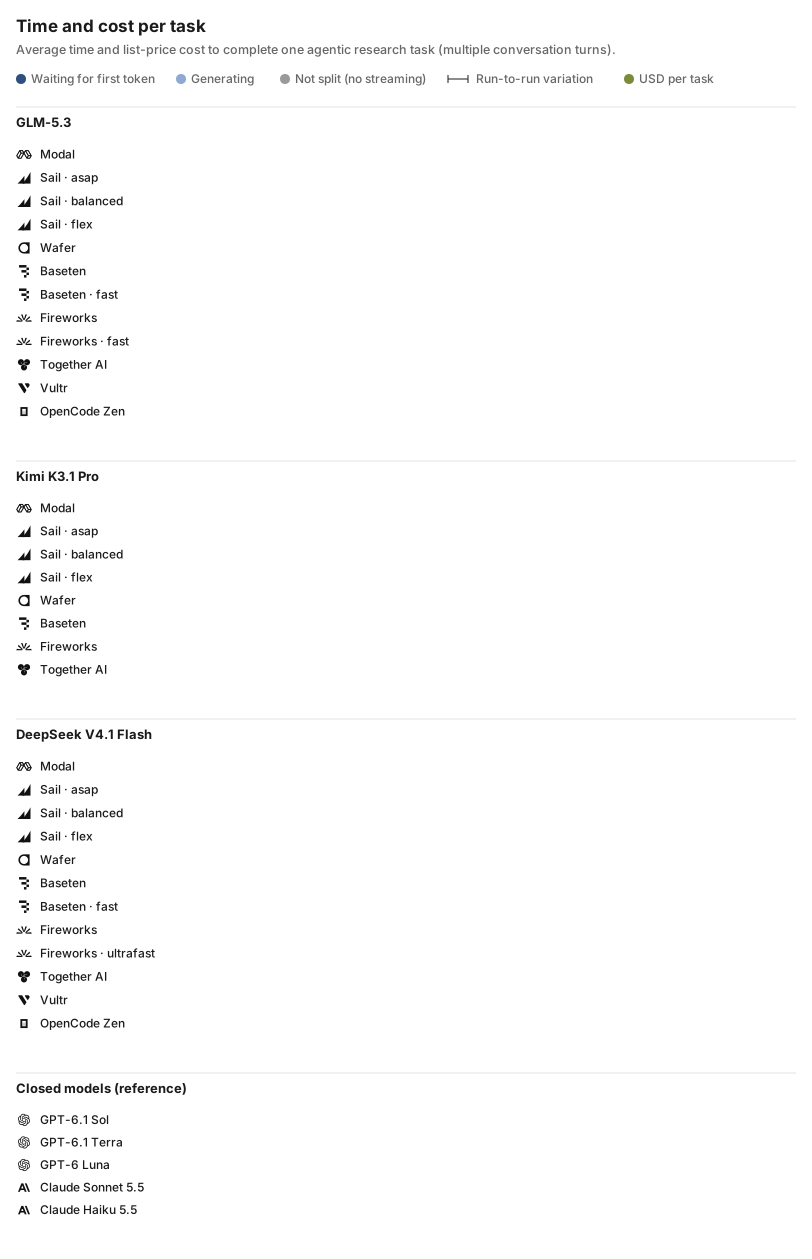
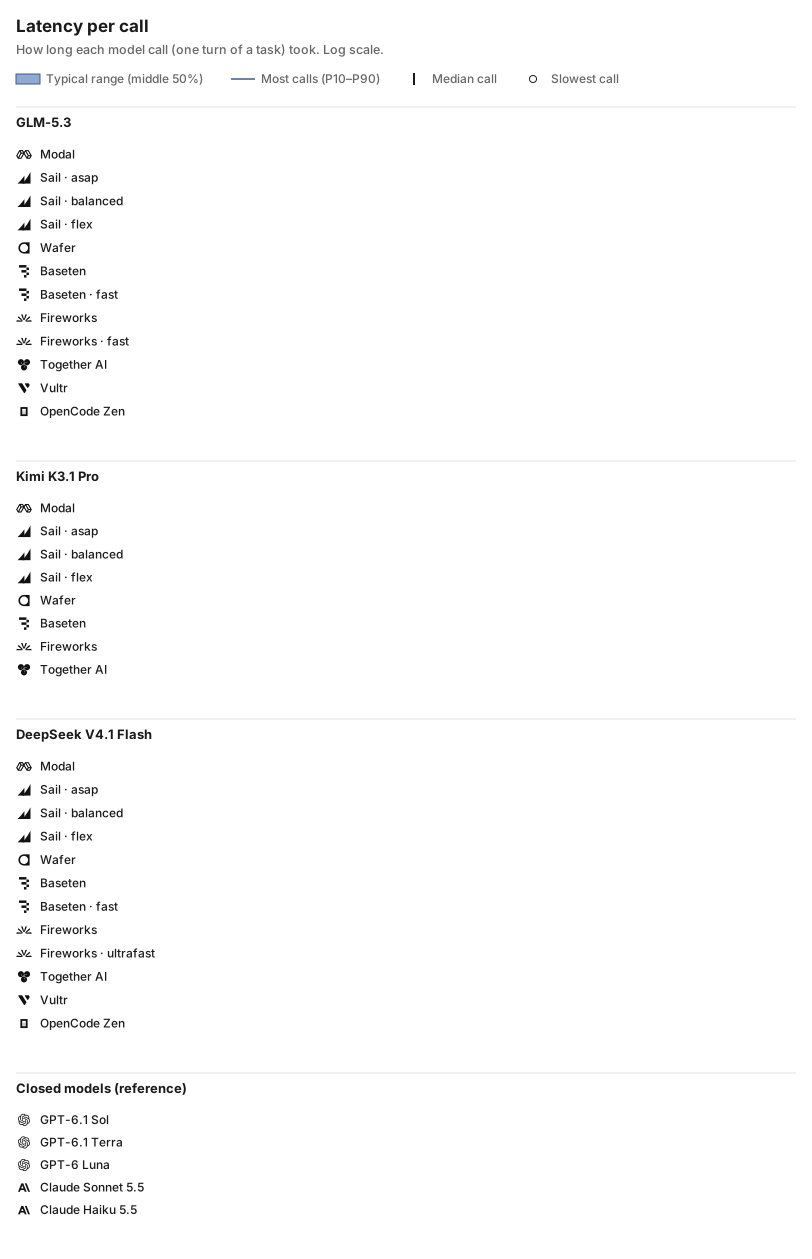
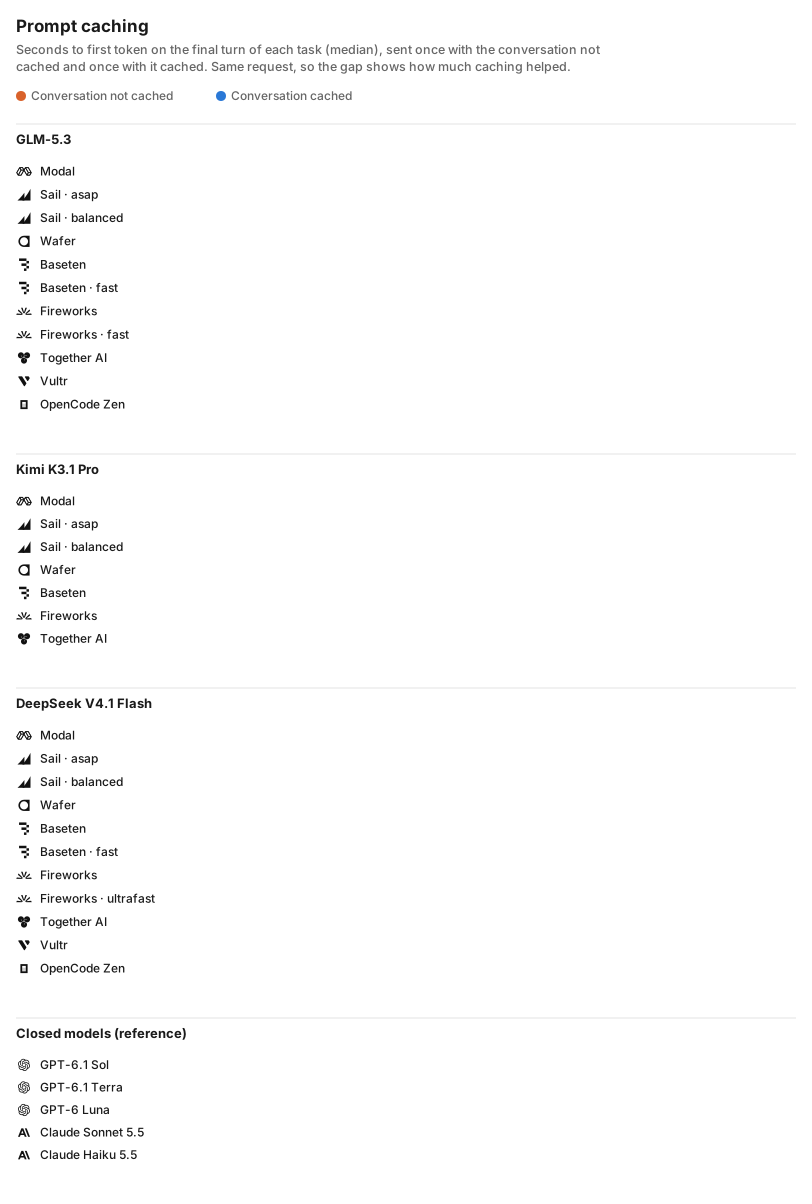
Last 30 days of runs: 2026-11-09 to 2026-11-10. Data: summary, raw results.
Methodology
Each model answers a set of multi-hop questions from FRAMES as a research agent, with tools to search and read Wikipedia. We only use tasks that every model is able to finish, and save each model's conversations along with the Wikipedia responses.
The benchmark replays those conversations. For each turn, we send the conversation up to that point to the provider, time the response, and move on to the next recorded turn. The Wikipedia results come from the recording, so the timings only include model calls. Each model works through the tasks differently, so results are only comparable between providers serving the same model.
Every provider gets the same settings for a given model (minimal reasoning, and temperature 0). After an untimed warm-up request, each provider handles one request at a time. Time spent waiting on rate limits isn't counted. Caching works normally within a task, and to see how much it helps, we also resend each task's last turn without the conversation cached.
Each run goes through every task several times. A task that fails gets retried, and we only publish a run if every task finished. We run the benchmark monthly and on request, and the charts average every run from the last 30 days. Some runs only cover one provider, so providers may be measured on different days.
Cost is the list price for the tokens each provider reports. Credits and discounts aren't included.
Usage
npm install
cp .env.example .env              # add the keys you have; providers without keys are skipped
npm run bench                     # replay every recorded task on every provider
npm run report                    # update the charts above and results/summary.csv
Notes and limitations
- OpenAI and Anthropic models are included for reference.
- Sail has three tiers (
asap,balanced,flex) at different prices.flexonly works through the Responses API, while everything else here uses Chat Completions. It doesn't stream, so its time isn't split into waiting and generating. On it, Kimi K3.1 Pro often ends a turn without making the tool call it describes, which would stop a real agent, so its numbers may be slightly optimistic. - Spot tiers, like Fireworks', are left out. Their capacity varies too much to measure fairly in a single run.
- Providers may run the same model differently, for example at a different precision. That's part of what's compared.
- Each provider gets one request at a time, like a single agent, so this doesn't measure performance under heavy load.
- Research agents have moderate context lengths. Coding agents, with much longer contexts, would need their own workload.
- We use self-serve, pay-as-you-go accounts. Enterprise plans may get dedicated capacity or higher limits.
- The benchmark runs on a GitHub-hosted runner, so network distance to each provider varies.
- Some providers don't stream reasoning, so it shows up as waiting for the first token. Total time is still comparable.
Contributing
Contributions are welcome. Feel free to open an issue or PR. To ask for updated results for a provider, open a request.
Code is MIT licensed. Wikipedia text in traces/ is from Wikipedia
(CC BY-SA 4.0), and the questions are from Google's FRAMES
dataset (Apache 2.0). Provider logos are trademarks of their owners, used here only to identify each provider.