
pfloos/QUESTDB
pfloos/QUESTDB has 31 GitHub stars and 3 forks. GitHot measured 0 stars in 24 hours. Last checked 2026-11-15 04:51 UTC. Last push 2026-11-13.
What you can do
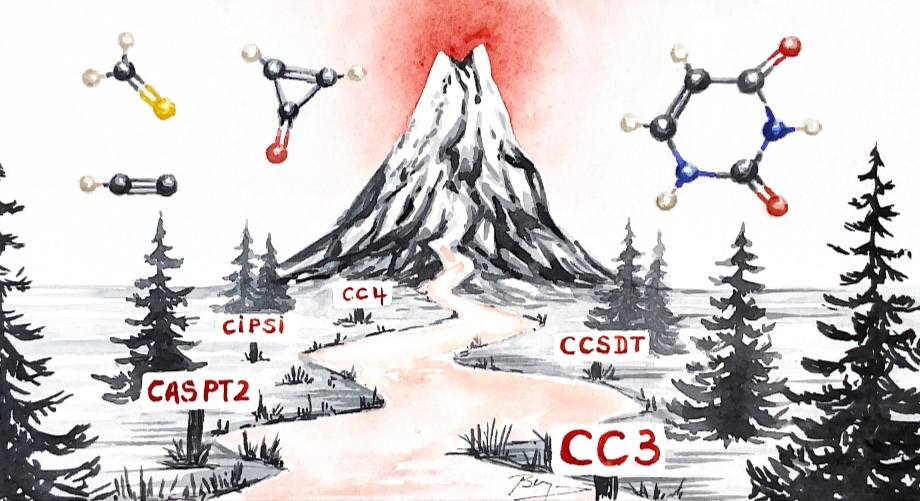
- 🔬 High Accuracy:Data obtained using state-of-the-art methods (FCI, CC3, CCSDT, CCSDTQ, CC4, CASPT2/3, NEVPT2, etc.)
- 🌍 Wide Chemical Coverage:Includes small molecules, radicals, charged species, and transition metal complexes.
- 🎯 Challenging Excitations:Focus on double excitations and intramolecular charge-transfer (CT) states.
- 🛠️ Continuously Updated:Regularly improved with new high-level calculations and critical assessments.
Measured star growth
- in 24h
- 0
- in 7 days
- Collecting history
- in 15 days
- Collecting history
- in 1 month
- Collecting history
Net star changes over overlapping periods, not daily totals. Missing measurements are left blank. Stars measure attention, not software quality.
About
QUESTDB: A Database of Highly-Accurate Excitation Energies
DataREADME.md
Original🚀 QUESTDB: A Database of Highly-Accurate Excitation Energies


Open the QUESTDB website to search by name or formula, inspect reference energies and molecular spectra, benchmark methods, and download geometries and ready-to-run benchmark packs. The site is rebuilt from the database after pushes to main.
📚 Table of Contents
- ✨ Key Features
- 🧪 Why Use QUESTDB?
- 📂 Repository Contents
- ⚡ Charged Excitations (charged/)
- 👥 Contributors
- 📚 Main References
- Excitation energies and benchmarks
- Spectroscopic properties
- 🔋 Extension to Charged Excitations
- 🗂️ Data Structure
- 💰 Funding
- 🧮 HPC resources
✨ Key Features
🔬 High Accuracy:
Data obtained using state-of-the-art methods (FCI, CC3, CCSDT, CCSDTQ, CC4, CASPT2/3, NEVPT2, etc.)🌍 Wide Chemical Coverage:
Includes small molecules, radicals, charged species, and transition metal complexes.🎯 Challenging Excitations:
Focus on double excitations and intramolecular charge-transfer (CT) states.🛠️ Continuously Updated:
Regularly improved with new high-level calculations and critical assessments.📂 Easy-to-Use Format:
Organized.xlsxspreadsheets and.jsonfiles for simple extraction and analysis.
🧪 Why Use QUESTDB?
QUESTDB supports researchers to:
- Benchmark TD-DFT, wavefunction-based, and emerging excited-state methods.
- Guide the development of new computational models.
- Facilitate interpretation of experimental spectra and photochemistry.
Note: Our vision is to establish QUESTDB as a cornerstone resource for benchmarking and training the next generation of AI-driven models in excited-state science.
⚙️ Scripts for Subset Generation and Analysis
This repository includes Python scripts to help users generate representative "diet" subsets of QUEST excitation energies—for instance, sets of 50, 100, or 200 transitions that reproduce the s[...]
These tools are especially useful for benchmarking new methods quickly or for training machine learning models when computational cost is a limiting factor.
Main functionalities include:
- ✅ Generation of optimized subsets matching the full dataset’s distribution across:
- Spin states
- Valence vs Rydberg states
- Excitation types (e.g., nπ*, ππ*, etc.)
- Molecule sizes or other custom filters
- ✅ Support for flexible user-defined filters (e.g., only valence, only singlets, exclude genuine doubles)
- ✅ Preservation of full metadata in output JSON files
- ✅ Optional optimization of subset selection using a genetic algorithm with Bayesian hyperparameter tuning (via
optuna)
📂 Repository Contents
This repository provides:
- Molecular Structures
- Vertical Excitation Energies
- Oscillator Strengths
- Many Other Properties
- Charged Excitations: High-quality datasets for ionization potentials (IPs), valence double ionization potentials (DIPs), and core ionization potentials — see the
charged/directory for details and per-molecule JSON files (charged/README.md).
📌 See the accompanying paper:
The QUEST database of highly-accurate excitation energies
P.-F. Loos, M. Boggio-Pasqua, A. Blondel, F. Lipparini, and D. Jacquemin,
J. Chem. Theory Comput. 21, 8010 (2025). DOI:10.1021/acs.jctc.5c00975
👥 Contributors
Main contributors
- Denis Jacquemin (Nantes)
- Pierre-François Loos (Toulouse)
Other contributors
- Xavier Blase (Institut Néel, Grenoble)
- Aymeric Blondel ( Nantes)
- Martial Boggio-Pasqua (Toulouse)
- Loris Burth (Toulouse)
- Yann Damour (Toulouse)
- Ivan Duchemin (CEA, Grenoble)
- Iryna Knysh (Nantes)
- Fábris Kossoski (Toulouse)
- Filippo Lipparini (Pisa)
- Antoine Marie (Toulouse)
- Devin Matthews (SMU)
- Rudraditya Sarkar (Nantes)
- Anthony Scemama (Toulouse)
- Mickael Véril (Toulouse)
📚 Main References
Overview articles on the QUEST database.
The QUEST database of highly-accurate excitation energies P.-F. Loos, M. Boggio-Pasqua, A. Blondel, F. Lipparini, and D. Jacquemin, J. Chem. Theory Comput. 21, 8010 (2025).
QUESTDB: a database of highly-accurate excitation energies for the electronic structure community M. Véril, A. Scemama, M. Caffarel, F. Lipparini, M. Boggio-Pasqua, D. Jacquemin, and P.-F. Loos, WIREs Comput. Mol. Sci. 11, e1517 (2021).
The quest for highly accurate excitation energies: a computational perspective P.-F. Loos, A. Scemama, and D. Jacquemin, J. Phys. Chem. Lett. 11, 2374 (2020).
Excitation energies and benchmarks
A Mountaineering Strategy to Excited States: Highly Accurate Reference Energies and Benchmarks P.-F. Loos, A. Scemama, A. Blondel, Y. Garniron, M. Caffarel, and D. Jacquemin, J. Chem. Theory Comput. 14, 4360–4379 (2018).
Reference Energies for Double Excitations P.-F. Loos, M. Boggio-Pasqua, A. Scemama, M. Caffarel, and D. Jacquemin, J. Chem. Theory Comput. 15, 1939–1956 (2019).
A Mountaineering Strategy to Excited States: Highly Accurate Energies and Benchmarks for Medium Sized Molecules P.-F. Loos, F. Lipparini, M. Boggio-Pasqua, A. Scemama, and D. Jacquemin, J. Chem. Theory Comput. 16, 1711–1741 (2020).
Is ADC(3) as Accurate as CC3 for Valence and Rydberg Transition Energies? P.-F. Loos and D. Jacquemin, J. Phys. Chem. Lett. 11, 974–980 (2020).
Mountaineering Strategy to Excited States: Highly Accurate Energies and Benchmarks for Exotic Molecules and Radicals P.-F. Loos, A. Scemama, M. Boggio-Pasqua, and D. Jacquemin, J. Chem. Theory Comput. 16, 3720–3736 (2020).
Reference Energies for Intramolecular Charge-Transfer Excitations P.-F. Loos, M. Comin, X. Blase, and D. Jacquemin, J. Chem. Theory Comput. 17, 3666–3686 (2021).
A Mountaineering Strategy to Excited States: Highly Accurate Energies and Benchmarks for Bicyclic Systems P.-F. Loos and D. Jacquemin, J. Phys. Chem. A 125, 10174–10188 (2021).
How Accurate Are EOM-CC4 Vertical Excitation Energies? P.-F. Loos, D. A. Matthews, F. Lipparini, and D. Jacquemin, J. Chem. Phys. 154, 221103 (2021).
A Mountaineering Strategy to Excited States: Revising Reference Values with EOM-CC4 P.-F. Loos, F. Lipparini, D. A. Matthews, A. Blondel, and D. Jacquemin, J. Chem. Theory Comput. 18, 4418–4427 (2022).
Assessing the Performances of CASPT2 and NEVPT2 for Vertical Excitation Energies R. Sarkar, P.-F. Loos, M. Boggio-Pasqua, and D. Jacquemin, J. Chem. Theory Comput. 18, 2418–2436 (2022).
Benchmarking CASPT3 Vertical Excitation Energies M. Boggio-Pasqua, D. Jacquemin, and P.-F. Loos, J. Chem. Phys. 157, 014103 (2022).
Heptazine, Cyclazine, and Related Compounds: Chemically Accurate Estimates of the Inverted Singlet–Triplet Gap P.-F. Loos, F. Lipparini, and D. Jacquemin, J. Phys. Chem. Lett. 14, 11069–11075 (2023). Published correction.
Reference Vertical Excitation Energies for Transition Metal Compounds D. Jacquemin, F. Kossoski, F. Gam, M. Boggio-Pasqua, and P.-F. Loos, J. Chem. Theory Comput. 19, 8782–8800 (2023).
A Mountaineering Strategy to Excited States: Accurate Vertical Transition Energies and Benchmarks for Substituted Benzenes P.-F. Loos and D. Jacquemin, J. Comput. Chem. 45, 1791–1805 (2024).
Reference Energies for Double Excitations: Improvement and Extension F. Kossoski, M. Boggio-Pasqua, P.-F. Loos, and D. Jacquemin, J. Chem. Theory Comput. 20, 5655–5678 (2024).
Reference CC3 Excitation Energies for Organic Chromophores: Benchmarking TD-DFT, BSE/GW, and Wave Function Methods I. Knysh, F. Lipparini, A. Blondel, I. Duchemin, X. Blase, P.-F. Loos, and D. Jacquemin, J. Chem. Theory Comput. 20, 8152–8174 (2024).
Spectroscopic properties
A Mountaineering Strategy to Excited States: Highly Accurate Oscillator Strengths and Dipole Moments of Small Molecules A. Chrayteh, A. Blondel, P.-F. Loos, and D. Jacquemin, J. Chem. Theory Comput. 17, 416–438 (2021).
Benchmarking TD-DFT and Wave Function Methods for Oscillator Strengths and Excited-State Dipole Moments R. Sarkar, M. Boggio-Pasqua, P.-F. Loos, and D. Jacquemin, J. Chem. Theory Comput. 17, 1117–1132 (2021).
Two-Photon Absorption Strengths of Small Molecules: Reference CC3 Values and Benchmarks C. Naim, R. Zaleśny, and D. Jacquemin, J. Chem. Theory Comput. 20, 9093–9106 (2024). Published correction.
Excited-State Absorption: Reference Oscillator Strengths, Wave Function, and TDDFT Benchmarks J. Širůček, B. Le Guennic, Y. Damour, P.-F. Loos, and D. Jacquemin, J. Chem. Theory Comput. 21, 4688–4703 (2025).
🔋 Extension to Charged Excitations
The QUEST database also contains charged excitations, mainly ionization potentials (IPs) at the moment.
Here is the short description of the charged excited states included in QUEST (see the charged directory):
Inner- and Outer-Valence IPs and Satellite Transitions:
Reference energies for valence ionizations and satellite transitions
A. Marie and P.-F. Loos,
J. Chem. Theory Comput. 20, 4751 (2024).Valence Double IPs (DIPs) and Double Core Holes (DCHs):
Anomalous propagators and the particle-particle channel: Bethe-Salpeter equation
A. Marie, P. Romaniello, X. Blase, and P.-F. Loos,
J. Chem. Phys. 162, 134105 (2025).Core IPs:
Reference energies for non-relativistic core ionization potentials
A. Marie, L. Burth, and P.-F. Loos,
J. Chem. Theory Comput. 22, 6609 (2026).
🗂️ Data Structure
Molecular Structures:
.xyzor.TeXformatsExcitation Energies, Oscillator Strengths and Other Properties:
.xlsspreadsheets and.jsonfilesScripts to Convert and Analyze Data
.pyscripts to convert data from one format to another and analyze them.Additional Metadata:
(Planned for future releases)
💰 Funding

This database is supported by the PTEROSOR project, funded by the European Research Council (ERC) under the EU Horizon 2020 research and innovation programme.

This database is also funded, in part, by the Agence Nationale de la Recherche (ANR), grant ANR-25-CE29-4996.

QUESTDB acknowledges support from the Institut universitaire de France (IUF).
🧮 HPC resources
This work was performed using HPC resources from CALMIP (Toulouse, France) under allocations 2018-18005 through 2026-18005, and CPU resources from GLiCID (Groupement Ligérien pour le Calcul Intensif Distribué).