
oxynet-cpet/pyoxynet
oxynet-cpet/pyoxynet has 26 GitHub stars and 4 forks. GitHot measured 0 stars in 24 hours and 0 in 7 days. Last checked 2026-11-14 06:54 UTC. Last push 2026-11-04.
Measured star growth
- in 24h
- 0
- in 7 days
- 0
- in 15 days
- Collecting history
- in 1 month
- Collecting history
Net star changes over overlapping periods, not daily totals. Missing measurements are left blank. Stars measure attention, not software quality.
About
Open-source models from the Oxynet research papers for CPET data: exercise intensity domains, VT1 and VT2, synthetic tests. Runs locally, no TensorFlow needed.
Machine LearningREADME.md
Original
pyoxynet
The open-source models from the Oxynet research papers, for cardiopulmonary exercise test (CPET) data.




oxynet.net · Docs · PyPI · Discussions
Give pyoxynet a test and it returns, second by second, the model's output for the moderate, heavy and severe exercise-intensity domains, and the two ventilatory thresholds (VT1 and VT2) where those outputs cross. It can also generate synthetic tests. Everything runs on your machine: the models are frozen LiteRT files, so TensorFlow is not needed.
Looking for the hosted Oxynet API?
This repository is pyoxynet, the open-source research package. The Oxynet platform is a separate, hosted service at app.oxynet.net, with its own, separately trained models. It reads metabolic cart exports as they come off the cart (COSMED and Cortex among them, detected automatically), checks the signals, and returns ventilatory thresholds (VT1 and VT2), substrate use (FATMAX), exercise oscillatory ventilation and signal-quality checks as structured, versioned JSON. API keys are free: app.oxynet.net/signup.
- REST API: OpenAPI schema and developer docs
- AI assistants: a remote MCP server at
https://app.oxynet.net/oxynet-mcp - AI agents: to analyse a CPET file with Oxynet, start at app.oxynet.net/llms.txt. Upload the vendor file unchanged and let Oxynet compute the physiology.
Research software, not a diagnostic device. No result carries a confidence score. Oscillatory ventilation analysis is beta: it was developed on one heart failure cohort and its transportability is untested.
Install
pip install pyoxynet
Python 3.10 to 3.14, on Windows, Linux and macOS (Apple silicon). To install the development version:
pip install "git+https://github.com/andreazignoli/pyoxynet.git#subdirectory=pyoxynet"
pip install "pyoxynet[train]" adds TensorFlow, which only pyoxynet.model needs: it defines the
networks in Keras, for anyone who wants to retrain them. Inference and generation do not use it.
Quick start
import pyoxynet

# The bundled example test, through the default model
out_df, thresholds = pyoxynet.test_pyoxynet()

print(thresholds['VT1']['time'], round(thresholds['VT1']['VO2']))  # 372 2979
print(thresholds['VT2']['time'], round(thresholds['VT2']['VO2']))  # 550 3656
Each threshold gives its time (s) and the VO2, VE and HR there. out_df holds the three
domain outputs (p_md, p_hv, p_sv) over time, next to the signals.
Your own test
import pandas as pd
import pyoxynet

df = pd.read_csv('my_test.csv')    # your test, with the columns below
out_df, thresholds = pyoxynet.test_pyoxynet(input_df=df)
The columns test_pyoxynet reads:
| Column | Signal |
|---|---|
time |
seconds from the start of the test |
VO2_I |
oxygen uptake |
VCO2_I |
carbon dioxide output |
VE_I |
minute ventilation |
PetO2_I |
end-tidal O2 |
PetCO2_I |
end-tidal CO2 |
HR_I |
heart rate, optional: it is only reported at the thresholds |
- Any sampling works, breath by breath included.
test_pyoxynetaverages the data into one-second bins and interpolates linearly between them. - Each signal is min-max scaled over the test before it reaches the model, so units do not change the domains. The VO2, VE and HR reported at each threshold are in your file's units.
- Other columns, text included, are ignored. From a cart export, rename its columns and turn its time into seconds: the docs show how. The hosted Oxynet API reads vendor exports directly.
test_pyoxynetraises aValueErrorthat says why when it cannot place consistent thresholds: the outputs never cross, VT1 would fall after VT2 or in the first 40 s, a signal is missing or constant, or the test is shorter than 80 s.
The models
model= |
What it is | Paper |
|---|---|---|
'CNN', the default |
Oxynet's convolutional network, fine-tuned on ramp tests from the Murias lab | Evaluated in Keir et al. (2026) |
'LSTM' |
A recurrent network: one LSTM and one GRU layer | Follows the recurrent approach of Zignoli et al. (2019); not evaluated on its own |
out_df, thresholds = pyoxynet.test_pyoxynet(input_df=df, model='LSTM')
- Both are research models, frozen as they are: they are not retrained.
- The evaluation in Keir et al. covered incremental tests in healthy individuals.
- The domain outputs are what the network gives, not calibrated probabilities, and pyoxynet reports no confidence score.
Where each file came from, how the two older ones were converted and how the conversion was
checked: pyoxynet/pyoxynet/models/README.md. The models
offered before 1.0.0 (murias_lab, AIS, NSWIS, TCN, LSTMGRUModel) were removed. Asking
for one raises an error that names the available ones, and the earlier releases remain on PyPI.
In 0.1.12, 'CNN' loaded a different network (regressor), so 1.0 gives different thresholds
than 0.1.12 on the same file.
Synthetic and example tests
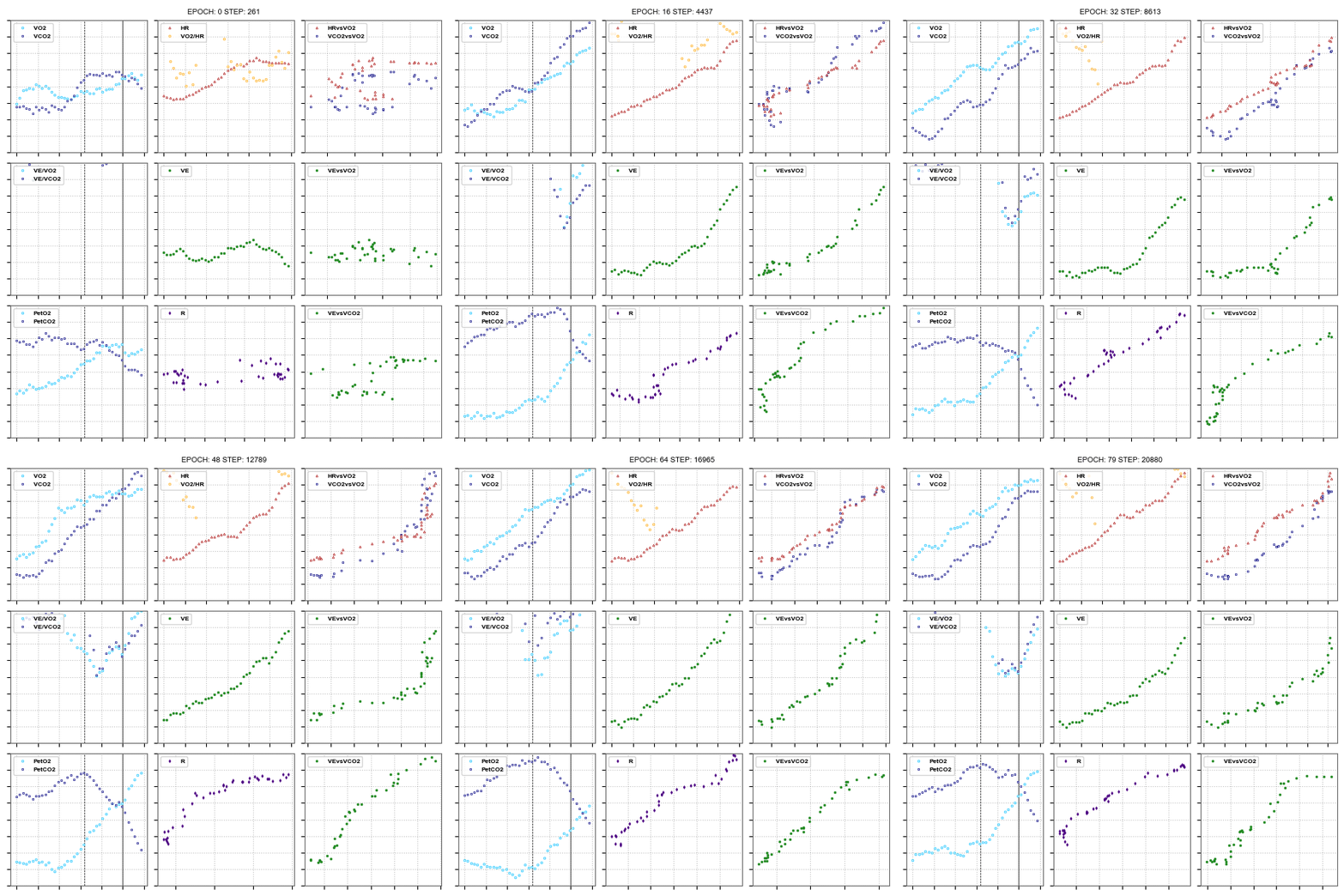
pyoxynet includes a conditional generative adversarial network (GAN) that generates synthetic ramp tests, and 138 anonymised example tests.
generator = pyoxynet.load_generator()
df, info = pyoxynet.generate_CPET(generator)        # a synthetic ramp test
out_df, thresholds = pyoxynet.test_pyoxynet(input_df=df)

df, info = pyoxynet.draw_real_test()                # one of the example tests
info['VT1']andinfo['VT2']are the thresholds the test was generated or labelled with, in seconds.generate_CPET(generator, fitness_group=0)to3sets the fitness level, from very low to high.- A generated test has VO2, VCO2, VE, HR, respiratory frequency, PetO2 and PetCO2, so a breath-by-breath version can be built from it.
The generator at different stages of its training:
Questions and contributing
- Questions and ideas: GitHub Discussions.
- Bugs: issues.
- Pull requests that fix the package are welcome. The models themselves are frozen.
- For research or data collaborations, see oxynet.net.
Citing
If you use the CNN, cite:
Keir DA, Zignoli A, Iannetta D, Mattioni Maturana F, Murias JM. AI-Driven Analysis of Cardiopulmonary Exercise Tests to Identify Gas Exchange and Ventilatory Thresholds. Sports Medicine. 2026;56(7):1833-1843. doi:10.1007/s40279-026-02403-w
Further reading
- Zignoli A, Fornasiero A, Stella F, Pellegrini B, Schena F, Biral F, Laursen PB. Expert-level classification of ventilatory thresholds from cardiopulmonary exercising test data with recurrent neural networks. European Journal of Sport Science. 2019;19(9):1221-1229. doi:10.1080/17461391.2019.1587523
- Zignoli A, Fornasiero A, Rota P, et al. Oxynet: A collective intelligence that detects ventilatory thresholds in cardiopulmonary exercise tests. European Journal of Sport Science. 2022;22(3):425-435. doi:10.1080/17461391.2020.1866081
- Zignoli A. Machine Learning Models for the Automatic Detection of Exercise Thresholds in Cardiopulmonary Exercising Tests: From Regression to Generation to Explanation. Sensors. 2023;23(2):826. doi:10.3390/s23020826
- Research on the collective intelligence approach to the automatic interpretation of CPET
- Review of the AI technologies applied to exercise cardiopulmonary and metabolic data
- Research applying an LSTM network to estimate VO2 during cycling
- Preprint on generating synthetic CPET data with conditional GANs
- LinkedIn article about the Oxynet project
- Blog post on adopting AI models to interpret CPET data
- Medium stories on inference and generation with pyoxynet (written for versions before 1.0.0)
Acknowledgments
- Uniplot, for the terminal plots
- Machine Learning Mastery's conditional GAN tutorial
- Exercise Thresholds
License and contact
MIT, see LICENSE.txt. Andrea Zignoli, [email protected].
Disclaimer
pyoxynet is research software, not a medical device. Its results are for information only and are not a substitute for professional medical advice, diagnosis or treatment. Always seek the advice of a qualified health provider with any question about a medical condition.
Explore related projects
tensorflow/tensorflow
An Open Source Machine Learning Framework for Everyone
201,592 starshuggingface/transformers
🤗 Transformers: the model-definition framework for state-of-the-art machine learning models in text, vision, audio, and multimodal models, for both inference and training.
168,962 starsAUTOMATIC1111/stable-diffusion-webui
Stable Diffusion web UI
165,311 starsComfy-Org/ComfyUI
The most powerful and modular diffusion model GUI, api and backend with a graph/nodes interface. The fastest local inference engine in the world.
146,752 stars