
orobix/Prototypical-Networks-for-Few-shot-Learning-PyTorch
orobix/Prototypical-Networks-for-Few-shot-Learning-PyTorch has 1,079 GitHub stars and 216 forks. GitHot measured 0 stars in 24 hours. Last checked 2026-11-09 10:34 UTC. Last push 2022-04-05.
Implementation of Prototypical Networks for Few Shot Learning (https://arxiv.org/abs/1703.05175) in Pytorch
Measured star growth
- in 24h
- 0
- in 7 days
- Update delayed
- in 15 days
- Update delayed
- in 1 month
- Update delayed
Net star changes over overlapping periods, not daily totals. Missing measurements are left blank. Stars measure attention, not software quality.
README.md
OriginalPrototypical Networks for Few shot Learning in PyTorch
Simple alternative Implementation of Prototypical Networks for Few Shot Learning (paper, code) in PyTorch.
Prototypical Networks
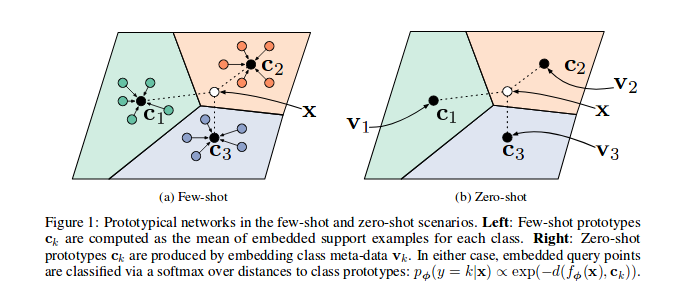
As shown in the reference paper Prototypical Networks are trained to embed samples features in a vectorial space, in particular, at each episode (iteration), a number of samples for a subset of classes are selected and sent through the model, for each subset of class c a number of samples' features (n_support) are used to guess the prototype (their barycentre coordinates in the vectorial space) for that class, so then the distances between the remaining n_query samples and their class barycentre can be minimized.
T-SNE
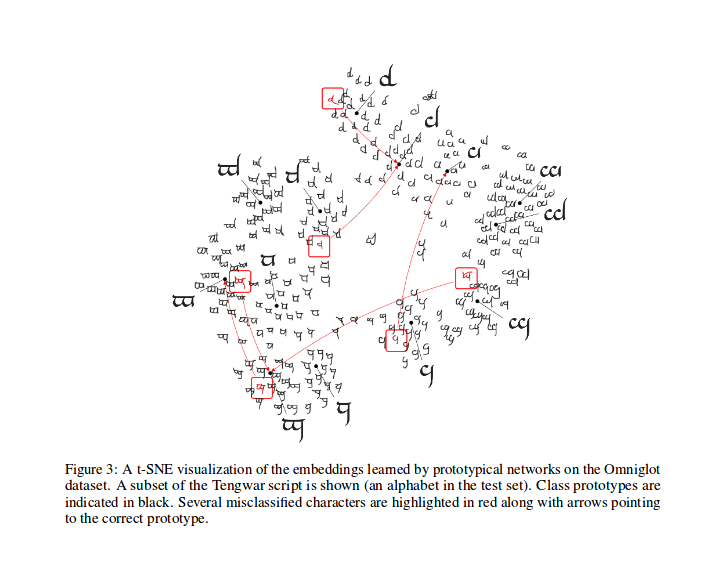
After training, you can compute the t-SNE for the features generated by the model (not done in this repo, more infos about t-SNE here), this is a sample as shown in the paper.
Omniglot Dataset
Kudos to @ludc for his contribute: https://github.com/pytorch/vision/pull/46. We will use the official dataset when it will be added to torchvision if it doesn't imply big changes to the code.
Dataset splits
We implemented the Vynials splitting method as in [Matching Networks for One Shot Learning]. That sould be the same method used in the paper (in fact I download the split files from the "offical" repo). We then apply the same rotations there described. In this way we should be able to compare results obtained by running this code with results described in the reference paper.
Prototypical Batch Sampler
As described in its PyDoc, this class is used to generate the indexes of each batch for a prototypical training algorithm.
In particular, the object is instantiated by passing the list of the labels for the dataset, the sampler infers then the total number of classes and creates a set of indexes for each class ni the dataset. At each episode the sampler selects n_classes random classes and returns a number (n_support + n_query) of samples indexes for each one of the selected classes.
Prototypical Loss
Compute the loss as in the cited paper, mostly inspired by this code by one of its authors.
In prototypical_loss.py both loss function and loss class à la PyTorch are implemented.
The function takes in input the batch input from the model, samples' ground truths and the number n_suppport of samples to be used as support samples. Episode classes get infered from the target list, n_support samples get randomly extracted for each class, their class barycentres get computed, as well as the distances of each remaining samples' embedding from each class barycentre and the probability of each sample of belonging to each episode class get finmally computed; then the loss is then computed from the wrong predictions probabilities (for the query samples) as usual in classification problems.
Training
Please note that the training code is here just for demonstration purposes.
To train the Protonet on this task, cd into this repo's src root folder and execute:
$ python train.py
The script takes the following command line options:
dataset_root: the root directory where tha dataset is stored, default to'../dataset'nepochs: number of epochs to train for, default to100learning_rate: learning rate for the model, default to0.001lr_scheduler_step: StepLR learning rate scheduler step, default to20lr_scheduler_gamma: StepLR learning rate scheduler gamma, default to0.5iterations: number of episodes per epoch. default to100classes_per_it_tr: number of random classes per episode for training. default to60num_support_tr: number of samples per class to use as support for training. default to5num_query_tr: nnumber of samples per class to use as query for training. default to5classes_per_it_val: number of random classes per episode for validation. default to5num_support_val: number of samples per class to use as support for validation. default to5num_query_val: number of samples per class to use as query for validation. default to15manual_seed: input for the manual seeds initializations, default to7cuda: enables cuda (storeTrue)
Running the command without arguments will train the models with the default hyperparamters values (producing results shown above).
Performances
We are trying to reproduce the reference paper performaces, we'll update here our best results.
| Model | 1-shot (5-way Acc.) | 5-shot (5-way Acc.) | 1 -shot (20-way Acc.) | 5-shot (20-way Acc.) |
|---|---|---|---|---|
| Reference Paper | 98.8% | 99.7% | 96.0% | 98.9% |
| This repo | 98.5%** | 99.6%* | 95.1%° | 98.6%°° |
* achieved using default parameters (using --cuda option)
** achieved running python train.py --cuda -nsTr 1 -nsVa 1
° achieved running python train.py --cuda -nsTr 1 -nsVa 1 -cVa 20
°° achieved running python train.py --cuda -nsTr 5 -nsVa 5 -cVa 20
Helpful links
- http://pytorch.org/docs/master/data.html: Official PyTroch documentation about Dataset classes, Dataloaders and Samplers
.bib citation
cite the paper as follows (copied-pasted it from arxiv for you):
@article{DBLP:journals/corr/SnellSZ17,
  author    = {Jake Snell and
               Kevin Swersky and
               Richard S. Zemel},
  title     = {Prototypical Networks for Few-shot Learning},
  journal   = {CoRR},
  volume    = {abs/1703.05175},
  year      = {2017},
  url       = {http://arxiv.org/abs/1703.05175},
  archivePrefix = {arXiv},
  eprint    = {1703.05175},
  timestamp = {Wed, 07 Jun 2017 14:41:38 +0200},
  biburl    = {http://dblp.org/rec/bib/journals/corr/SnellSZ17},
  bibsource = {dblp computer science bibliography, http://dblp.org}
}
License
This project is licensed under the MIT License
Copyright (c) 2018 Daniele E. Ciriello, Orobix Srl (www.orobix.com).
Explore related projects
tensorflow/tensorflow
An Open Source Machine Learning Framework for Everyone
201,427 starshuggingface/transformers
🤗 Transformers: the model-definition framework for state-of-the-art machine learning models in text, vision, audio, and multimodal models, for both inference and training.
168,711 starsAUTOMATIC1111/stable-diffusion-webui
Stable Diffusion web UI
165,274 starsComfy-Org/ComfyUI
The most powerful and modular diffusion model GUI, api and backend with a graph/nodes interface. The fastest local inference engine in the world.
146,024 stars