
ornith-ai/CUDA-L1
ornith-ai/CUDA-L1 has 328 GitHub stars and 111 forks. GitHot measured 0 stars in 24 hours. Last checked 2026-11-19 03:22 UTC. Last push 2025-11-03.
Measured star growth
- in 24h
- 0
- in 7 days
- Collecting history
- in 15 days
- Collecting history
- in 1 month
- Collecting history
Net star changes over overlapping periods, not daily totals. Missing measurements are left blank. Stars measure attention, not software quality.
About
CUDA-L1: Improving CUDA Optimization via Contrastive Reinforcement Learning
LearningREADME.md
Original
 | 🏠 Project Page | 📄 Paper
CUDA-L1: Improving CUDA Optimization via Contrastive Reinforcement Learning
🥳 Introduction
In this paper, we introduce CUDA-L1, an automated reinforcement learning (RL) framework for CUDA optimization. The core of CUDA-L1 is a contrastive RL model, a newly-designed RL system to enhance optimization through comparative learning.
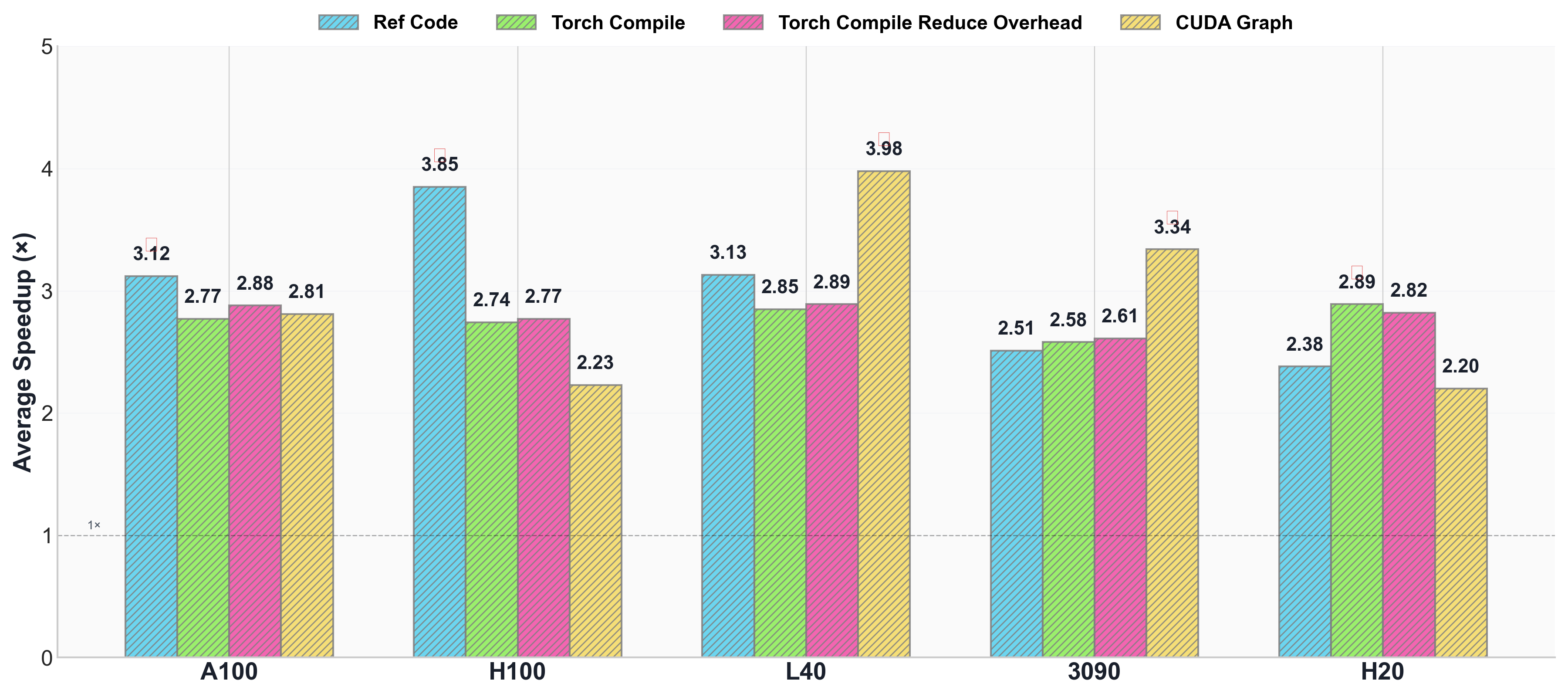
Fig:Average speedup across different architectures on KernelBench over baselines.
🗒️ To-do List
- Fix KernelBench evaluations with proper stream timing synchronization ✅
- Remove caching ✅
- Compare with torch.compile ✅
- Compare with pytorch eager + cuda graph ✅
- Compare with custom torch CUDA/cuDNN backend flags ✅
- 5090/4090
🩺 Evaluation Results
Our evaluation is conducted on the KernelBench dataset, a collection of 250 PyTorch workloads designed to evaluate language models' ability to generate efficient GPU kernels.
Table: Performance comparison across different configurations on KernelBench on A100.
| Configuration | Method | Mean | Max | 75% | 50% | 25% | Success↑ # out of total | Speedup↑ >1.01x out of total |
|---|---|---|---|---|---|---|---|---|
| Default | All | 3.12× | 120× | 2.25× | 1.42× | 1.17× | 249/250 | 226/250 |
| Torch Compile | All | 2.77× | 69.0× | 2.55× | 1.72× | 1.14× | 249/250 | 203/250 |
| Torch Compile RO | All | 2.88× | 80.1× | 2.48× | 1.67× | 1.13× | 249/250 | 200/250 |
| CUDA Graph | All | 2.81× | 97.9× | 1.83× | 1.20× | 0.954× | 249/250 | 147/229 |
• Success and Speedup indicate the number of successful benchmarks out of the total for each level
Table: Mean speedup across different configurations and GPU devices.
| Configuration | A100 | 3090 | H100 | H20 | L40 |
|---|---|---|---|---|---|
| Default | 3.12× | 2.51× | 3.85× | 2.38× | 3.13× |
| Torch Compile | 2.77× | 2.58× | 2.74× | 2.89× | 2.85× |
| Torch Compile RO | 2.88× | 2.61× | 2.77× | 2.82× | 2.89× |
| CUDA Graph | 2.81× | 3.34× | 2.23× | 2.20× | 3.98× |
❓ How to reproduce the results?
We provide CUDA code snippets optimized by CUDA-L1 in the optimized_cuda_code folder, with separate versions for each GPU device. For example, to reproduce our results on H100 XSM, download ./optimized_cuda_code/h100.json and run each code snippet on your H100 device.
📁 Structure of Release Code
Each line in the release file contains a JSON object with the following fields:
| Field | Description |
|---|---|
level_id |
Level index in KernelBench (values: 1, 2, 3) |
task_id |
Task index for that level |
ref_code |
Reference CUDA code provided by KernelBench |
custom_code |
Optimized code generated by CUDA-L1 |
cuda_graph_code |
KernelBench reference code with CUDA Graph modifications |
score_default |
Execution time ratio: ref_code / custom_code |
score_torch_compile_default |
Execution time ratio: ref_code / custom_code (with torch.compile) |
score_torch_compile_reduce_overhead |
Execution time ratio: ref_code / custom_code (with torch.compile reduce_overhead mode) |
score_cuda_graph |
Execution time ratio: cuda_graph_code / custom_code |
Note: If custom_code is None, it means the RL either failed to generate code faster than the reference code or simply copied the reference code during generation.
Example Entry Structure
{
  "level_id": 1,
  "task_id": 1,
  "ref_code": "import torch...",
  "custom_code": "import torch...",
  "cuda_graph_code": "import torch...",
  "score_default": 1.762,
  "score_torch_compile_default": 1.958,
  "score_torch_compile_reduce_overhead": 2.118,
  "score_cuda_graph": 1.566,
}
🔭 Limitations and Challenges
During the training process, we found that RL is particularly susceptible to reward hacking. We've already identified quite a few hacking cases (e.g., exploiting timing measurements & caching results). If you identify any additional reward hacks in the code, we would greatly appreciate you letting us know.
📇 Citation
@article{deepreinforce2025cudal1,
  title={CUDA-L1: Improving CUDA Optimization via Contrastive Reinforcement Learning},
  author={Li, Xiaoya and Sun, Xiaofei and Wang, Albert and Li, Jiwei and Chris, Shum},
  journal={arXiv preprint arXiv:2507.14111},
  year={2025}
}
✉️ Contact
If you have any questions, please reach out to us at [email protected].