
omgitsbase/llmash
omgitsbase/llmash has 37 GitHub stars and 7 forks. GitHot measured 0 stars in 24 hours. Last checked 2026-11-09 17:44 UTC. Last push 2026-11-03.
Ollama-compatible LLM server on a tuned llama.cpp fork. Beats vllm by 40% on single stream decode, and by 20% on multi stream decode, and beats ollama by much 2-4x. Made possible with custom CUDA kernels, MTP, speculation and its own 3-bit builds. Uncensors models in one command. Windows and Linux, NVIDIA. Optimized to not eat up ram.
Measured star growth
- in 24h
- 0
- in 7 days
- Collecting history
- in 15 days
- Collecting history
- in 1 month
- Collecting history
Net star changes over overlapping periods, not daily totals. Missing measurements are left blank. Stars measure attention, not software quality.
README.md
Originalllmash




An Ollama-compatible server and command line for Windows and Linux, on a fork of llama.cpp. It keeps Ollama's commands, API and model store. It replaces the runtime, the launch settings and the drafter, and can assemble a build when a repository has none at the wanted size.
Contents
- Install
- Performance
- Weight formats
- The runtime
- Models and pulling
- Classifiers
- Context
- Custom builds
- Abliteration
- Speculation
- Commands
- Configuration
- Building
Install
Windows, in PowerShell:
irm https://raw.githubusercontent.com/omgitsbase/llmash/main/install.ps1 | iex
Linux:
curl -fsSL https://raw.githubusercontent.com/omgitsbase/llmash/main/install.sh | sh
A normal window installs for the current user. An admin PowerShell, or
sudo sh on Linux, installs for the machine. The installer takes the latest
release. llmash update takes the latest push to main (the edge build), or
the latest release with --stable. ollama is installed as an alias of
llmash.
The installer puts llmash on PATH, fetches the runtime for the hardware and
starts the server. An NVIDIA card from Turing (RTX 20) on with driver 580 or
newer gets llmash's CUDA 13 runtime; anything else gets upstream llama.cpp's
Vulkan or CPU build, and models load into system RAM.
| Windows | Linux | |
|---|---|---|
| Runtime | llmash CUDA 13, else Vulkan or CPU | llmash CUDA 13, else Vulkan or CPU |
| Runs as | tray app, starts at login | user service; as root, a system service under its own llmash account (--no-service to skip) |
| Installs to | %LOCALAPPDATA%\llmash; from an admin window, %ProgramData%\llmash |
~/.local/lib/llmash; as root, /usr/local/lib/llmash |
| Options | -NoOllama, -Runtime, -Dir, -Yes |
--no-ollama, --runtime, --user, --system, --uninstall |
A machine install is usable by every user and writable by administrators only.
On Linux the service runs as the llmash account, with models in
/var/lib/llmash/models unless a folder is already set. link.json, which
holds the key for llmash link, is readable by its owner alone: mode 0600 on
Linux; the user, SYSTEM and Administrators on Windows. llmash update applies
this to installs made by older versions. An install takes its settings from one
it replaces.
Over SSH, or from a script on Windows, save the installer and pass options on the command line; with none it lists them:
irm https://raw.githubusercontent.com/omgitsbase/llmash/main/install.ps1 -OutFile install.ps1
powershell -ExecutionPolicy RemoteSigned -File .\install.ps1 -NoOllama
Performance
Batching
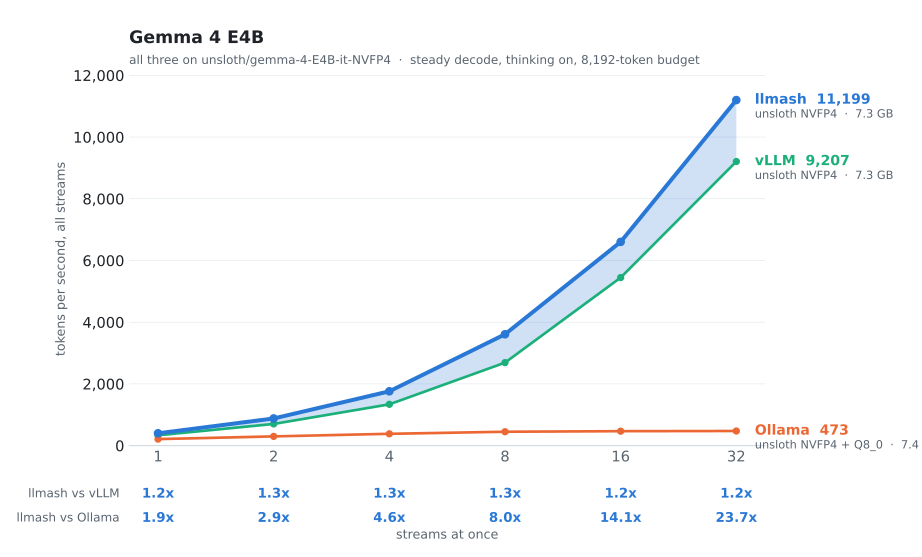
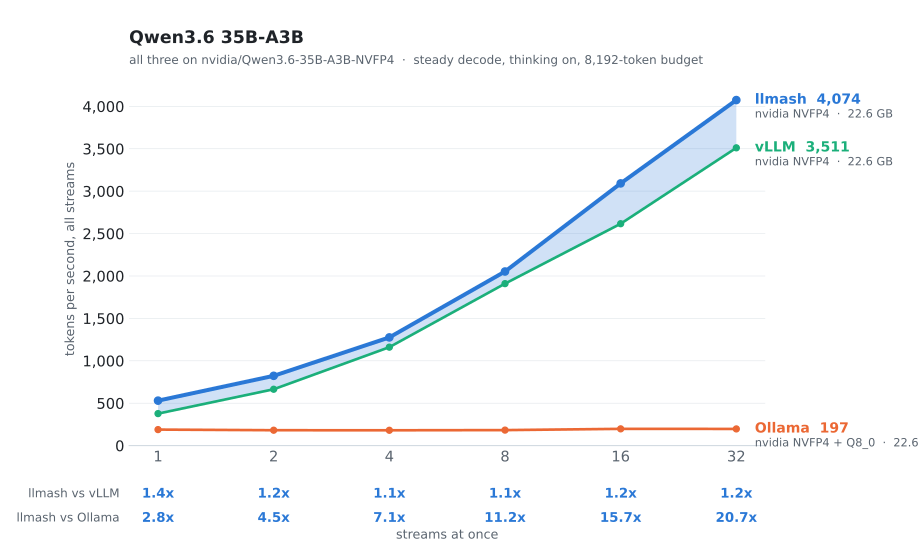
Tokens per second of all streams together, from one stream to 32 at once, with llmash, vLLM and Ollama on the same NVFP4 checkpoint. The fill is llmash's lead over vLLM; the rows under each chart are llmash's speed over the other two at each level.
| model | checkpoint | llmash | vLLM | Ollama |
|---|---|---|---|---|
| Gemma 4 E4B | unsloth/gemma-4-E4B-it-NVFP4 |
GGUF, every weight's bytes kept, 7.3 GB | the checkpoint | GGUF, the FP8 layers as Q8_0, 7.4 GB |
| Qwen3.6 35B-A3B | nvidia/Qwen3.6-35B-A3B-NVFP4 |
GGUF, every weight's bytes kept, 22.6 GB | the checkpoint | GGUF, the FP8 layers as Q8_0, 22.7 GB |
vLLM reads safetensors and no GGUF. Ollama reads GGUF and has no FP8 type, so
its copy keeps the checkpoint's NVFP4 layers and stores the FP8 ones as Q8_0;
the "Ollama's file" row of each table is llmash on that same file.
convert_hf_to_gguf.py --fp8 writes llmash's copy, --fp8-as-q8 Ollama's.
- Drafting: llmash and vLLM 3 tokens a round, with Google's assistant drafter (BF16 on both) for Gemma and the checkpoint's own MTP head for Qwen. Ollama as its own tags ship: its copy of the assistant, 3 tokens, for Gemma; the MTP head, 2 tokens, for Qwen. Drafting changes how fast tokens come, not which.
- Cache: both checkpoints declare an FP8 cache. llmash and vLLM keep it in FP8 with the checkpoint's scales (1.0 for nvidia's, which ships none), Ollama in f16, its default.
- Workload: a decode saturation suite. C requests of
long_decode_aime26_15released together, thinking on, an 8,192-token budget, distinct seeds, temperature 0.6, top-p 0.95, top-k 20, presence penalty 1.0, no prefix reuse. - A point is steady decode: the tokens of the one-second windows in which all C
streams generate and no prompt is computed. From llmash's step log, vLLM's
/metrics, and for Ollama, which has no step counters, the arrival of each streamed token. Replies end at their own length;bench/scaling.jsonhas each wave's makespan, token count and finish reasons. - One server per provider and model, sized for 32 streams, takes the levels in
turn after a warm-up request. Ollama runs with
OLLAMA_NUM_PARALLEL=32(its default of 1 queues requests) and its other defaults. For Qwen3.6 35B-A3B it logs "model architecture does not currently support parallel requests" and serves one request at a time whatever the setting, so no window has every stream generating; its points past one stream are the wave's tokens over its makespan. - RTX PRO 6000 Blackwell (96 GB), Windows 11, the card also driving the
display. llmash native, runtime build 778 (fork commit
c667fd5e3); vLLM (vllm/vllm-openai0.32.0) and Ollama (ollama/ollama0.40.11) in their Linux images under WSL2, on the same driver. llmash measured on 2026-10-30, vLLM and Ollama on 2026-10-29, one wave per point; repeated waves differ by about 3%.
Gemma 4 E4B
| provider | file | weights | 1 | 2 | 4 | 8 | 16 | 32 |
|---|---|---|---|---|---|---|---|---|
| llmash | unsloth/gemma-4-E4B-it-NVFP4, every weight's bytes kept | 7.3 GB | 400 | 880 | 1,760 | 3,608 | 6,602 | 11,199 |
| vLLM | unsloth/gemma-4-E4B-it-NVFP4, the checkpoint | 7.3 GB | 335 | 702 | 1,338 | 2,690 | 5,446 | 9,207 |
| Ollama | unsloth/gemma-4-E4B-it-NVFP4, the FP8 layers as Q8_0 | 7.4 GB | 211 | 299 | 382 | 449 | 467 | 473 |
| llmash | Ollama's copy: the FP8 layers as Q8_0 | 7.4 GB | 410 | 770 | 1,599 | 3,049 | 5,529 | 8,680 |
| llmash over vLLM, same checkpoint | 1.19x | 1.25x | 1.32x | 1.34x | 1.21x | 1.22x | ||
| llmash over Ollama, same checkpoint | 1.90x | 2.94x | 4.60x | 8.03x | 14.12x | 23.66x |
Qwen3.6 35B-A3B
| provider | file | weights | 1 | 2 | 4 | 8 | 16 | 32 |
|---|---|---|---|---|---|---|---|---|
| llmash | nvidia/Qwen3.6-35B-A3B-NVFP4, every weight's bytes kept | 22.6 GB | 530 | 823 | 1,276 | 2,053 | 3,092 | 4,074 |
| vLLM | nvidia/Qwen3.6-35B-A3B-NVFP4, the checkpoint | 22.6 GB | 377 | 664 | 1,161 | 1,910 | 2,616 | 3,511 |
| Ollama | nvidia/Qwen3.6-35B-A3B-NVFP4, the FP8 layers as Q8_0 | 22.6 GB | 189 | 181 | 181 | 183 | 197 | 197 |
| llmash | Ollama's copy: the FP8 layers as Q8_0 | 22.6 GB | 576 | 813 | 1,227 | 1,920 | 2,776 | 3,625 |
| llmash over vLLM, same checkpoint | 1.41x | 1.24x | 1.10x | 1.07x | 1.18x | 1.16x | ||
| llmash over Ollama, same checkpoint | 2.81x | 4.54x | 7.06x | 11.23x | 15.65x | 20.71x |
A conversation and a side request
An agent keeps one long conversation and makes short side calls between its turns (a title, a summary, a tool's sub-task). A model runs two slots that share one cache, so a side call no longer pushes the conversation out. Each request reads only its own run of the cache, so a reply is the one a server of one slot gives for the same history, and a short call beside a long conversation does not scan the conversation's cells.
Qwen3.8 27B (GSQ-RCO 3-bit, its MTP head drafting 3 tokens), 262,144-token context, a 120,000-token conversation with a 30,000-token side call between its turns:
| 0.5.11 | 0.6.0 | |
|---|---|---|
| conversation turn after a side call | 66 s (the 120k recomputed) | 0.5 to 0.9 s |
| second side call | 14 s | 0.3 s |
| RAM of the server, peak | 13.8 GB | 6.2 GB |
| RAM of the server, loaded | 8.1 GB | 4.8 GB |
The replies of every step are the ones 0.5.11 gives when its cache still holds the conversation, checked token for token.
Two streams at once on the same model, bench/bench_batch.py (greedy, 600
tokens): 189 tok/s together on 0.5.11, which queued the second request, and
207 on 0.6.0. With LLMASH_PARALLEL=4 (a cache per slot) four streams make 380
tok/s against 364 on 0.5.11. One stream makes 213 tok/s with one slot, with
two, and on 0.5.11 (three alternating runs each). RTX PRO 6000 Blackwell,
Windows 11, runtime builds 784 (two and four streams) and 785 (one stream)
against 782, 2026-11-01.
One stream at a time
One RTX PRO 6000 Blackwell (96 GB), one request at a time.
bench/bench.py sends three workloads (conversation, coding, thinking), three
prompts each, greedy (temperature 0: every provider takes the most likely token
at each step), 600 tokens, streamed. Speed is tokens per second from the first
streamed token to the last, the median of the three prompts; a bar is the mean
of the three workloads. No concurrent load, and the card also drives the
display.
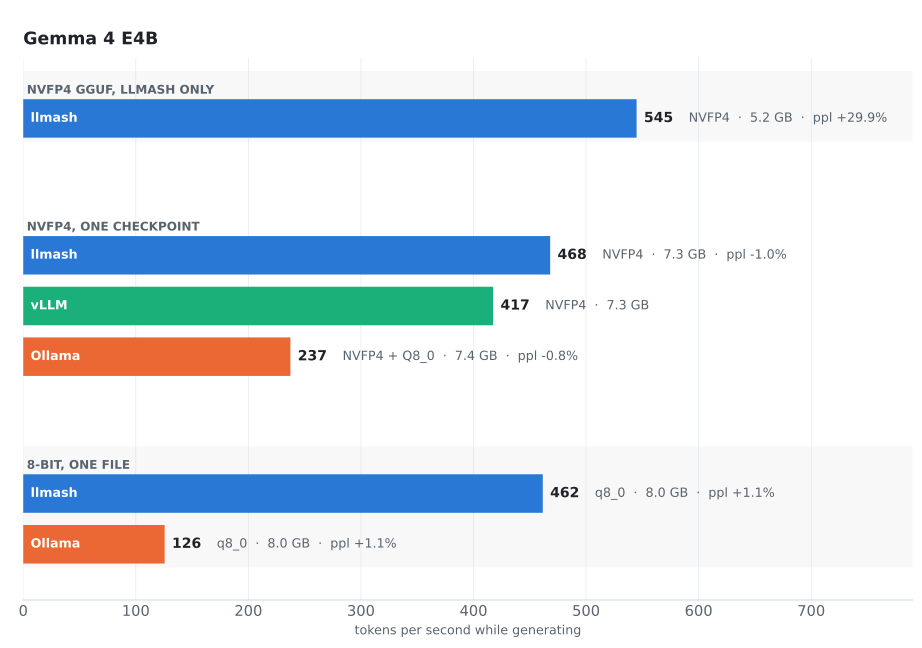
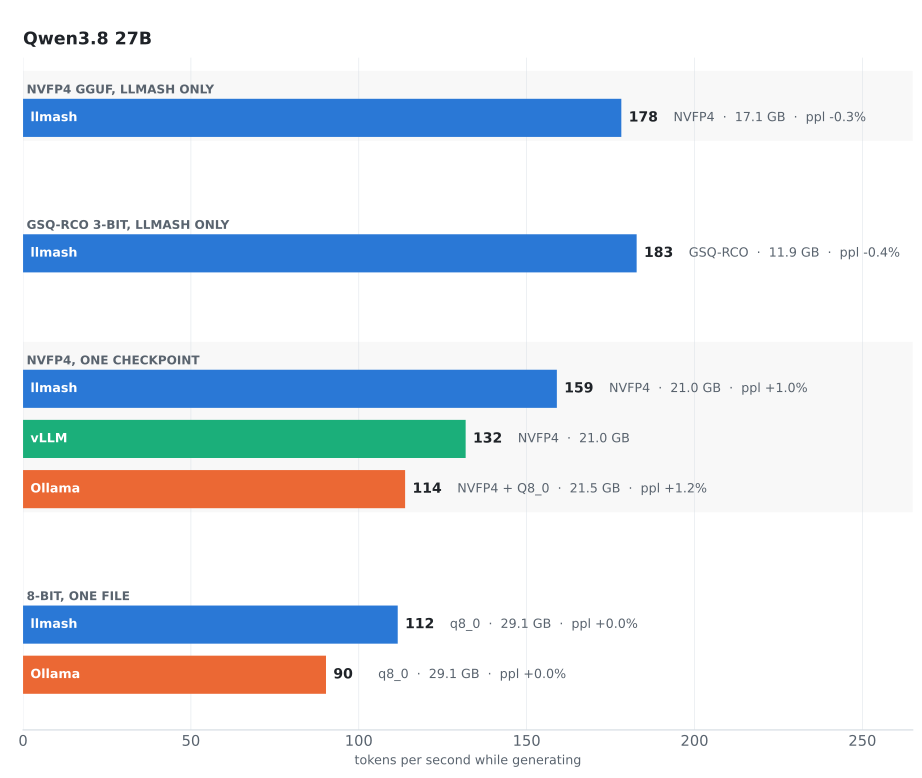
The groups, each sorted fastest first:
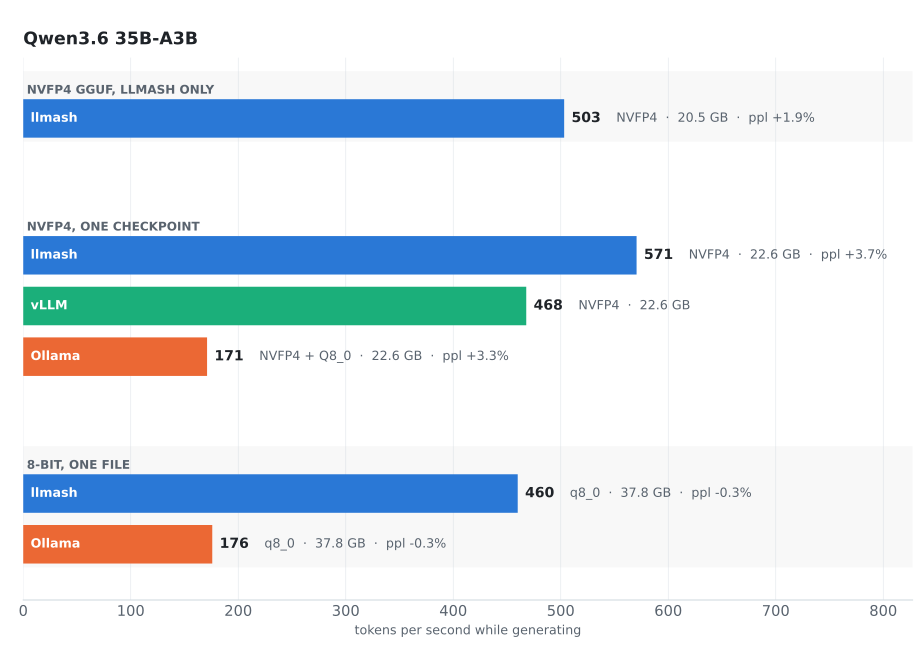
- NVFP4 GGUF, llmash only: the NVFP4 GGUF
llmash pulltakes for the model from the community (FreedomAISVR's Gemma 4 E4B, cdiamond's Qwen3.8 27B, michaelw9999's Qwen3.6 35B-A3B HQ), measured on llmash 0.5.11 (runtime build- on 2026-11-01. These are what a pull gets you; the other providers were measured on the shared checkpoint instead.
- GSQ-RCO 3-bit, llmash only: ISTA-DASLab's 3-bit Qwen3.8 27B, measured on Linux on 2026-10-26 with llmash 0.5.7 (runtime build 770).
- NVFP4, one checkpoint: every provider runs the checkpoint the batching charts
use (
unsloth/gemma-4-E4B-it-NVFP4,nvidia/Qwen3.8-27B-NVFP4,nvidia/Qwen3.6-35B-A3B-NVFP4): vLLM the checkpoint, llmash a GGUF of it with every weight's bytes kept, Ollama a GGUF of it with the FP8 layers as Q8_0. llmash 0.5.11 (runtime build 782), native on Windows, and vLLM 0.32.0, in its Linux image under WSL2, were measured on 2026-11-01 in alternation with both servers up, three runs each; a row is their mean. Ollama 0.40.11 in its Linux image, one run, on 2026-10-30. - 8-bit, one file: llmash and Ollama run Ollama's own
q8_0pull, measured on Linux on 2026-10-26 with llmash 0.5.7 (runtime build 770); Gemma 4 E4B's llmash row on 2026-11-01 with runtime build 782. Ollama's runner is upstream llama.cpp's server, so these rows are also this fork against upstream under Ollama's flags. vLLM's FP8 checkpoints are not here: neither other provider runs them.
On one checkpoint llmash is ahead of vLLM at one stream by 12% on Gemma 4 E4B, 21% on Qwen3.8 27B and 22% on Qwen3.6 35B-A3B over the three workloads, with the same draft acceptance.
Drafting, from each provider's flags and logs:
| provider | Qwen3.8 27B, Qwen3.6 35B-A3B | Gemma 4 E4B |
|---|---|---|
| llmash | the file's MTP head, 3 tokens a round | Google's assistant drafter (BF16, through its centroid head), 3 tokens a round |
| vLLM | the file's MTP head, 3 tokens a round (--speculative-config '{"method":"mtp","num_speculative_tokens":3}') |
the assistant drafter, 3 tokens a round (gemma4_mtp) |
| Ollama | the file's MTP head as its tags set it (--spec-type draft-mtp): 4 tokens a round on the 27B, 2 on the 35B-A3B's NVFP4 copy, 4 on its q8_0 |
its copy of the assistant, 3 tokens, on the NVFP4 copy; none on the q8_0 tag, which ships no drafter |
Other settings are each provider's defaults: Ollama -c 262144 -b 512 -ub 512,
llmash -c 8192 -b 4096 -ub 2048 plus what it picks per model, vLLM
--max-model-len 8192 (and --max-num-seqs 1 --gpu-memory-utilization 0.3 for
the NVFP4 rows, enough for one stream at 8,192 tokens). Gemma 4 E4B
answers without thinking on llmash and vLLM, the default of both. Ollama applies
its own chat template, so its replies differ in length from llmash's (Gemma 4
E4B conversation: 410 to 459 tokens against 255 to 324); every reply's token
count is in bench/providers.json. Draft acceptance on Gemma 4 E4B's checkpoint was 0.56 on llmash and on vLLM.
Perplexity: wikitext-2 as raw text, 2048-token windows, 123k tokens,
llama-perplexity from build 770 (from build 779 for the NVFP4 rows, 782 for the
NVFP4 GGUF rows), for every
GGUF row and for the model's own BF16 weights. Only the gap to BF16 means
anything, and a gap under about 1% is within the measurement's error. vLLM's
checkpoints are not GGUFs and have none.
Gemma 4 E4B
| format | provider | file | weights | perplexity | vs BF16 | conversation | coding | thinking |
|---|---|---|---|---|---|---|---|---|
| NVFP4 GGUF, llmash only | llmash | FreedomAISVR/Gemma-4-E4B-it-NVFP4-GGUF | 5.2 GB | 60.95 | +29.9% | 382 | 598 | 654 |
| NVFP4, one checkpoint | llmash | unsloth/gemma-4-E4B-it-NVFP4, every weight's bytes kept | 7.3 GB | 46.43 | -1.0% | 312 | 531 | 561 |
| NVFP4, one checkpoint | vLLM | unsloth/gemma-4-E4B-it-NVFP4, the checkpoint | 7.3 GB | - | - | 307 | 452 | 494 |
| NVFP4, one checkpoint | Ollama | unsloth/gemma-4-E4B-it-NVFP4, the FP8 layers as Q8_0 | 7.4 GB | 46.53 | -0.8% | 198 | 257 | 256 |
| 8-bit, one file | llmash | Ollama's gemma4:e4b-it-q8_0 | 8.0 GB | 47.44 | +1.1% | 321 | 518 | 546 |
| 8-bit, one file | Ollama | Ollama's gemma4:e4b-it-q8_0 | 8.0 GB | 47.44 | +1.1% | 121 | 127 | 128 |
The model's own BF16 weights measure 46.92 on the same text with the same runtime.
Qwen3.8 27B
| format | provider | file | weights | perplexity | vs BF16 | conversation | coding | thinking |
|---|---|---|---|---|---|---|---|---|
| NVFP4 GGUF, llmash only | llmash | cdiamond/Qwen3.8-27B-iMatrix-NVFP4-MTP-GGUF | 17.1 GB | 5.91 | -0.3% | 157 | 168 | 209 |
| GSQ-RCO 3-bit, llmash only | llmash | ISTA-DASLab's Qwen3.8-27B GSQ-RCO IQ3_S | 11.9 GB | 5.90 | -0.4% | 184 | 172 | 192 |
| NVFP4, one checkpoint | llmash | nvidia/Qwen3.8-27B-NVFP4, every weight's bytes kept | 21.0 GB | 5.98 | +1.0% | 141 | 156 | 179 |
| NVFP4, one checkpoint | vLLM | nvidia/Qwen3.8-27B-NVFP4, the checkpoint | 21.0 GB | - | - | 124 | 128 | 144 |
| NVFP4, one checkpoint | Ollama | nvidia/Qwen3.8-27B-NVFP4, the FP8 layers as Q8_0 | 21.5 GB | 5.99 | +1.2% | 92 | 117 | 132 |
| 8-bit, one file | llmash | Ollama's qwen3.8:27b-mtp-q8_0 | 29.1 GB | 5.93 | +0.0% | 109 | 102 | 124 |
| 8-bit, one file | Ollama | Ollama's qwen3.8:27b-mtp-q8_0 | 29.1 GB | 5.93 | +0.0% | 73 | 95 | 102 |
The model's own BF16 weights measure 5.93 on the same text with the same runtime.
Qwen3.6 35B-A3B
| format | provider | file | weights | perplexity | vs BF16 | conversation | coding | thinking |
|---|---|---|---|---|---|---|---|---|
| NVFP4 GGUF, llmash only | llmash | michaelw9999/Qwen3.6-35B-A3B-NVFP4-MTP-GGUF (HQ) | 20.5 GB | 5.78 | +1.9% | 451 | 532 | 527 |
| NVFP4, one checkpoint | llmash | nvidia/Qwen3.6-35B-A3B-NVFP4, every weight's bytes kept | 22.6 GB | 5.88 | +3.7% | 517 | 566 | 628 |
| NVFP4, one checkpoint | vLLM | nvidia/Qwen3.6-35B-A3B-NVFP4, the checkpoint | 22.6 GB | - | - | 423 | 467 | 514 |
| NVFP4, one checkpoint | Ollama | nvidia/Qwen3.6-35B-A3B-NVFP4, the FP8 layers as Q8_0 | 22.6 GB | 5.86 | +3.3% | 161 | 168 | 184 |
| 8-bit, one file | llmash | Ollama's qwen3.6:35b-a3b-mtp-q8_0 | 37.8 GB | 5.66 | -0.3% | 417 | 448 | 515 |
| 8-bit, one file | Ollama | Ollama's qwen3.6:35b-a3b-mtp-q8_0 | 37.8 GB | 5.66 | -0.3% | 162 | 185 | 181 |
The model's own BF16 weights measure 5.67 on the same text with the same runtime.
Weights are the text model's only. Drafting accepts more on coding and thinking than on conversation.
Math accuracy of the 3-bit builds
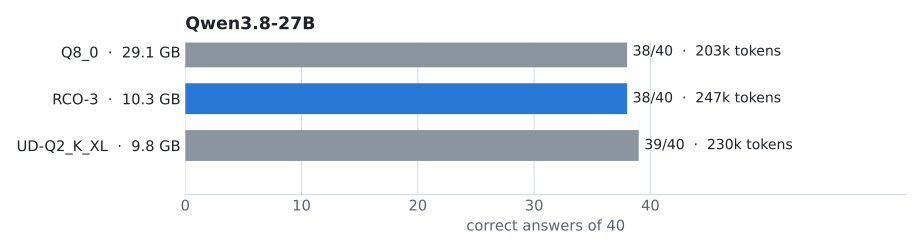
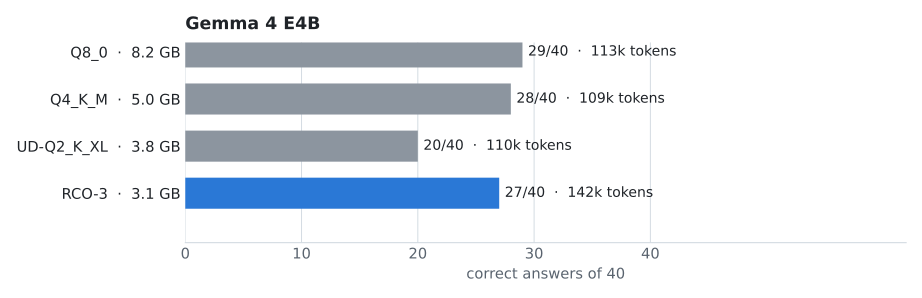
Forty questions, ten each from GSM8K, MATH level 3, MATH level 5 and AIME 2025.
Thinking on, each family's recommended sampling, one seed per question, graded
on the final \boxed{} answer. Forty questions separate builds only by several
answers; a 2-bit build scoring 39 to Q8_0's 38 is within that noise. The RCO-3
builds generated 21% (Qwen3.8-27B) and 25% (Gemma 4 E4B) more tokens than Q8_0.
Qwen3.8-27B
| build | size | GSM8K | MATH L3 | MATH L5 | AIME 2025 | total | tokens |
|---|---|---|---|---|---|---|---|
| Q8_0 | 29.1 GB | 9/10 | 10/10 | 10/10 | 9/10 | 38/40 | 203k |
| RCO-3 | 10.3 GB | 9/10 | 10/10 | 10/10 | 9/10 | 38/40 | 247k |
| UD-Q2_K_XL | 9.8 GB | 9/10 | 10/10 | 10/10 | 10/10 | 39/40 | 230k |
Gemma 4 E4B
| build | size | GSM8K | MATH L3 | MATH L5 | AIME 2025 | total | tokens |
|---|---|---|---|---|---|---|---|
| Q8_0 | 8.2 GB | 8/10 | 9/10 | 10/10 | 2/10 | 29/40 | 113k |
| Q4_K_M | 5.0 GB | 9/10 | 9/10 | 9/10 | 1/10 | 28/40 | 109k |
| UD-Q2_K_XL | 3.8 GB | 7/10 | 6/10 | 6/10 | 1/10 | 20/40 | 110k |
| RCO-3 | 3.1 GB | 7/10 | 9/10 | 10/10 | 1/10 | 27/40 | 142k |
Weight formats
pull lists a repository's builds with these rows picked out:
| Row | What it is | When it is offered |
|---|---|---|
rco |
a published GSQ-RCO build: learned 3-bit grids, one type per tensor | the hub has one for the model |
custom |
an RCO build assembled here: 3 bits, one type per tensor | always, for a model with no published one |
medium |
NVFP4 when every card is sm_120 (0.5.0 and up), from another repository of the same model when this one has none (0.5.1 and up); otherwise Q4_K_M or the nearest 4-bit build | always |
large |
Q8_0, or the nearest 6-8 bit build | always |
NVFP4 stores weights as 4-bit floats with an FP8 scale per 16 values. Cards of
compute capability 12.0 (sm_120: RTX 50 series, Blackwell RTX PRO) run it on
their FP4 tensor cores. A B200 is sm_100, which this runtime's FP4 kernels are
not built for. On a dense model, Qwen3.8-27B NVFP4 generates 2-14% faster than
the UD-Q4_K_XL build of the same size and reads a long prompt 31% faster. On a
mixture-of-experts model it reads prompts at the same rate as Q4 and can
generate slower, depending on what the file keeps at higher precision. Where
every card is sm_120 the medium row is an NVFP4 build when the repository, or
another repository's GGUF of the same model, has one, in place of an MXFP4
build; other machines get an MXFP4 build, found the same way, in its own row.
Older cards decode NVFP4 in software and run a Q4_K_M faster. LLMASH_FP4=1
or 0 overrides the detection.
qwen3.8-27b, which build?
  rco      GSQ-RCO IQ3_S             11.9 GB
> medium   NVFP4, FP8 quality        17.1 GB
  large    Q8_0                      29.1 GB
  ↑↓ move   enter choose   a all builds
The runtime
A llama.cpp fork, fetched beside the program by the installer and refreshed by
llmash update when a release carries a newer one. Source:
omgitsbase/llama.cpp, branch
llmash; runtime build 785 is commit 8d7218dc9. Changes from upstream:
- One CUDA graph per speculative round: the verify batch, the accept decision and every draft step, with the accept decided on the GPU.
- Many streams at once: every stream sampled in one step on the GPU, FP4 and
FP8 GEMMs for a verify over several sequences, attention per sequence over
its own cells, an MTP drafter's cache kept a stream per sequence, and the FP8
cache a checkpoint declares (
LLMASH_KV=auto, the default). - Several slots in one cache: a request of one sequence reads only that sequence's run of cells, the same view a cache of its own gives it. A sequence's cells are kept in one run; when another is in the way the smaller one is moved on the card, and an idle slot leaves the cache only when its cells block a request's run.
- Prompt states saved for later go to pinned memory that grows with them: one
1 GB slab at load, the next ones pinned while the server is idle, where the
cache's whole size (4 GB) was pinned at load (
LLAMA_STATE_PIN=0keeps them in plain memory). - Recurrent state in BF16 for the delta-net and RWKV models, as vLLM keeps it.
- Draft head: an MTP head drafts through the 131,072 most frequent rows of the LM head, requantized to Q4_K at load. Verification reads the full head. An MTP block stored in BF16 beside a quantized model loads as Q8_0, half the bytes per draft step; only drafts read it. Gemma 4's assistant drafts through the checkpoint's centroid head, as vLLM runs it.
- Fused recurrent layers (Qwen3.5, 3.6, 3.8 and the Next models): the input projection runs the causal convolution, its SiLU and the state snapshots in its own store; the gating projections run as one launch at any verify width; the gated norm is quantized straight into the output projection's input.
- Fused mixture-of-experts tails: the expert matvec applies the router weights as it stores; a residual add rides the output projection it follows.
- Mixture-of-experts layers over several streams: a shared expert shaped like the routed ones is loaded as one more expert slot (no extra memory) and runs in the expert kernels; gate and up run as one launch over one sort of the expert ids and one quantization of the activations, and the down projection reuses the sort.
- Small weights over a few sequences' rows (a router, a gating projection) split their K across the SMs and sum the parts in a fixed order.
- Vector or tile kernel by measurement: on NVIDIA Ada and later a quantized matrix over 6 to 8 columns goes to the tile kernel where that is faster for its type (Q4_K to Q6_K, MXFP4, NVFP4, IQ2_S, IQ4_XS and Q4_0).
- NVFP4 under speculation: the second-level scales, per expert or per tensor, ride the matvecs of a verify batch as they do for one token, so the expert gate and up still fuse, and a float gate and up pair runs as one launch.
- Every fusion is matched on the graph, not by model name. Each has a bit in
GGML_CUDA_FUSE_OFFthat turns it off.
Through build 770 each release's runtime was checked for the same greedy text as the previous one on dense, mixture-of-experts and delta-net models, across NVFP4, 3-bit and 4-bit builds, with MTP and n-gram drafting, and on 1, 2 and 3 GPUs under layer split. Build 776 changes the text on purpose: the BF16 recurrent state (wikitext-2 perplexity of Qwen3.6 35B-A3B 5.8651 against 5.8716 with F32 state) and the FP8 cache where a checkpoint declares one. Build 777 moves the numbers slightly: a shared expert goes through the expert kernels' quantization and small products sum in another order (perplexity 5.8791, 5.8751 with the shared expert computed apart). Build 778 changes the drafts: the MTP block in Q8_0 proposes slightly different tokens, and a greedy reply can then part at a near tie (acceptance 0.653 against 0.658 with the block in BF16, over eight greedy replies); perplexity is unchanged at 5.8791. Build 779 drafts Gemma 4's assistant through its centroid head, which proposes slightly different tokens (acceptance unchanged), and keeps a draft's length to the end of a capped reply. Build 780 runs on Turing cards (GTX 16, RTX 20), where one norm kernel needed more registers than its block could have. Build 782 sums a verify's quantized products in another order (a warp per row set) and fuses more norms; perplexity at verify width moves by 0.02 to 0.12%, and one stream drafts behind its verify on the device as several streams already did. Build 785 keeps the text: two slots sharing a cache give the replies one slot gives for the same history on Qwen3.8 27B (3-bit), Gemma 4 E4B (8-bit, assistant drafter) and Qwen3.6 35B-A3B (NVFP4), and one slot the replies of build 782. Each release's notes list what it was checked with.
Models and pulling
Models on the machine are found without setup: every Ollama store (the default
one, OLLAMA_MODELS, and any folder shaped like one at the top of a drive), LM
Studio's folders, the Hugging Face and llama.cpp download caches, Jan's and
GPT4All's folders, and a top-level folder on any drive named models, gguf,
llm or similar. They are read in place, subfolders included. Nothing is copied
or deleted and rm does not touch them. llmash models lists every folder read
and why; llmash models ignore <folder> drops one; llmash models set <folder>
makes a folder of GGUFs the main one (the same setting as OLLAMA_MODELS):
llmash models set D:\models
pull takes an Ollama name or a Hugging Face repository as hf.co/<org>/<repo>,
lists its builds and asks which. hf.co/<org>/<repo>@<quant> or --quant
names one. A width asked for by name is required: when the repository lacks it,
the pull stops and lists what it has. A repository with no GGUF is answered only
by a GGUF conversion of that exact model, never a fine-tune, merge or
abliteration; when there is none, the pull says so and lists the near matches as
different models. Files come down over several connections inside the server,
so closing the terminal does not stop a pull. A gated repository is read with
the token from hf auth login or HF_TOKEN; the token is sent to the hub only.
A build named without a width (-APEX-Balanced, gemma-2b.gguf) is listed by
what sets it apart and taken by that name.
rm takes a model's full name or any part of it: llmash rm qwen removes the
one model with qwen in its name; when several match it lists them and removes
none.
Classifiers
A classifier answers questions about a text from one forward pass and generates
nothing (0.5.2 and up). The hub tags them text-classification: decision models
such as Laya, Jev-Style and decider, and rerankers with a scoring head. pull
records the tag and takes what the repository publishes for reading the
answers: Laya's decision head is fetched as a sidecar beside the encoder; a
verdict or answer-letter model gets its readout written to
<model>.classifier.json; a scoring head inside the GGUF needs nothing more. A
model pulled earlier gets the same the first time it is shown or run. show
lists such a model with the capability classification.
run on a classifier takes questions first, one per line, then judges every
line of text against them:
>>> Which team should handle this? [billing, technical, sales]
>>> score: How urgent is it? [not at all, slightly, very]
>>> Is the customer angry?
>>> I was charged twice for my subscription this month and nobody answers.
Which team should handle this?  billing 91%  ·  technical 6%  ·  sales 3%
score: How urgent is it?        1.7 of 0-2  ·  not at all 4%  ·  slightly 22%  ·  very 74%
Is the customer angry?          yes 83%
A choice lists its options in brackets; name: description describes one;
score: lists ordered levels, lowest first; a question with no options is
answered yes or no. The same lines work in any chat client pointed at llmash,
after the text or in the system prompt, and /api/chat, /api/generate and
/v1/chat/completions answer with the lines above plus an answers object.
POST /api/classify (also /v1/systemone) takes the questions as JSON:
{"model": "laya:q8_0",
 "state": "I was charged twice for my subscription this month.",
 "questions": {"team": {"type": "choice", "instructions": "Which team should handle this?",
                        "criteria": {"billing": "payments, invoices, refunds", "technical": "bugs and outages"}},
               "urgent": {"type": "score", "instructions": "How urgent is it?",
                          "criteria": ["not at all", "slightly", "very"]},
               "angry": {"type": "noul", "instructions": "Is the customer angry?"}}}
It answers {"answers": {"team": {"type": "choice", "choice": "billing", "probabilities": {...}, "confidence": 0.8}, ...}}.
state may be an object. A chat model asked on /api/classify is read at the
answer letter of the common decision prompt, which works less well than a model
trained for it. <model>.classifier.json beside a GGUF says how a model is read.
Context
A model runs at 8192 tokens unless the request's num_ctx, llmash ctx, or
the num_ctx in an Ollama model's Modelfile asks for more. Past its trained
context it runs under YaRN, up to four times the trained length.
llmash ctx qwen3.8-27b:rco-3 768k --keep
qwen3.8-27b:rco-3 runs at 768k (YaRN x3 over the trained 256k); 59 GB on the card at f16, 92 free
loading and keeping it ... loaded
--kv q8_0 halves the cache; --keep holds the model loaded. The cost is
computed from the model's header: how many layers attend over the whole
context, how many heads they keep, and what a recurrent or windowed layer holds
instead. On Windows every video allocation is backed by commit charge (RAM plus
pagefile); llmash reads that figure and ctx reports when a window exceeds it.
Custom builds
pull lists a build assembled on this machine beside the published ones. Every
tensor is measured at each candidate type and given the one with the most
accuracy per byte under a size budget. The measure is imatrix-weighted weight
error; the budget is met by bisection on one Lagrange multiplier; only the
output head and the embedding keep a floor. The ladder is 2.4, 2.75 and 3 bits
a weight.
This is the allocation idea of the published GSQ-RCO method, run with ggml's
quantizers. llmash does not implement GSQ's learned grids, and GSQ-RCO's
published scores do not describe the files llmash makes. Where the hub has a
GSQ-RCO build, pull lists it first as rco.
The source is the smallest published build at least two bits wider than the
target (Q6_K or wider for RCO-3; never a 4-bit file), read a block at a time
and quantized on the GPU; only the result is written to disk. The RCO-3 rows
above were assembled from bartowski's bf16 (Gemma 4 E4B) and unsloth's GGUFs
(the Qwen models). Qwen3.6-35B-A3B goes from 32 GB to 13 GB in 12 minutes, 10 of
them the download. rco convert does the same from a model on disk and needs an
importance matrix (--imatrix, a file or the repository holding one).
Abliteration
llmash ablate MODEL # or: abliterate, or pull MODEL --ablate
Removes a model's refusals without changing its weights. llmash finds the
direction each layer uses for refusing and writes a control vector that projects
it out at inference, kept beside the model as <model>.ablation.gguf (a few
hundred KB; 1.2 MB on a 27B). It loads with the model; deleting it undoes the
change.
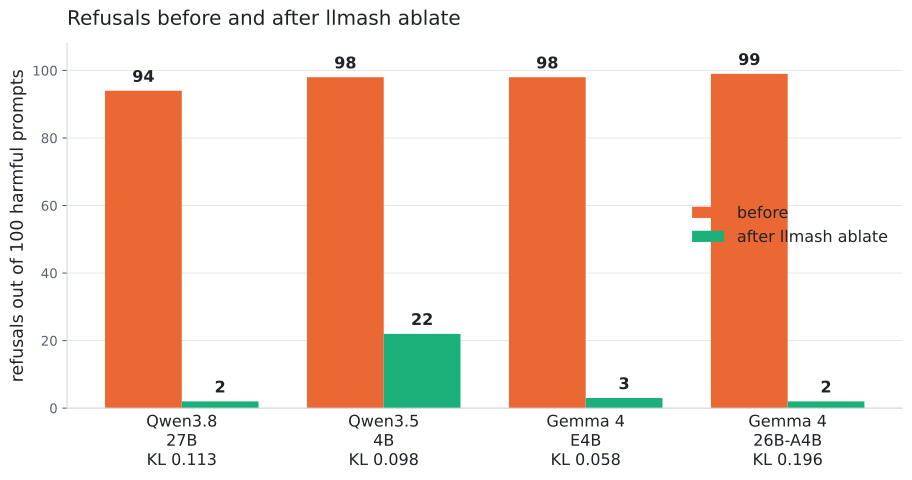
Refusals are counted on 100 held-out prompts from mlabonne/harmful_behaviors
by an uncensored model reading each whole answer, so the count is a model's
judgement. KL is the shift of the first answer token from the original model
on 100 harmless prompts, and says nothing about later tokens; a 16-pass search
minimises it. Each layer gets its own direction. When the best vector still has
a high KL, nothing is written and the command says so.
Against AEON Ultimate, another Qwen3.8-27B abliteration graded the same way:
| build | refusals | what it changes | search |
|---|---|---|---|
| Qwen3.8-27B, as released | 94/100 | nothing | none |
| AEON Ultimate | 36/100 | the bf16 weights | 50 trials on an H200 |
| llmash ablate | 2/100 | a 1.2 MB sidecar | 16 passes, 70 s on one RTX PRO 6000 |
The prompt sets are fetched and cached on first use. Over a pipe, from an agent
or over SSH without a terminal, --yes is required.
The search is llama-ablate, a tool in llmash's runtime. Source:
omgitsbase/llmash-ablate.
Speculation
A model carrying an MTP head drafts for itself. For a model without one, run
asks once whether to look for a drafter on Hugging Face, and pulldraft looks
when asked. The search identifies the model from its own header, takes a drafter
trained for that exact model, and offers a choice when several fit:
- an EAGLE-3, DFlash, DSpark or plain draft model published for it;
- Gemma 4's assistant drafter, published by Google for each Gemma 4 model;
- the MTP head out of a full build that carries one (an
-MTPGGUF): only the head's own layer is fetched (258 MB for a 9B); the embedding and output are copied from the model on disk; - for a fine-tune with nothing under its own name, the drafters of the model it was tuned from, marked as such. They share its vocabulary and accept fewer tokens.
Each is checked against the weights before anything downloads. One sidecar
serves every build of its model. pulldraft MODEL hf.co/ORG/REPO names a
drafter instead of searching. A model with no drafter drafts by n-gram lookup
(LLMASH_SPEC_FALLBACK), which only speeds up text already in the conversation.
Commands
list ps show run pull cp stop |
as in Ollama |
rm, remove |
remove a model by its name or any part of it |
start |
start llmash in the background with its tray icon (Windows) |
serve |
run the server in this console; --host, --port, --ctx, --kv, --gpu-budget, --verbose |
ctx |
the context a model runs at, up to 4x its trained length under YaRN; --kv, --keep, --release |
pulldraft |
find and install a draft model for a model on the machine; pulldraft MODEL REPO takes a named one |
rco convert |
assemble a custom build from a model on disk |
ablate, abliterate |
remove a model's refusals; pull MODEL --ablate does it on pull |
models |
list every folder models are read from; set points llmash at one; ignore drops a found one |
doctor |
check the install, runtime, GPU, models and routes |
update |
install the latest push to main (the edge build); --stable the latest release; --force reinstalls |
launch |
point Claude Code, OpenCode, Hermes Agent, OpenClaw, Codex, Droid and others at this server |
link |
expose the API over a Tailscale funnel, with a key |
uninstall |
remove everything the installer created |
ollama is installed as an alias.
Configuration
Optional. local.json beside the program, or environment variables; a variable
wins over the file.
OLLAMA_MODELS, LLMASH_MODELS |
the models directory: a store, or a folder of GGUFs read in place |
LLMASH_PORT |
local API port (default 11434) |
LLMASH_CTX |
default context length (default 8192) |
LLMASH_KV |
K/V cache type: auto (default: FP8 when the model carries cache scales, as vLLM does, else f16), f16, q8_0, f8_e4m3 |
LLMASH_YARN_MAX |
how far past its trained context a model may run under YaRN (default 4) |
LLMASH_GPU_BUDGET_GB |
what one process may hold on the card, instead of what commit charge allows |
LLMASH_VRAM_HEADROOM |
what to leave free on the cards when fitting (default 8% of them, 1 to 6 GB) |
LLMASH_PARALLEL |
server slots (default 1); above 1, each slot gets a cache of its own |
LLMASH_SIDE_SLOT |
0 to drop the second slot that shares a single slot's cache (default on) |
LLMASH_PIN |
comma-separated models never evicted |
LLMASH_FP4 |
1 or 0: whether every card runs FP4, instead of asking nvidia-smi |
LLMASH_SPEC_FALLBACK |
drafter for models without one (default ngram-mod; none for no drafting) |
LLMASH_MTP_DRAFT |
tokens an MTP head drafts per round (default 3) |
LLMASH_PREFER_DFLASH |
draft with a DFlash drafter beside the model even when it has an MTP head |
LLMASH_TUNE_OFF |
disable individual tuning: cache-reuse,cache-ram,batch,prio |
LLMASH_RCO_THREADS |
cores a custom build may quantize on (default: all but one) |
local.json takes the same keys, plus per-model ones: ctx_override,
ctx_max, fit (a model's cache type), pin, launch_extra (extra
llama-server flags by name fragment), no_mmproj, runtime (another
llama-server by name fragment), extra_roots and ignore_roots (folders to
read, and found folders not to), and gguf_dir (where pulled GGUFs go).
llmash serve --help lists the rest.
Building
Windows: Visual Studio 2022 with the C++ workload; CMake comes with it.
python build.py                 # dist/llmash-win-x64.zip, and the Linux tarball when Docker is there
python build.py --here          # ...and run this checkout on it
python build.py --publish TAG   # both, with both test runs, uploaded to release TAG if they pass
Linux: cpp/build-linux.sh in the container from cpp/Dockerfile.test, and
cpp/run-tests.sh for the tests. bench/bench.py measures a build on a
provider and bench/charts.py redraws the charts and tables.
License
Apache-2.0.
Explore related projects
affaan-m/ECC
The agent harness performance optimization system. Skills, instincts, memory, security, and research-first development for Claude Code, Codex, Opencode, Cursor and beyond.
300,253 starsNousResearch/hermes-agent
The agent that grows with you
262,082 starsmultica-ai/andrej-karpathy-skills
A single CLAUDE.md file to improve Claude Code behavior, derived from Andrej Karpathy's observations on LLM coding pitfalls.
231,373 starsfirecrawl/firecrawl
Supercharge your AI agents with data from the web and beyond. Building the library for superintelligence. 🔥
199,847 stars