
oiov/vmail
oiov/vmail has 1,498 GitHub stars and 394 forks. GitHot measured -1 stars in 24 hours. Last checked 2026-11-07 05:52 UTC. Last push 2026-10-18.
📫 只需一个域名部署临时邮箱到 Cloudflare Worker,支持收发邮件,使用 D1 保存数据,支持多域名后缀,密码找回,开放API接口。
Measured star growth
- in 24h
- -1
- in 7 days
- Update delayed
- in 15 days
- Update delayed
- in 1 month
- Update delayed
Net star changes over overlapping periods, not daily totals. Missing measurements are left blank. Stars measure attention, not software quality.
README_en.md
OriginalUpgrading to v3.2.1? Read the upgrade guide. Anonymous API keys, old mailbox passwords and pagination changed. Run pnpm setup:check and configure mailbox signing, OAuth and the first administrator before deployment. See CHANGELOG for release notes.
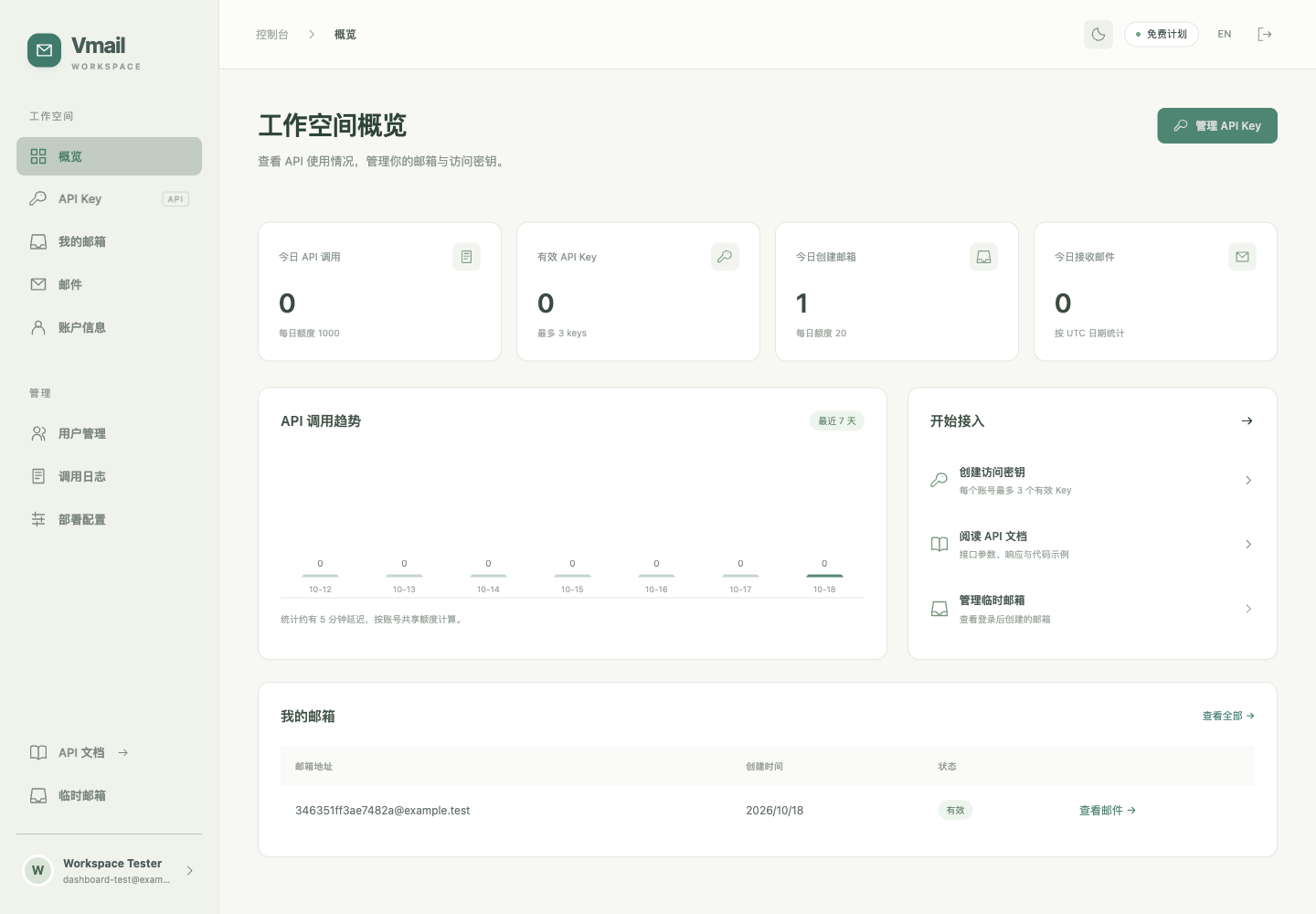
Dashboard preview
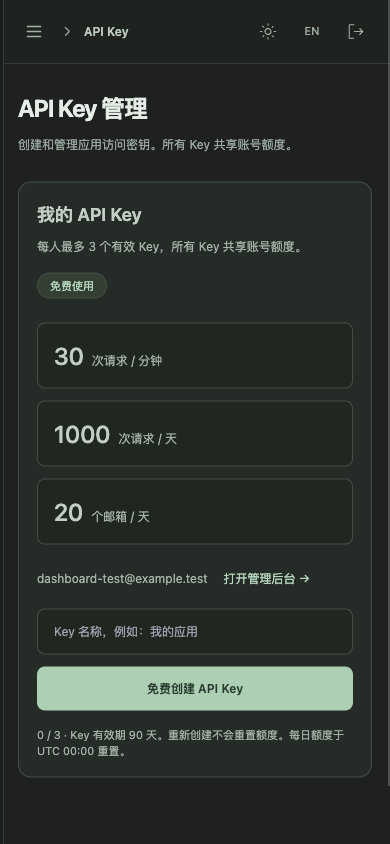
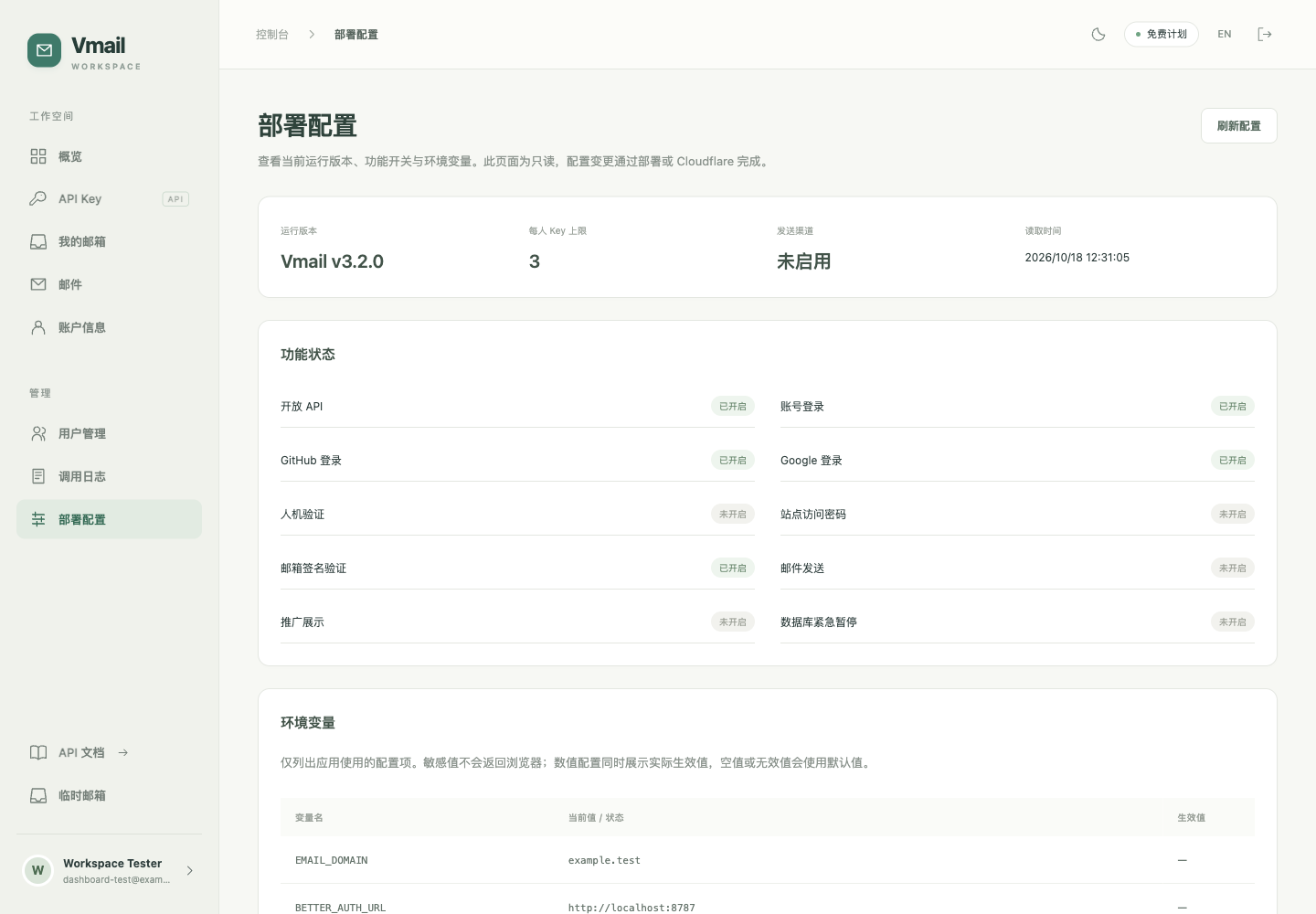
Manage API keys, mailboxes, messages and account information on separate pages. Administrators have dedicated user management and request log pages. The dashboard defaults to dark mode with a persistent light-mode switch. API documentation is public.
Actual screenshots from a local demo account, with no real user details or access secrets.
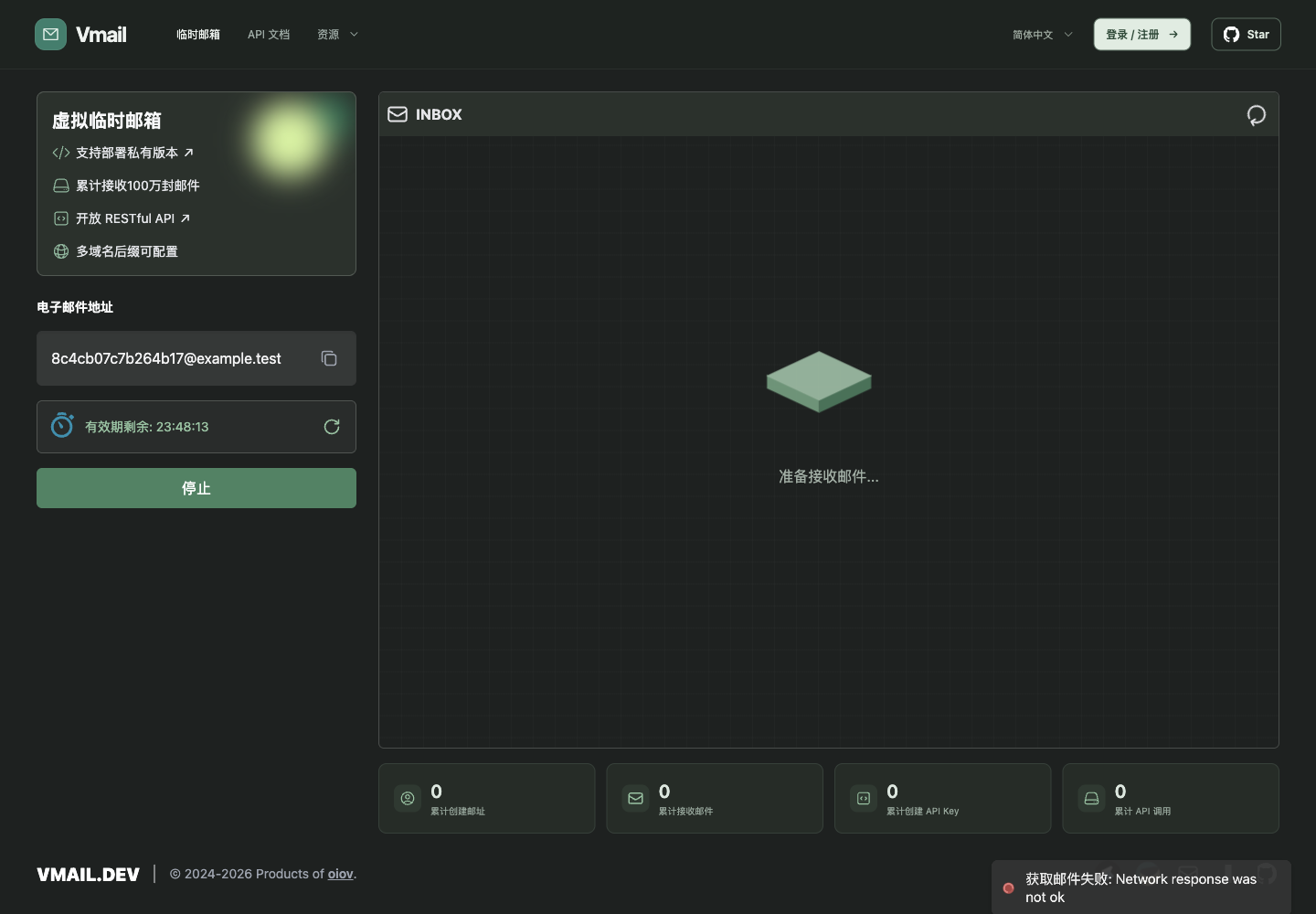
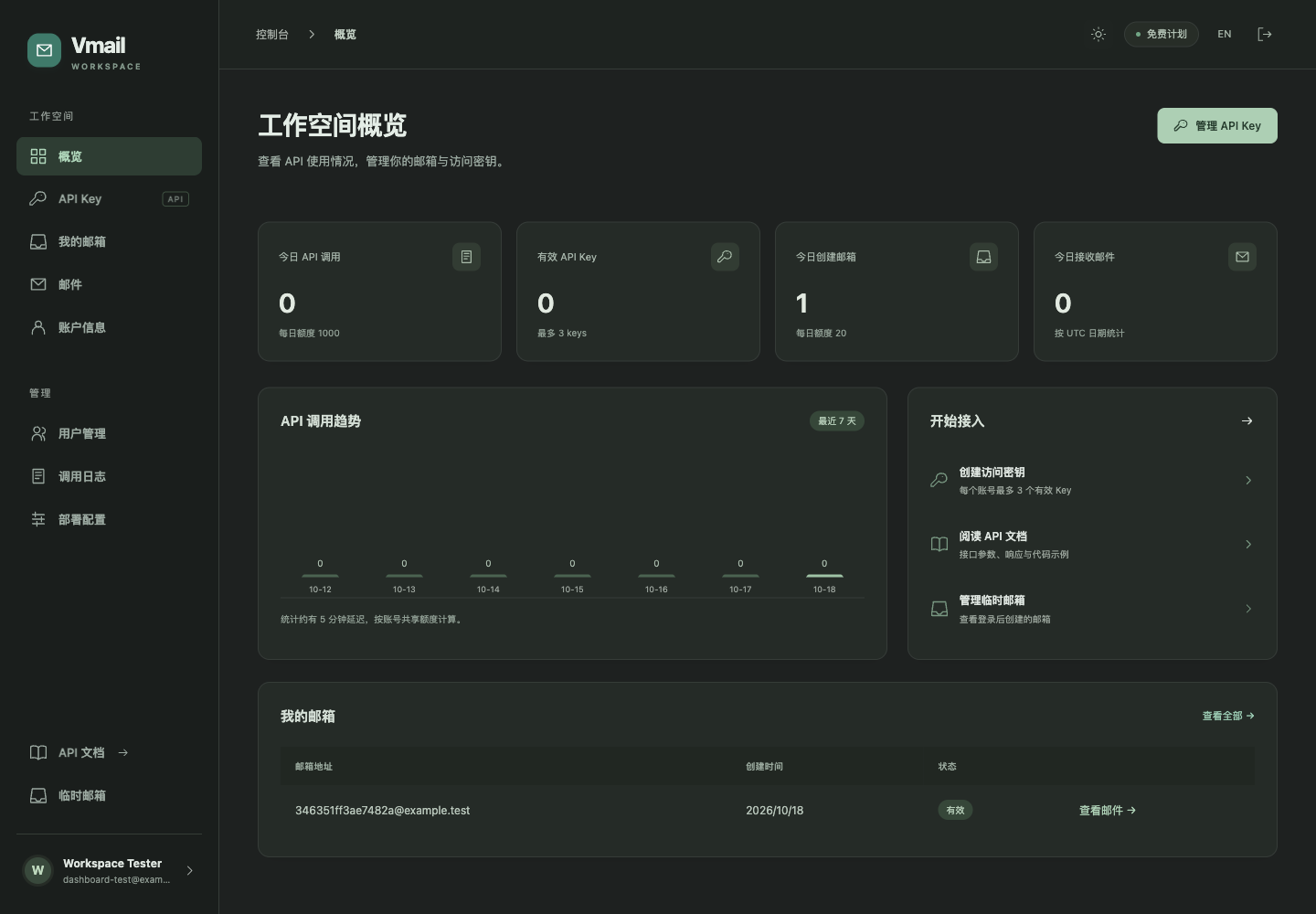
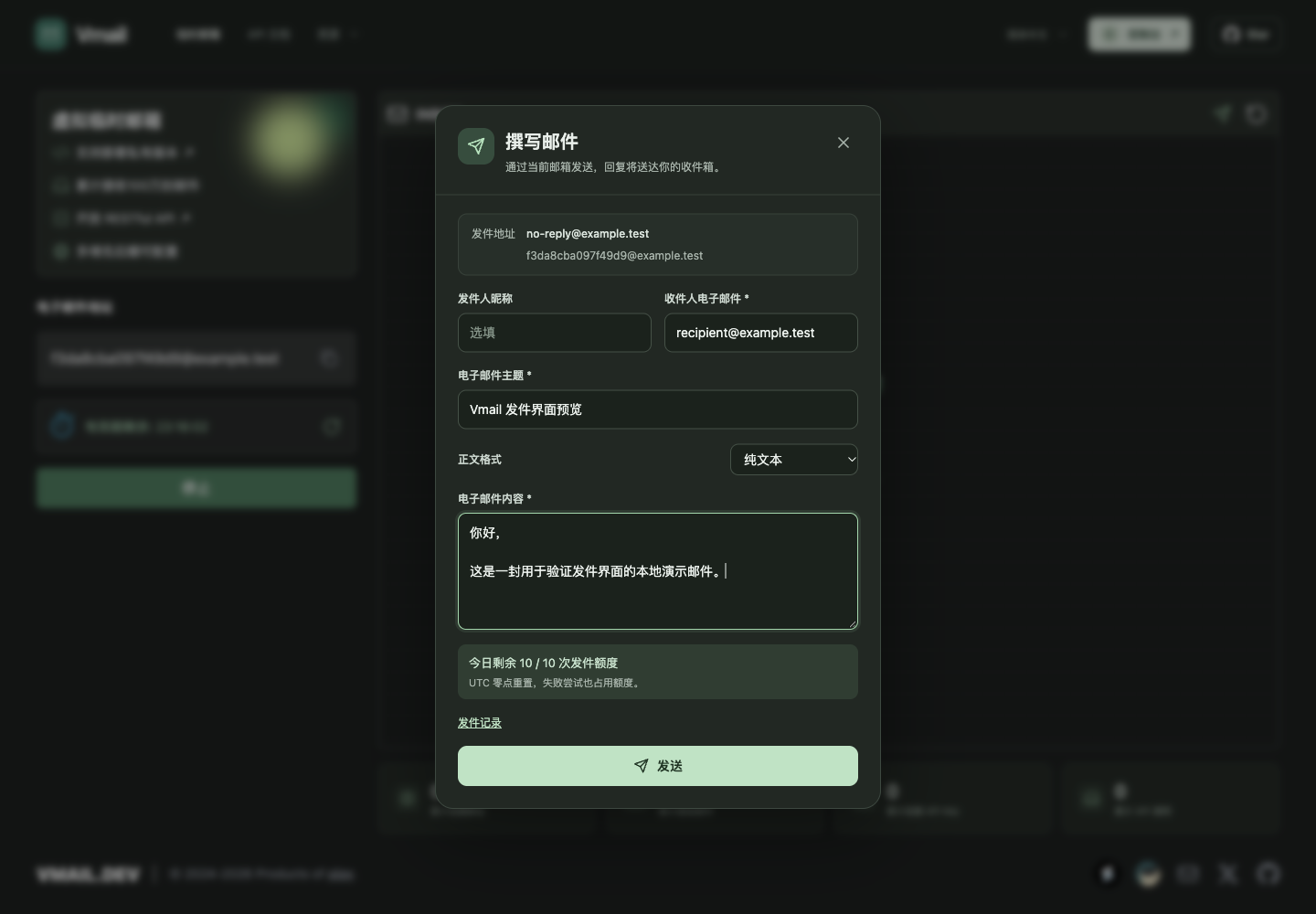
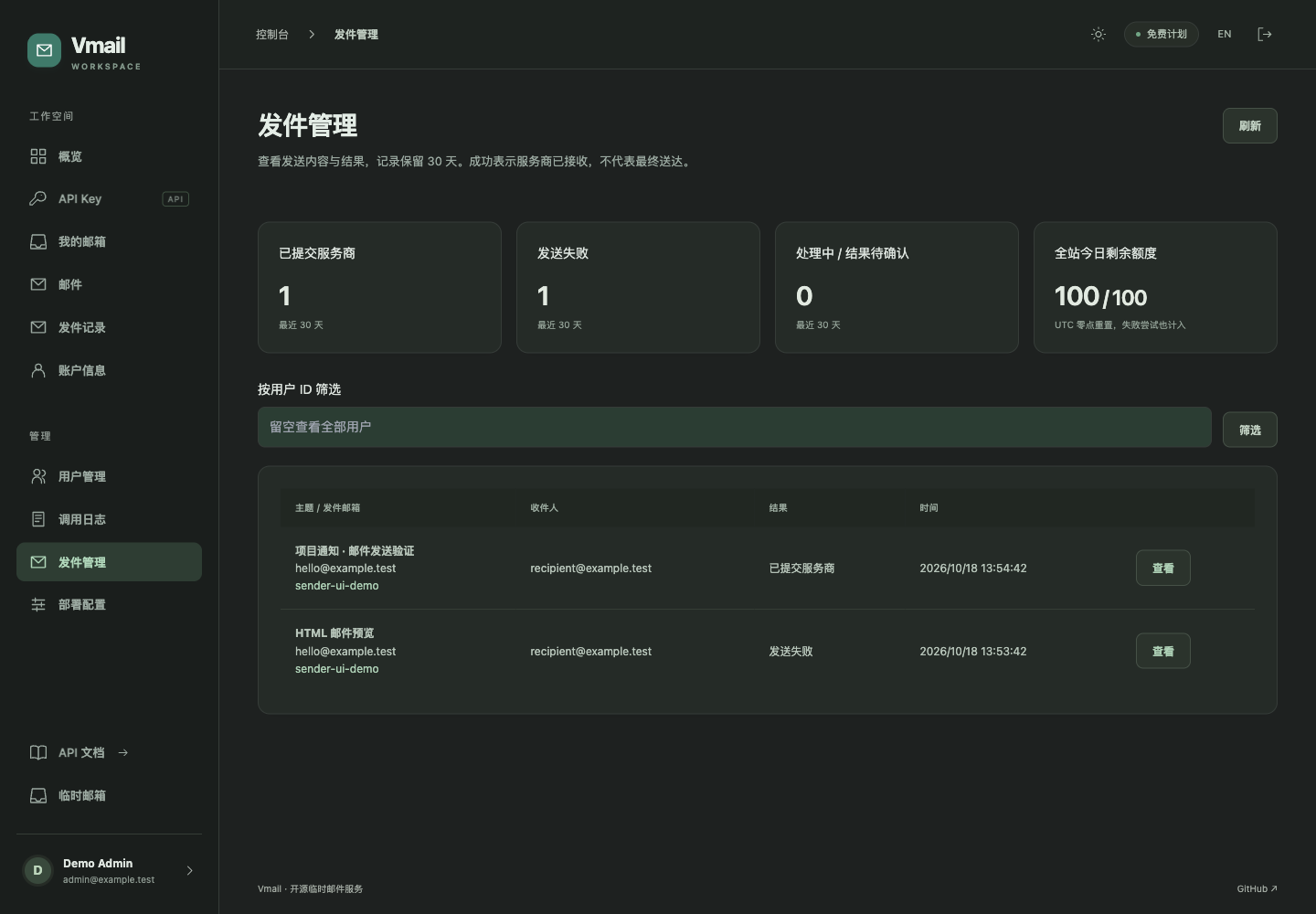
Light theme and mobile view
Features
- 🎯 Anonymous mailbox creation and receiving; sign-in required for sending and API keys
- ✈️ Support email sending and receiving
- ✨ Save server-issued credentials to restore unexpired mailboxes
- 😄 Support multiple domain name suffixes
- 🔌 Open RESTful API, support programmatic access
- 🚀 100% open source, quick deployment, pure Cloudflare solution, no server required
Principles:
- Receiving emails (Cloudflare Email Worker)
- Display email (Vite + React, assets served by the Worker)
- Mail Storage (Cloudflare D1)
- Send email using Resend, MailChannels, or Cloudflare native email
📖 API Documentation
Vmail provides a complete RESTful API for programmatic access to create temporary mailboxes and query inboxes.
Get API Key
Sign in to the API key dashboard to create a free API key. The API documentation remains public.
API Endpoints
| Method | Endpoint | Description |
|---|---|---|
POST |
/api/v1/mailboxes |
Create temporary mailbox |
GET |
/api/v1/mailboxes/:id |
Get mailbox information |
GET |
/api/v1/mailboxes/:id/messages |
Get inbox (with pagination) |
GET |
/api/v1/mailboxes/:id/messages/:messageId |
Get message details |
DELETE |
/api/v1/mailboxes/:id/messages/:messageId |
Delete message |
Quick Start
# 1. Create temporary mailbox
curl -X POST https://vmail.dev/api/v1/mailboxes \
  -H "X-API-Key: your-api-key" \
  -H "Content-Type: application/json"

# Response: { "data": { "id": "abc123", "address": "[email protected]", ... } }

# 2. Query inbox
curl https://vmail.dev/api/v1/mailboxes/abc123/messages \
  -H "X-API-Key: your-api-key"

# 3. Get message details
curl https://vmail.dev/api/v1/mailboxes/abc123/messages/msg_001 \
  -H "X-API-Key: your-api-key"
Full documentation: https://vmail.dev/api-docs
Self-hosted Tutorial
This project is based on Cloudflare Workers and Cloudflare D1. All you need is a domain name hosted on Cloudflare.
Requirements
- Cloudflare account and a domain name hosted on Cloudflare
- Local installation of Node.js (version >= 22.x) and pnpm
Automatic Deployment (Recommended)
This project includes a pre-configured GitHub Action workflow to help you automatically deploy the Vmail application to Cloudflare.
For detailed steps, please refer to the GitHub Action Auto-Deployment Tutorial.
Manual deployment
Clone and install:
git clone https://github.com/oiov/vmail
cd vmail
pnpm install --frozen-lockfile
cp .env.example .env
Create a Cloudflare D1 database and fill
.envwith its name/ID, mailbox domains and secrets. UseCLOUDFLARE_API_TOKEN/CLOUDFLARE_ACCOUNT_ID(orCF_API_TOKEN/CF_ACCOUNT_ID), or authenticate withpnpm exec wrangler login. The token needs Worker deployment and D1 migration permissions.Configure OAuth callbacks, bootstrap admins and optional features, then run:
pnpm setup:check
pnpm deploy
The script validates, tests, typechecks, builds, applies D1 migrations and deploys Worker assets and Durable Objects. Keep the source
wrangler.tomlplaceholders; the script generates the ignored, secret-freewrangler.deploy.tomland uploads secrets separately. Cloudflare Pages variables do not configure this Workers project.Match the site custom domain to
BETTER_AUTH_URL. Enable Email Routing on mailbox domains and set Catch-all → Send to a Worker to this Worker; complete DNS setup.
Environment variables
Configuration comes from .env.example and scripts/configure.mjs. Manual deployments use an untracked .env; Actions uses repository Secrets/Variables. See the deployment guide for exact mappings. Dashboard edits may be overwritten by the next deployment.
Core configuration
| Variable | Description |
|---|---|
D1_DATABASE_NAME/D1_DATABASE_ID |
Required D1 name and ID; preserve on upgrade |
EMAIL_DOMAIN |
Required allowed mailbox domains, comma-separated |
MAILBOX_TOKEN_SECRET |
Required for every deployment; independent random secret of at least 32 characters; preserve to keep mailbox tokens valid |
TURNSTILE_KEY/TURNSTILE_SECRET |
Optional; configure both or leave both empty |
PASSWORD |
Optional site password; does not replace OAuth or mailbox tokens |
SHOW_AFF |
Default false; true enables promotional UI |
ENABLE_OPENAPI |
Default false; true enables /api/v1/* and API key creation; does not hide public docs or control web sending |
SUSPEND_DATABASE_ACCESS |
Default false; true pauses HTTP database paths, inbound mail and cleanup; queued statistics may still write |
OAuth and administrators
| Variable | Description |
|---|---|
BETTER_AUTH_URL |
HTTPS site origin, e.g. https://mail.example.com, without a path; local .dev.vars may use http://localhost:8787 |
BETTER_AUTH_SECRET |
Independent random session signing secret, at least 32 characters |
API_KEY_SECRET |
Independent random API key signing secret, at least 32 characters; rotation invalidates existing keys |
GITHUB_CLIENT_ID/GITHUB_CLIENT_SECRET |
GitHub OAuth App credentials; use GH_OAUTH_CLIENT_ID / GH_OAUTH_CLIENT_SECRET in Actions |
GOOGLE_CLIENT_ID/GOOGLE_CLIENT_SECRET |
Google OAuth Web application credentials |
ADMIN_EMAILS |
Optional comma-separated verified OAuth emails for bootstrap admins; other new users have role user |
Sign-in, API keys and web sending require complete OAuth configuration for both providers, even when public API access stays disabled. Deployment validation requires it when ENABLE_OPENAPI=true. Anonymous mailbox creation and receiving do not require OAuth.
| Provider | Callback URL |
|---|---|
| GitHub | https://mail.example.com/api/auth/callback/github |
https://mail.example.com/api/auth/callback/google |
Replace the example origin with BETTER_AUTH_URL. Set Google Authorized JavaScript origins to the site origin and add test users while in Testing mode. Set your verified email in ADMIN_EMAILS before signing in to /dashboard/admin/users; the first registered user is not automatically an admin.
Quotas and cost controls
| Variable | Default | Scope |
|---|---|---|
API_RATE_LIMIT_PER_MINUTE |
30 | API requests per user per minute, shared across keys |
API_DAILY_LIMIT |
1000 | API requests per user per day |
MAILBOX_DAILY_LIMIT |
20 | API mailbox creations per user per day |
MAX_ACTIVE_MAILBOXES |
20 | Active mailboxes per user |
GLOBAL_API_DAILY_LIMIT |
100000 | Daily HTTP database-path budget, including web and auth; 16 fixed shards |
GLOBAL_INBOUND_DAILY_LIMIT |
100000 | Daily inbound email budget across 16 fixed shards |
MAILBOX_INBOUND_DAILY_LIMIT |
100 | Inbound messages per mailbox per day |
MAX_EMAIL_BYTES |
262144 | Maximum inbound message size in bytes (256 KiB) |
SEND_USER_DAILY_LIMIT |
10 | Daily sending attempts per user, shared across mailboxes |
SEND_GLOBAL_DAILY_LIMIT |
100 | Daily sending attempts across the site, separate from inbound budget |
SEND_RATE_LIMIT_PER_MINUTE |
3 | Sending attempts per user and per mailbox per minute (runtime cap 1,000) |
SEND_IP_RATE_LIMIT_PER_MINUTE |
10 | Sending attempts per IP per minute (runtime cap 1,000) |
Numeric settings must be positive integers. Daily quotas reset at 00:00 UTC. Each user can hold 3 active API keys, valid for 90 days; the key count is not an environment variable. Anonymous web use also has 20 creations and 3,000 requests per IP daily, plus 30 requests/minute and 3,000/day per mailbox. Busy global shards may exhaust early. These limits are not a hard cap on the Cloudflare bill.
Sending configuration
| Variable | Description |
|---|---|
SEND_CHANNEL |
Empty disables sending; resend / mailchannels / cloudflare; send_email is a legacy alias |
SENDER_EMAIL |
Required for sending; fixed provider-approved sender; temporary mailbox is Reply-To |
RESEND_API_KEY |
Required only for resend |
MAILCHANNELS_API_KEY |
Required only for mailchannels |
Sending requires a signed-in, non-banned user and a valid mailbox token. Provider failures consume quota; Durable Objects enforce limits before D1 send-log writes. Users view /dashboard/outbound; admins review the site at /dashboard/admin/outbound. Native Cloudflare sending uses SEND_EMAIL and requires Email Routing and Cloudflare recipient/sender permissions; arbitrary recipients are not guaranteed.
COOKIES_SECRET belongs to the legacy frontend mailbox-password scheme and is unused by the deployment script; new deployments do not need it. The three signing secrets serve different purposes.
Local development
Use independent test secrets. Wrangler reads local bindings from .dev.vars; the deployment script reads .env. Keep these separate.
cp .dev.vars.example .dev.vars
# Fill local signing secrets before starting.
pnpm exec wrangler d1 migrations apply DB --local
pnpm dev
Open http://localhost:8787. pnpm dev builds and serves the frontend through Wrangler; it does not start Vite HMR. Run pnpm frontend:dev separately for HMR. Use the same-origin 8787 entry and matching callbacks for OAuth/sending. Local D1/DO are simulated; a remote database is not required. pnpm setup:check validates deployment .env; use pnpm test and pnpm typecheck for code checks.
Community Group
- Discord: https://discord.gg/d68kWCBDEs
License
GNU General Public License v3.0
Star History
Sending authorization, quotas and audit
After upgrading, /api/send requires a signed-in session, valid mailbox token and same-site Origin. Anonymous mailbox holders must sign in first. Banned accounts and mailboxes owned by another account are rejected.
New settings: SEND_USER_DAILY_LIMIT=10 and SEND_GLOBAL_DAILY_LIMIT=100. Attempts, including provider failures, consume quota. User quotas span mailboxes and reset at 00:00 UTC. Existing mailbox/IP minute limits remain; the mailbox minute limit also applies per user. Durable Objects atomically reserve quota before provider dispatch.
Apply 0006_outbound_logs.sql before deployment (the deployment script does this). Users view their own mail at /dashboard/outbound; admins review all content and filter by user at /dashboard/admin/outbound. Subject, body, addresses and result are retained for 30 days, with hourly cleanup. HTML is sandboxed and remote resources are blocked. Success means provider acceptance, not delivery; pending may mean an unconfirmed result, so do not automatically retry.
Explore related projects
codecrafters-io/build-your-own-x
Master programming by recreating your favorite technologies from scratch.
560,800 starspublic-apis/public-apis
A collective list of free APIs
497,028 starsmorluto/rea
Reverse engineer anything with agents, from app behavior down to native binaries.
441,107 starsopenclaw/openclaw
The AI that really does things. Any OS. Any Platform. The lobster way. 🦞
394,147 stars