
nvim-telescope/telescope-fzf-native.nvim
nvim-telescope/telescope-fzf-native.nvim has 1,762 GitHub stars and 70 forks. GitHot measured 0 stars in 24 hours and +1 in 7 days. Last checked 2026-11-11 15:44 UTC. Last push 2026-05-06.
FZF sorter for telescope written in c
Measured star growth
- in 24h
- 0
- in 7 days
- +1
- in 15 days
- Update delayed
- in 1 month
- Update delayed
Net star changes over overlapping periods, not daily totals. Missing measurements are left blank. Stars measure attention, not software quality.
README.md
Originaltelescope-fzf-native.nvim
fzf-native is a c port of fzf. It only covers the algorithm and
implements few functions to support calculating the score.
This means that the fzf syntax is supported:
| Token | Match type | Description |
|---|---|---|
sbtrkt |
fuzzy-match | Items that match sbtrkt |
'wild |
exact-match (quoted) | Items that include wild |
^music |
prefix-exact-match | Items that start with music |
.mp3$ |
suffix-exact-match | Items that end with .mp3 |
!fire |
inverse-exact-match | Items that do not include fire |
!^music |
inverse-prefix-exact-match | Items that do not start with music |
!.mp3$ |
inverse-suffix-exact-match | Items that do not end with .mp3 |
A single bar character term acts as an OR operator. For example, the following
query matches entries that start with core and end with either go, rb,
or py.
^core go$ | rb$ | py$
This is an advantage over the more simpler fzy algorithm, which is also
available for telescope (as native component or as lua component).
Installation
To get fzf-native working, you need to build it with either cmake or make. As of now, we do not ship binaries.
Both install methods will be supported going forward.
CMake (Windows, Linux, MacOS)
This requires:
- CMake, and the Microsoft C++ Build Tools on Windows
- CMake, make, and GCC or Clang on Linux and MacOS
vim-plug
Plug 'nvim-telescope/telescope-fzf-native.nvim', { 'do': 'cmake -S. -Bbuild -DCMAKE_BUILD_TYPE=Release && cmake --build build --config Release --target install' }
packer.nvim
use { 'nvim-telescope/telescope-fzf-native.nvim', run = 'cmake -S. -Bbuild -DCMAKE_BUILD_TYPE=Release && cmake --build build --config Release --target install' }
lazy.nvim
{ 'nvim-telescope/telescope-fzf-native.nvim', build = 'cmake -S. -Bbuild -DCMAKE_BUILD_TYPE=Release && cmake --build build --config Release --target install' }
Make (Linux, MacOS, Windows with MinGW)
This requires gcc or clang and make
vim-plug
Plug 'nvim-telescope/telescope-fzf-native.nvim', { 'do': 'make' }
packer.nvim
use { 'nvim-telescope/telescope-fzf-native.nvim', run = 'make' }
lazy.nvim
{ 'nvim-telescope/telescope-fzf-native.nvim', build = 'make' }
Telescope Setup and Configuration
-- You dont need to set any of these options. These are the default ones. Only
-- the loading is important
require('telescope').setup {
  extensions = {
    fzf = {
      fuzzy = true,                    -- false will only do exact matching
      override_generic_sorter = true,  -- override the generic sorter
      override_file_sorter = true,     -- override the file sorter
      case_mode = "smart_case",        -- or "ignore_case" or "respect_case"
                                       -- the default case_mode is "smart_case"
    }
  }
}
-- To get fzf loaded and working with telescope, you need to call
-- load_extension, somewhere after setup function:
require('telescope').load_extension('fzf')
Developer Interface
This section is only addressed towards developers who plan to use the library (c or lua bindings). This section is not addressed towards users of the telescope extension.
C Interface
fzf_slab_t *slab = fzf_make_default_slab();
/* fzf_case_mode enum : CaseSmart = 0, CaseIgnore, CaseRespect
 * normalize bool     : always set to false because its not implemented yet.
 *                      This is reserved for future use
 * pattern char*      : pattern you want to match. e.g. "src | lua !.c$
 * fuzzy bool         : enable or disable fuzzy matching
 */
fzf_pattern_t *pattern = fzf_parse_pattern(CaseSmart, false, "src | lua !.c$", true);

/* you can get the score/position for as many items as you want */
int score = fzf_get_score(line, pattern, slab);
fzf_position_t *pos = fzf_get_positions(line, pattern, slab);

fzf_free_positions(pos);
fzf_free_pattern(pattern);
fzf_free_slab(slab);
Lua Interface
local fzf = require('fzf_lib')

local slab = fzf.allocate_slab()
-- pattern: string
-- case_mode: number with 0 = smart_case, 1 = ignore_case, 2 = respect_case
-- fuzzy: enable or disable fuzzy matching. default true
local pattern_obj = fzf.parse_pattern(pattern, case_mode, fuzzy)

-- you can get the score/position for as many items as you want
-- line: string
-- score: number
local score = fzf.get_score(line, pattern_obj, slab)

-- table (does not have to be freed)
local pos = fzf.get_pos(line, pattern_obj, slab)

fzf.free_pattern(pattern_obj)
fzf.free_slab(slab)
Disclaimer
This projects implements fzf algorithm in c. So there might be differences in matching. I don't guarantee completeness.
TODO
Stuff still missing that is present in fzf.
- normalize
- case for unicode (i don't think this works currently)
Benchmark
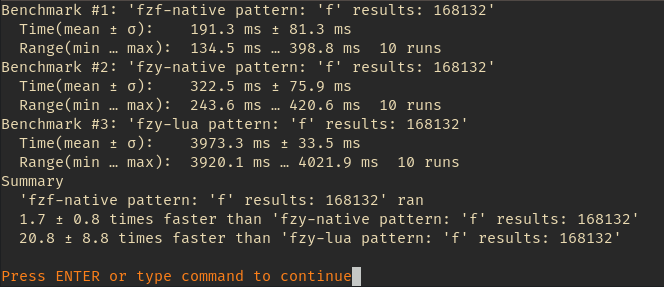
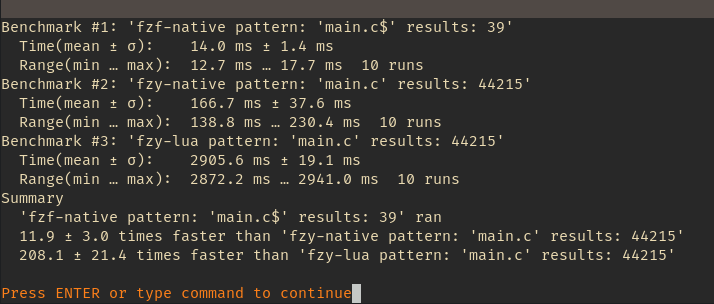
Comparison with fzy-native and fzy-lua with a table containing 240201 file strings. It calculated the score and position (if score > 0) for each of these strings with the pattern that is listed below:
Credit
All credit for the algorithm goes to junegunn and his work on fzf. This is merely a c fork distributed under MIT for telescope.
Explore related projects
codecrafters-io/build-your-own-x
Master programming by recreating your favorite technologies from scratch.
561,922 starspublic-apis/public-apis
A collective list of free APIs
498,311 starsmorluto/rea
Reverse engineer anything with agents, from app behavior down to native binaries.
453,272 starsopenclaw/openclaw
The AI that really does things. Any OS. Any Platform. The lobster way. 🦞
394,374 stars