
nsaintot/cdj3k-emu
nsaintot/cdj3k-emu has 353 GitHub stars and 39 forks. GitHot measured +8 in 7 days and +16 in 15 days. Last checked 2026-11-10 21:18 UTC. Last push 2026-11-02.
An emulator for the Linux based CDJs in QEMU, with emulated SPI controls, jog LCD, USB, PC-LINK and Pro DJ Link network
Measured star growth
- in 24h
- Update delayed
- in 7 days
- +8
- in 15 days
- +16
- in 1 month
- Update delayed
Net star changes over overlapping periods, not daily totals. Missing measurements are left blank. Stars measure attention, not software quality.
README.md
Original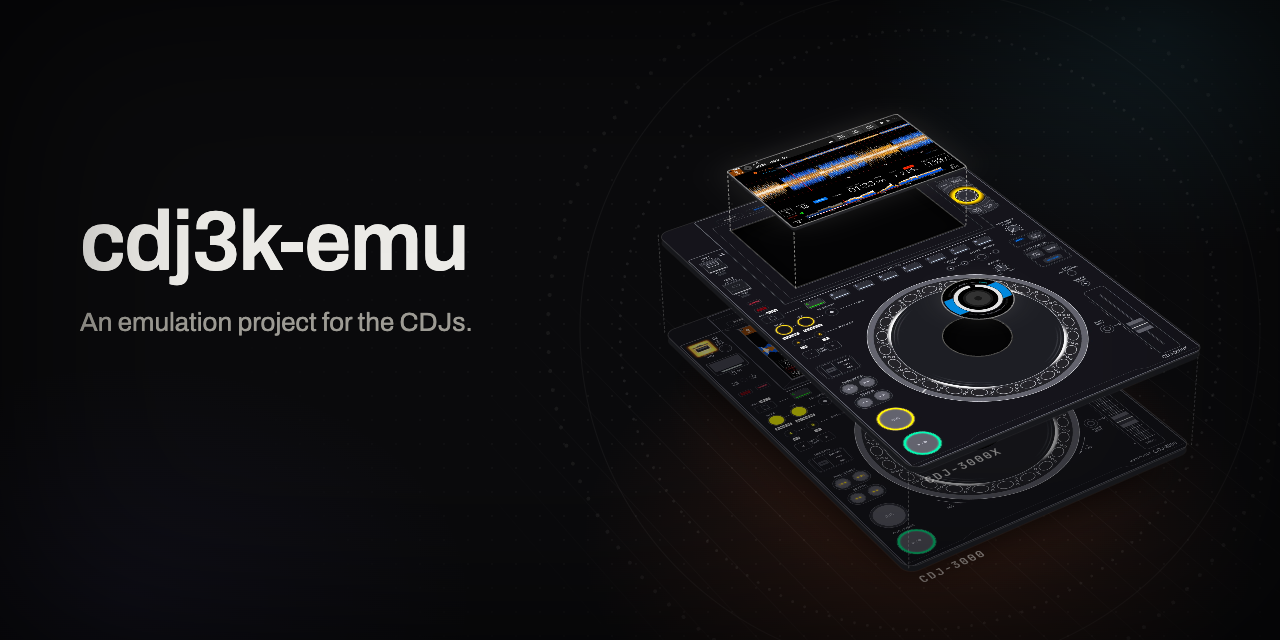
A desktop app for macOS, Linux and Windows that boots a CDJ's firmware inside QEMU and shows the device's main LCD, jog LCD, jog wheel, faders, buttons, USB, PC-Link, and Pro DJ Link network in a native window.
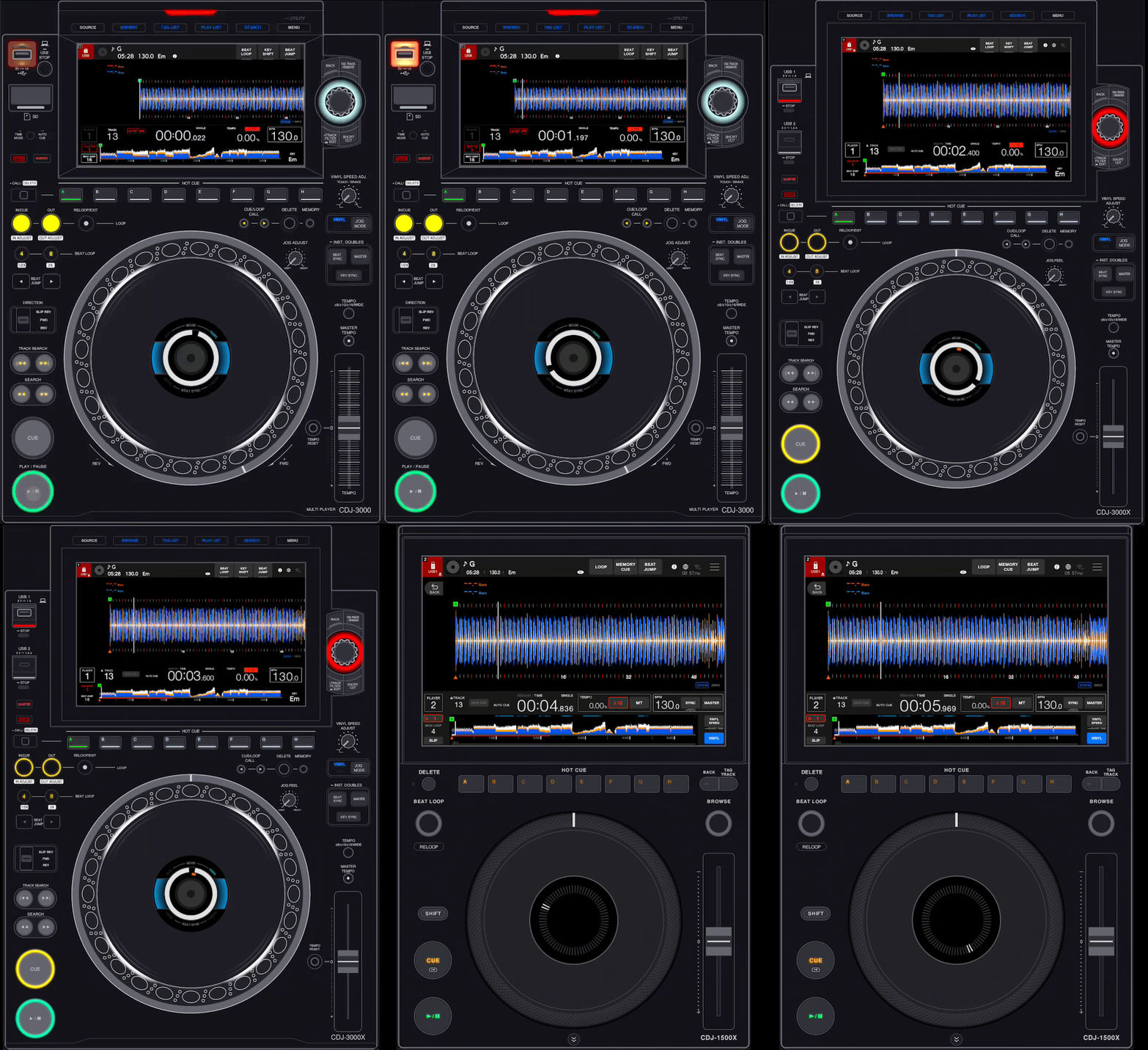 The emulated players' slates · full preview |
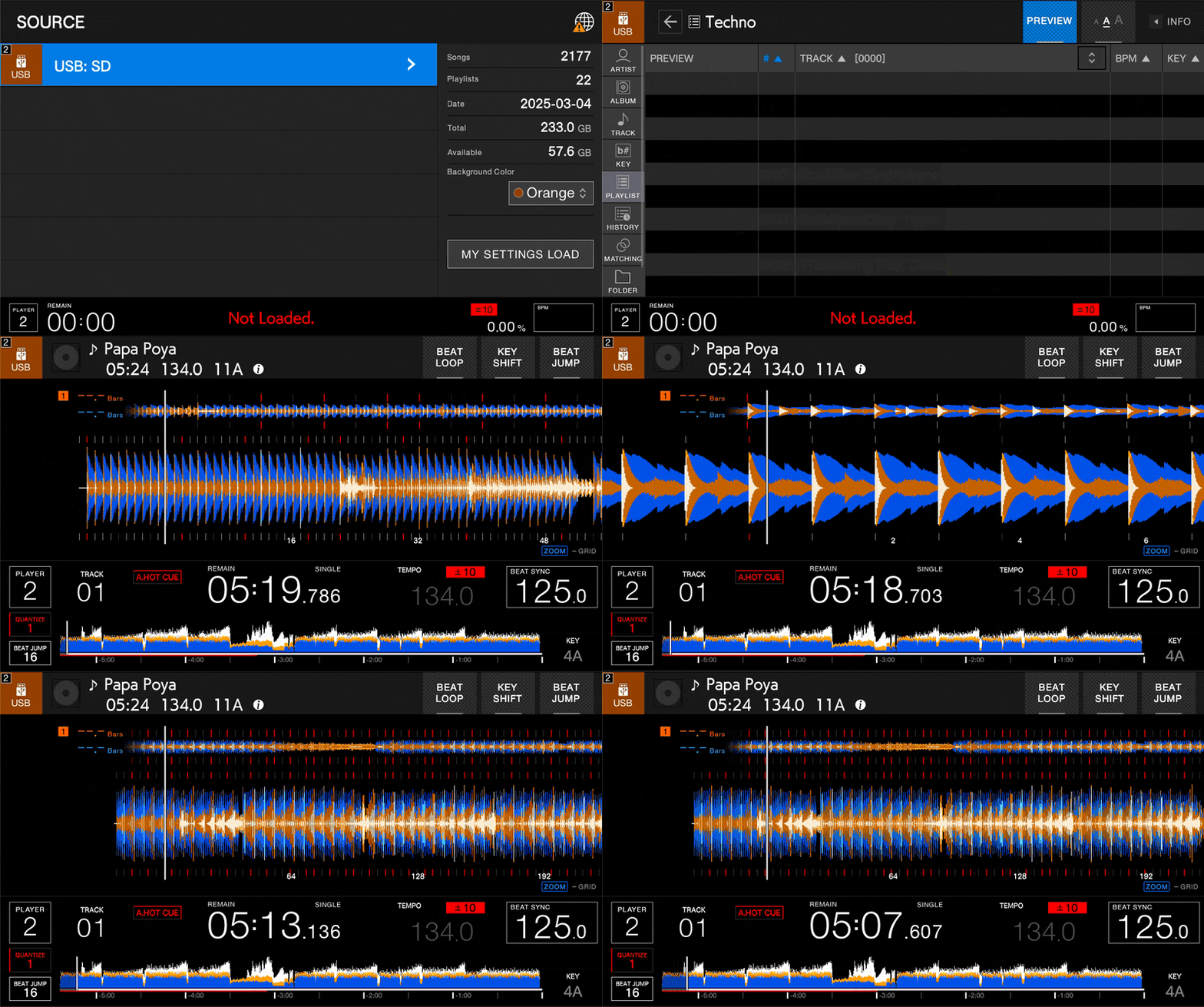 Interacting with the firmware and controls |
Why this exists
The project exists mainly for the technical challenge of putting a piece of proprietary, tightly coupled DJ hardware on a host hypervisor while its real firmware keeps working. The interesting parts are the small surfaces between a stock Linux kernel and the Pioneer userspace: DRM/KMS for the jog LCD, the SPI sub-CPU protocol for the controls, and the virtio-snd cadence that EP122's audio callback expects.
A secondary goal is a reproducible bench for studying the Pro DJ Link (DJPL) network protocol: beat broadcasts, the master/slave hand-off, abs-pos sync, and the relationship between audible playback and what other players see on the wire. Several emulator slots on the same host let you observe both ends of a sync transaction with a packet capture between them, which is harder to do with real CDJs on a physical LAN.
[!TIP]
What it is
- A user-space wrapper around QEMU
aarch64-virtrunning a vanilla Linux 6.6 kernel, with a small set of out-of-tree modules and an LD_PRELOAD shim that emulate the Pioneer-specific hardware:- virtio_snd for audio (custom kernel module sized for the EP122 audio callback cadence).
- subucom_virt for the SPI sub-CPU protocol (buttons, jog encoder, rotary, slider, capacitive sensors).
- deck_shim (LD_PRELOAD), which emulates the Rockchip-specific DRM/KMS ABI that EP122 expects (the jog LCD as DSI-2, vsync_time, and so on) and routes the jog LCD pixels through ivshmem so the host renders them as an egui texture.
[!CAUTION]
What it is not
- It does not ship Pioneer firmware. You need to supply your own copy of the deck's firmware update file (
.UPD) and decryption key at first launch. The in-app Install Firmware wizard decrypts it locally and provisions a per-instance eMMC qcow2 disk image under~/Library/Application Support/com.cdj3k.emu/(~/.local/share/com.cdj3k.emu/on Linux,%LOCALAPPDATA%\com.cdj3k.emu\on Windows). Nothing Pioneer-owned is in this repository or the distributed bundle.- Not endorsed by, affiliated with, or sponsored by AlphaTheta Corporation / Pioneer DJ. CDJ, rekordbox, and Pro DJ Link are trademarks of their respective owners.
- Not a frame-accurate hardware simulator. Pixel output and SPI timings are close enough to run EP122 and EP145 (the stock firmware) for everyday use.
- Not a turntable replacement. The jog wheel and rotaries are driven with pointer drags and the scroll wheel; an external MIDI controller cannot drive the emulated SPI bus.
- macOS (Apple silicon, Intel), Linux (aarch64, x86_64) and Windows (arm64, x64) only; see Platform support for what differs.
- Not compatible with pre-3.00 firmware. See Firmware compatibility below — on the CDJ-3000, only firmware 3.00 and newer is accepted.
Firmware compatibility
[!IMPORTANT]
On the CDJ-3000, cdj3k-emu accepts firmware version 3.00 or newer only.All CDJ-3000X/CDJ-1500X firmwares are supported.
Pioneer shipped two different system-on-chip families across the CDJ-3000's lifetime:
- Renesas G2M, used in firmware 1.x and 2.x. It has a different kernel, a very different driver stack and a different DRM/KMS path for the jog LCD. cdj3k-emu does not support this hardware target.
- Rockchip RK3399, used in firmware 3.00 and newer. This is the target
cdj3k-emu emulates: the vanilla Linux 6.6 aarch64 kernel, the
deck_shimLD_PRELOAD, thesubucom_virtSPI emulation and thevirtio_sndaudio pipeline are all written against the RK3399 userspace that the 3.00+ firmware ships.
If your .UPD decrypts to a Renesas G2M kernel and rootfs, the firmware
wizard rejects it before provisioning the eMMC image. Use a 3.00+ update file.
Emulated models
--model <slug> (or CDJ3K_MODEL) skips the picker; slugs are cdj3k,
cdj3kx, cdj1500x. A slot holds one installation, and its model is
persisted in the slot's settings (see Storage).
| Model | Board / kernel | Panel | Status |
|---|---|---|---|
| CDJ-3000 | RK3399, vanilla 6.6 kernel | 9-inch display | Boots, Plays, Pro DJ Link |
| CDJ-3000X | RK3399, vanilla 6.6 kernel | 10.1-inch display | Boots, Plays, Pro DJ Link |
| CDJ-1500X | RK3566, vanilla 6.6 kernel | 10.1-inch display | Boots, Plays, Pro DJ Link |
See Models and slates.
About the decryption key
Pioneer ships firmware updates as .UPD files whose payload is LUKS-encrypted.
The "decryption key" the firmware wizard asks for is the LUKS keyfile that
unlocks that payload, so the wizard can mount it and extract the kernel and
rootfs.
This repository does not ship that key, for the same reason it does not
ship the .UPD itself: it is Pioneer-controlled material that this project
has no right to redistribute. Nothing Pioneer-owned is in the repository or in
the bundle. Getting the keyfile is the user's responsibility, by whatever means
they are entitled to.
System requirements
macOS
- macOS 15 (Sequoia) or newer, one universal app.
- Apple silicon runs under HVF with Apple's in-kernel ARM vGIC
(
hv_gic_create), which removes the vCPU exit on each interrupt; those exits dominate the cost of EP122's interrupt load. If the vGIC is refused, QEMU falls back to userspace GIC emulation (kernel-irqchip=off). - Intel runs under software emulation (TCG): HVF virtualizes only x86 guests there.
Linux
- A Wayland or X11 desktop with GL 3.3, PipeWire, and udisks2.
- aarch64 with KVM (
/dev/kvm, user in thekvmgroup) runs at full speed. x86_64 runs under software emulation (TCG). /dev/shmwith 3 GiB free, and 29.1 GB free for each slot's eMMC image.
Windows
- Windows 10 2004 (build 19041) or newer, x64 or arm64; one installer per architecture.
- arm64 runs under WHPX on Windows 11 24H2 build 26100.3915 or later with the Windows Hypervisor Platform feature on (the installer enables it and asks for a restart). x64, and arm64 without that build or that feature, run under software emulation (TCG).
- Bridged Pro DJ Link through
netsh bridgeneeds Windows 11 22H2 with KB5030310; on older builds the Network Bridge is made by hand in Network Connections. - 29.1 GB free for each slot's eMMC image.
Every host
- Roughly 8 GB of free RAM to run two instances at once (3 GiB for each guest, plus the host's overhead).
- A firmware update file for a supported model, and its decryption key if it needs one.
Known limitations
- Audio is not a bit-perfect reproduction of the real hardware. The CDJ-3000
has dedicated audio silicon with its own clock domain and DSP path. The
emulator routes the firmware's PCM through
virtio_snd, then a QEMU bypass ring, then CoreAudio, PipeWire or WASAPI, which is a different pipeline. Occasional pops and transient artifacts can occur, especially under host CPU pressure or when the host device clock drifts against the guest. The pipeline mitigates this with a lock-free SPSC ring, a dedicated RT writer thread, soft-PLL clock-skew correction, a pipeline-depth watchdog and a RELEASE flush on recovery; seedocs/audio-stack.md. Steady-state output on a device at the guest's rate is clean, but it is not identical to a physical CDJ-3000. - Audio latency depends on the host audio queue depth; it is typically 30-80 ms end to end with the bundled bypass-ring patches. ALC (Audio › Enable ALC (Experimental)) shifts the alignment between the audible output and the Pro DJ Link broadcasts to compensate, but adds a little jitter. It is on by default.
- The jog wheel is good enough for cueing but has no torque feedback. The
brake stop time follows the
jog_adjustrotary as on the deck, so stops take the same time even though the touch differs. - Service Mode (Emulation › Service Mode, or
--service-mode) boots the sub-CPU test mode through an injected button sequence. It is unreliable when the emulation runs too slowly. Some test routines that read hardware-only registers, such as the fan RPM, return fixed values. - LINK MODE, where rekordbox reaches the emulated deck over the network, does not work.
- Over PC Link (USB-B), rekordbox is blocked by its own HID probing and does not connect. USB audio (UAC2) is not supported.
Controls
Jog wheel
You can control the jog wheel a few different ways:
- Click and drag the center to scratch.
- Click and drag the outside ring for a subtle pitch bend.
- Scroll the mouse wheel anywhere on the jog to bend the pitch.
- Hold Ctrl, click and drag, then release ("slingshot") to flick the wheel. A line shows the pull; the faster you pull, the more the wheel spins.
Using multiple controls at once
On a real CDJ, you can hold a button or touch the screen while doing something else, like turning the jog wheel. With a mouse, there's only one pointer, so you can hold Ctrl to "latch" a button or touchscreen press:
- Ctrl-click a button: the button stays pressed until you release Ctrl.
- Ctrl-click the LCD touchscreen: the touch stays down until you release Ctrl.
This lets you, for example, keep Search Forward held down while moving the jog wheel to search faster, just like on real hardware.
Mods
Mods change what runs on the emulated deck. Each slot has its own, installed from a file or a local folder under Emulation › Manage Emulation › Manage mods. See Mods.
Supported mods
cdj3k-mods (Smart/Gate/Preview cues, MOD SETTINGS, Themes, STEMS, X-PAD).
Developer Mode
Emulation › Developer Mode (or --dev) opens the slot's control API on TCP
port 4400 + slot and QEMU's gdb stub on port 1235 + slot. Scripts and
cdj3k-emu ctl then press buttons, touch the screen, read the lamps, compare
LCD captures with reference images, run shell commands in the guest and follow
its journal. --headless runs a slot without a window. See
Control API. cdj3k-emu ctl e2e runs the scenarios in
tests/e2e/ against ephemeral slots; see E2E scenarios.
Building
See Building for building from source on each host, and Releases and updates for CI, the release flow, its secrets and the update feeds.
First-run privilege prompts
cdj3k-emu asks for elevation only when you ask it to do one of these.
macOS
macOS asks for the admin password in three situations:
| Action | Why it elevates |
|---|---|
| Selecting a TAP interface (OpenVPN-style) for Pro DJ Link | The app creates a macOS bridge and a tap for QEMU with ifconfig, which is root-only. Both are removed when the slot stops using them or the app exits. |
| Selecting a network interface or Host-only (link-local) on macOS 15 | On macOS 15 the com.apple.developer.networking.vmnet entitlement does not cover bridged mode and keeps host-only instances apart, so the app starts the bundled socket_vmnet as root. Slots on the same interface, or on Host-only, share one daemon, which stops when the last of them stops. On macOS 27 QEMU opens vmnet itself and no prompt appears. |
| Attaching a physical USB drive in pass-through mode | chmod 660 on /dev/diskN so QEMU can open it O_RDWR. The app checks the device path against /dev/disk[0-9]+(s[0-9]+)? before elevation (see crates/cdj3k-emu-runtime/src/disk/macos.rs::is_valid_bsd_disk_path). |
The TAP bridge and socket_vmnet ask through Authorization Services, and the
USB pass-through through an osascript admin prompt. All three use the native
macOS password dialog. No elevation gives the app lasting privileges. The root
processes it starts (the TAP bridge watcher, and socket_vmnet with its
watchdog) exit when the last slot using them stops.
Linux
The desktop's polkit agent asks, in two situations:
| Action | Why it elevates |
|---|---|
| Bridging onto a NIC or a bridge for Pro DJ Link | Creates a macvtap, or a tap on the bridge, through pkexec. The link lasts while the slot uses it, so each bridged start asks once. Picking an existing tap you own asks nothing. |
| Attaching a physical USB drive in pass-through mode | udisks opens the disk exclusively for the app (org.freedesktop.udisks2.open-device) when your user cannot. The host cannot mount it while the deck holds it. |
Windows
UAC asks, in three situations:
| Action | Why it elevates |
|---|---|
| Bridging onto a NIC for Pro DJ Link | The app re-runs itself elevated (--windows-net-helper) to create the slot's TAP-Windows6 adapter and join it and the NIC to the Network Bridge. A watcher it leaves running takes both down when the slot quits or changes network, so each bridged start asks once. |
| Attaching a physical USB drive in pass-through mode | When your user cannot open the disk, a PowerShell script grants it read and write on \\.\PhysicalDriveN and its volumes. The grant lasts until the disk is unplugged. |
| Creating a blank virtual USB image | Attaching the new VHDX to partition and format it (Mount-DiskImage, Format-Volume) is admin-only. |
Documentation and reference
- Platform support
- Building
- Releases and updates
- Audio stack
- ALC
- Network stack
- Storage
- PC-Link
- Mods
- Control API
- E2E scenarios
- Models and slates
- Host/guest stream transports
- subucom SPI protocol
- G2M (Renesas) — unsupported target
Repository layout
app/cdj3k-emu/       binary (eframe egui app and runtime worker)
crates/cdj3k-emu-*   Rust workspace: panel, streams, platform, control, ui,
                     runtime, storage, firmware
  ui/src/app/ui/       shared control toolkit and slate/<model>
guest/               C sources built for the guest:
  cfgd/                cdj3k-cfgd  - virtio-serial config daemon
  deck_shim/           deck_shim.so - LD_PRELOAD shim (core/ + per-model)
  subucom/             subucom_forwarder, subucom_live
  pc_link_bridge/      cdj3k-pc-link-bridge - bridge between the USB-B gadget and the host
  modules/             out-of-tree kernel modules (subucom_virt, virtio_snd, udev_usb1)
  kernel-patches/      vanilla 6.6 patches and the guest kernel .config
qemu/                upstream QEMU source and the overlay patches
winit/               winit fetched from crates.io and the overlay patch
dropbear/            static aarch64 dropbear for firmware without SSH
docker/              Alpine and Ubuntu build pipeline for guest artefacts, and
                     the Linux and Windows host-build images
packaging/macos/     staging (universal or one arch), signing, notarization, .dmg
packaging/linux/     staging, .deb/.rpm (nfpm) and AppImage
packaging/windows/   cross-build, staging and the Inno Setup installer
initramfs-patch/     numbered rootfs patch scripts (concatenated by the stagers)
scripts/             bundle-dylibs.sh (self-contained .app), bundle-sos.sh
                     (Linux $ORIGIN tree), bundle-dlls.sh (Windows DLLs)
License
cdj3k-emu's original sources are dual-licensed at your option under either of:
- Apache License, Version 2.0 (LICENSE-APACHE)
- MIT License (LICENSE-MIT)
Linux kernel modules in guest/modules/, kernel patches in
guest/kernel-patches/, the QEMU embedding shim in qemu/shim/, and QEMU
patches in qemu/patches/ are derivatives of GPL-2.0 upstreams and retain
GPL-2.0-or-later. See NOTICE for a full inventory of bundled
third-party components and the firmware-acquisition expectation.
Contributing
Issues and pull requests are welcome. By submitting a contribution you agree it is dual-licensed Apache-2.0 / MIT per LICENSE-APACHE and LICENSE-MIT, except for contributions inside the GPL-2.0 carve-outs listed in NOTICE, which remain GPL-2.0-or-later.
Explore related projects
ytdl-org/youtube-dl
Command-line program to download videos from YouTube.com and other video sites
141,527 starsexcalidraw/excalidraw
Virtual whiteboard for sketching hand-drawn like diagrams
135,492 starsgodotengine/godot
Godot Engine – Multi-platform 2D and 3D game engine
119,942 starsmrdoob/three.js
JavaScript 3D Library.
118,122 stars