
nodemaven/serpmaven
nodemaven/serpmaven has 122 GitHub stars and 10 forks. GitHot measured +2 stars in 24 hours. Last checked 2026-11-15 15:46 UTC. Last push 2026-11-13.
What you can do
- ⚡ Hybrid mode Results pages over HTTPS between Google's checks: a fraction of a browser's traffic and time. The browser takes over by itself when needed. - 🛡️ Poisoned results protection Pages of results for some other query are caught: the proxy IP serving them is dropped within a few pages and the query is asked again on a fresh one.
- 🌐 Real browser Real Chrome via Patchright, warmed up once and then carrying the cookies Google already trusts to every new identity, so Google's checks pass. - 🧩 SERP API-style JSON organic_results, ads, related_questions, related_searches, pagination, ai_overview, local_results.
- 🔌 Bring your own proxy Any residential proxy with sticky sessions, built-in NodeMaven support. - 🚦 Honest failures Captchas and blocks come back labeled, not as empty results.
- 🤖 For AI agents An MCP server that gives agents live Google search, with the AI Overview and map places. - 🐳 Run it your way CLI, Python library, HTTP API, MCP server or Docker image. Traffic and cost per 1000 pages in every run summary.
Measured star growth
- in 24h
- +2
- in 7 days
- Update delayed
- in 15 days
- Update delayed
- in 1 month
- Update delayed
Net star changes over overlapping periods, not daily totals. Missing measurements are left blank. Stars measure attention, not software quality.
About
Self-hosted Google search scraper for Python. Scrape Google SERP results with a real Chrome browser and your own residential proxy. Self-hosted SERP API alternative with JSON output, an HTTP API and an MCP server for AI agents.
Self-hostedREADME.md
Original
 SERP Maven
Self-hosted SERP API alternative: search results from a real Chrome browser and your own residential proxy.
pip install serpmaven. Formerly gserp and google-browser-scraper: both now install serpmaven, and their old commands, imports and GSERP_* / GBS_* variables keep working.





Quickstart · Output · Poisoned results · HTTP API · MCP · Docker · How it works · Options
| ✅ 100% | 📉 0.4 MB | ⚡ 1.4 s |
|---|---|---|
| success rate | per search | per search on a warm proxy IP |
Latest version benchmarks (v0.1)
Scrape Google search results (SERP) with a real Chrome browser and your own residential proxy, and get clean JSON back. Use it as a CLI, a Python library, a local HTTP API, or an MCP server that gives AI agents live Google search.
Plain HTTP is no longer a reliable way to scrape Google, and a fresh browser on a fresh proxy IP is refused quickly. So the scraper warms its first sticky proxy session with ordinary browsing and starts later ones from the cookies Google already accepts, lets the browser pass Google's checks, and then fetches results pages directly over HTTPS with the browser's own cookies. Captchas and blocks are reported as such, never as "no results".
Features
⚡ Hybrid mode |
🛡️ Poisoned results protection |
🌐 Real browser |
🧩 SERP API-style JSON |
🔌 Bring your own proxy |
🚦 Honest failures |
🤖 For AI agents |
🐳 Run it your way |
Use cases
- SEO rank tracking and SERP monitoring for your own keywords
- Keyword and competitor research from live Google results
- Web search for AI agents and LLM apps through MCP
- A self-hosted alternative to paid Google search APIs when you already pay for proxies
Install
Python 3.10 or newer. On Windows:
pip install serpmaven
On macOS and Linux the system Python refuses pip install outside a virtual environment, so
make one first:
python3 -m venv serpmaven-env
source serpmaven-env/bin/activate
pip install serpmaven
In a new terminal, run source serpmaven-env/bin/activate again before using serpmaven.
The first run offers to download its browser (about 150 MB, once per machine);
serpmaven install does it ahead of time, and serpmaven doctor ends with ready when the
browser starts and looks like a desktop.
With uv: one command, no Python or virtual environment needed
uv tool install serpmaven
No uv yet? It installs with one line too: curl -LsSf https://astral.sh/uv/install.sh | sh on
macOS and Linux, powershell -ExecutionPolicy ByPass -c "irm https://astral.sh/uv/install.ps1 | iex"
on Windows; then open a new terminal, so it finds the commands. To try SERP Maven without
installing it, put uvx in front of any command below: uvx serpmaven search ....
On a Linux server (no screen)
The browser runs with a window, so a server needs a virtual display, and software WebGL when there is no GPU:
sudo apt install xvfb
serpmaven install --with-deps
export SERPMAVEN_BROWSER_ARGS=--enable-unsafe-swiftshader
xvfb-run -a serpmaven doctor
Then start every command with xvfb-run -a. The Docker image has
all of this built in.
Quickstart
[!NOTE] You need a residential proxy with sticky sessions.
Save your proxy login once. For NodeMaven it asks for the Proxy Username and Proxy Password from the dashboard:
serpmaven login
serpmaven search "best running shoes" --country us -o results.jsonl
Any other provider: save its proxy URL, with {session} where it expects a session id in the
username:
serpmaven login --proxy "http://USER-session-{session}:[email protected]:7000"
serpmaven search "best running shoes" -o results.jsonl
The first query takes a few minutes while the first proxy IP warms up on a few ordinary pages; the terminal shows each step. Later queries take seconds, and new proxy IPs start from its cookies. Every run ends with the pages served and the traffic used, warm-up apart from the pages.
A file of queries, one per line: serpmaven search -f queries.txt -o results.jsonl.
--proxy, --nodemaven, SERPMAVEN_PROXY and NODEMAVEN_LOGIN / NODEMAVEN_PASSWORD
win over the saved login; serpmaven logout deletes it.
Through NodeMaven, each proxy IP's session id starts with serpmaven, so the
traffic shows up as the scraper's on your account; other proxies get the plain id.
[!TIP] 🎁 2 GB of free traffic. No NodeMaven account yet? Sign up and enter the code GOOGLENM. Once per account.
Cap a run's traffic with a demo sub-user
--nodemaven-demo creates a sub-user with a traffic limit from your dashboard API
key, shares it across workers, and deletes it when the run ends (--keep-subuser
keeps it). The account needs sub-users enabled. A fresh warm-up alone uses about
60 MB, so keep the cap well above that:
export NODEMAVEN_API_KEY=...
serpmaven search -f queries.txt --nodemaven-demo --traffic-limit-mb 300 -o results.jsonl
Try it without a proxy
serpmaven search "best running shoes" --no-proxy
Google then sees one address for every query, so it starts answering with
captchas sooner than it would across a pool of proxy IPs. Those pages come back as
captcha in page_verdict, not as empty results.
From Python
from serpmaven import ProxyTemplate, Scraper, Settings

proxy = ProxyTemplate("http://USER-session-{session}:[email protected]:7000")
for page in Scraper(proxy, Settings(pages=2)).run(["best running shoes"]):
    for result in page.get("organic_results", []):
        print(result["position"], result["title"], result["link"])
What you get
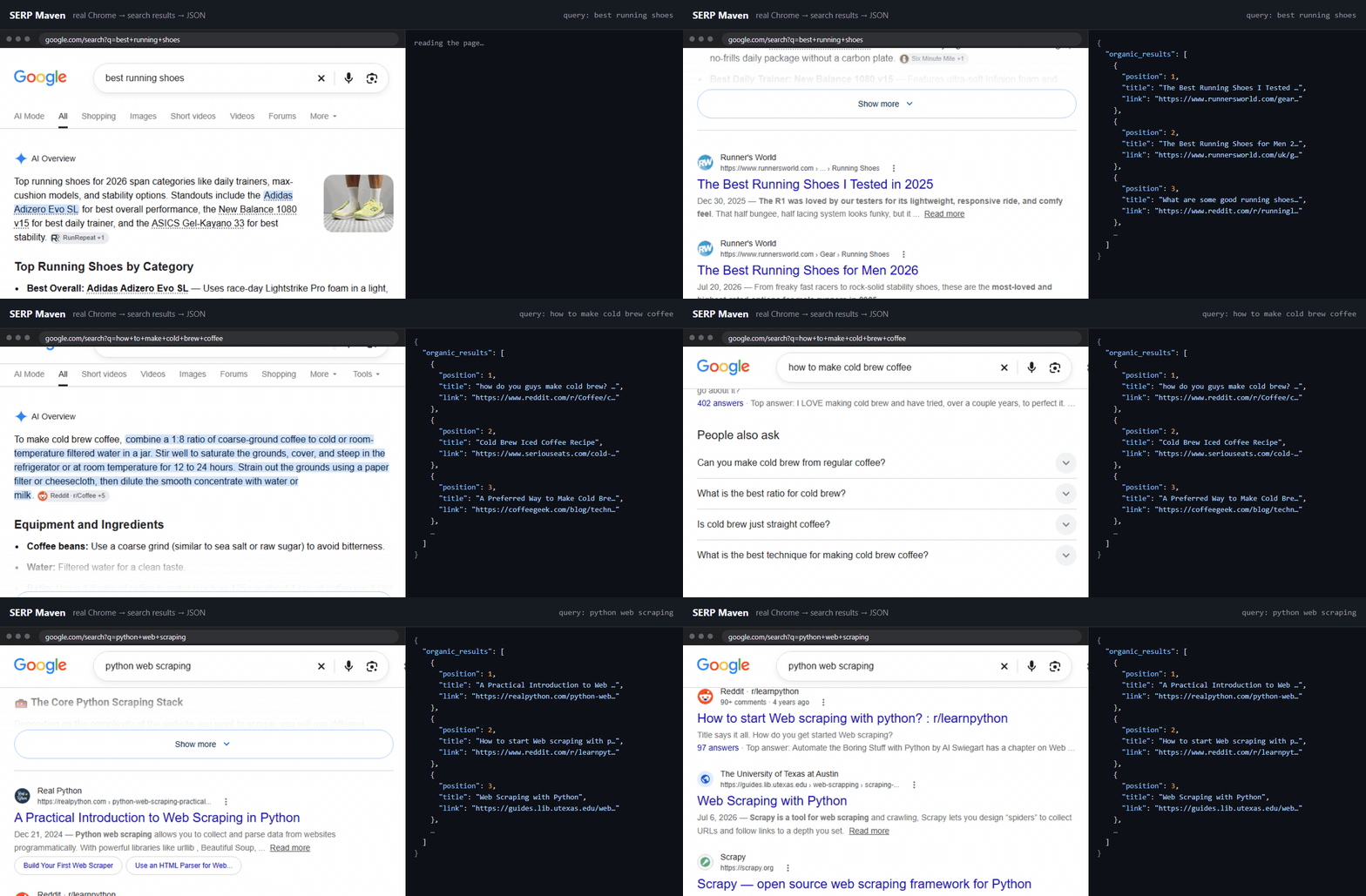
SERP Maven  returns one JSON object per results page:
{
  "search_metadata": {"status": "Success", "page_verdict": "ok", "fetched_with": "http"},
  "search_parameters": {"engine": "google", "q": "best running shoes", "page": 1},
  "organic_results": [
    {"position": 1, "title": "...", "link": "https://...", "snippet": "..."}
  ],
  "related_questions": [{"question": "..."}],
  "ai_overview": {"text": "..."},
  "exit": {"session": "...", "queries_on_exit": 1, "bytes": "..."}
}
The field names are the ones common to SERP APIs, so simple consumers can often switch with minimal mapping.
All fields
organic_results,ads,related_questions,related_searches,pagination,search_metadataai_overview: the text of Google's AI Overview when the page shows one (pages in English,--hl en, the default)local_results: the places of the map pack on local queries (name, rating, reviews, type, address, phone, opening hours)exit: which proxy IP (sticky session) answered and how many bytes the page costsearch_metadata.fetched_with:httporbrowsersearch_metadata.timings: seconds per step (httpfor a page fetched over HTTP;type,load,readyandreadfor one the browser rendered;parse;links, which overlaps the next query)- A query that failed is a record too, with an
error
Knowledge panels, shopping, images and other special blocks are not parsed.
--format csv writes the organic results as a table, and --price-per-gb adds
the cost per 1000 pages to the summary.
Poisoned results protection
Google does not always block a scraper. Sometimes it answers with a normal-looking results page for a different query: no captcha, no error, just wrong data that slips into your pipeline unnoticed.
The scraper checks results pages against the queries it asked. When a proxy IP starts returning unrelated results, it is dropped within a few pages and the query is asked again on a fresh one.
- No extra requests, no extra traffic: the check runs on the page already downloaded
- On by default
Run it as an API
serpmaven serve --country us --prewarm
curl "http://127.0.0.1:8000/search.json?q=best+running+shoes"
In PowerShell, call curl.exe (plain curl there is another command).
- Same record format as above
--hostand--portset the address (default127.0.0.1:8000)pages=Nreturns N result pages for one query, up to--max-pages(default 3); more is answered 400. One page is a single record, more are a JSON array of recordshl(language) andgl(country) per request:/search.json?q=...&hl=de&gl=at--prewarmfinds a proxy IP Google serves at startup, so the first request does not wait for a warm-up;/healthanswers 503warminguntil then- Results pages are read one at a time on one held proxy IP; a page's links resolve in the background, so the next request starts while the last one waits for its links
links=Nresolves the links of the first N organic results only (0: none)links_wait=Sanswers after S seconds with the links resolved by then; links still being resolved arenulland counted insearch_metadata.links_pendingasync=trueanswers at once withsearch_metadata.id;GET /searches/<id>.jsonanswers"status": "Processing"until the search and its links are done, then the record. The newest 500 searches are kept there, each for up to an hour; up to 50 async searches wait for the browser at once, more are answered 429- Set
SERPMAVEN_API_KEYto require a key; without one the server only listens on localhost
Use it from an AI agent (MCP)
{
  "mcpServers": {
    "google-search": {
      "command": "serpmaven",
      "args": ["mcp", "--country", "us", "--prewarm"]
    }
  }
}
It uses the login saved with serpmaven login; or add
"env": {"NODEMAVEN_LOGIN": "...", "NODEMAVEN_PASSWORD": "..."}. One tool,
google_search(query, pages, hl, gl, links). It returns the organic results,
"People also ask", related searches, and the AI Overview and map places when
Google shows them. links is how many of the top results get their full URL
(default 5, or --links N on the mcp command); fewer answers sooner, and a
result without one carries its site when Google shows it.
Docker
A ready image is published to GitHub Container Registry with every release:
docker run --rm ghcr.io/nodemaven/serpmaven doctor
docker run --rm -p 8000:8000 -e SERPMAVEN_API_KEY=change-me \
  -e SERPMAVEN_PROXY='http://USER-session-{session}:[email protected]:7000' \
  ghcr.io/nodemaven/serpmaven serve --host 0.0.0.0
To build it yourself: docker build -t serpmaven .
How it works
- New identity: a sticky proxy session and a fresh browser profile.
- Warm-up: the first proxy IP opens a few ordinary pages, staying on each for 20-45 seconds. Later ones start from the Google cookies of a served proxy IP and are warmed up only when no such set is accepted.
- Search: the first query on a proxy IP goes through the browser. Once Google serves it, the next pages come over HTTPS with the browser's cookies, until Google asks for its check again.
- Check before parsing: a captcha or a block is reported as one, never parsed as an empty result.
- Keep or drop: a proxy IP Google answers is reused; one it refuses is dropped and the query retried on a new one. If one proxy IP after another is refused, the run stops instead of spending more traffic.
More detail: HTTP between checks, holding proxy IPs, copied cookies, result links, traffic
HTTP between checks. After the browser passes Google's check, results pages
are fetched over HTTPS with the browser's own headers and cookies. If that stops
working, the scraper goes back to the browser on its own. --no-hybrid uses the
browser for every page.
Unrelated results. A proxy IP that starts returning results unrelated to the queries is dropped, and the query is asked again on a new one.
Holding proxy IPs. A served proxy IP is kept for up to 300 queries. Every new one pays for a browser check, and for a warm-up when no cookie set is accepted, so a short cap mostly buys more of that traffic. Every 50 results pages it renders, the browser is restarted on the same profile and proxy IP, which keeps its memory from growing over a long hold. A browser error on a search is retried once on the same proxy IP before it is dropped; a network error, running out of memory or a crashed browser drops it at once.
Copying cookies. With --renew-cookies 0, the command line copies the
cookies of the first proxy IP Google serves and starts new proxy IPs from that
copy, on new sticky sessions, instead of warming each one; all workers share
the copy. Google's acceptance follows the cookies more than the address, so a
copy usually starts out served and costs a few MB instead of a full warm-up. A
copy waits 40-60 seconds after its browser starts before the first search.
Copying the cache. Pages get cheaper as a proxy IP is held, because the
browser cache fills with Google's shared scripts and images. Copies carry that
cache too, so a new proxy IP starts with cheap pages, and the copy is refreshed
from the held one at each browser restart, when its cache is warm. If two
copies carrying the cache are refused on their first search, the rest of the
run copies cookies only (--no-clone-cache does that from the start).
Starting from saved cookies. --cookies FILE gives every new proxy IP the
Google cookies of a browser Google already serves, so it skips the warm-up; the
file can come from another machine. --renew-cookies N replaces that set with
the cookies of a served proxy IP every N queries, so it stays fresh, and without
--cookies it ends the warm-ups after the first renewal. It is on by default,
every 25 queries, so a run warms up its first proxy IP and rarely another;
--renew-cookies 0 goes back to copies of the first served profile.
--cookies-out DIR saves each renewed set for the next run, readable by its
owner only. If every set is refused in turn, new proxy IPs are warmed up again,
and with --renew-cookies the next renewal brings the sets back. A file is a
JSON list of Playwright cookie records, or an object with that list under
"cookies", and must hold Google's NID cookie.
Result links. Google wraps result links in encrypted /goto redirects.
Each one is resolved with a small request on the proxy IP the page came from,
with that page's cookies, in the background while the next query runs; a link
left over is tried through a separate short-lived proxy session. Google answers
only a few links of a page at once and holds the rest on a "Verifying your
request" page; a link held for up to 30 seconds is asked again when the wait is
over, twice at most and within 45 seconds a page, so a page's links can take up
to 45 seconds while the queries carry on.
Records still come out in the order each browser searched them.
Traffic. Everything goes through a small local relay that counts bytes per host and refuses what no search needs: the models and data files Chrome otherwise downloads into every fresh profile, and the videos of a warm-up page.
The defaults come from measurements in proxy-benchmark.
Options
All search options
| Option | Default | What it does |
|---|---|---|
-f, --file FILE |
Queries from FILE, one per line | |
-o, --output FILE |
stdout | Where the results are written |
--resume |
Skip the queries the --output file already has results for and add to it (jsonl); failed ones are asked again |
|
--workers N |
1 | Search on N proxy IPs at once, one browser each, from one list of queries |
--max-per-exit N |
300 | Queries before a served proxy IP is retired |
--restart-every N |
50 | Results pages the browser rendered before it restarts on the same profile and proxy IP; 0 never |
--no-hybrid |
Fetch every results page in the browser instead of over HTTP between Google's checks | |
--hl, --gl |
en, unset |
Language and country of the results |
--location PLACE |
unset | Search as from this place, by its canonical name: "Austin,Texas,United States" |
--tbs FILTER |
unset | Google's tbs filter as it is, e.g. qdr:w for the past week |
--no-personalization |
Results without personalization (pws=0) |
|
--no-autocorrect |
Search a misspelt query as typed (nfpr=1) |
|
--cr COUNTRIES, --lr LANGUAGES |
unset | Only documents from these countries (countryUS) or in these languages (lang_en) |
--clone N |
10 | With --renew-cookies 0: new proxy IPs started from copied cookies; 0 turns copying off |
--clone-max-age |
180 | Minutes copied cookies stay in use |
--clone-refusals N |
1 | Copies refused in a row on their first query that end the copying |
--no-clone-cache |
Copies carry cookies only, not the browser cache | |
--cookies FILE |
Start every new proxy IP from the Google cookies in FILE instead of a warm-up; repeat for more files, the next one taking over after two proxy IPs in a row are refused on their first query, and warm-ups again once every file has been refused that way. Turns --clone off |
|
--renew-cookies N |
25 | Every N served queries, a proxy IP's Google cookies become the set new proxy IPs start from; 0 turns it off and brings back --clone |
--cookies-out DIR |
Write each renewed cookie set to DIR, for the next run's --cookies |
|
--warmup |
L3 |
Pages a fresh proxy IP opens before its first query: L3, light (without Google Trends: much less traffic, served on the first query less often), L2, L1, off |
--spare N |
0 | Proxy IPs warmed in the background so a retired one is replaced at once; each costs a warm-up |
--direct |
all |
Open results pages directly: all, follow-ups (all but the first query on each proxy IP), none |
--input |
type |
How a query goes into the search box: type, insert, words |
--gap LOW,HIGH |
2,5 | Seconds between queries on one proxy IP |
--pages N |
1 | Result pages per query |
--format |
from -o, else jsonl |
jsonl, json or csv; -o results.csv picks csv by itself |
--patient MINUTES |
0 (stop) |
When Google refuses proxy IPs until the run stops, wait and go on with the queries left, up to 3 times; a query cut short is asked again from its first page, so its earlier pages appear twice in the output |
--price-per-gb |
Your proxy price, to print the cost per 1000 pages | |
--no-resolve-links |
Keep result links as Google /goto redirects |
|
--links N |
all; mcp 5 |
Resolve the links of the first N organic results on each page only; the rest keep their /goto redirect. Fewer answers sooner |
--save-html DIR |
Keep every page's HTML, gzipped | |
--channel NAME |
Browser channel, e.g. chrome for the installed Chrome |
|
--timezone ZONE |
IANA timezone for the browser, e.g. Europe/Berlin |
|
--browser-arg=ARG |
Extra Chromium switch, e.g. --browser-arg=--disable-gpu; repeat for more, or set SERPMAVEN_BROWSER_ARGS |
|
--headless |
Run the browser without a window; serpmaven doctor --headless shows what a website sees then |
|
--no-relay |
Hand the proxy to the browser directly: traffic is not counted, and every results page is fetched in the browser | |
--stop-after-read |
Experimental: leave each query's last results page once it is read | |
-v, --verbose |
Print every step as a JSON line on stderr instead of the progress line, after one plain proxy: ... line; the run ends with summary: {...} |
Proxies
Any provider with sticky sessions works through --proxy and a {session}
placeholder. A proxy without one is accepted with a warning: if the proxy IP changes
on every request, warming it does nothing. SOCKS5 needs an IP-whitelisted
endpoint, because Chrome cannot send a SOCKS5 username and password.
Check your machine
serpmaven doctor
Starts the browser on a blank page, sends nothing, and reports what a website would see: whether the browser looks headless, whether WebGL works, the screen size. Google answers some machines much less than others, so run this first.
What this is not
Not a free Google Search API, and not a guarantee that every proxy IP will work. It is a browser-based collector that makes failures explicit, drops proxy IPs Google refuses, and tells you what each page cost.
Status
Early. The cloak engine (--engine cloak) is experimental; patchright is
the default.
Google changes its pages often. If results come back empty or wrong, run with
--save-html DIR and open an issue with what you see.
You are responsible for using this within Google's terms and the law where you run it.
Adding an engine
An engine joins this tool only after it has been measured on proxy-benchmark. Add it there and run the warm-up ladder against Google:
python scripts/run_ladder.py --engines your-engine
Then open a pull request here with the run file. The ladder runs identities with and without the warm-up in the same hours, so the result shows whether the engine actually gets served, not whether it got lucky once.
License
SERP Maven by NodeMaven