
neka-nat/probreg
neka-nat/probreg has 1,000 GitHub stars and 152 forks. GitHot measured 0 stars in 24 hours, -1 in 7 days, and 0 in 15 days. Last checked 2026-11-25 00:25 UTC. Last push 2026-07-21.
What you can do
- Open3D interface
- Rigid and non-rigid transformation
Measured star growth
- in 24h
- 0
- in 7 days
- -1
- in 15 days
- 0
- in 1 month
- Collecting history
Net star changes over overlapping periods, not daily totals. Missing measurements are left blank. Stars measure attention, not software quality.
About
Python package for point cloud registration using probabilistic model (Coherent Point Drift, GMMReg, SVR, GMMTree, FilterReg, Bayesian CPD)
Creative & MediaREADME.md
Original



Probreg is a library that implements point cloud registration algorithms with probablistic model.
The point set registration algorithms using stochastic model are more robust than ICP(Iterative Closest Point). This package implements several algorithms using stochastic models and provides a simple interface with Open3D.
Core features
- Open3D interface
- Rigid and non-rigid transformation
Algorithms
- Maximum likelihood when the target or source point cloud is observation data
- Coherent Point Drift (2010)
- Extended Coherent Point Drift (2016) (add correspondence priors to CPD)
- Color Coherent Point Drift (2018)
- FilterReg (CVPR2019)
- Variational Bayesian inference
- Distance minimization of two probabilistic distributions
- Hierarchical Stocastic model
Transformations
| type | CPD | SVR, GMMReg | GMMTree | FilterReg | BCPD (experimental) |
|---|---|---|---|---|---|
| Rigid | Scale + 6D pose | 6D pose | 6D pose | 6D pose (Point-to-point, Point-to-plane, FPFH-based) |
- |
| NonRigid | Affine, MCT | TPS | - | Deformable Kinematic (experimental) |
Combined model (Rigid + Scale + NonRigid-term) |
CUDA support
You need to install cupy.
pip install cupy
Installation
You can install probreg using pip.
pip install probreg
Or install probreg from source.
git clone https://github.com/neka-nat/probreg.git --recursive
cd probreg
pip install -e .
Getting Started
This is a sample code that reads a PCD file and calls CPD registration. You can easily execute registrations from Open3D point cloud object and draw the results.
import copy
import numpy as np
import open3d as o3
from probreg import cpd

# load source and target point cloud
source = o3.io.read_point_cloud('bunny.pcd')
source.remove_non_finite_points()
target = copy.deepcopy(source)
# transform target point cloud
th = np.deg2rad(30.0)
target.transform(np.array([[np.cos(th), -np.sin(th), 0.0, 0.0],
                           [np.sin(th), np.cos(th), 0.0, 0.0],
                           [0.0, 0.0, 1.0, 0.0],
                           [0.0, 0.0, 0.0, 1.0]]))
source = source.voxel_down_sample(voxel_size=0.005)
target = target.voxel_down_sample(voxel_size=0.005)

# compute cpd registration
tf_param, _, _ = cpd.registration_cpd(source, target)
result = copy.deepcopy(source)
result.points = tf_param.transform(result.points)

# draw result
source.paint_uniform_color([1, 0, 0])
target.paint_uniform_color([0, 1, 0])
result.paint_uniform_color([0, 0, 1])
o3.visualization.draw_geometries([source, target, result])
Resources
Results
Compare algorithms
| CPD | SVR | GMMTree | FilterReg |
|---|---|---|---|
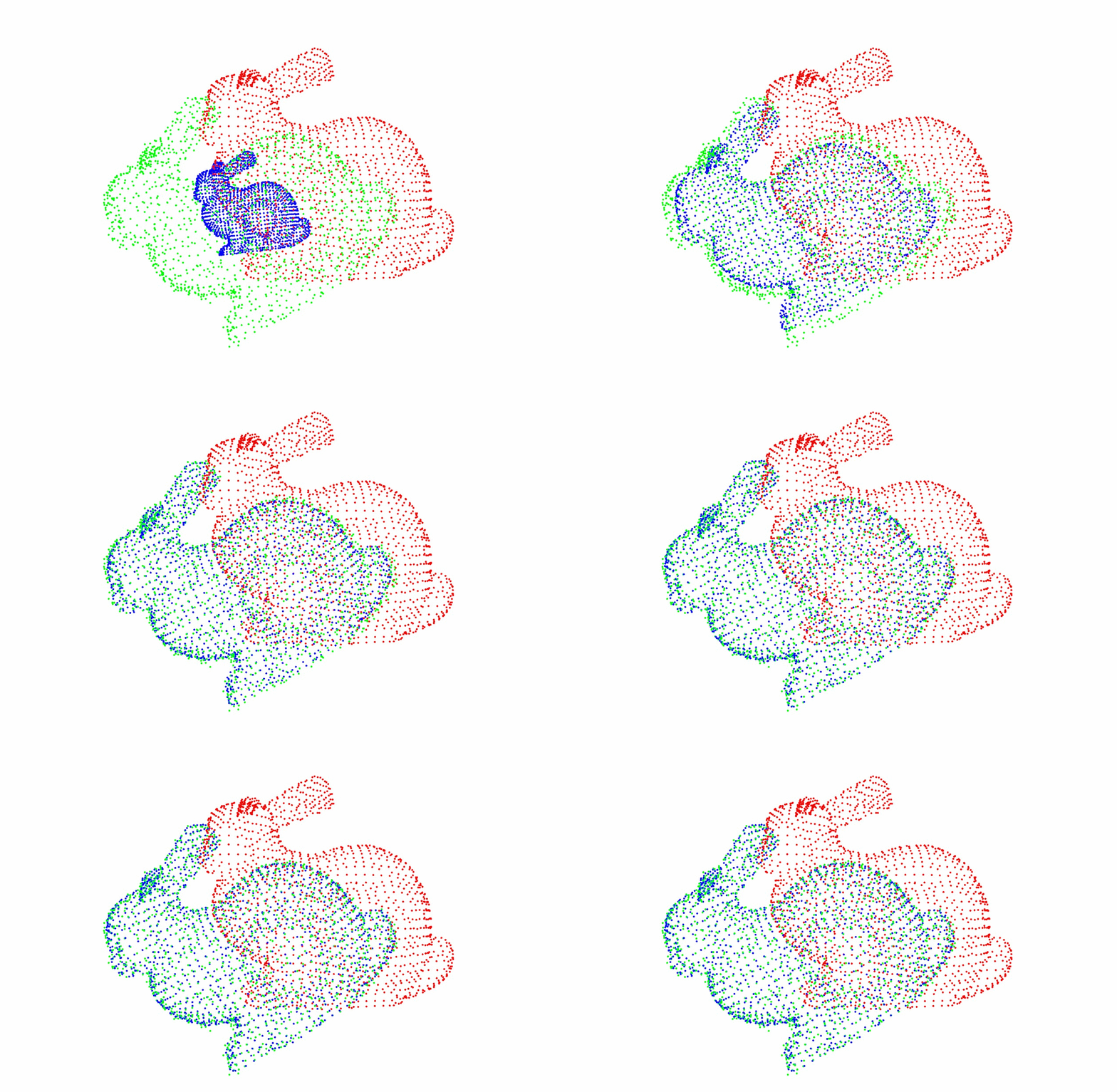 |
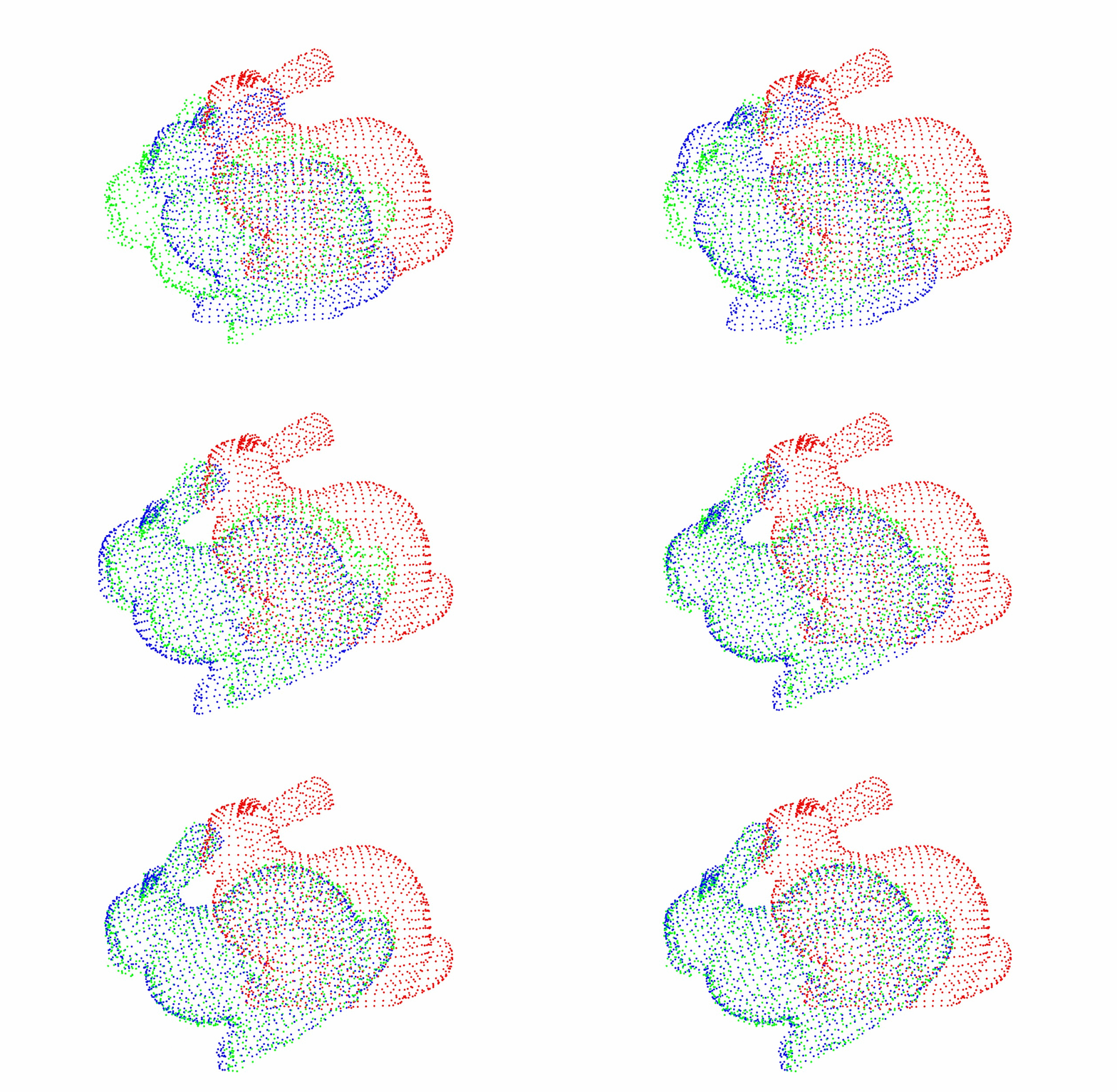 |
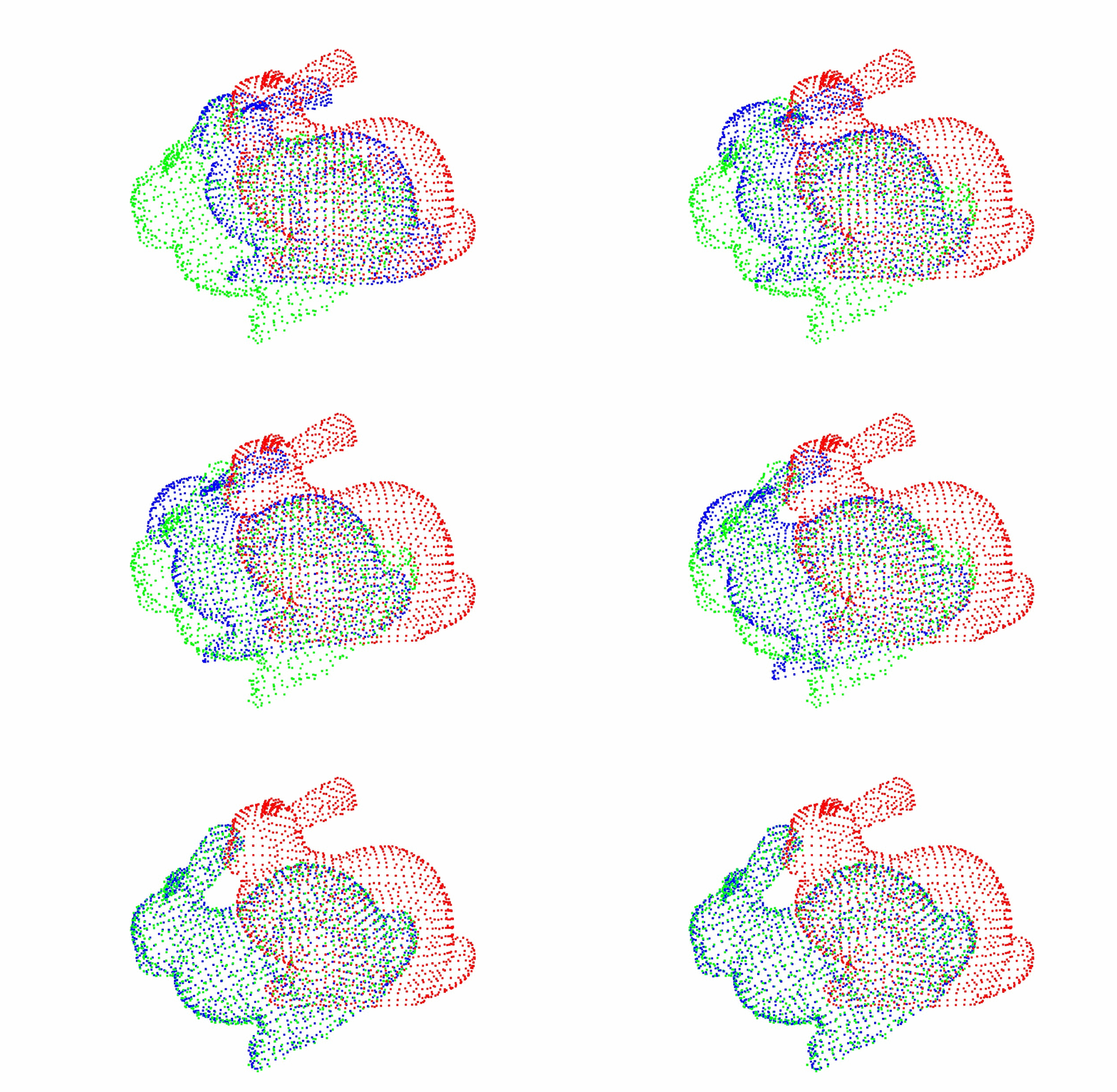 |
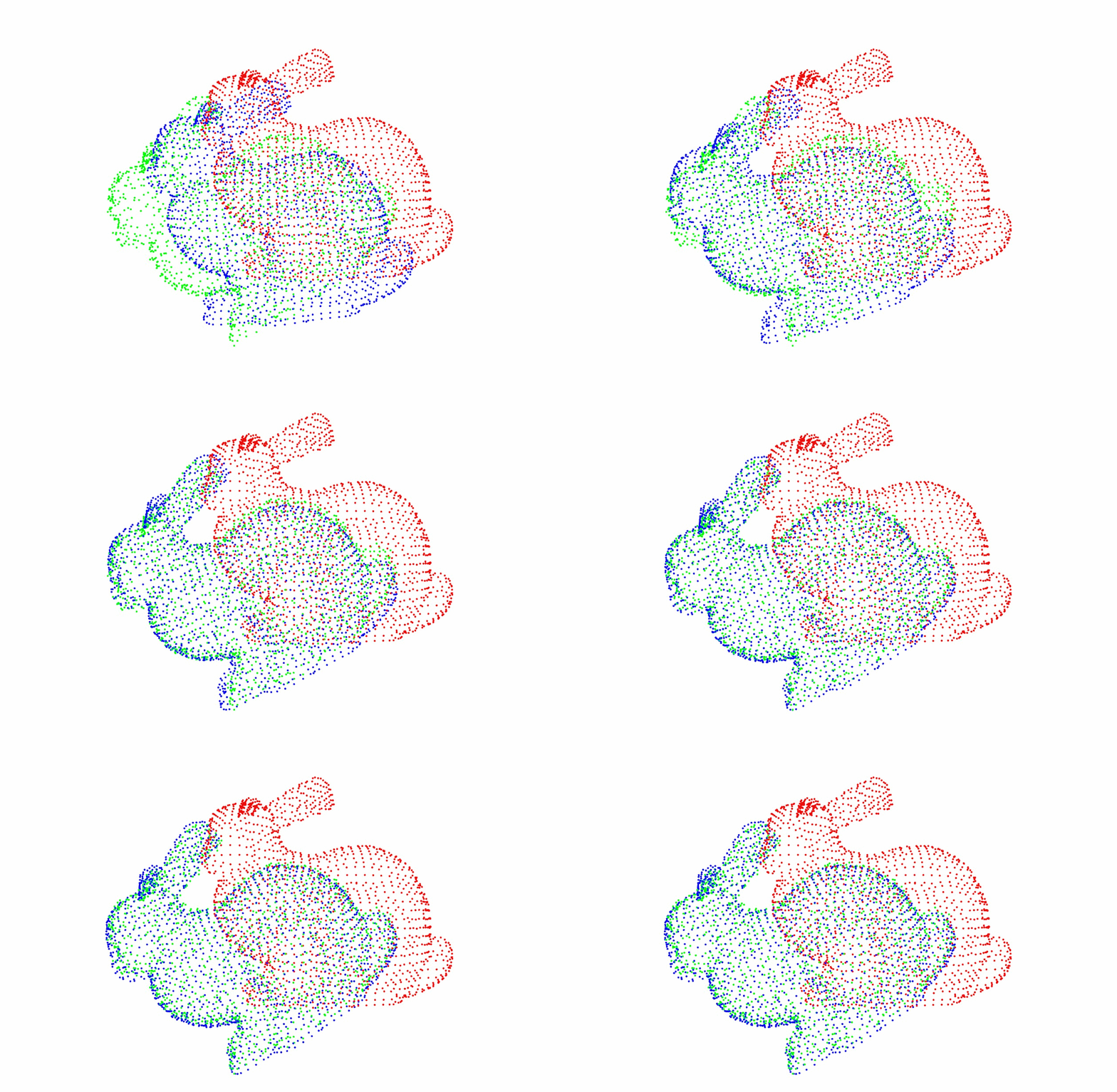 |
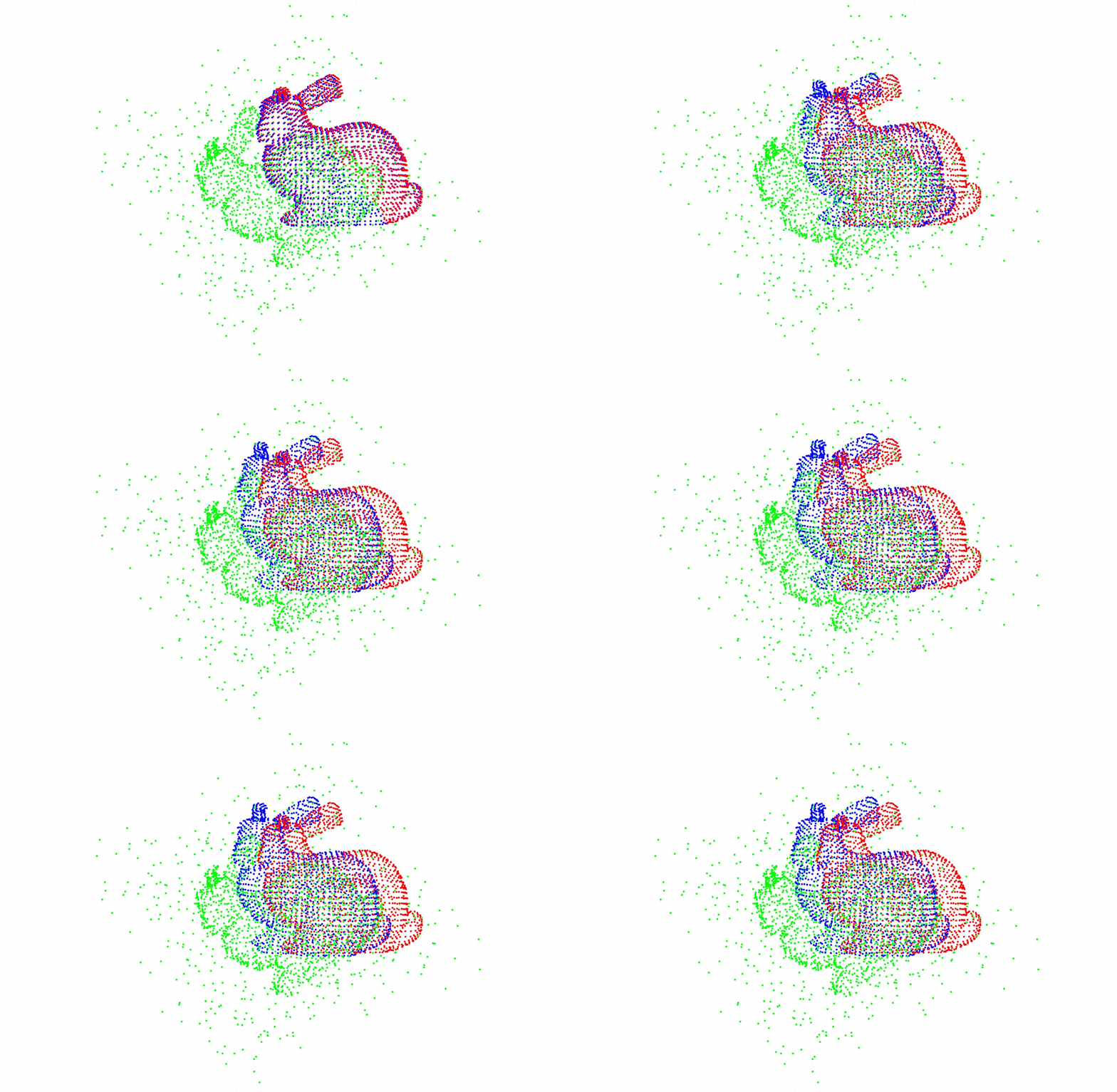
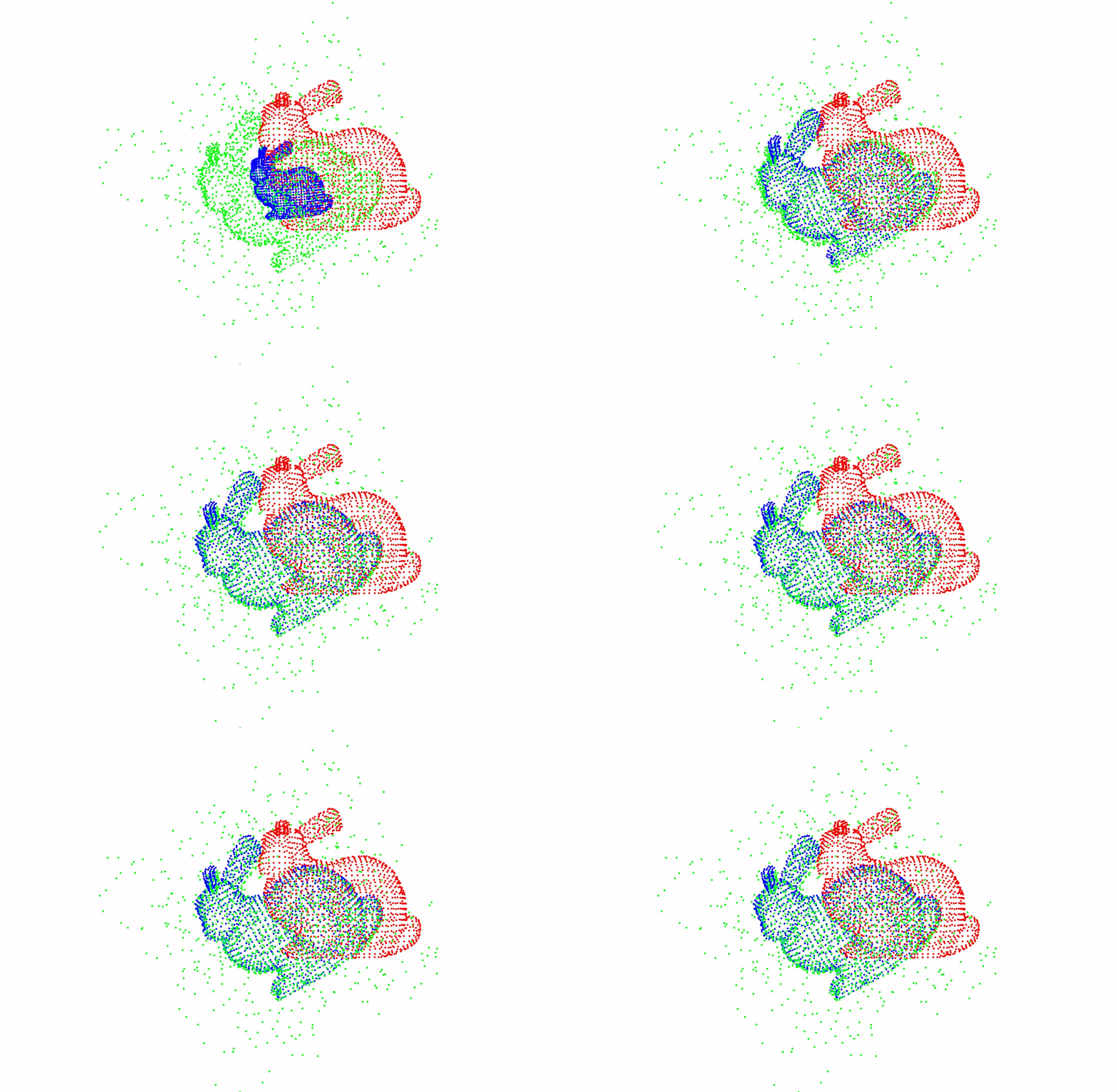
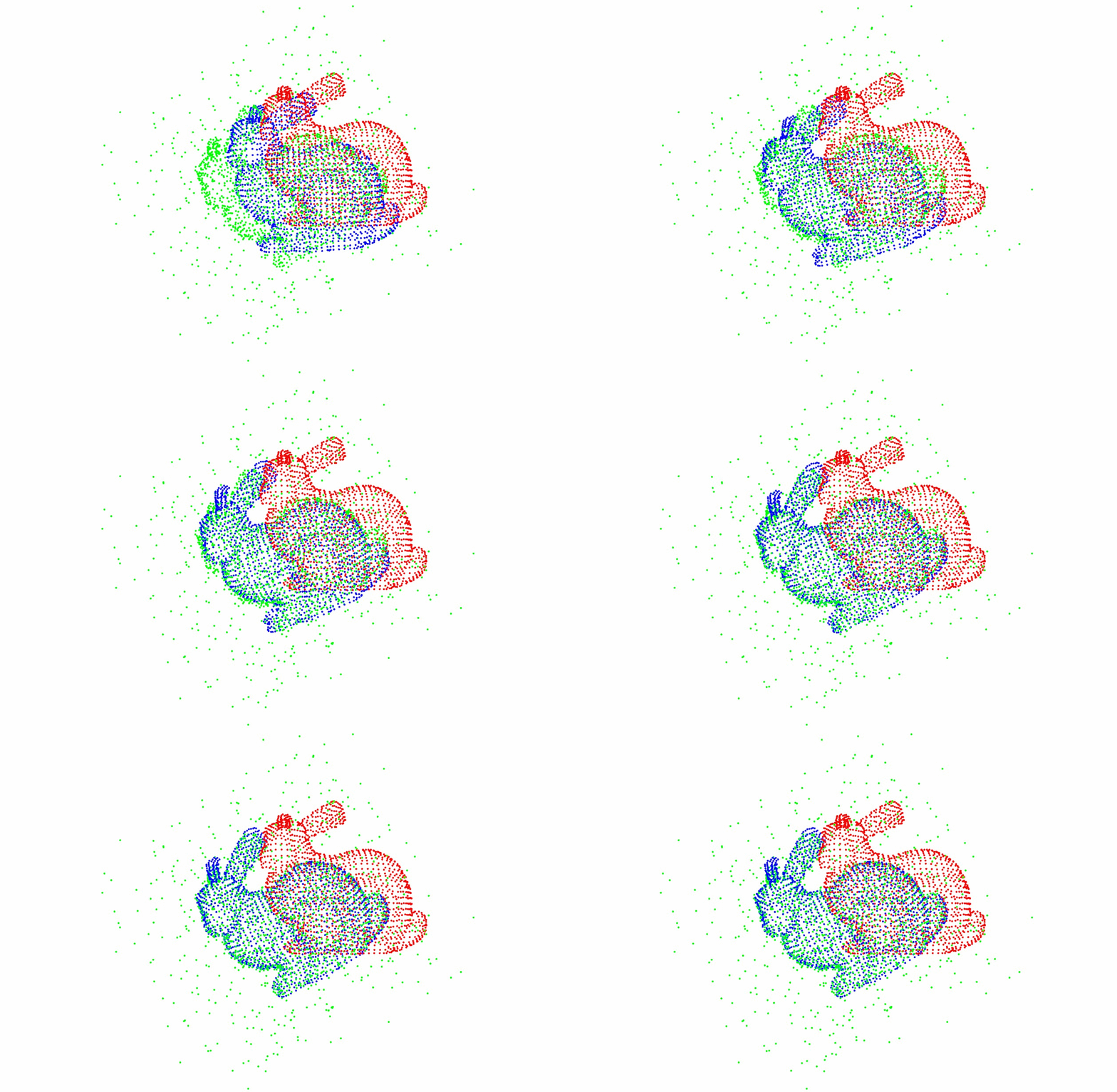
Noise test
| ICP(Open3D) | CPD | FilterReg |
|---|---|---|
 |
 |
 |
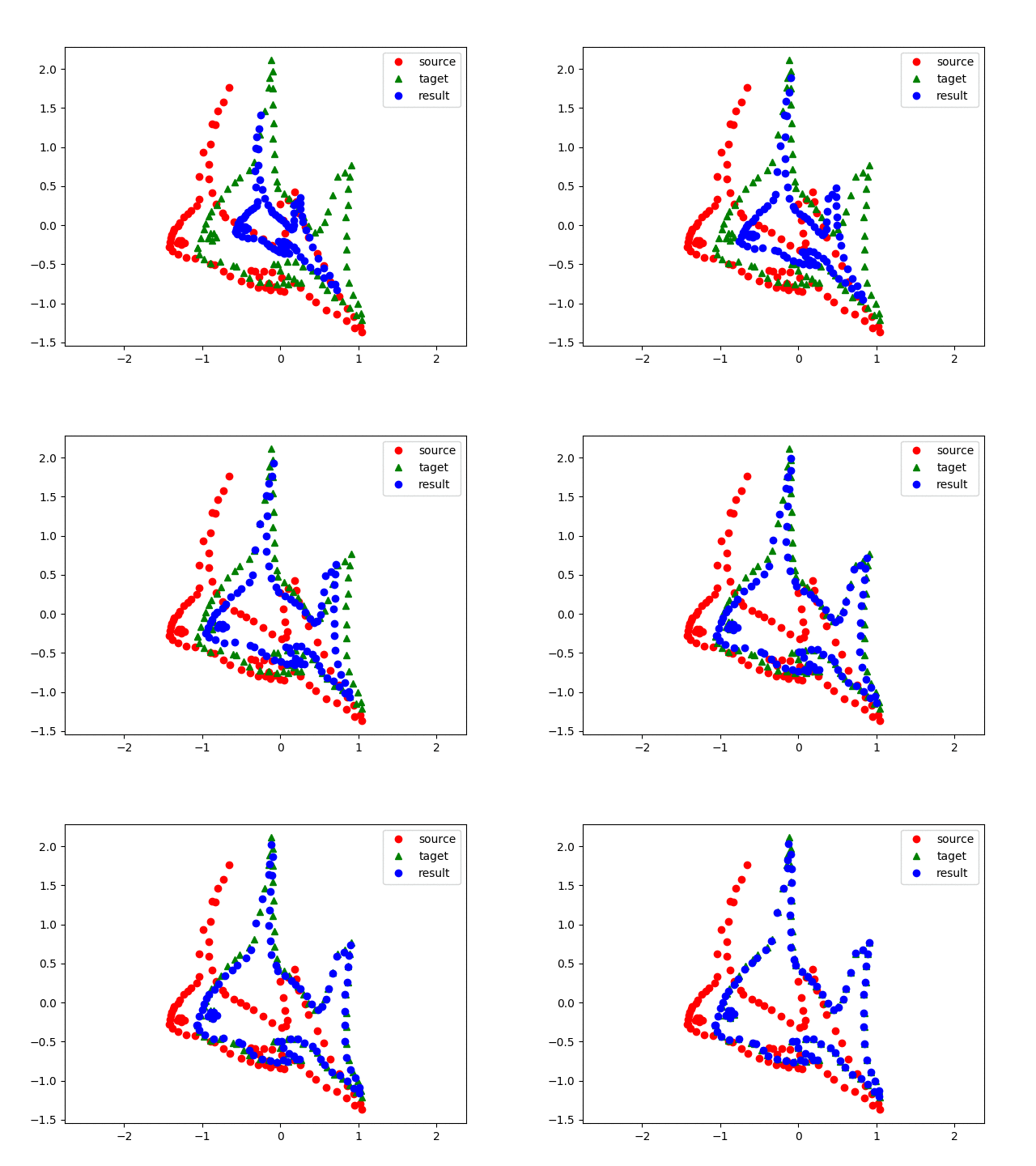
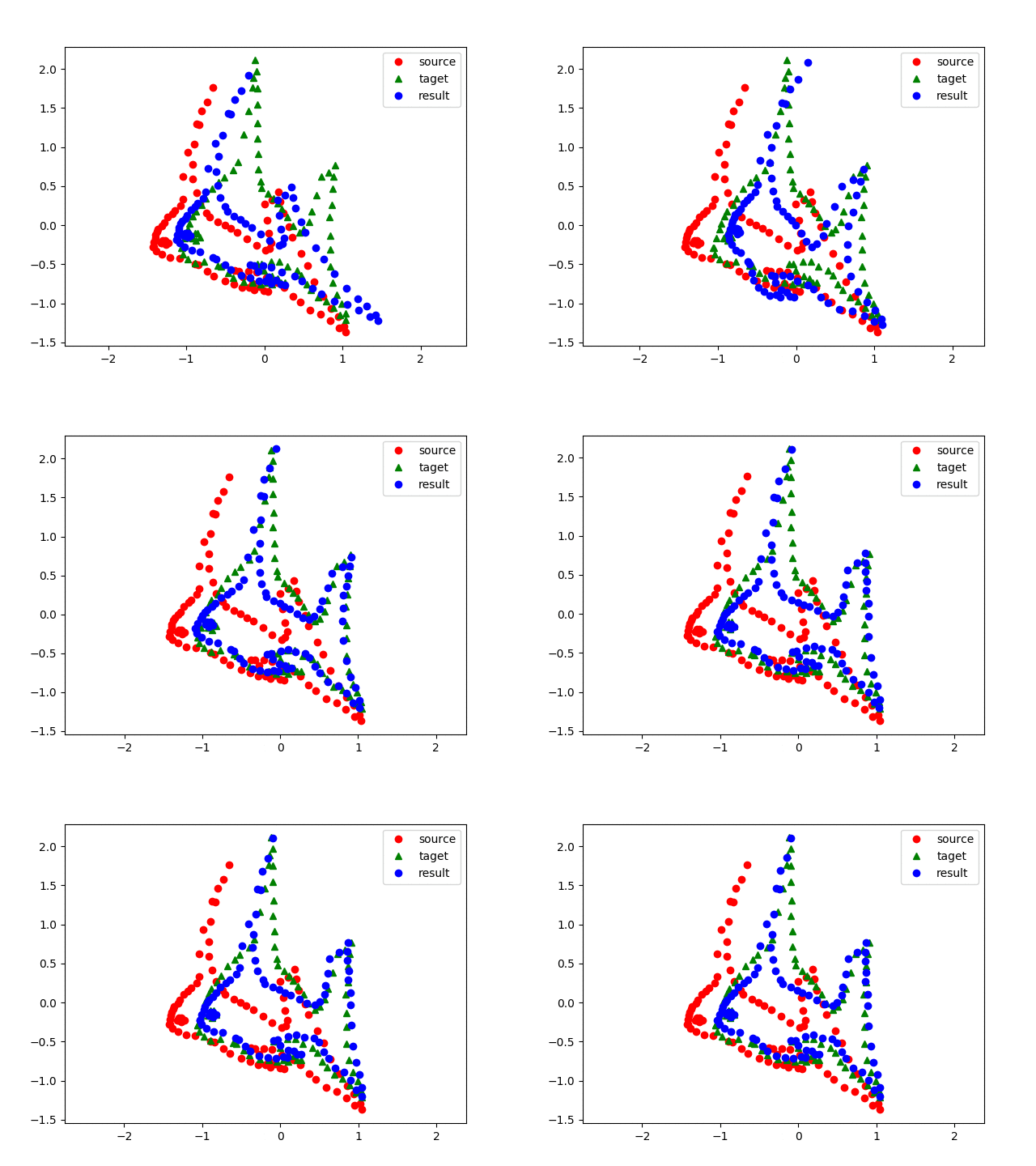
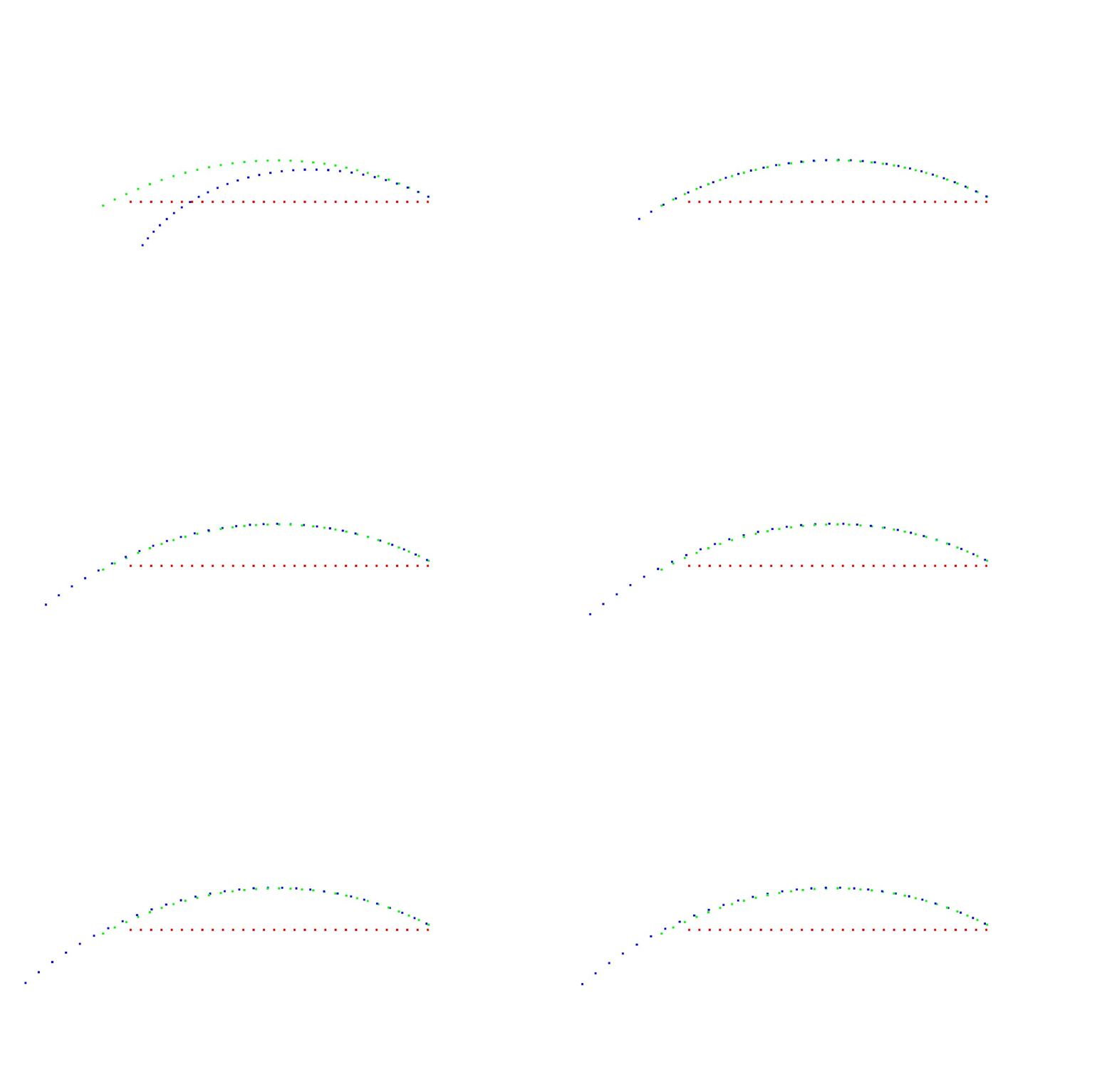
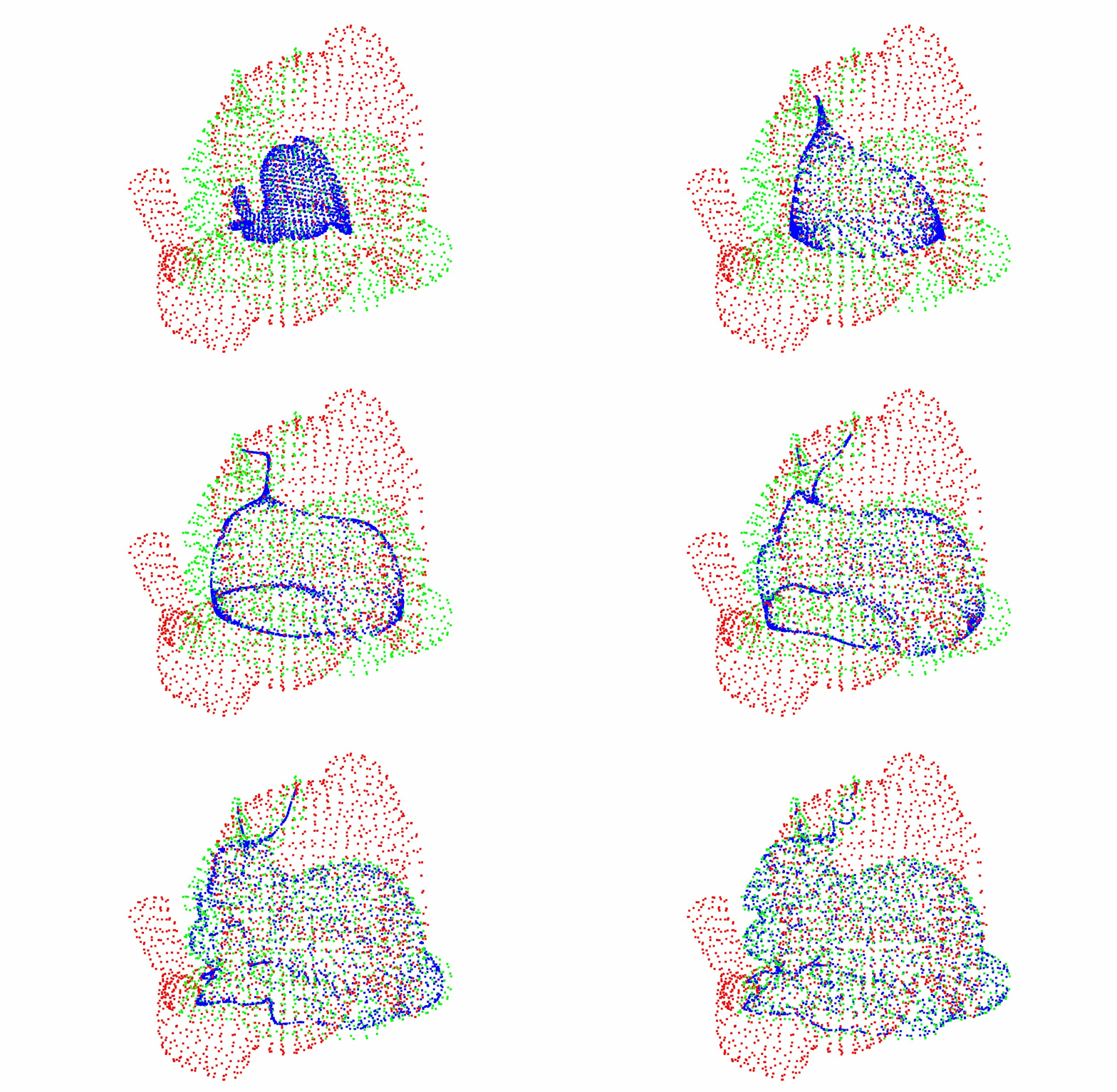
Non rigid registration
| CPD | SVR | Filterreg | BCPD |
|---|---|---|---|
 |
 |
 |
 |
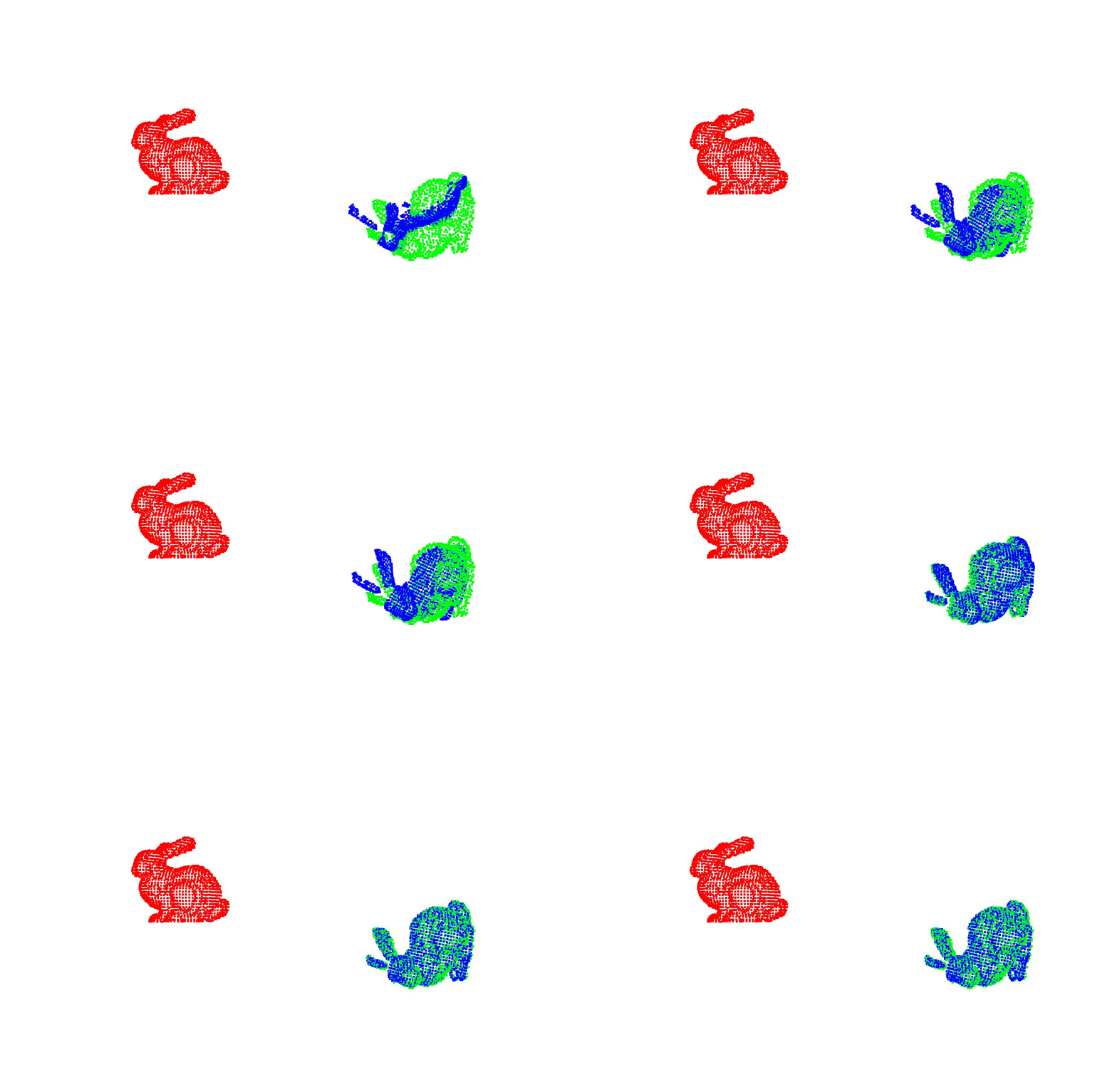
Feature based registration
| FPFH FilterReg |
|---|
 |
Time measurement
Execute an example script for measuring time.
OMP_NUM_THREADS=1 python time_measurement.py

# Results [s]
# ICP(Open3D):  0.0014092829951550812
# CPD:  0.038112225010991096
# SVR:  0.036476270004641265
# GMMTree:  0.10535842599347234
# FilterReg:  0.005098833993542939
Citing
@software{probreg,
    author = {{Kenta-Tanaka et al.}},
    title = {probreg},
    url = {https://probreg.readthedocs.io/en/latest/},
    version = {0.1.6},
    date = {2019-9-29},
}
Explore related projects
Loading…