
ndrplz/ConvLSTM_pytorch
ndrplz/ConvLSTM_pytorch has 2,271 GitHub stars and 441 forks. GitHot measured 0 stars in 24 hours. Last checked 2026-11-06 22:49 UTC. Last push 2020-07-26.
Implementation of Convolutional LSTM in PyTorch.
Measured star growth
- in 24h
- 0
- in 7 days
- Update delayed
- in 15 days
- Update delayed
- in 1 month
- Update delayed
Net star changes over overlapping periods, not daily totals. Missing measurements are left blank. Stars measure attention, not software quality.
README.md
OriginalConvLSTM_pytorch
This file contains the implementation of Convolutional LSTM in PyTorch made by me and DavideA.
We started from this implementation and heavily refactored it add added features to match our needs.
Please note that in this repository we implement the following dynamics:
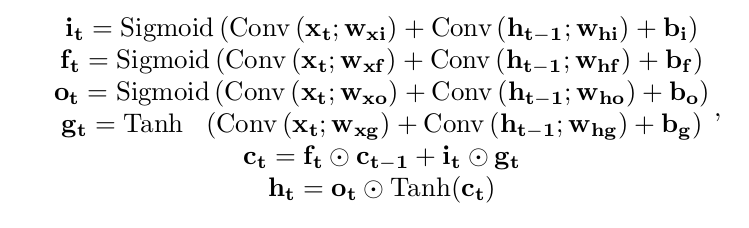
which is a bit different from the one in the original paper.
How to Use
The ConvLSTM module derives from nn.Module so it can be used as any other PyTorch module.
The ConvLSTM class supports an arbitrary number of layers. In this case, it can be specified the hidden dimension (that is, the number of channels) and the kernel size of each layer. In the case more layers are present but a single value is provided, this is replicated for all the layers. For example, in the following snippet each of the three layers has a different hidden dimension but the same kernel size.
Example usage:
model = ConvLSTM(input_dim=channels,
                 hidden_dim=[64, 64, 128],
                 kernel_size=(3, 3),
                 num_layers=3,
                 batch_first=True
                 bias=True,
                 return_all_layers=False)
TODO (in progress...)
- Comment code
- Add docs
- Add example usage on a toy problem
- Implement stateful mechanism
- ...
Disclaimer
This is still a work in progress and is far from being perfect: if you find any bug please don't hesitate to open an issue.
Explore related projects
tensorflow/tensorflow
An Open Source Machine Learning Framework for Everyone
201,367 starshuggingface/transformers
🤗 Transformers: the model-definition framework for state-of-the-art machine learning models in text, vision, audio, and multimodal models, for both inference and training.
168,609 starsAUTOMATIC1111/stable-diffusion-webui
Stable Diffusion web UI
165,245 starsComfy-Org/ComfyUI
The most powerful and modular diffusion model GUI, api and backend with a graph/nodes interface. The fastest local inference engine in the world.
145,470 stars