
naftiko/ikanos
naftiko/ikanos has 38 GitHub stars and 10 forks. GitHot measured 0 stars in 24 hours. Last checked 2026-11-16 20:53 UTC. Last push 2026-11-13.
What you can do
- Spec-Driven Integration - Declare capabilities entirely in YAML — no Java required
- Multi-Protocol Servers - Expose capabilities via MCP, Skill, REST, or Control
- Data Format Conversion - Protobuf, XML, YAML, CSV, TSV, PSV, Avro, HTML, Markdown → JSON
- HTTP API Consumption - Bearer, API key, basic, digest, OAuth 2.1 auth out of the box
Measured star growth
- in 24h
- 0
- in 7 days
- Update delayed
- in 15 days
- Update delayed
- in 1 month
- Update delayed
Net star changes over overlapping periods, not daily totals. Missing measurements are left blank. Stars measure attention, not software quality.
About
Capability Engine for Agents
Developer ToolsREADME.md
Original






Ikanos is the open source capability engine for Spec-Driven Integration.
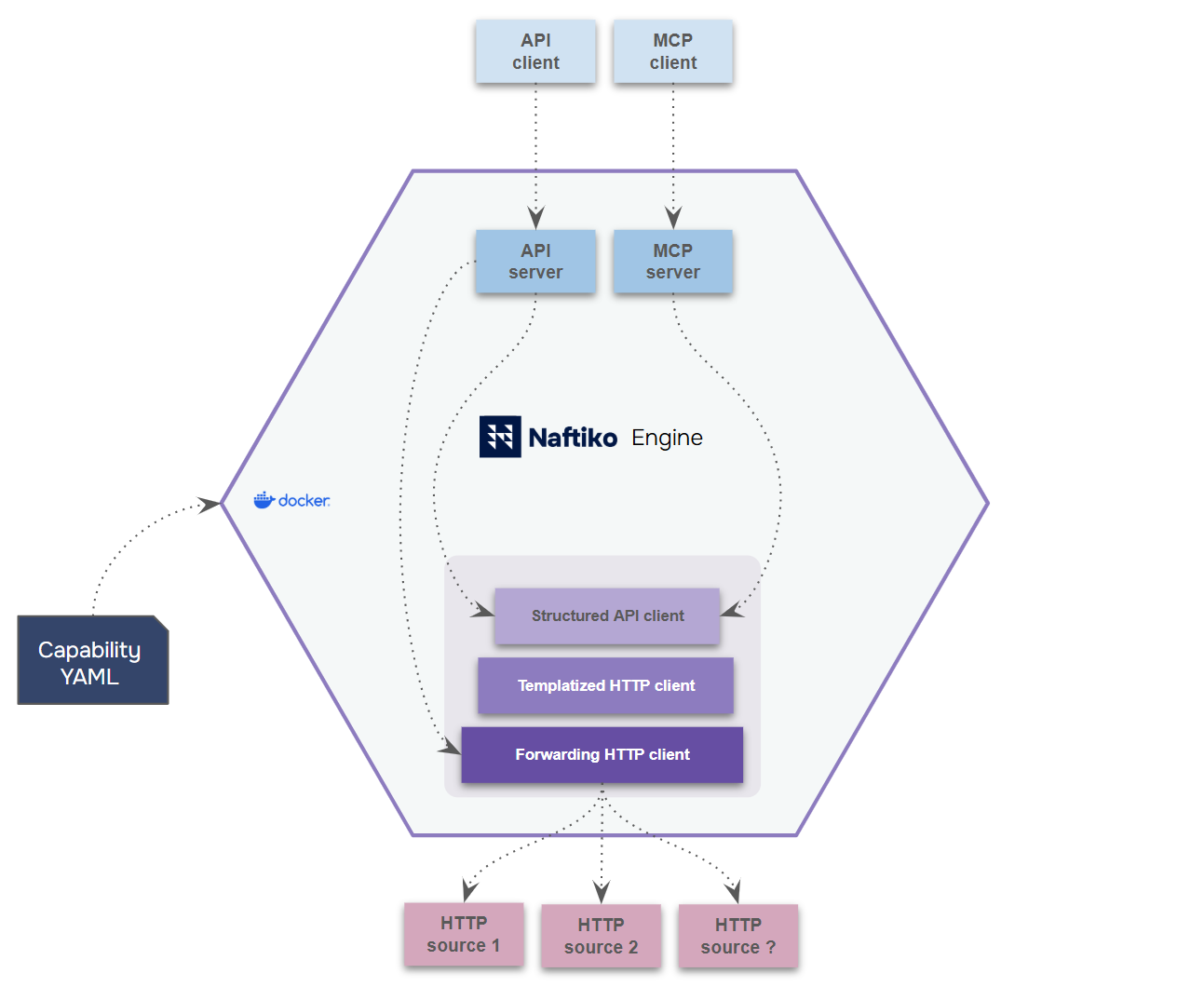
It reads one YAML file describing a slice of your business — say customers or orders. A capability consumes the HTTP/REST APIs you already have and structures their responses into clean JSON, then aggregates and orchestrates those operations into a unified contract that it instantly serves to AI agents, web apps, and partners over several protocols at once. One source of truth, many audiences, no code to write or compile.
What that means for you
- :robot: You're building AI agents — give agents governed MCP tools without writing handlers, and send the model exactly the context a task needs. → Context engineering tutorial
- :electric_plug: You own a sprawl of APIs, microservices, or a monolith — put a clean, governed contract in front of messy or legacy endpoints. → API reusability tutorial
- :bricks: You want one source of truth for every client — write the domain once and serve it as REST, MCP, and Skill from the same spec. → Use cases
See Who is it for? for the full persona map.
Key features at a glance
| Feature | Description |
|---|---|
| Spec-Driven Integration | Declare capabilities entirely in YAML — no Java required |
| Multi-Protocol Servers | Expose capabilities via MCP, Skill, REST, or Control |
| Data Format Conversion | Protobuf, XML, YAML, CSV, TSV, PSV, Avro, HTML, Markdown → JSON |
| HTTP API Consumption | Bearer, API key, basic, digest, OAuth 2.1 auth out of the box |
| Templating & Querying | Mustache templates and JSONPath expressions for flexible data mapping |
| Inline Scripting | Sandboxed JavaScript, Python, or Groovy steps via GraalVM |
| Domain-Driven Aggregates | Define reusable functions once, reference from multiple adapters |
| OpenAPI Interoperability | Import Swagger 2.0, OAS 3.0/3.1; export REST adapters as OpenAPI |
| Cloud-Native Operations | OTel tracing, RED metrics, Prometheus scrape, single Docker image |
| AI Native | Designed for context engineering and agent orchestration |
For the full feature list see Features.
What it is not
- Not a code generator. No source files are produced. The spec is the artifact and the runtime contract.
- Not a workflow engine. Multi-step orchestration is supported, but long-running workflows, schedules, and durable state are out of scope.
- Not a service mesh. Ikanos focuses on the application contract; mesh features (mTLS between services, traffic shifting) live below it.
Continue reading
- Installation — install with the installer script or Docker
- Use Cases — typical integration scenarios
- Schema — the full reference for every keyword
- Linting Guide — pair Ikanos with Polychro
- Roadmap — what's coming in upcoming alphas
