
mustafacagri/vibe-usage
mustafacagri/vibe-usage has 71 GitHub stars and 2 forks. GitHot measured +4 stars in 24 hours. Last checked 2026-11-15 01:48 UTC. Last push 2026-11-07.
Measured star growth
- in 24h
- +4
- in 7 days
- Collecting history
- in 15 days
- Collecting history
- in 1 month
- Collecting history
Net star changes over overlapping periods, not daily totals. Missing measurements are left blank. Stars measure attention, not software quality.
About
See the quota left on Claude Code, Codex, Cursor and Antigravity, launch the tool that has room and hand a task over. Windows tray, macOS menu bar and CLI.
Developer ToolsREADME.md
OriginalEnglish · Türkçe · Deutsch · Español · Français · Italiano · Português · Nederlands · Polski · 日本語 · 한국어 · 简体中文 · Русский
Vibe Usage
Every AI coding subscription you pay for, in one menu-bar window.
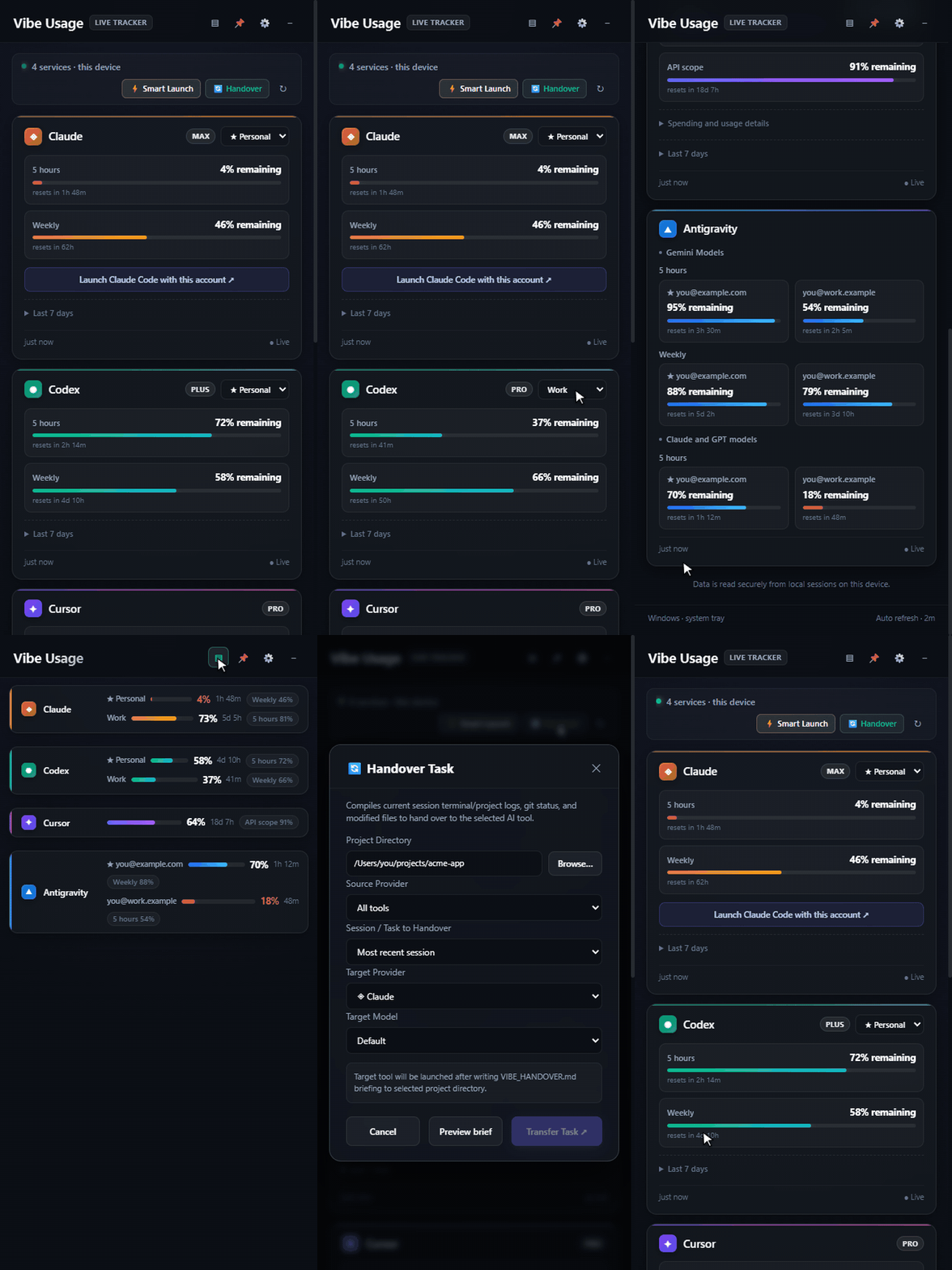
See how much quota Claude Code, Codex, Cursor, Antigravity and GitHub Copilot have left, and keep working when a limit runs out: your session continues on another account or tool, without re-explaining the task.
Windows tray · macOS menu bar · 13 languages · no passwords, no tokens stored
Download for Windows and macOS · Terminal: npm install -g vibe-usage-cli
Why
If you code with several AI tools, you hit the same wall over and over: the 5-hour limit runs out mid-task, you open another tool, and you start explaining the task from scratch. Each provider shows its usage somewhere different, if at all.
Vibe Usage reads the sessions already signed in on your machine and shows every limit side by side: how much is left and when it resets. When one tool is running low, it starts the next one with verified quota in your project folder, and writes a briefing of the current session so the new tool can continue where the old one stopped.
Features
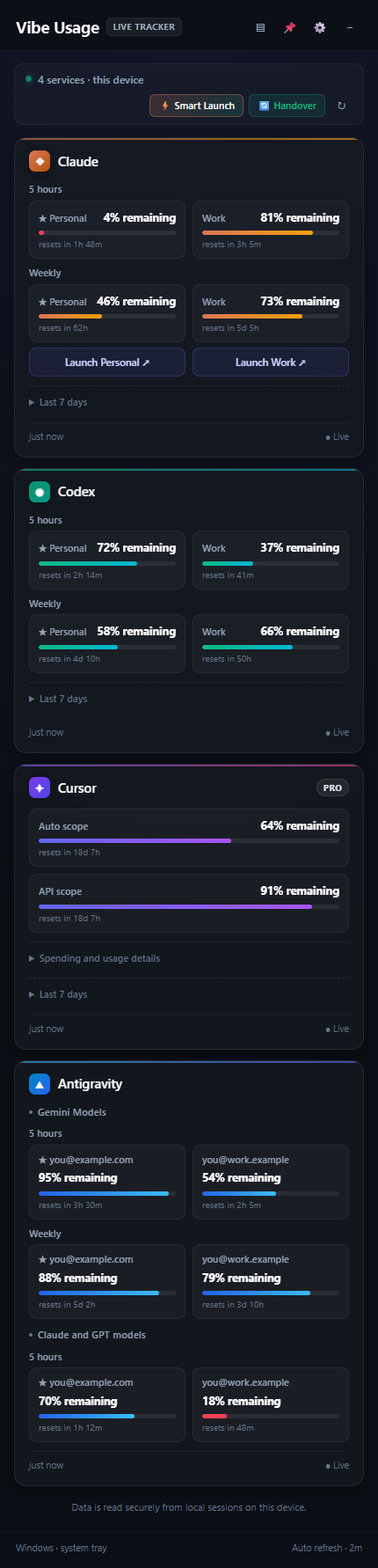
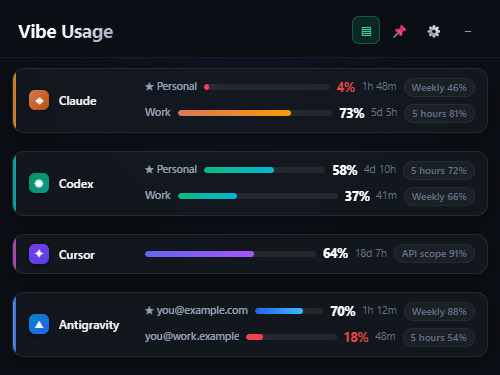
Quota at a glanceEvery limit of every account: 5-hour and weekly windows, per-model scopes, spend pools. Countdowns show when each one resets, and a limit that will run out before it resets says when, at the current pace. The last 7 days and the last 24 hours are one click away as charts, and Claude Code and Codex show the tokens they used (today, over the week, by model) counted from their own logs. When a tool's maker reports a problem on its status page, the card says so: a slow or failing tool may not be your limit. If a refresh fails, the last reading stays visible and is clearly marked as stale. Unknown numbers are never shown as a full quota. The tray icon is a ring that fills with what your first tool has left; hover it for every tool. Show each tool's accounts side by side, order the tools as you like, and switch to a compact view with one line per account. |
  |
Keep working when a limit runs outWhen Claude Code or Codex stops because its account hit the usage limit, the session continues where there is room:
on the same tool's account with the most quota left, then, if you allow it, on the next tool in your fallback order.
Opt in and it happens on its own; otherwise it is one click. The trigger is the tool's own "usage limit reached"
record, never a percentage, so two agents never work on the same folder at once. A Claude Code session moves to your
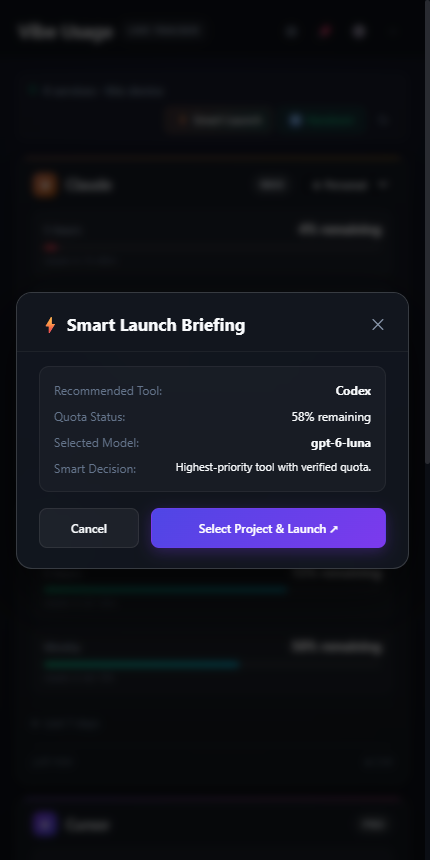
other Claude account whole and goes on by itself; other tools get a handover brief (kept out of If the computer goes down (a restart, a crash, a power cut) while Claude Code sessions are open, they open again where they left off, on the account they belong to, and a turn that was cut off goes on. Suggested by default, or on its own if you choose. Sessions you closed yourself stay closed. Smart LaunchPicks the first tool in your priority order whose quota is verified to have room, then opens it in a new terminal in the project folder you choose. It names each tool it passed over and why (not signed in, quota spent, not read yet), and starts the tool on the model you prefer for it, else on the tool's own default. If no tool can be verified, it says so and starts nothing. |
 |
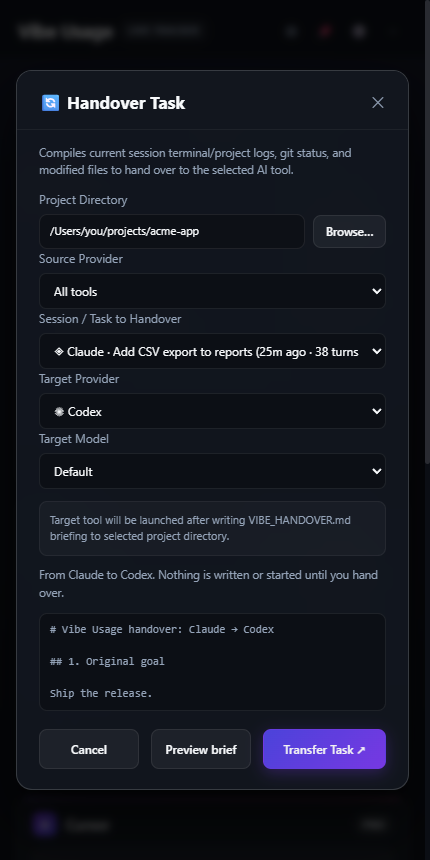
HandoverChoose a session from Claude Code, Codex, Cursor Agent or Antigravity. Vibe Usage summarizes it into
|
 |
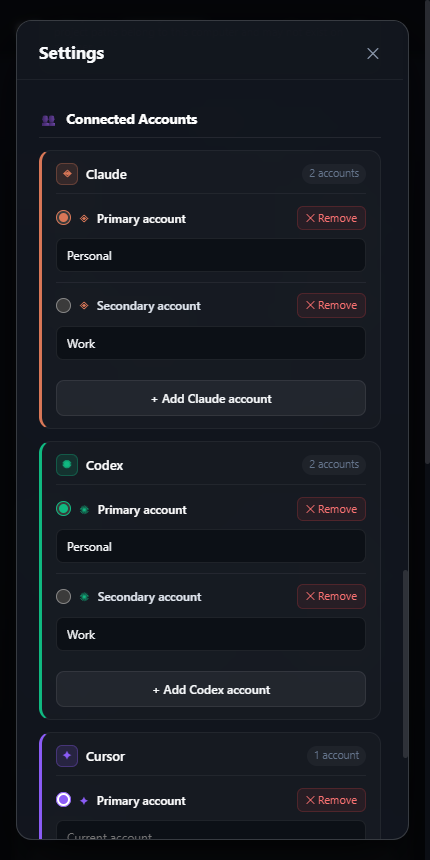
Multiple accountsClaude and Codex keep one sign-in per profile folder. Add account creates a new folder and opens the tool's sign-in
there; |
 |
Settings, history and diagnostics
 |
 |
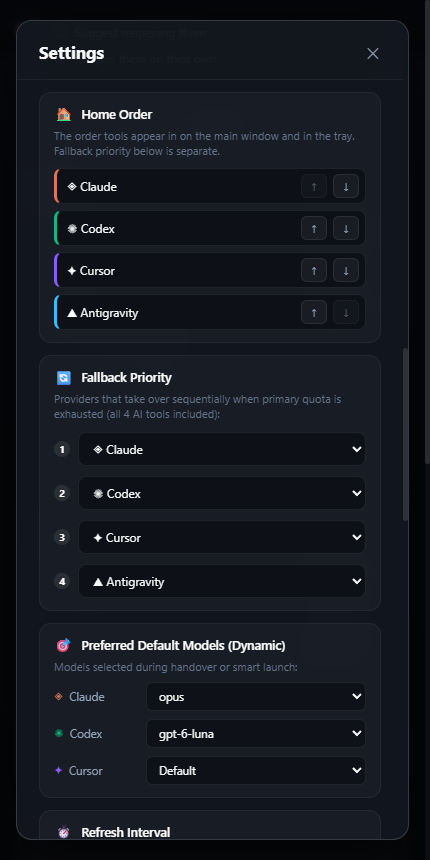 |
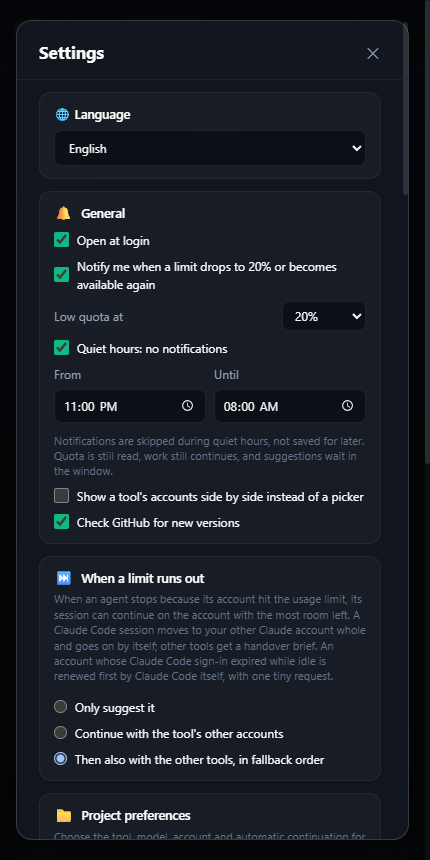
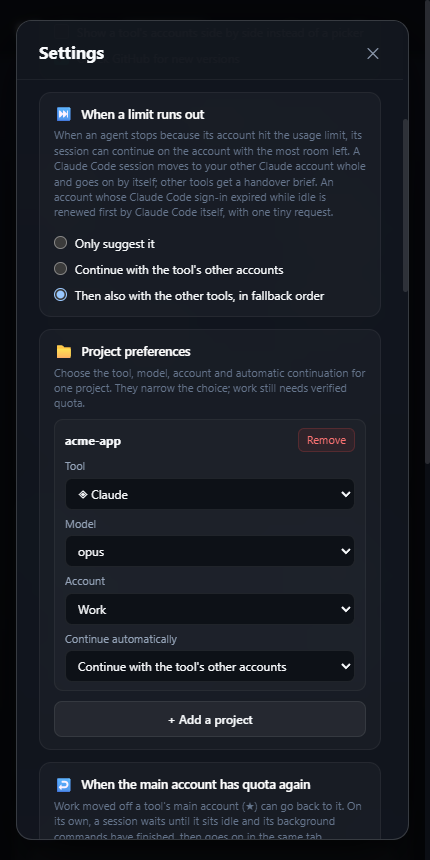
| General: open at login, notifications at your low-quota line, quiet hours, accounts side by side and the update check. | When a limit runs out: only suggest, continue on the tool's other accounts, or then on the other tools in fallback order; per project as well. | Order and models: how tools are listed, which one takes over next, the model each one starts with, and how often quota is read. |
- When a limit runs out (Settings): only suggest it, continue with the tool's other accounts, or then also with the other tools, in fallback order. When the main account has quota again, work that moved off it can go back (off, ask, or on its own once the session is idle). When the computer goes down, open Claude Code sessions can open again where they left off.
- Home order and fallback priority are separate: one is how tools are listed in the window and the tray, the other which tool takes over next. Preferred models set the model Smart Launch and handover start each tool with; left at Default, Smart Launch uses the tool's own default and handover the closest match to the session's model. The eye beside each tool in Home order hides it: it leaves the window and the tray, its quota is no longer read and it raises no alerts. Handover and the command line still use it. One tool always stays visible.
- Project preferences (Settings): give a folder its own tool, model, account and automatic continuation. They narrow what Smart Launch and continuation pick, never replace the verified-quota check, and a project set to off stays off even when continuation is on globally.
- Notifications: choose the low-quota line and quiet hours (they may cross midnight). Quiet hours skip notifications (they are not sent later); quota is still read, work still continues and suggestions wait in the window.
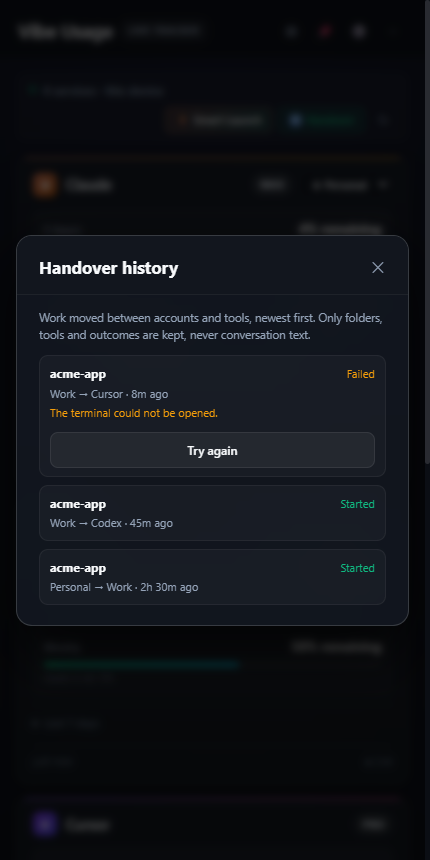
- Handover history lists each continuation with its project, route and outcome. A failed one can be tried again, checked against current quota first.
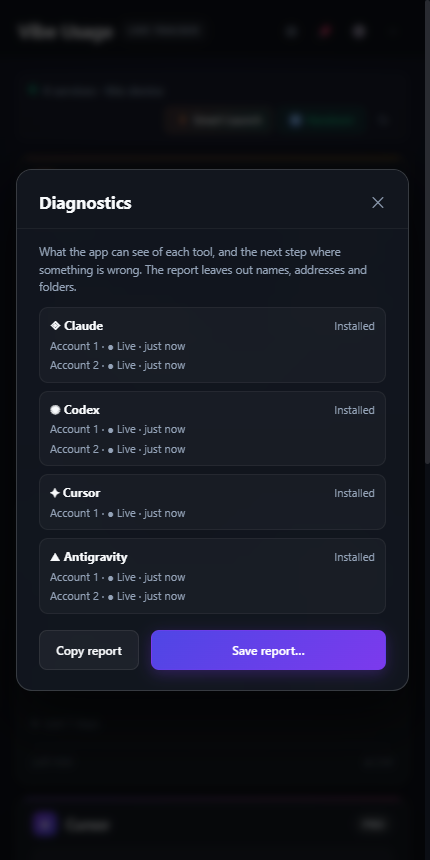
- Diagnostics shows, per tool, whether it is installed, each account's state and freshness, and the next step, plus the latest unexpected errors (what failed and the system's error code, never the error's text) and each time the window stopped responding for 2 seconds or more. Copy report gives a version without names, e-mail addresses or folders, ready for an issue.
- Backup and restore: export, import or reset the settings. Every save keeps the previous good copy; a damaged settings file is restored from it (and kept aside), and a file written by a newer version is never overwritten.
 |
 |
Supported tools
| Tool | Where the quota comes from | Sessions for handover | Launch |
|---|---|---|---|
| Claude Code | The profile's OAuth usage endpoint (Keychain on macOS) | ~/.claude/projects |
claude CLI with the chosen profile |
| Codex | The installed CLI's app-server rate-limit methods | ~/.codex/sessions |
codex CLI |
| Cursor | The signed-in session's usage summary | Cursor Agent CLI chats (~/.cursor/chats) |
cursor-agent, otherwise the app |
| Antigravity | The running app's local service (process and port ownership verified) | ~/.gemini/antigravity-ide |
Antigravity app |
| GitHub Copilot | GitHub's Copilot usage endpoint, with the GitHub CLI's sign-in | none | none: only its quota is shown |
Model lists come from each tool's own data: Claude Code aliases and the models you used, the Codex model cache, and
cursor-agent --list-models (cached for 24 hours).
Cursor's quota is read from the Cursor app's own sign-in on macOS and Windows; on Windows the sign-in the Cursor Agent CLI
keeps (%APPDATA%\Cursor\auth.json) is read too, and used when the app's has run out. Sign in opens the app, or on a
Windows machine with only the CLI runs cursor-agent login.
GitHub Copilot's quota is read with the token the GitHub CLI uses: GH_TOKEN or GITHUB_TOKEN when set, otherwise
gh auth token. The token goes only to api.github.com/copilot_internal/user. GitHub does not document that
endpoint, so it may change without notice; the card then reports an unexpected answer instead of guessing. The card
appears once such a sign-in exists, and without a GitHub sign-in nothing is shown. Copilot is not a handover or
fallback target: the app starts nothing in it.
Privacy and safety
- Your sign-ins stay as they are. It uses the sessions that already exist. It never asks for a password, never stores refresh tokens in its own data, never signs you out, and never interrupts busy work. Existing credential documents are read in memory; the renewal check inspects whether a refresh token exists. When work may move between accounts on its own, an expired Claude Code sign-in is renewed by Claude Code itself: one minimal Haiku request (one word, no tools, nothing saved), at most every 30 minutes per account. Continuing a Claude Code session on another account copies its transcript into that account's profile folder; the original is left as it is.
- Few endpoints. Quota requests go only to the Anthropic, Cursor and GitHub Copilot usage endpoints, with TLS verification on (and the renewal above goes through Claude Code). Every five minutes the app reads the status pages of Claude, OpenAI, Cursor and GitHub (public JSON, no sign-in sent); Settings → General turns this off. Codex and Antigravity are read locally. Once a day the app asks GitHub for its latest release (Settings → General turns this off). An installed Windows copy then downloads a new version itself, only from this repository's releases, checks it against the release's SHA-512 checksums (and, for a signed release, its publisher), and installs it only when you click Restart to update.
- Local data, no saved credentials. Settings live in
%APPDATA%\Vibe Usage\settings.json(Windows) or~/Library/Application Support/Vibe Usage/settings.json(macOS), withsettings.json.bak(the previous good copy) and, if the file was ever damaged,settings.json.damaged-<time>. Next to them,history.jsonkeeps a week of quota percentages for the chart and the forecast (numbers only),token-usage.jsonthe token counts read from Claude Code's and Codex's own logs (numbers, model names and the log files' paths; never the conversations),measurements.jsoneach account's last good reading (its limits, percentages, reset times and plan, shown as stale after a restart until a fresh read), andcontinuity.jsonthe handover history: project folders, tool and account ids, session ids and outcomes, never conversation text, tokens or e-mails. Settings can include account email labels and local paths. The localsettings.json.lock.sqlitecoordinates writes from the desktop app and CLI. A save cut short by a crash or power cut can leave a temporary.<file>.<id>.tmpbeside its file; the app removes these when it starts. A handover brief contains redacted conversation text; review it because unknown secret formats cannot be guaranteed to be removed. - A locked-down app. The window is sandboxed with a strict CSP, cannot navigate or open other windows, and only
answers its own page. Electron fuses disable
runAsNode,NODE_OPTIONSand the inspector, and enforce ASAR integrity.
See Privacy and local data for storage, sharing and redaction limits. Found a security issue? Please report it privately as described in SECURITY.md.
Install
Windows
Download Vibe-Usage-<version>-win-setup.exe from the latest release and
run it: it installs for your user only (no administrator rights). A supported signed installation downloads an update
when you click Download, then installs it only when you choose Restart to update. Or take the portable
Vibe-Usage-<version>-win-x64.zip (or -arm64), unzip it and run Vibe Usage.exe; a portable copy links to the
release page when there is a new version. Either way it lives in the system tray.
Unless a release says it is signed, the app is not code-signed, so on first launch Windows SmartScreen may say Windows protected your PC. Click More info, then Run anyway.
Claude Code and Codex are found whether they were installed with their own installers or with npm. Sign-ins and launches open through Windows PowerShell; if a security policy or an antivirus program does not let the app start it, the app says so, and you can sign in from your own terminal instead.
macOS
Download Vibe-Usage-<version>-mac-arm64.dmg (Apple silicon) or -mac-x64.dmg (Intel) from the
latest release, open it and drag Vibe Usage to
Applications. The app is not signed with an Apple Developer ID yet, so Gatekeeper blocks the first launch: open
System Settings › Privacy & Security and click Open Anyway, or run:
xattr -dr com.apple.quarantine "/Applications/Vibe Usage.app"
To skip that step, build it yourself. You only need Node.js 24:
git clone https://github.com/mustafacagri/vibe-usage.git && cd vibe-usage
npm ci
npm run build:mac
cp -R "release/mac-arm64/Vibe Usage.app" /Applications/
On an Intel Mac the folder is release/mac. An app you build yourself is not quarantined and opens directly.
macOS lets only a signed app replace itself, so until releases are signed a new version is installed the same way: when one is out, the app's Download button fetches the disk image for your Mac.
Command line
The same data is available in the terminal on Windows and macOS, with or without the desktop app. It needs Node.js 24 or later and reads the same signed-in sessions as the app; when both are installed they share settings and language.
npm install -g vibe-usage-cli
vibe-usage status
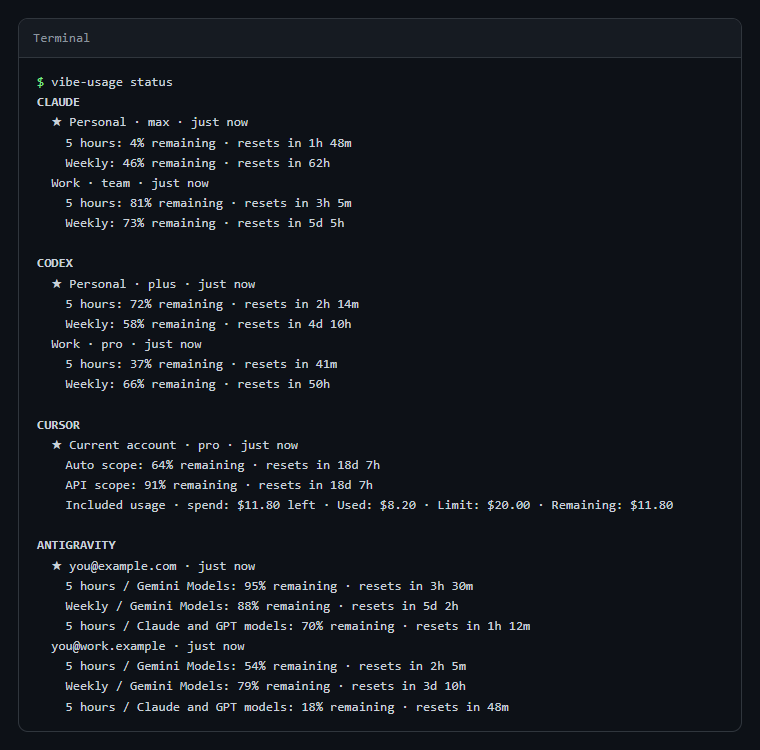
vibe-usage status [--json]   # every account's quota once; --json for scripts
vibe-usage watch             # the same, refreshed until Ctrl+C
vibe-usage run <claude|codex|cursor> [--account ID] [--cwd PATH] [--model MODEL] [--dry-run]
vibe-usage handover [--from TOOL] [--to TOOL] [--session ID] [--cwd PATH]
vibe-usage help
To try it without installing, run npx vibe-usage-cli status.
run starts the tool in this terminal with an account whose quota is verified; otherwise name one with --account
(the IDs are in status --json). --dry-run prints the account and the command without starting anything.
handover writes VIBE_HANDOVER.md for the folder's latest session (or --session) and opens the target tool with
it.
Development
TypeScript in strict mode on Node.js 24 (the version Electron 44 embeds). Tests, the CLI and scripts run straight from
the .ts sources; the app is compiled to build/.
npm ci
npm start              # build and run the app
npm test               # unit and integration tests
npm run test:coverage  # the same, with the coverage gates CI enforces
npm run lint           # ESLint with type information
npm run format         # Prettier
npm run ui-check       # renders the built UI in all 13 languages and checks that every text fits
npm run media          # regenerates the screenshots and the walkthrough in docs/media (needs ffmpeg)
npm run build:win      # or build:mac
| Folder | Runs in | Contains |
|---|---|---|
src/shared |
anywhere | provider catalog, data types, IPC contract, i18n |
src/ui |
the window | the interface |
src/core, src/providers, src/main, src/cli.ts |
Node/Electron | service, provider adapters, main process, CLI |
test, scripts |
Node | type-checked only, never compiled |
VIBE_DATA_DIR moves the settings folder. VIBE_CLAUDE_BINARY, VIBE_CODEX_BINARY and VIBE_CURSOR_AGENT_BINARY
point at specific CLI binaries. Tests never start a real tool or read real accounts.
Limitations
- The macOS build is not notarized (see macOS).
- Antigravity's session model comes from an undocumented local record; if it cannot be read, the model is left blank.
- Cursor IDE (Composer) chats cannot be handed over; only Cursor Agent CLI sessions are read.