
mjventalon/quantforge
mjventalon/quantforge has 7 GitHub stars and 0 forks. GitHot measured +1 stars in 24 hours. Last checked 2026-11-15 17:25 UTC. Last push 2026-11-12.
Measured star growth
- in 24h
- +1
- in 7 days
- Update delayed
- in 15 days
- Update delayed
- in 1 month
- Update delayed
Net star changes over overlapping periods, not daily totals. Missing measurements are left blank. Stars measure attention, not software quality.
About
Open-source quant finance on real market data: Python library, C++ engine, paper trading and Academy
LearningREADME.md
Original

English · Français





🚀 Quick start · 🧰 Tools · 📚 Tutorials · 🎓 Academy · ⬇️ Download · 💬 Discussions · 👤 Creator
quantforge is an open-source quantitative-finance platform built on real market data only: a Python library, a multithreaded C++17 pricing engine, a 25-page research web app, paper trading with $1,000,000 of virtual money, and an Academy that takes you from what is a stock to writing your own pricing engine, with verifiable certificates.
Real numbers, nothing invented. Prices, option chains, rates and fundamentals come from Yahoo Finance, FRED, Massive (Polygon), FMP or Alpha Vantage. Every dataset shows its source and download time. If a source fails, you see the error; quantforge never fills the gap with made-up data.
📑 Contents
- Quick start: install in three commands, or double-click to launch
- What's inside: every tool, with screenshots
- Use it as a library
- Using the C++ engine · Academy curriculum · Validation
- Documentation · Contributing · Disclaimer
🚀 Quick start
git clone https://github.com/mjventalon/quantforge.git
cd quantforge
pip install -e ".[all]"
quantforge-app
Your browser opens on http://localhost:8501.
Prefer not to use the terminal? Download the ZIP, unzip it and
double-click Start quantforge.command (macOS: right-click → Open the first time) or
Start quantforge.bat (Windows). The first launch installs everything automatically.
Step-by-step install (beginners, macOS · Windows · Linux)
Install Python 3.11+ from python.org. On Windows, tick Add Python to PATH.
Download the project: green Code button → Download ZIP, then unzip it. Or use
git clone.Open a terminal in the
quantforgefolder and run:python -m venv .venv source .venv/bin/activate # Windows: .venv\Scripts\activate pip install -e ".[all]" quantforge-appOptional, for the C++ engine: install a compiler (macOS:
xcode-select --install, Windows: Visual Studio Build Tools, Linux:sudo apt install g++) and runquantforge-build-native.
Docker
docker compose up --build # → http://localhost:8501
API keys are optional. Yahoo Finance and FRED work out of the box. To add Massive/Polygon,
FMP, Alpha Vantage or an AI copilot, copy .env.example to .env and paste your keys there.
.env is git-ignored: your keys never leave your computer.
🧰 What's inside
📈 Live market & stock analysis
Intraday candles that refresh on their own, decades of daily history for long-horizon research, technical indicators, heatmaps, and ticker suggestions as you type.
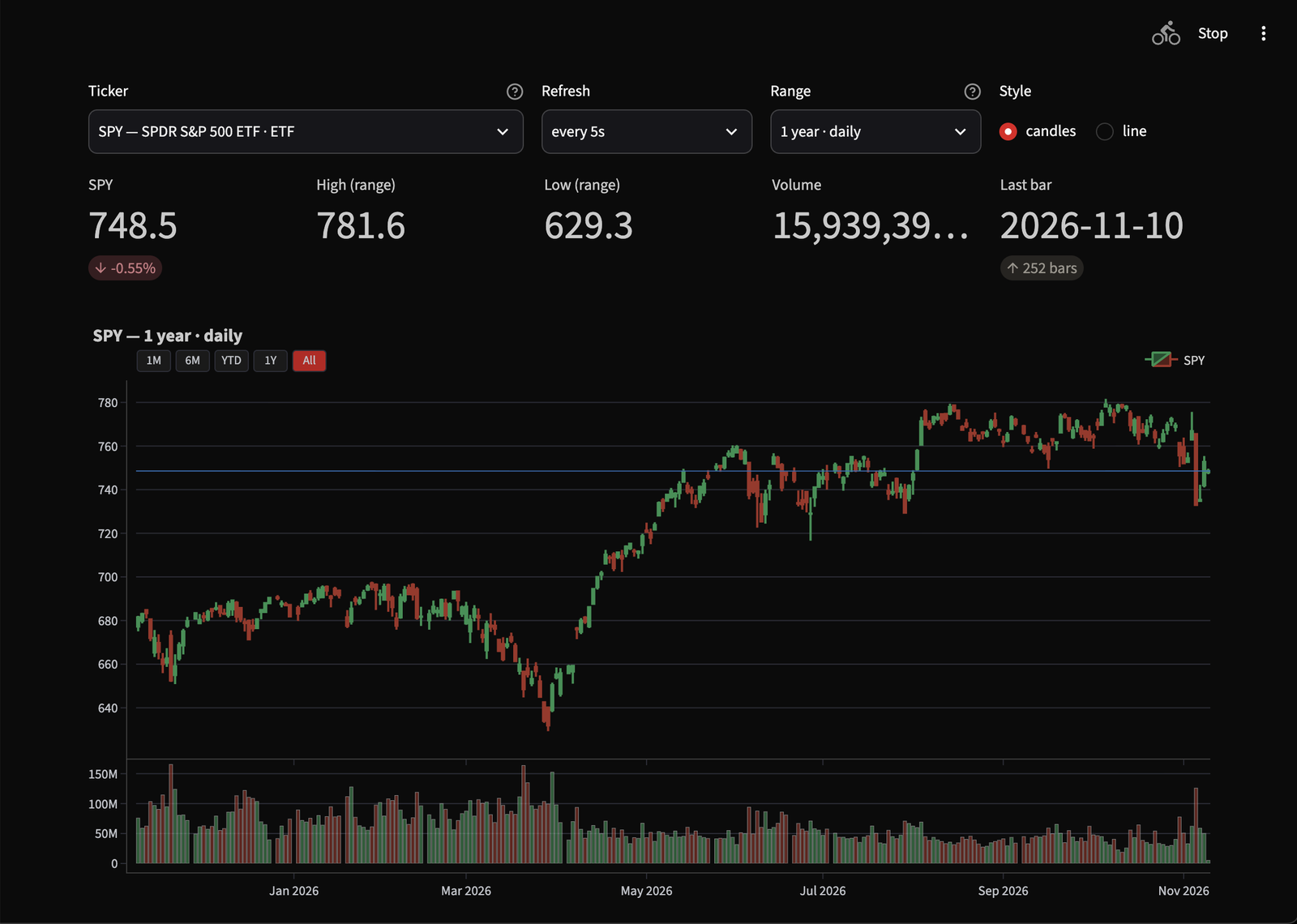
- Ranges from 1 day (1-minute bars) to the full history (weekly bars)
- Scroll to zoom, drag to pan, double-click to reset; adjustable zoom speed
- Market pulse heatmaps, technical analysis, SEC company universe
💼 Paper trading
Trade with $1,000,000 of virtual money at real prices. Your account is saved and you can come back to it.
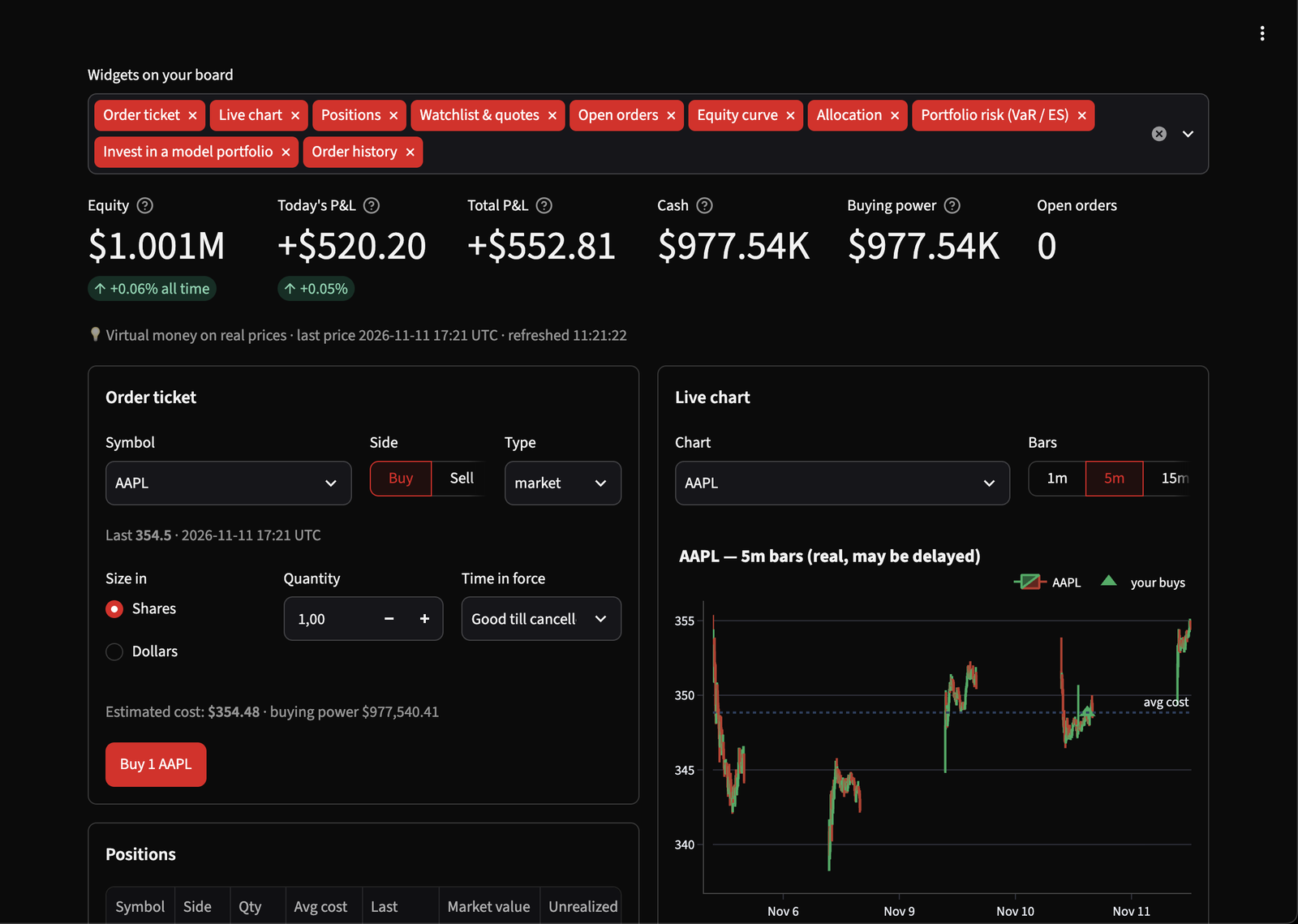
- Market, limit, stop, stop-limit and trailing-stop orders, day or GTC
- Short selling with margin, commissions and slippage, average-cost P&L
- Buy a whole model portfolio in one click and rebalance it
- Board of 14 resizable widgets: quotes, P&L, equity curve, positions, orders, risk
🧮 Options: pricing, volatility surfaces, strategies
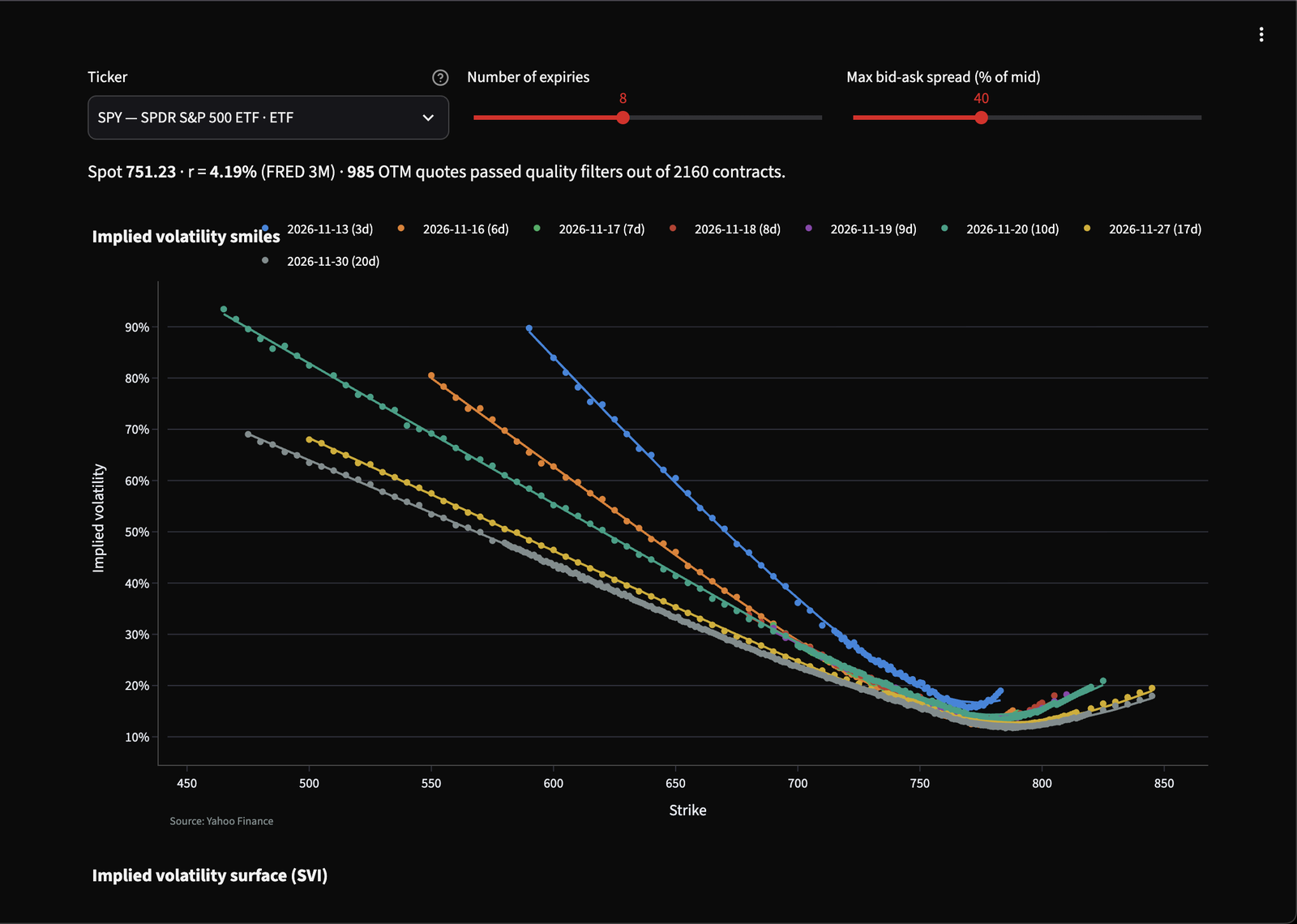
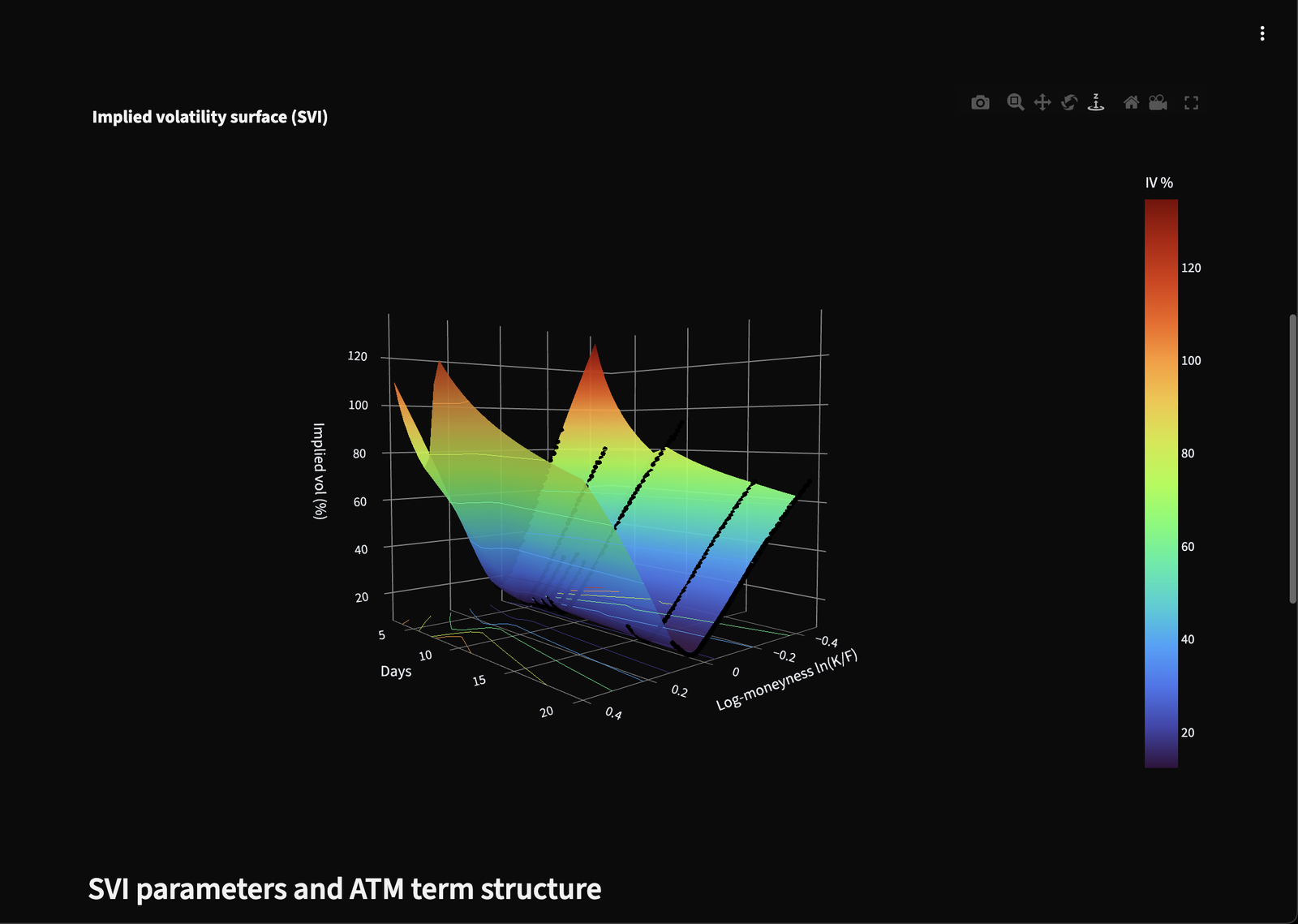
- Black-Scholes-Merton and Greeks, Black-76, implied volatility
- CRR and Leisen-Reimer trees (American), Monte-Carlo with variance reduction, 8 barrier types
- SVI smiles and 3-D implied-volatility surfaces built from live option chains
- Multi-leg strategy builder, expected move, max pain, open-interest walls
🌀 Advanced models: Heston · SABR · jumps
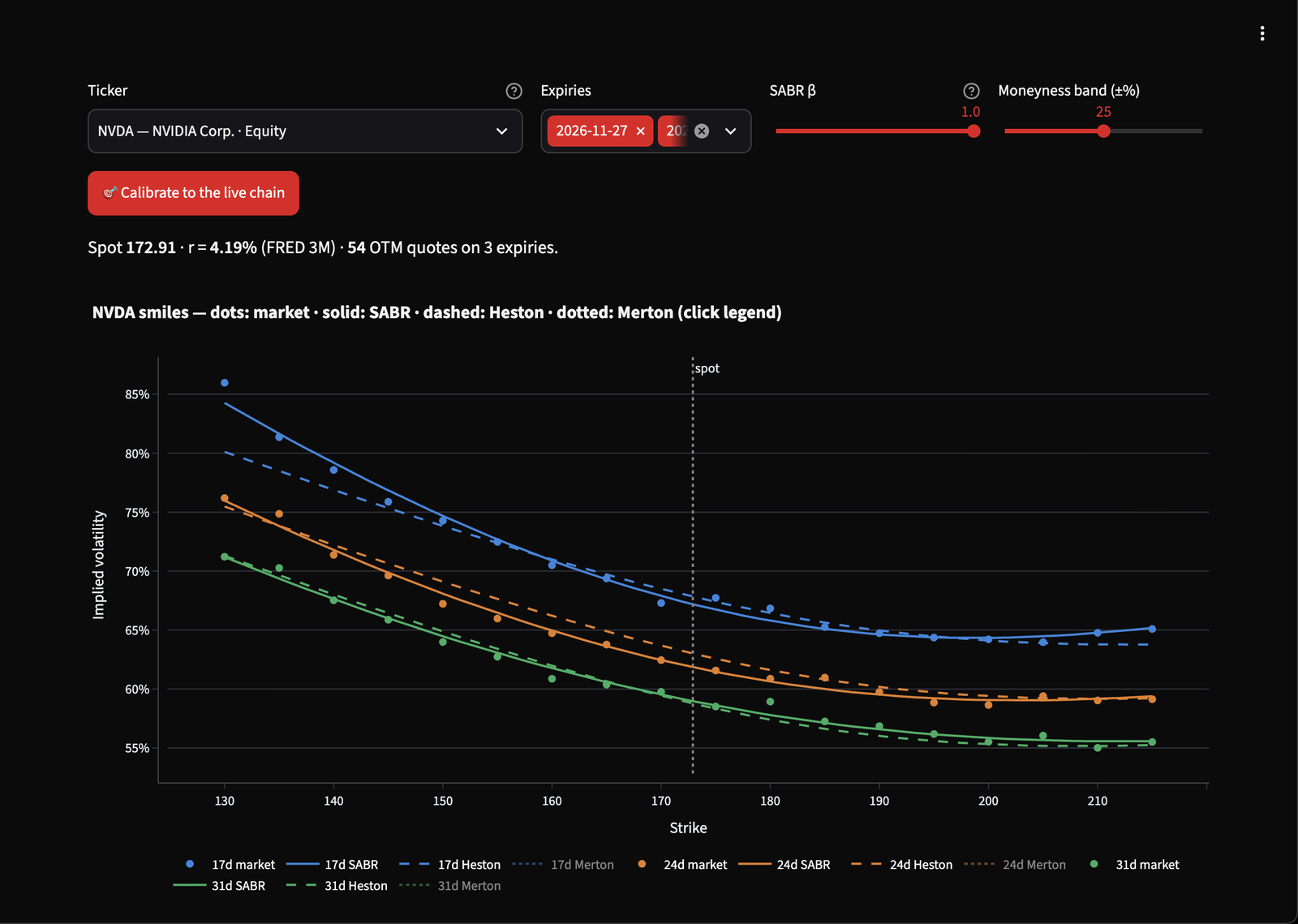
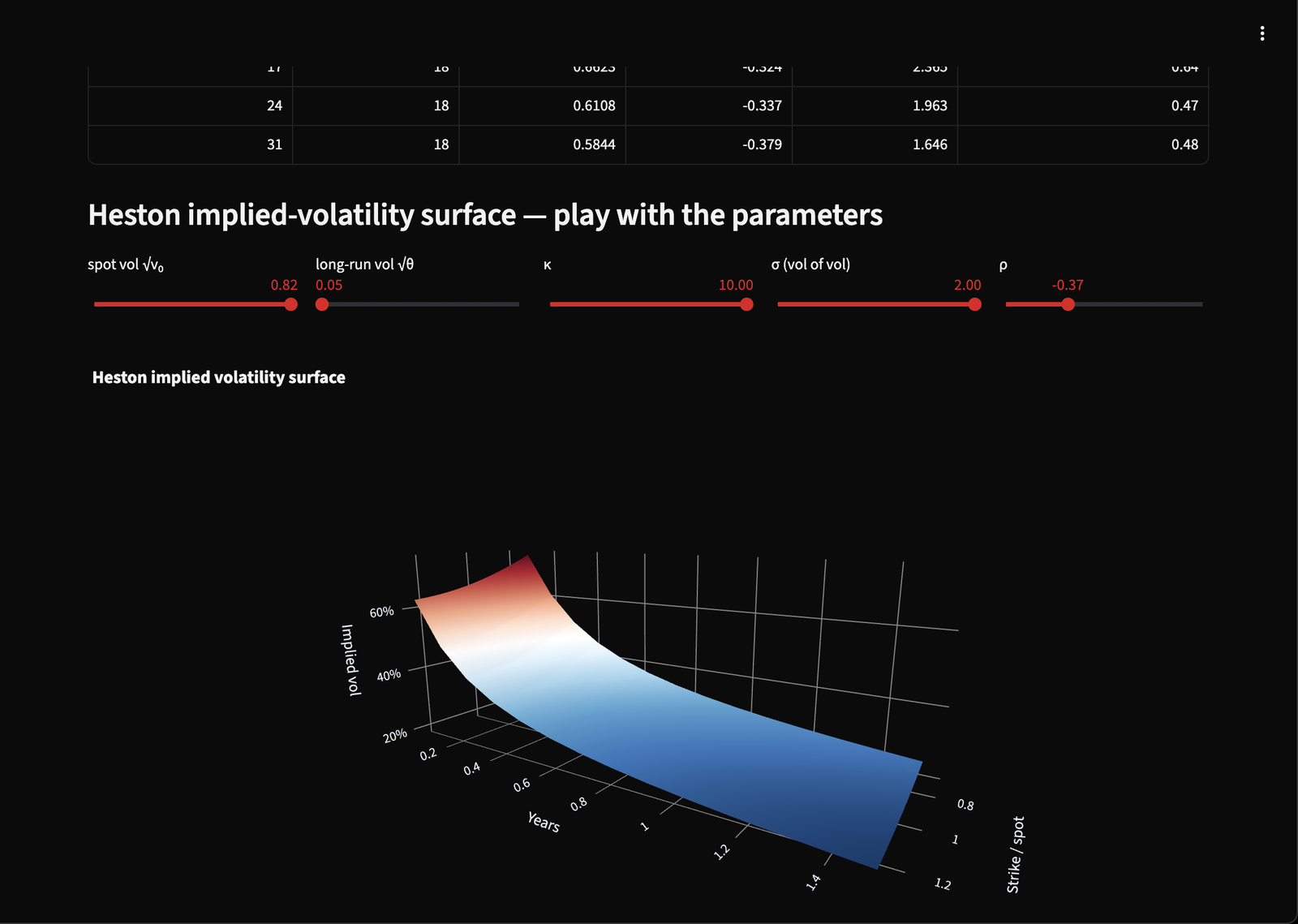
- Heston stochastic volatility (semi-analytic and Monte-Carlo)
- SABR (Hagan 2002) and Merton jump-diffusion
- Calibration to live option chains, with fit diagnostics
🔬 Research lab: backtests, Strategy Lab, regimes
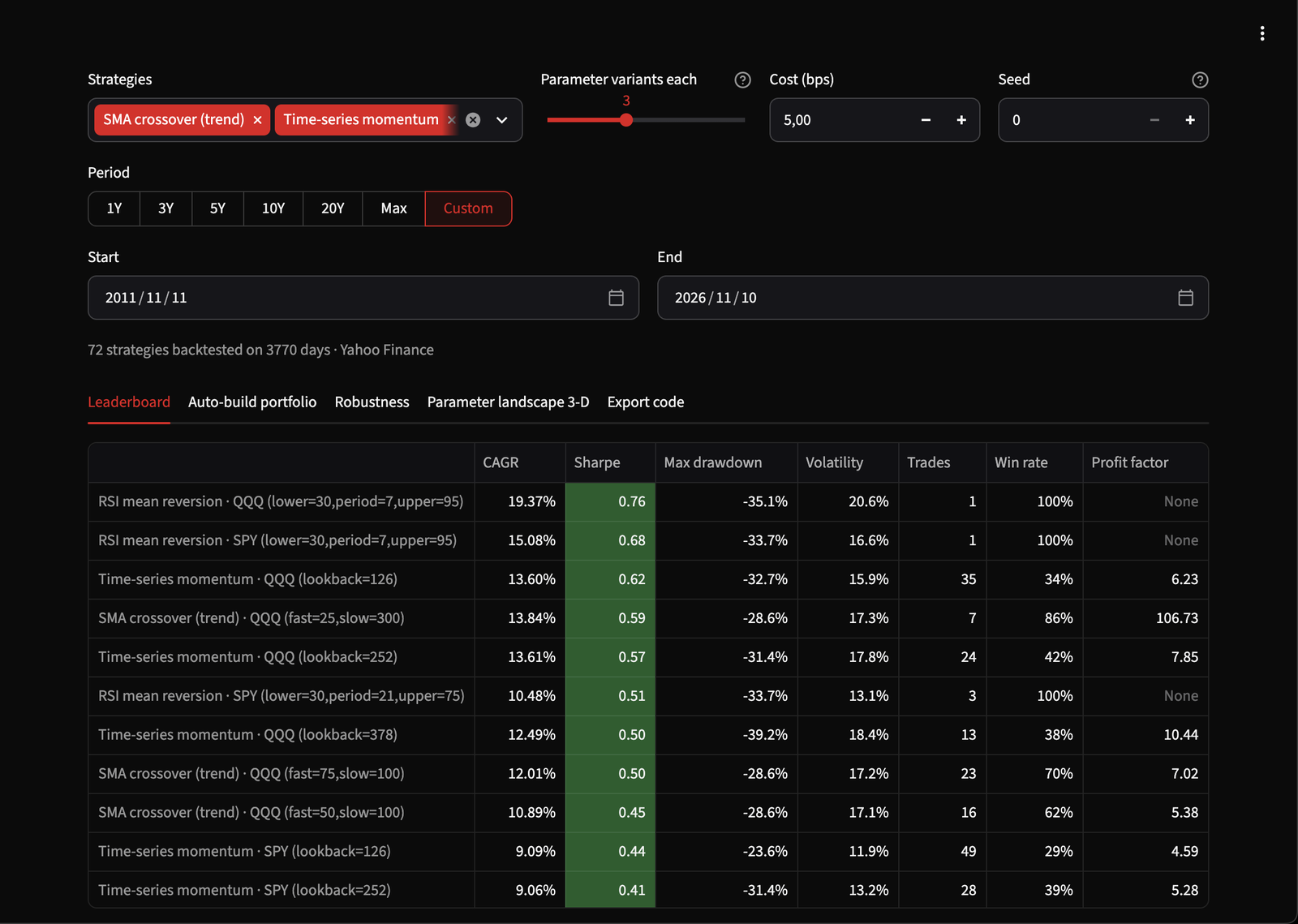
- Backtest engine with no look-ahead, plus transaction costs and a strategy library
- Train/test grid search, walk-forward, pairs trading, trade Monte-Carlo
- Strategy Lab: multi-strategy books, diversity score, export of reusable Python code
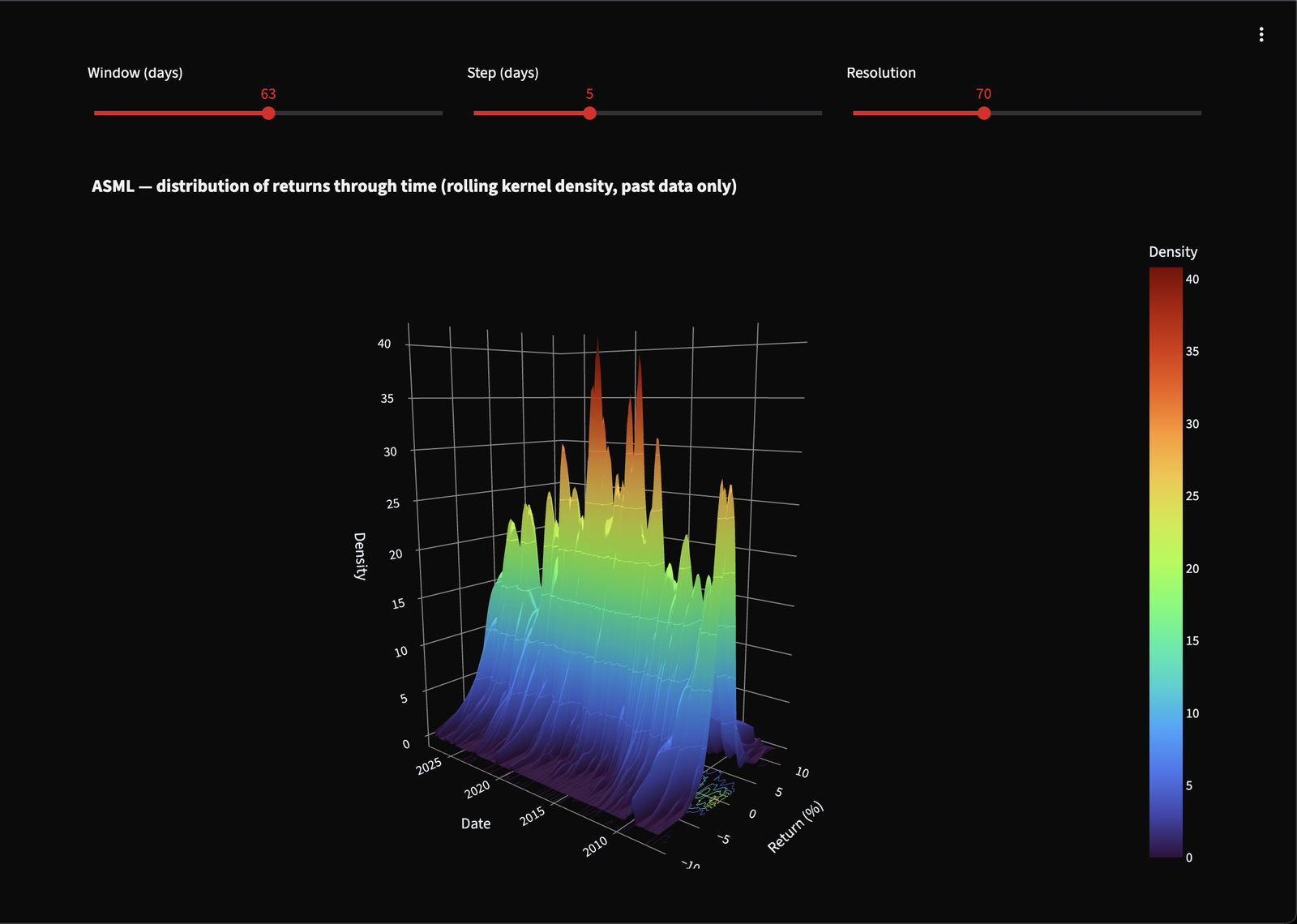
- Gaussian HMM regimes and rotating 3-D return-distribution surfaces
📊 Portfolio & risk
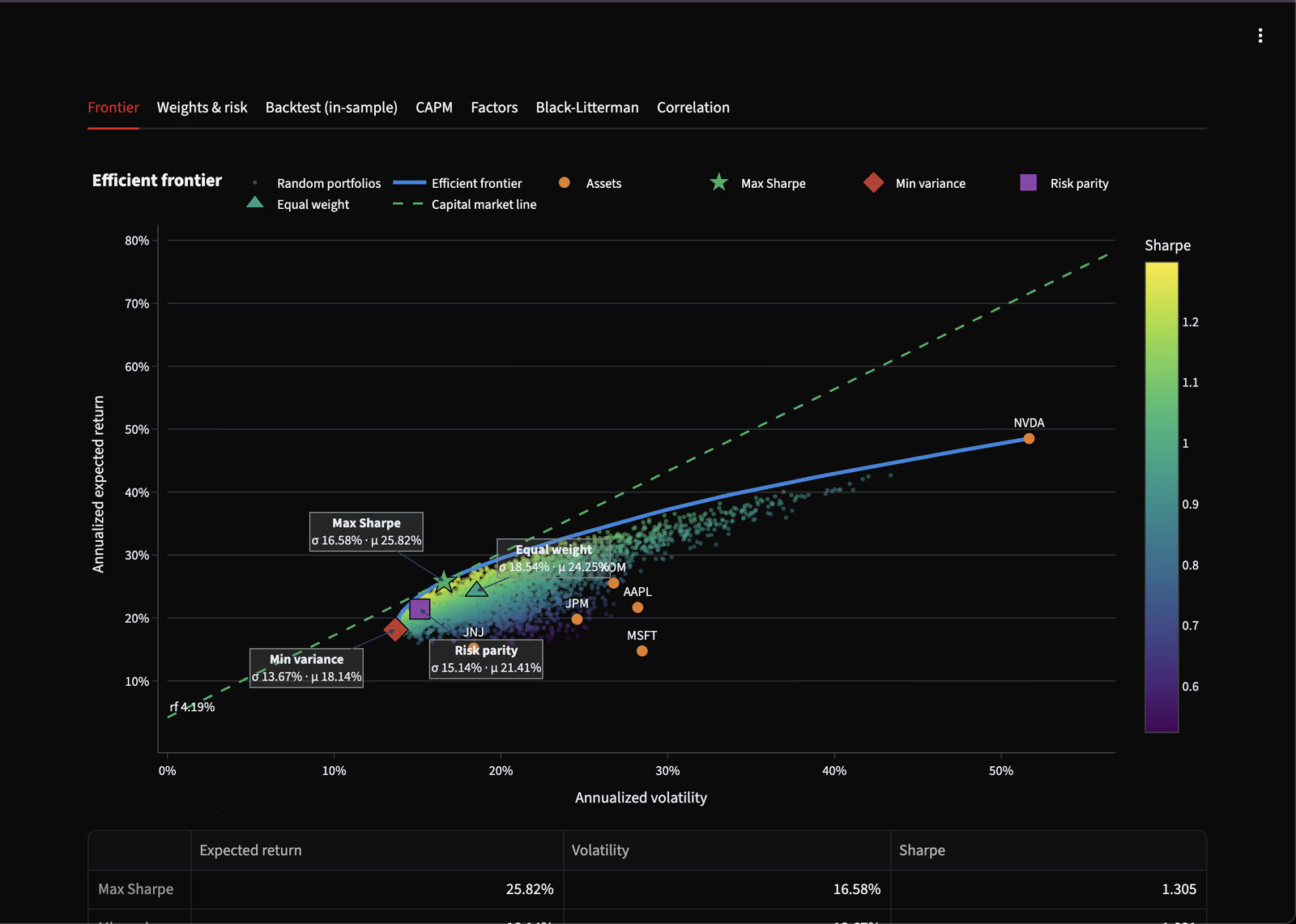
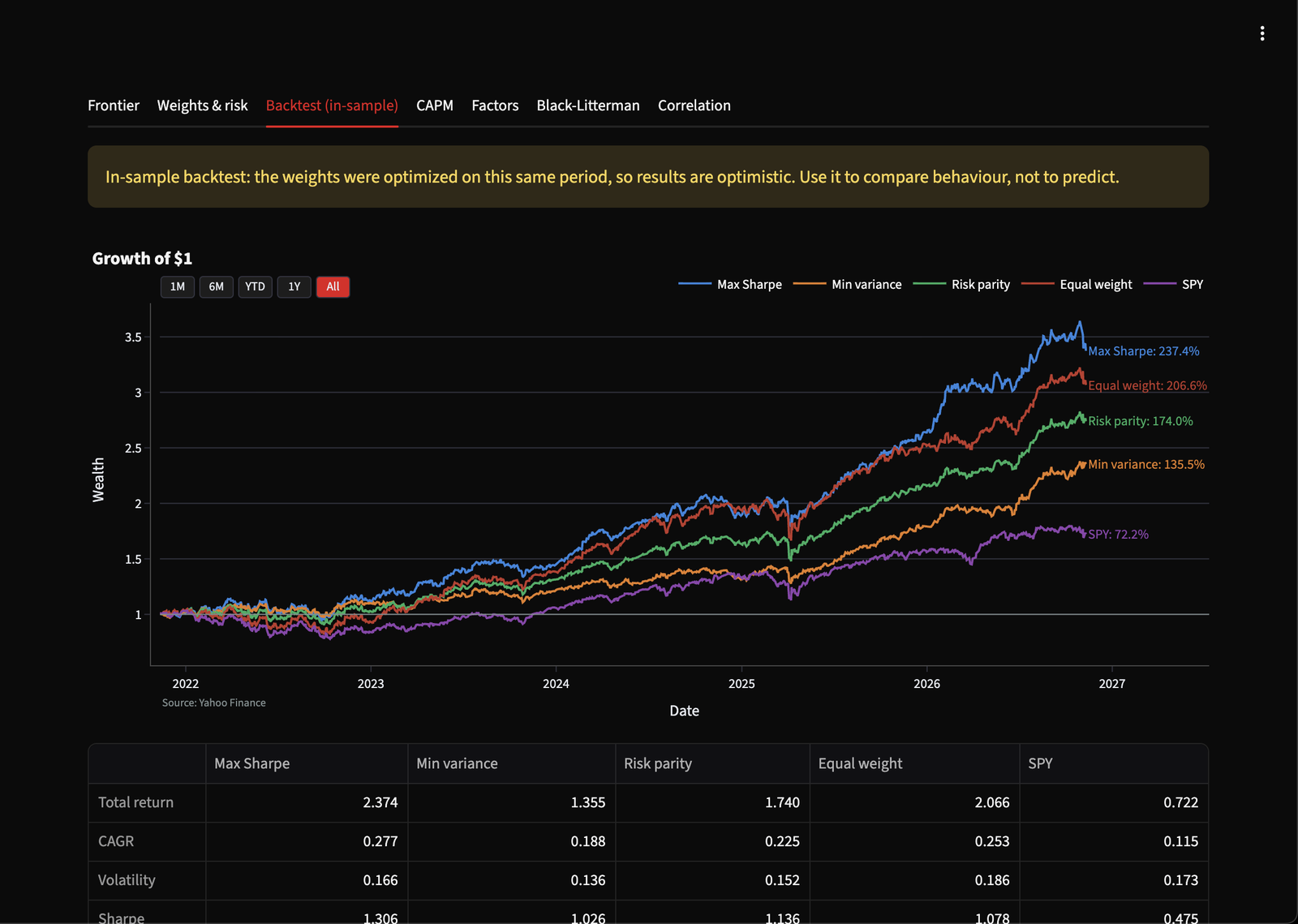
- Markowitz family, Ledoit-Wolf, risk parity, Black-Litterman, CAPM, factor exposures
- Wealth simulator (block bootstrap with real CPI inflation)
- VaR/ES with five methods, component VaR, Kupiec/Christoffersen backtests, Basel zones
- Stress tests that replay real historical crises
- ARMA, GARCH/GJR-t, cointegration; credit models (logistic PD, scorecards, Merton/KMV, Altman Z)
🤖 AI copilot
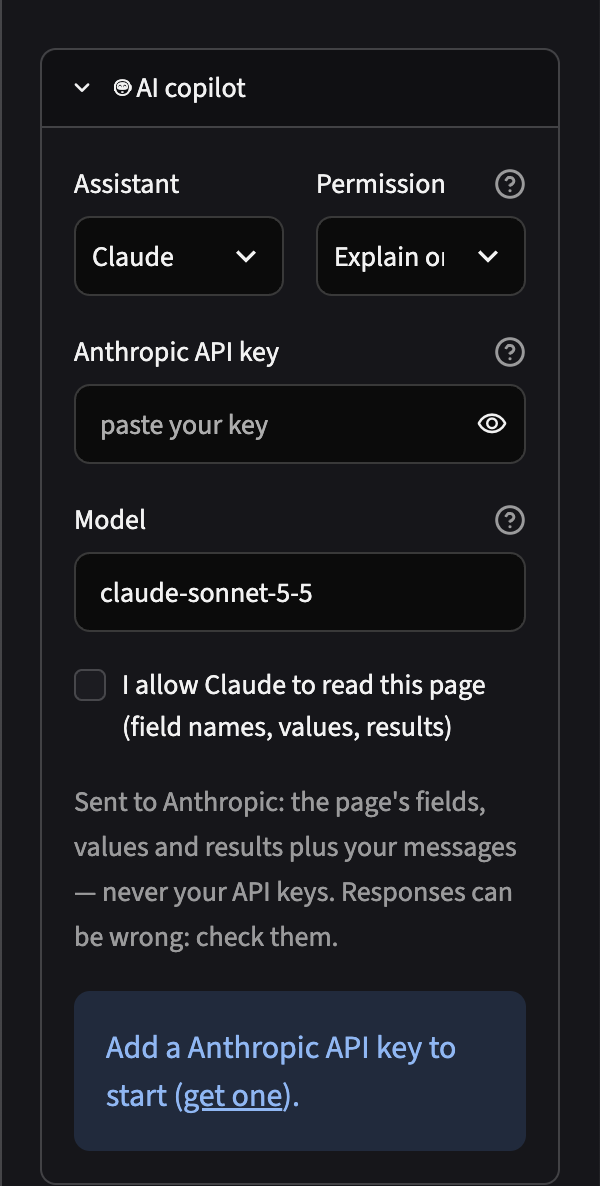
Connect Claude, ChatGPT or Gemini with your own API key. The copilot explains every field, suggests settings, or fills in the page and runs it for you. It needs your permission for each AI, and it can never see your keys or press delete, reset or export buttons.
⚡ C++ engine
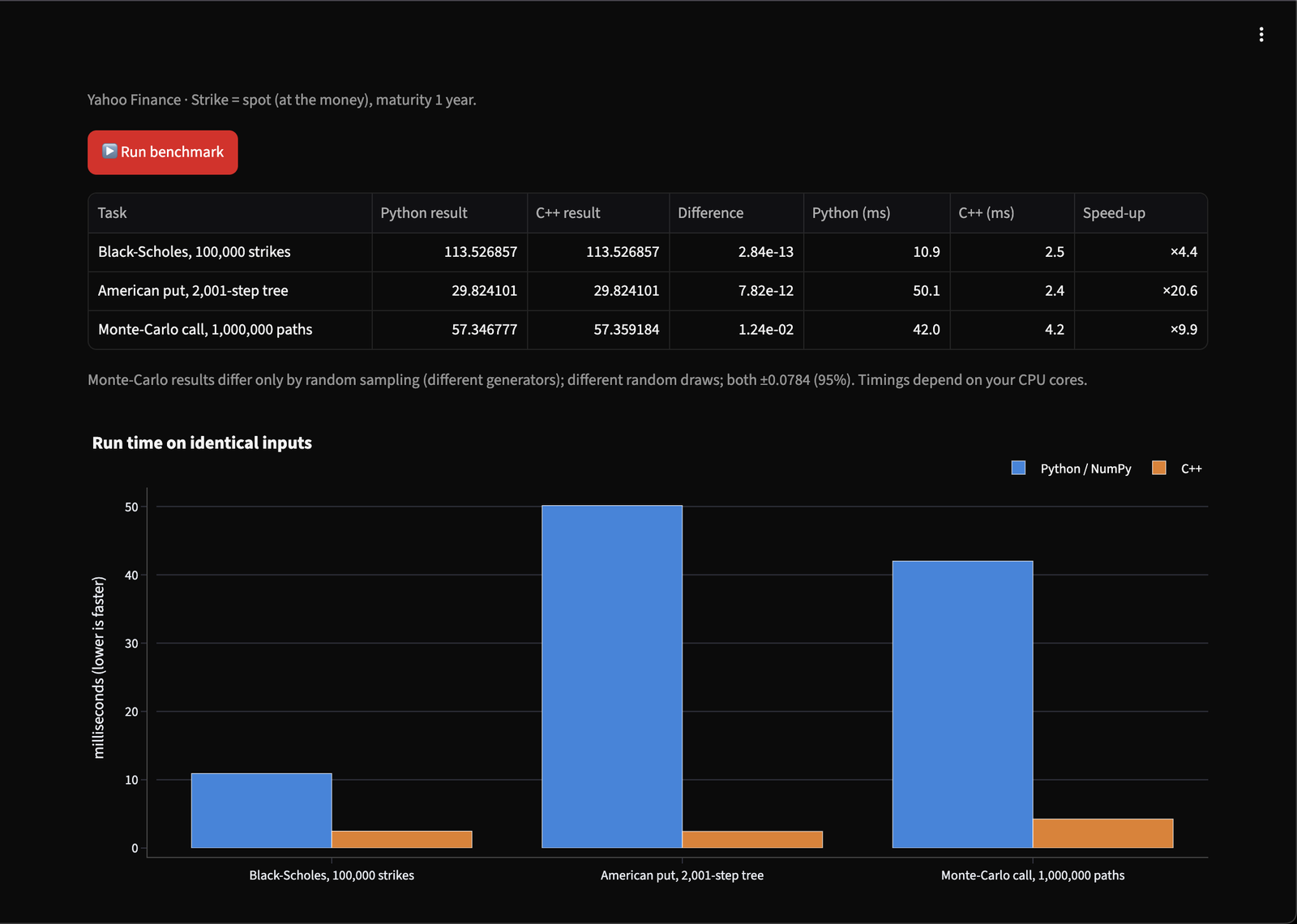
A header-only C++17 library with Python bindings: Black-Scholes and Greeks, Newton implied vol, LR/CRR trees and multithreaded deterministic Monte-Carlo. It matches the Python implementation to about 1e-10 and is many times faster.
🎓 Academy
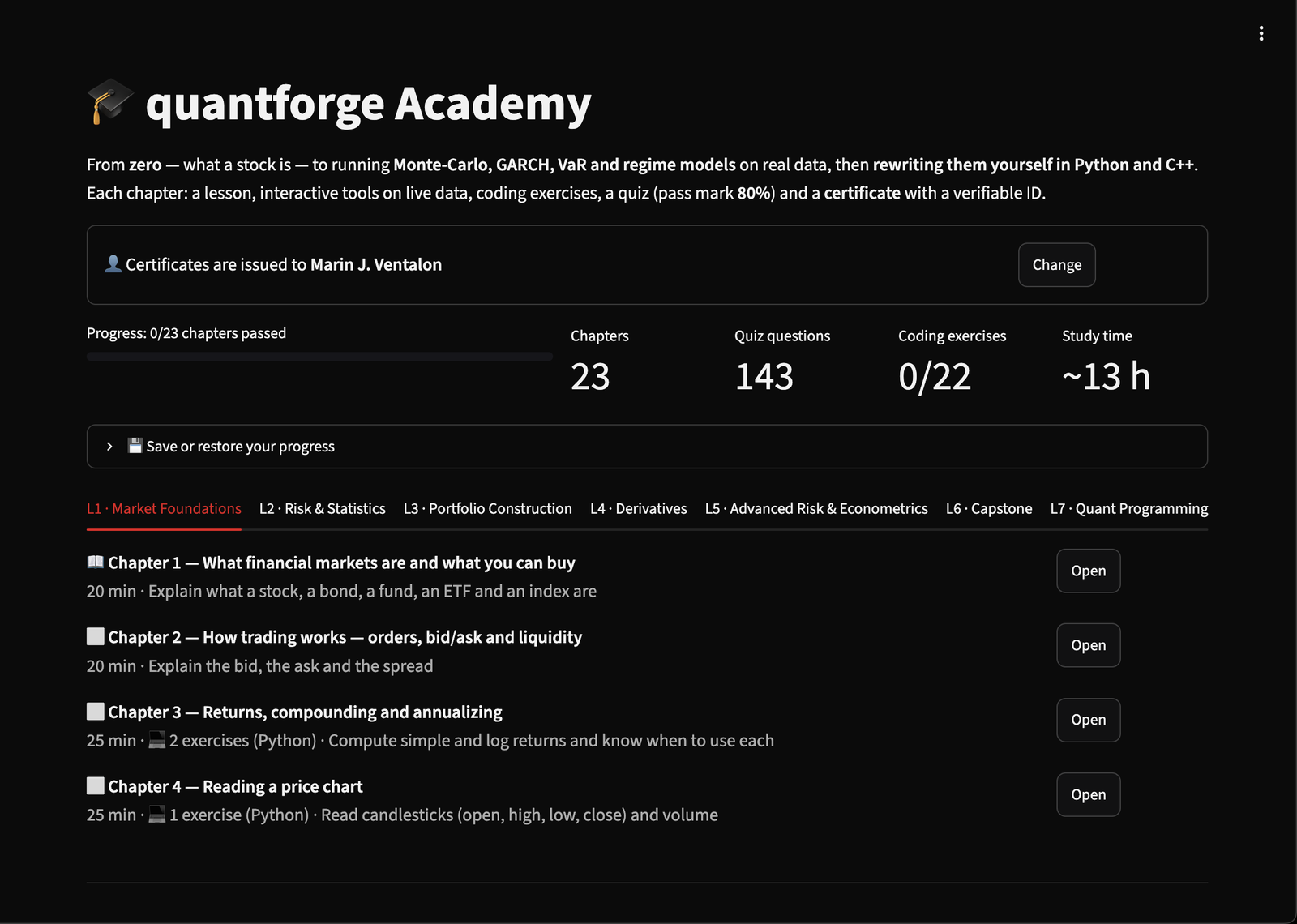
23 chapters across 7 levels: original lessons with cited sources, interactive tools on live data, "rewrite it yourself" exercises in Python and C++ with automatic grading, quizzes and PDF certificates that anyone can verify.
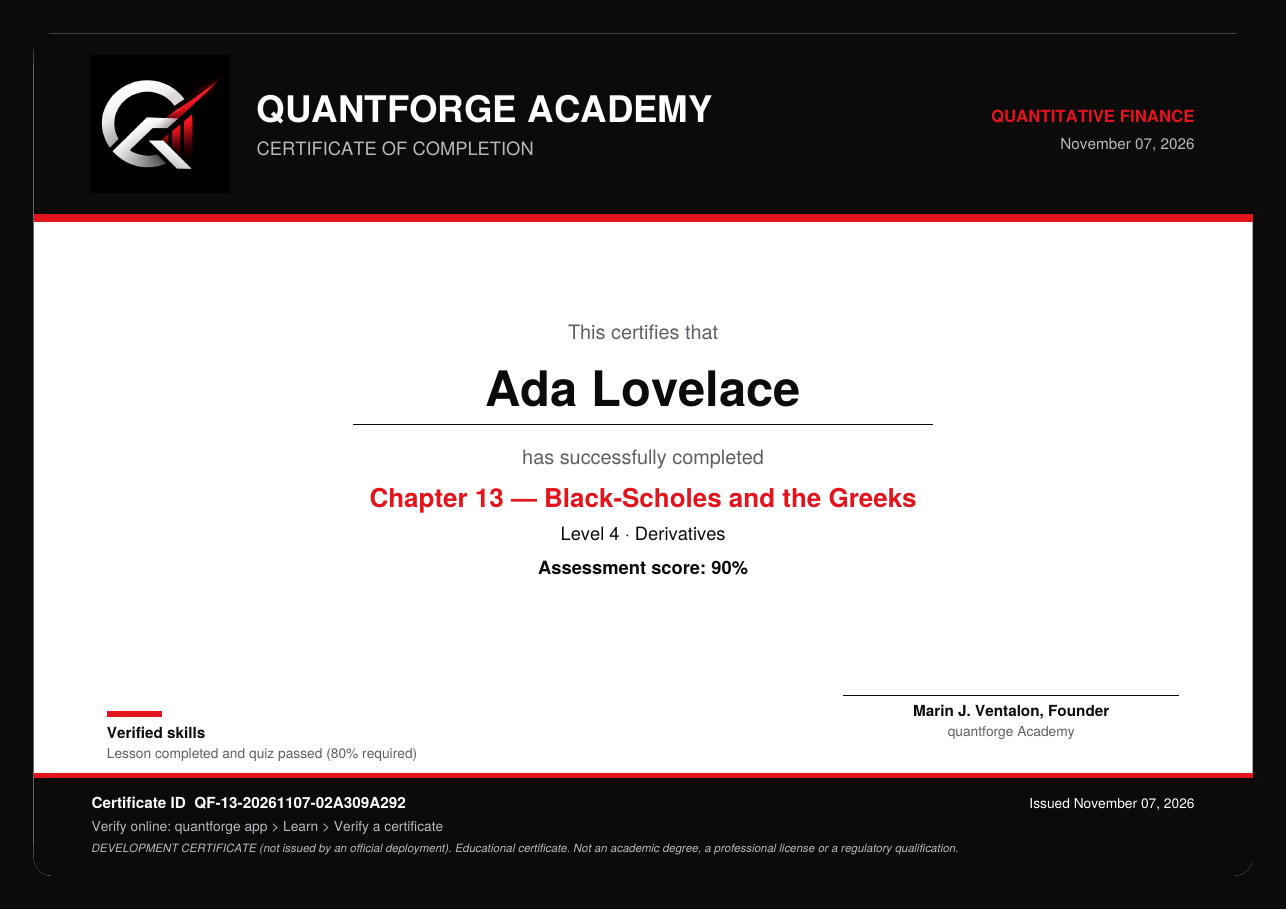
Example certificate
🐍 Use it as a library
pip install -e ".[all]"
from quantforge.data import MarketData
from quantforge.pricing import binomial_price, implied_volatility
from quantforge.portfolio import estimate_inputs, max_sharpe
from quantforge.risk import var_report

md = MarketData("yahoo")

# 1. Price a real American put and compare with the market
chain = md.option_chain("AAPL", md.option_expiries("AAPL")[3])
spot, r = md.quote("AAPL"), md.risk_free_rate("3M")
opt = chain[(chain.type == "put")].iloc[(chain[chain.type == "put"].strike - spot).abs().argmin()]
T = opt.days / 365
iv = implied_volatility(opt.mid, spot, opt.strike, T, r, "put")
print(binomial_price(spot, opt.strike, T, r, iv, "put", "american"))

# 2. Max-Sharpe portfolio on 5 years of real prices
rets = md.returns(["AAPL", "MSFT", "JPM", "XOM", "JNJ"], start="2020-01-01")
mu, cov = estimate_inputs(rets)
print(max_sharpe(mu, cov, risk_free_rate=r))

# 3. Tail risk of SPY
print(var_report(md.returns("SPY")["SPY"], confidence=0.99, position_value=1_000_000))
Each module is documented in the tutorials:
| Module | Purpose |
|---|---|
quantforge.data |
MarketData facade (Yahoo, Massive/Polygon, FMP, Alpha Vantage, FRED), intraday, Treasury curve, cache |
quantforge.pricing |
BSM, trees, Monte-Carlo, barriers, SVI, strategies, Heston, SABR, Merton |
quantforge.portfolio |
Optimisers, Black-Litterman, CAPM, factors, wealth simulator |
quantforge.risk |
VaR/ES, backtests, stress tests |
quantforge.timeseries |
ARMA, GARCH, ADF, cointegration, indicators, HMM regimes |
quantforge.backtest |
Backtest engine, walk-forward, pairs, Strategy Lab |
quantforge.credit |
PD models, scorecards, Merton/KMV, Altman Z |
quantforge.paper |
Paper-trading engine and saved wallets |
quantforge.native |
C++ engine bindings |
quantforge.academy |
Curriculum, exercises, certificates |
quantforge.viz |
About 40 interactive Plotly charts |
⚡ Using the C++ engine
from quantforge import native
native.build()                                            # once
native.bs_price(42, 40, 0.5, 0.10, 0.20, "call")          # 4.759422392871532
native.binomial(50, 50, 5/12, 0.10, 0.40, "put", "american", steps=2001)
native.mc_european(100, 100, 1, 0.05, 0.2, n_paths=4_000_000, seed=7)
native.benchmark()                                        # C++ vs NumPy on identical inputs
Or use the headers directly (src/quantforge/native/cpp, a CMake project with tests):
cmake -S src/quantforge/native/cpp -B build && cmake --build build && ctest --test-dir build
🎓 Academy curriculum
| Level | Chapters |
|---|---|
| 1 · Market Foundations | markets & instruments · orders, bid/ask, liquidity · returns & compounding · reading charts |
| 2 · Risk & Statistics | volatility & drawdowns · fat tails · correlation & beta · rates & bonds |
| 3 · Portfolio Construction | efficient frontier · CAPM & factors · honest backtesting |
| 4 · Derivatives | options & payoffs · Black-Scholes & Greeks · trees & Monte-Carlo · implied vol surfaces |
| 5 · Advanced Risk & Econometrics | VaR/ES & stress tests · ARMA/GARCH · regimes & pairs · credit risk |
| 6 · Capstone | a complete research project |
| 7 · Quant Programming | Python for quants · C++ for quants · build a pricing engine in C++ |
Certificates attest completion of quantforge content. They are not academic degrees or professional qualifications, and quantforge is not an accredited institution.
✅ Validation
| Check | Reference | Result |
|---|---|---|
| BS call/put S=42 K=40 r=10% σ=20% T=0.5 | Hull, Ex. 15.6: 4.76 / 0.81 | 4.7594 / 0.8086 |
| American put S=K=50 r=10% σ=40% T=5/12 | Hull, Ex. 21.1: ≈4.28 | 4.2842 (LR, 1001 steps) |
| Put-call parity, Greeks vs finite differences | identities | < 1e-6 |
| Monte-Carlo vs Black-Scholes | closed form | within 3 standard errors |
| MC barriers (BGK) vs Reiner-Rubinstein closed form | closed form | within ~1-2 SE, all 8 types |
| SVI fit on a known surface | round trip | exact recovery |
| GARCH / GJR-t parameters & log-likelihood | arch package |
match to ~3 decimals |
| ARMA(2,1) estimates & forecasts | statsmodels |
match to ~3 decimals |
| Logistic regression, OLS (HC1) | statsmodels |
match to 1e-8 |
| Engle-Granger cointegration & ADF | statsmodels coint / adfuller |
identical statistic |
| Ledoit-Wolf shrinkage | scikit-learn |
match to 1e-6 |
| Backtest engine | hand-computed P&L, foresight test | exact; no look-ahead |
| Gaussian HMM regimes | hmmlearn |
log-likelihood ≥ reference |
| Heston | BS limit, adaptive quadrature, Monte-Carlo, parity | 1e-6 / 1e-8 / within 4 SE / 1e-10 |
| SABR, Merton | flat-vol and no-jump limits, round-trip calibration, Monte-Carlo | exact / 1e-6 / within 4 SE |
| Paper-trading engine | order types, average-cost P&L, margin, persistence | unit tests |
| C++ engine vs Python (BS, Greeks, IV, LR/CRR trees) | Python implementation | ≤ 1e-9 relative |
| C++ Monte-Carlo | Black-Scholes; 1 vs 8 threads | within 4 SE; bit-identical |
| Academy exercises | reference solutions / starters | all pass / all fail |
Run them: pytest -q (Python) and ctest (C++).
📚 Documentation
| 📘 Tutorials | 10 step-by-step guides on live data |
| 🏗️ Architecture | How the pieces fit together |
| 🌐 Deployment | Put the web app online with your own domain |
| 🗺️ Roadmap · 📝 Changelog | What's next, what changed |
| 🇫🇷 Lisez-moi | French quick start |
🤝 Contributing
Contributions are welcome: bug reports, new models, translations, tutorials.
Start with CONTRIBUTING.md and look for issues labelled
good first issue. Please read the
Code of conduct. To report a vulnerability, see SECURITY.md.
To cite quantforge, see CITATION.cff.
If quantforge helps you, a ⭐ on the repository helps other people find it.
📄 Disclaimer
quantforge is research and educational software, provided as is under the MIT license.
Nothing here is investment advice. Third-party data may be delayed or wrong, and its
providers' terms apply. Yahoo Finance data accessed through yfinance is intended for personal use.

Built by Marin J. Ventalon · LinkedIn
Made with care in France 🇫🇷