
minsight-ai-info/AI-Search-Hub
minsight-ai-info/AI-Search-Hub has 1,319 GitHub stars and 113 forks. GitHot measured 0 stars in 24 hours and +5 in 7 days. Last checked 2026-11-12 00:40 UTC. Last push 2026-04-27.
One Query. All Search Skill. 聚合 Gemini、Grok、豆包、元宝等平台原生 AI 搜索能力,免费获取科技趋势、行业舆情、热点追踪、旅行规划、日常问题统一接进自己的 Agent 与工作流,指定链接免费爬取
Measured star growth
- in 24h
- 0
- in 7 days
- +5
- in 15 days
- Collecting history
- in 1 month
- Collecting history
Net star changes over overlapping periods, not daily totals. Missing measurements are left blank. Stars measure attention, not software quality.
README.en.md
OriginalAI Search Hub
One Query. All Search.








An open-source skill for aggregating platform-native AI search. Pull WeChat Official Accounts, Douyin, Weibo, and more through major AI platforms, then let them collect, clean, and structure the data for your OpenClaw.
Plug Big-Tech Native Search into Your OpenClaw
AI Search Hub is an open-source skill that turns fragmented AI search surfaces, page-extraction abilities, and the native data worlds behind those platforms into one reusable orchestration hub.
It is not just for one-query, all-search workflows. Give it a link and it can also borrow the page understanding, search, and extraction abilities already refined by major AI platforms. More importantly, it lets you reach data that those platforms are better positioned to surface, such as WeChat Official Accounts, Douyin, Weibo, and other native content ecosystems, then let them collect, clean, and structure the result for your agents and workflows.
It is not trying to make you maintain:
- fragile crawler stacks and brittle parsing rules
- separate browser automation and login recovery flows for every provider
- endless login, captcha, rate-limit, and anti-bot recovery
- direct work against fragmented entry points like WeChat, Douyin, Weibo, and the open web
- link-by-link body extraction, ad removal, noise cleanup, key-point extraction, and structuring by hand
- manual stitching of scattered results at the end
Its job is simple:
Give it a question and let those platforms search for you. Give it a link and let them fetch, read, clean, and structure it for you. The hardest data entry points are exactly where you let major platforms do the work for your agent.
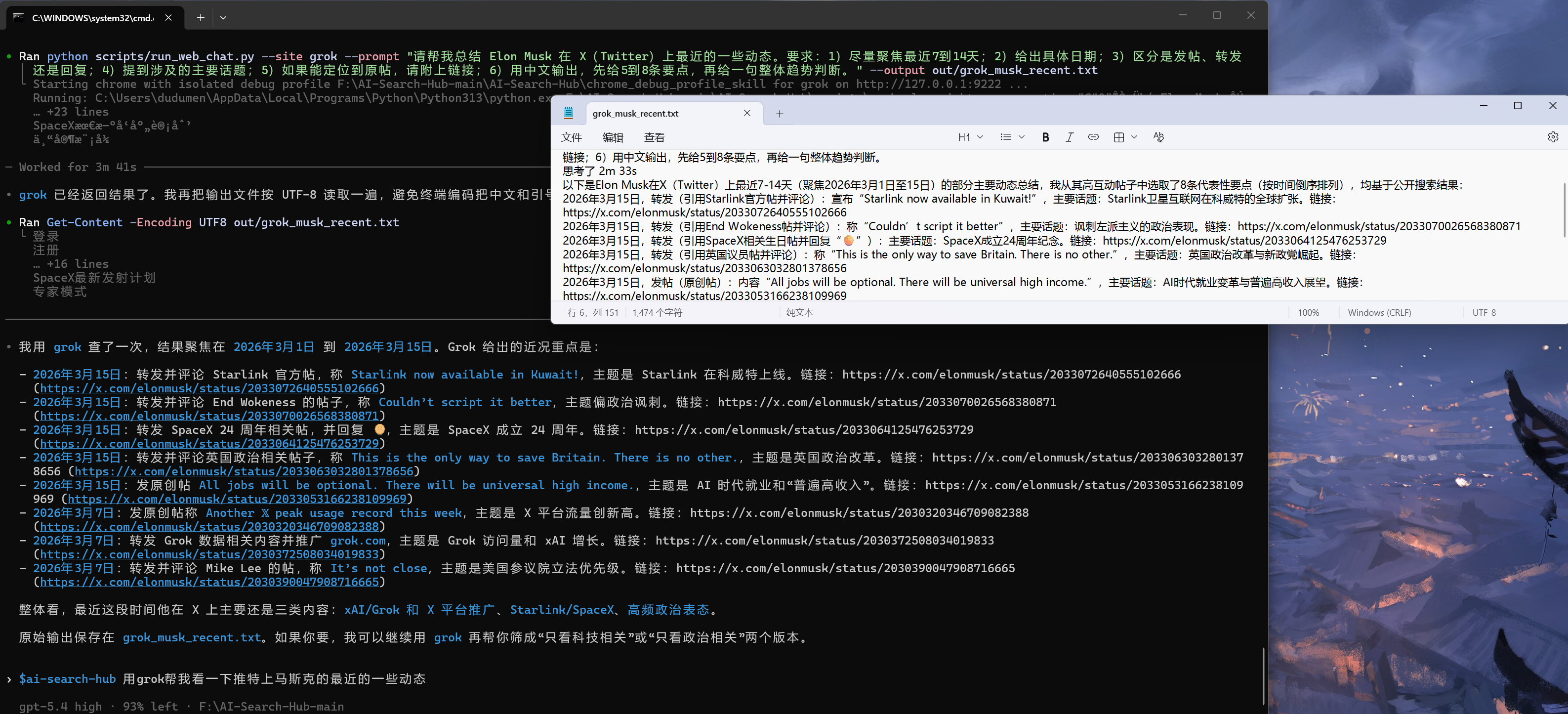
Real Grok run result |
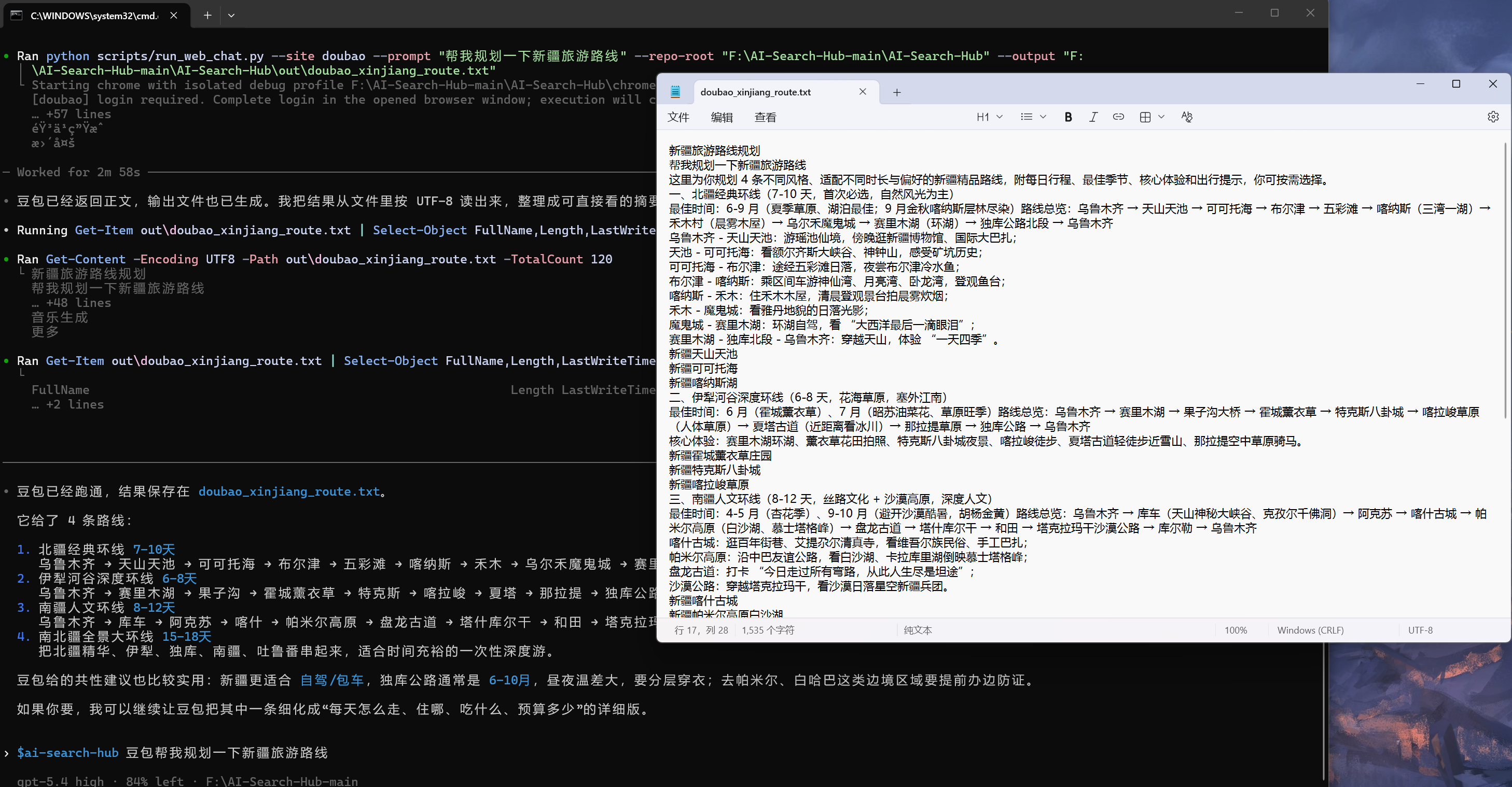
Real Doubao run result |
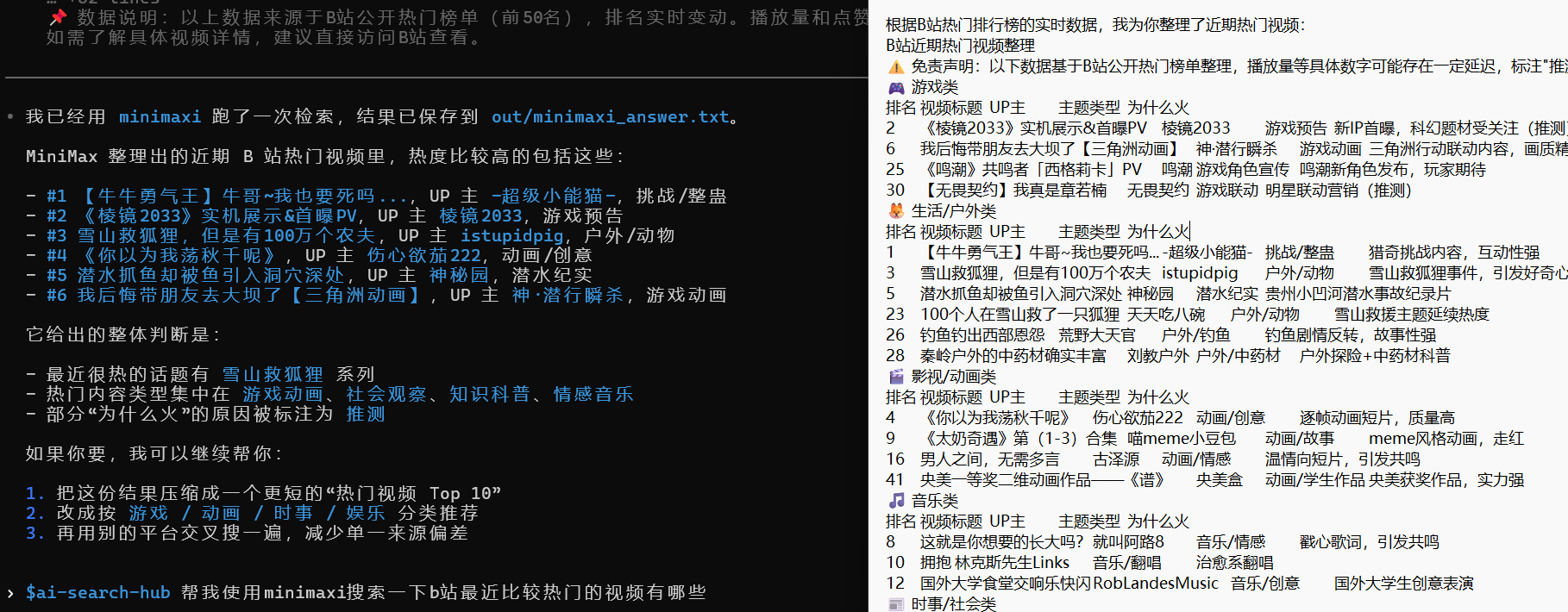
Real MiniMax run result |
Install
AI Search Hub is not a traditional SDK. It is a skill.
Give this repository to any skill-capable agent or tool such as OpenClaw, Claude Code, Codex, or Cursor, and let it install or mount the skill directly.
Traditional Workflow vs AI Search Hub
| Traditional workflow | AI Search Hub |
|---|---|
| 🔧 Build crawlers yourself You own scraping, parsing, and long-term maintenance |
⚡ Reuse platform-native search Plug directly into mature search surfaces |
| 🧩 One automation flow per provider Every new source adds one more integration to maintain |
🚀 One query, multi-provider dispatch Use one entrypoint for multiple search providers |
| 🛡️ Constant anti-bot handling Login, rate limits, and UI changes drain engineering time |
🎯 Lean on existing platform entry points Reduce repeated recovery work and focus on orchestration |
| 🔍 Endless keyword tuning Usable coverage often needs constant search tweaking |
🧠 Reuse provider-optimized search logic Reuse ranking, retrieval, and interaction patterns |
| 🧱 Manual result stitching You still need to unify scattered outputs afterward |
📦 Unified output for agents and workflows Pull results back into one reusable output channel |
Supported Platforms
These platforms are not side notes. They are the search surfaces AI Search Hub orchestrates first.
Currently integrated: Gemini / Grok / Doubao / Yuanbao / LongCat / Qwen / MiniMax / Kimi
| Platform | Search Strength | Typical Coverage | Status |
|---|---|---|---|
| Gemini Google-first discovery |
Google search web discovery knowledge lookup |
Google public web knowledge sites |
 |
| Grok Real-time social search |
X / Twitter live signals trend discovery |
real-time posts social chatter trending topics |
|
| Doubao Chinese trend sensing |
Chinese understanding hot topics content summarization |
Douyin Chinese content trending discussions |
|
| Yuanbao Chinese source supplement |
Chinese supplement official account lookup source cross-checking |
WeChat Official Accounts Chinese web public content |
|
| LongCat Chinese knowledge blend |
Chinese knowledge industry context structured summaries |
Chinese knowledge bases industry reports public information |
|
| Qwen / Tongyi Chinese web expansion |
Chinese search web Q&A public content |
Chinese web search surfaces open information |
|
| MiniMax Agent General Chinese assistant |
Chinese chat general web tasks consumer queries |
general Chinese prompts lifestyle questions broad assistance |
|
| Kimi Long-context exploration |
long context document reading information structuring |
long-form content research material public web |
|
| Perplexity Web-native answer engine |
web search source citation fast summaries |
public web news sites knowledge content |
 |
| Claude Reasoning and synthesis |
complex reasoning information synthesis long-form summarization |
research material multi-source synthesis knowledge Q&A |
|
| Wenxin Baidu ecosystem expansion |
Chinese search Baidu ecosystem public web |
Chinese pages search results public sites |
|
| More Vertical Sources Extensible surface |
continuous expansion new surfaces new providers |
vertical communities industry sites niche content sources |
|
How it works
1. Receive one query
The user or agent asks one question only once. No repeated rewriting per provider.
2. Dispatch across providers
The same query is sent to multiple providers so each one can search the ecosystem it knows best.
3. Reuse platform-native strengths
Gemini is strong at Google and web search, but is still an experimental integration here. Grok is strong at X / Twitter and real-time discovery. Doubao leans into Douyin and Chinese trends, Yuanbao leans into WeChat-adjacent supplementation, Qwen leans into the public web, and LongCat leans into Chinese knowledge and industry context.
4. Collect and normalize results
Outputs from multiple providers are pulled back into a single channel, ready for normalization, fusion, and workflow consumption.
5. Return to your workflow
The final output is meant for agents, research pipelines, monitoring systems, and automation workflows, not just browser tabs.
Search Worlds It Can Reach
By reusing platform-native search capabilities, AI Search Hub can indirectly reach these core search worlds:
|
🌐 Global Web Google, public websites, knowledge pages |
⚡ Real-Time Social X / Twitter, Reddit, live discussions |
🔥 Chinese Trends Weibo, Douyin, Chinese hot topics |
|
📰 WeChat Ecosystem WeChat Official Accounts, source supplements |
🧭 Overseas Signals overseas social media, public trend signals |
🏮 Chinese Internet Chinese web pages, vertical sites, content ecosystems |
Original list backup
- Douyin
- X / Twitter
- WeChat Official Accounts
- public web pages
- overseas social media
- Chinese internet ecosystems
The point is not to crawl every platform yourself. The point is:
Let platforms search the worlds they already know best.
Advanced Usage
Example Configuration
# agents/openai.yaml
interface:
  display_name: "AI Search Hub"
  short_description: "Run AI Search Hub browser scripts across supported AI platforms"
  default_prompt: "Use $ai-search-hub to run one of the repository chat sites with automatic Chrome debug startup and login waiting."

policy:
  allow_implicit_invocation: true
This is not a conceptual interface. It is the actual agent configuration snippet currently used in the repository.
The runtime entrypoint is still scripts/run_web_chat.py.
Example Request
python3 scripts/run_web_chat.py \
  --site doubao \
  --prompt "Help me plan a Xinjiang travel route" \
  --output out/doubao_xinjiang_route.txt

python3 scripts/run_web_chat.py \
  --site grok \
  --prompt "Summarize Elon Musk's posts on X from the last 14 days, list them by date in descending order, and include links" \
  --output out/grok_musk_recent.txt
Example Output
Doubao output excerpt:
1. Northern Xinjiang classic loop, 7-10 days
Urumqi -> Heavenly Lake -> Keketuohai -> Burqin -> Five-Colored Beach -> Kanas -> Hemu -> Urho Ghost City -> Sayram Lake

2. Ili grassland and flower route, 6-8 days
Urumqi -> Sayram Lake -> Guozigou -> Huocheng lavender -> Tekes -> Kalajun -> Xiata -> Nalati -> Duku Highway
Grok output excerpt:
2026-03-15: Starlink now available in Kuwait
2026-03-15: Couldn't script it better
2026-03-15: SpaceX 24th anniversary related post

Overall, the recent pattern on X is mostly three buckets: xAI/Grok and X platform promotion, Starlink/SpaceX, and frequent political commentary.
MiniMax output excerpt:
Based on Bilibili's trending board, here is a recent hot-video summary:

Games:
2. Prism 2033 gameplay reveal and first PV
6. I regretted bringing my friend to the dam

Lifestyle / outdoors:
1. Brother Niu, am I going to die too...
3. Rescuing a fox on a snowy mountain, but with one million farmers

Trend summary:
Hottest theme: the snowy-mountain fox rescue series
Popular categories: game animation, social observation, science explainers, emotional music
FAQ
Is this a crawler framework? No. It is a search capability aggregation skill.
Do I still need browser automation for every provider? Reducing that burden is exactly what AI Search Hub is trying to do.
Do I still need to tune keywords constantly? Far less than traditional workflows, because AI Search Hub tries to reuse search systems already optimized by the platforms.
Why is this useful for agents? Because agents need search as a reusable capability, not a pile of brittle scripts.
Can I add more providers? Yes. The design is intentionally lightweight and extensible.
Contributing
Issues and PRs are welcome.
If you also believe the future of search should not be one more crawler stack, but one smarter way to use all existing AI search surfaces together, feel free to contribute.
Star History
If this project is useful to you, consider giving it a Star.
If you have ideas, feedback, or want to see more platforms integrated, open an Issue or send a PR.
Explore related projects
affaan-m/ECC
The agent harness performance optimization system. Skills, instincts, memory, security, and research-first development for Claude Code, Codex, Opencode, Cursor and beyond.
301,406 starsNousResearch/hermes-agent
The agent that grows with you
262,743 starsmultica-ai/andrej-karpathy-skills
A single CLAUDE.md file to improve Claude Code behavior, derived from Andrej Karpathy's observations on LLM coding pitfalls.
232,236 starsfirecrawl/firecrawl
Supercharge your AI agents with data from the web and beyond. Building the library for superintelligence. 🔥
200,932 stars