
miao-org/awesome-supermimic
miao-org/awesome-supermimic has 607 GitHub stars and 27 forks. GitHot measured +8 stars in 24 hours. Last checked 2026-11-15 17:00 UTC. Last push 2026-11-13.
Measured star growth
- in 24h
- +8
- in 7 days
- Update delayed
- in 15 days
- Update delayed
- in 1 month
- Update delayed
Net star changes over overlapping periods, not daily totals. Missing measurements are left blank. Stars measure attention, not software quality.
About
A curated collection of SuperMimic implementations, extensions, demos, and resources.
Developer ToolsREADME.md
OriginalAwesome SuperMimic




A curated collection of SuperMimic implementations, extensions, demos, and resources.
English · 简体中文
Original paper · Official website · Official code · Official talk · Interactive demo · Community projects

World-model predictions
 Simulation |
 Real G1 |
Original footage: SuperMimic authors · Click a preview for the full video · Media credits
Start with the original work below, then choose an implementation by framework and task. This is a community-maintained resource list; the linked implementations are credited to their own authors.
Contents
- Original SuperMimic
- Community projects (43)
- Related methods and baselines
- Data and learning resources
- Contributing
- Citation
- Acknowledgements and license
- Star History
Original SuperMimic
SuperMimic: Scaling Humanoid Whole-Body Control with One Differentiable World Model
Qiayuan Liao, Yiyang Shao, Junfeng Long, Kevin Zakka, Roberto Horowitz, Pieter Abbeel, and Koushil Sreenath.
UC Berkeley · CoRL 2026 Oral
Paper · PDF · Code · Project · Official talk (MP4) · Video · Browser demo
SuperMimic learns shared humanoid dynamics from simulator transitions and improves a motion-tracking policy through short imagined rollouts. The world model and policy are updated in the same training loop; policy gradients pass through the learned model. Method overview.
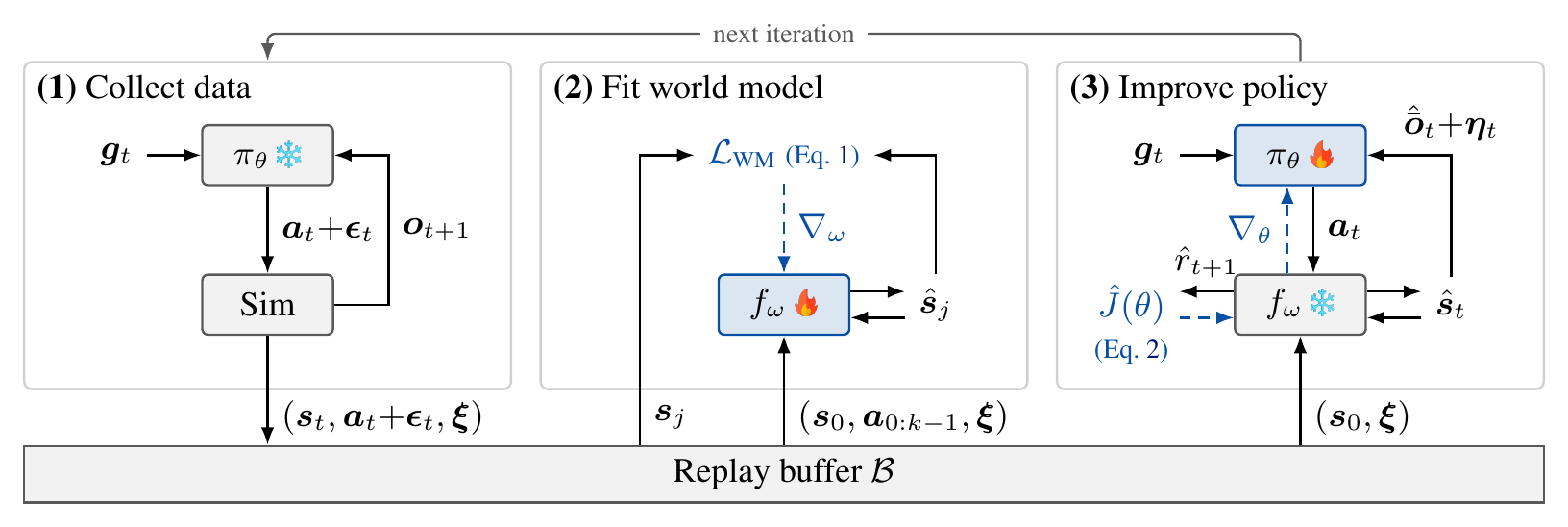
Original paper, Figure 2 · Framework, p. 4 · Algorithm A.1, p. 15
The world model is fit on 8-step replay windows; the policy and critic learn from 32-step imagined rollouts. During the policy update, model weights stay fixed while gradients pass through the model to the policy. Blue dashed arrows show gradients; ❄️ marks frozen weights and 🔥 marks weights being trained in that phase.
SONIC trained for 7 days on 128 NVIDIA L40 GPUs (about 21,000 GPU-hours). The SuperMimic authors report surpassing the normalized return (0.90) of SONIC's released checkpoint after 3 hours on one H100. Across those runs, SONIC took over 50× as long and used over 1,000× as many GPU-hours. The runs used different GPUs and training data: SONIC's full dataset and the public BONES-SEED subset for SuperMimic. SONIC paper · Official compute accounting.
On the same 129,514 training motions, the SONIC checkpoint failed 179, while SuperMimic failed 25 after 3 hours on one H100 and 0 after 9.8 hours on two H100s. Official motion coverage results.
Official implementation — released 2026-11-10: HybridRobotics/supermimic is the project's public implementation repository, released under Apache-2.0. It provides G1 world-model and policy training plus playback scripts built on the sibling mjlab_research repository. See the setup and usage guide. The projects below remain separately maintained community implementations and extensions.
Official CoRL 2026 talk · 8:35 MP4
Click to play or download. The talk covers the motivation, differentiable world model, single-H100 training result, real-G1 demonstrations, and code release.
Community projects
Update notes identify new versions or results and their review dates; historical results retain their original conditions and sources. Review of all 41 projects.
43 projects in 7 categories, grouped by purpose. Each project appears once; overlapping capabilities are described in its entry. The guide retains complementary starting points; ⭐ marks documented experiments, tools or learning examples.
Within each category, all projects are sorted by GitHub Stars, highest first (2026-11-03 snapshot; ties by repository name), regardless of highlight status. The ⭐ marker identifies editorial highlights but does not change the order. The overview table retains category grouping and follows the same Stars order. Badges update dynamically; the order does not. Stars reflect repository popularity; results and demos are upstream reports.
⭐ Featured projects
| Explore | Project · Stars | Why it matters · evidence |
|---|---|---|
| 🔬 Reproduction & training (19) | supermimic_vibed  By Chong Zhang |
40/40 LAFAN1 motions in 1.47 hours! A ready-to-run Isaac Lab G1 reproduction on one RTX PRO 6000 Blackwell, with evaluation and rendering tools; note its disabled self-collisions and extra orientation input. |
SuperMimic-Reproduced  By CuboiLeo |
129k motions, released weights, and a crucial failure lesson. Trains on 129,943 BONES-SEED clips in 7.1 h (4× 5090), but its logs expose drift on 100–300 s LAFAN1 motions: short-clip scores are not long-horizon robustness. | |
UniSuperMimic  By Motphys |
Strong G1 tracking in ~40 minutes (author-reported): UniLab / mjwarp with EMA, no-sync training and LR tuning. The optimized 8k run reports 0.9395 return and 193/129,487 BONES-SEED failures; its precise elapsed time is not separately stated. | |
MorphMimic  By Lizhi Yang et al. |
One policy drives three robot bodies! Unified G1 / X2 Ultra / T2 control plus direct PICO teleoperation, without motion retargeting; only G1 has hardware tests, and later checkpoints exposed standing sway. | |
InstantTrack  By Huy-Quang-Dao |
Update · v1.2: 0/40 failures in ~7 minutes. One RTX 5090, mean of 5 seeds, return ≥ 0.82 held for three checkpoints; Muon, CUDA graphs and a smaller policy. The earlier 15-minute result is retained below. | |
BlinkMimic  By Fuyi Chen |
One policy tracks all 40 motions in ~3.4 minutes! One RTX 4090, mean of 3 seeds, return ≥ 0.82 and 0/40 failures held for three checkpoints; includes a same-GPU InstantTrack v1.2 comparison, on training motions in simulation. | |
allmimic  By Shimingyi |
0/40 failures and 0.91 return in 50 minutes! A 4090 G1 recipe combining residual upper-body / absolute leg actions, balanced sampling and weighted world-model losses; evaluation time excluded. | |
ScaleBFM_Plus  By Hxxxz0 |
99.5% success on 2,575 unseen motions! Injects 32-step world-model BPTT into a humanoid Transformer (ScaleTrack); trained for 8.3 h on 16× 5090, not a matched-compute speed comparison. | |
SuperMimic Mjlab  By Breezewrf |
From 0.60 to 0.85 return, with the ablations to explain why! Actor/critic normalization, orientation anchors, world-model normalization and LR fixes are documented step by step; checkpoints released. | |
| 👁️ Perception & terrain (5) | InstinctMJ  By Project Instinct |
G1 learns to track over terrain with depth perception! Reports 94.9% success across 10 motions after ~2.7 h on one RTX 3090; one training seed, not a broad generalization benchmark. |
Go2-SuperMimic  By Zhengtianjin |
SuperMimic goes quadruped: chase, dodge, navigate terrain. Three released Go2 actors span flat ground, obstacles and terrain, with evaluation/recording tools; simulation only. | |
Terrain-Grounded Imagination  By Matthias Heyrman |
Learns perceptive locomotion over sparse and rough terrain, matching PPO in sim performance but 6.2× faster, training to 40k iterations in 5.4 hours on one RTX 4090; tested on hardware. | |
| 🦾 Manipulation & hands (5) | Dex SuperMimic  By CumulusAlpha |
Cube reorientation and pen spinning with a dexterous hand! Wuji-hand manipulation ships three 8k-iteration checkpoints, assets and Viser playback, making contact-rich behavior easy to inspect. |
supermimic_manipulation  By Zhiqiang Zhou (emoPointer) |
Update · five arm-manipulation tasks. Adds nut insertion and drawer closing: 95.0% / 90.2% across staged held-out starts, 95% / 81% from the full-task category; new-task weights are not released. | |
In-Hand Rotation mjlab  By Msornerrrr |
25 minutes vs PPO's 6.5 hours on LEAP-hand rotation! World-model-based optimization reaches the same reported reward level on one RTX 4090; simulation-only, one run per configuration. | |
Sharpa SuperMimic  By Mingrui Yu |
Update · single-stage SuperMimic without distillation. 686 s of RTX 4090 training; fixed 240-scene simulation evaluation: return 43.59, 0.671 rad/s rotation, 2.08% drops; not hardware validation. | |
| 💪 Muscles & interaction (3) | muscle-supermimic  By Kaibo He (kaibohex) |
Update · MyoFullBody completes 108/108 held-out clips. One RTX 5090, 16k iterations / 9.6 h, return 0.90; also supports MS-Human-700, with 10k/16k checkpoints released for both bodies. |
| 🤖 Robot ports (7) | SuperMimic Retargeted  By tianshuwu |
Retarget once, prepare motions for three robot bodies. SOMA pipelines for G1, A3 and X2 Ultra handle coordinate corrections and foot-contact checks; this is data preparation, not released training weights. |
| 🚀 Real robots (2) | SuperMimic-Repro-Sim2Real  By NJU R&L Group Embodied Lab |
From simulation to a real G1 dance! A ~22-second sequence with rapid turns and a one-foot landing was completed twice on hardware; clip-specific fine-tuning and a slack safety tether were used. |
| 💡 Learning examples (2) | FlatWorld  By swaggyliu |
Understand SuperMimic in 2D, without a giant robotics stack! Eight-joint humanoid, procedural motions and skill-by-skill rendering, plus a 33.3 s multi-skill demo; not a G1 benchmark. |
Reproductions, methods and training frameworks
Original-method reproductions, training acceleration, algorithm variants, shared policies across bodies and framework integrations. Projects may span several directions; their strengths and training setups describe the differences.
⭐ supermimic_vibed
Repository · Setup and usage · Results
- By Chong Zhang. An independent G1 implementation on Isaac Lab 3, with a kit-less setup, training, full-clip evaluation and rendering tools.
- Update (checked 2026-11-03): Links a community-trained checkpoint by Pantelis Manouselis: a separate run reports 0.8696 return and 0 / 40 failed LAFAN1 training clips, with inference-only Safetensors weights requiring the compatible fork. This is separate from the original 1.47-hour experiment below. Update source.
- Upstream report: On 40 LAFAN1 clips, normalized return 0.829 and 0 / 40 failures after 1.47 hours on one RTX PRO 6000 Blackwell.
- Useful context: The author describes it as a rapid, unreviewed reproduction. Documented deviations include disabled self-collisions, bf16 MLP computation and an extra reference-root orientation input. Source snapshot.
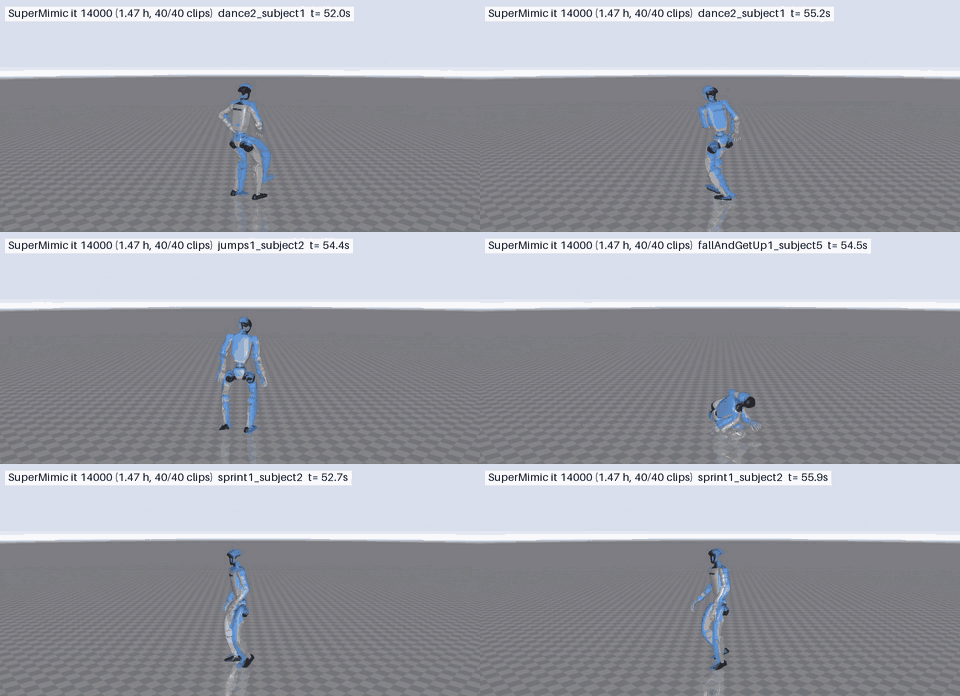
Simulation · LAFAN1 highlights
HoloMotion · SuperMimic 
Repository · Training guide · Results
- By Horizon Robotics. Integrates SuperMimic into HoloMotion’s G1 assets, HDF5 motion data and Hydra workflow, sharing tasks and evaluation with PPO on MuJoCo Warp and Isaac PhysX.
- Upstream report: The selected MuJoCo Warp recipe completes 32 / 40 LAFAN1 training clips after 30 minutes on one RTX 5090.
- Useful context: The validated route uses a compact policy. The preview shows short excerpts from a separate run; it does not replace complete-clip evaluation or establish the planned large-policy integration. Source snapshot.
Simulation · PPO / SuperMimic, two backends
⭐ SuperMimic-Reproduced
Repository · Setup · Experiment log · Checkpoint
- By CuboiLeo. A from-scratch mjlab implementation for G1, with Chinese reproduction notes, LAFAN1/BONES-SEED processing, multi-GPU training, an interactive replay viewer and a released full-data checkpoint.
- Upstream report: With paper observations, four RTX 5090s train on 129,943 BONES-SEED clips for 7.1 hours (about 28 GPU·h). The experiment log reports 0.930 return, 495 / 129,943 failures on that library; after excluding 452 clips by name, it reports 0.932 return, 145 / 129,491 failures (0.11%) on the filtered evaluation set. On LAFAN1, anchor-relative observations reach 0.904, 3 / 40 failures, while paper observations reach 0.56–0.59, 3–9 / 40 across three runs.
- Useful context: BONES-SEED clips are short (median 5.8 seconds), whereas paper-observation policies drift on 100–300-second LAFAN1 clips. The two observation settings are not directly comparable. The upstream README pairs 0.930 with the filtered failure count; the set-specific figures above follow the experiment log. Source snapshot.
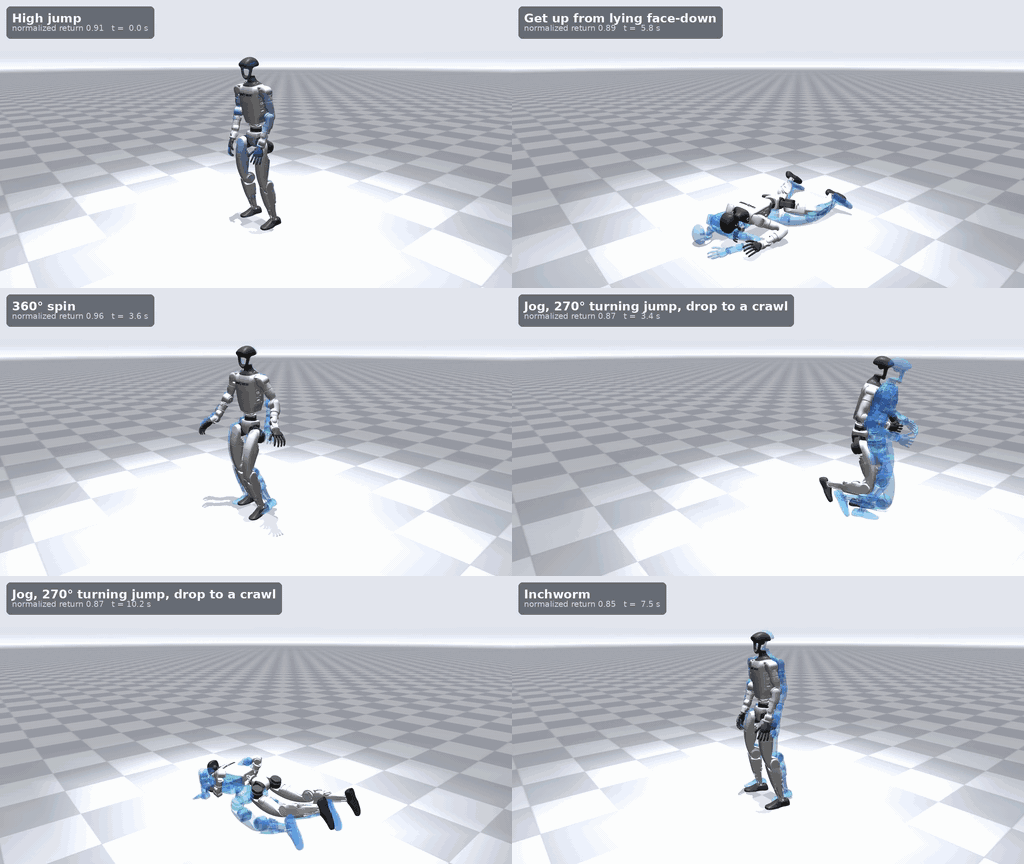
Simulation · one full-BONES-SEED policy across six challenging motion clips
⭐ UniSuperMimic
Repository · Installation · Results
- By Motphys. Implements G1 tracking in UniLab with LAFAN1/BONES-SEED download, filtering, packing, training and full-clip evaluation, plus mjwarp, MuJoCo and Motrix entrypoints. The updated evaluator recycles finished environments to reduce long-clip batch tails.
- Update (checked 2026-11-03): Releases the LAFAN1 12k, BONES-SEED 12k and EMA/no-sync 8k checkpoints, plus Viser batch playback with grid/single-environment views, pause and stepping, and motion-library selection from the run configuration. These are new weights and playback entrypoints; the training results below are unchanged. Update source.
- Upstream report: On 129,487 BONES-SEED clips, one RTX 4090 (48 GB as reported upstream) trains the 12k baseline in 1.69 h, with full-library return 0.9243 and 350 / 129,487 failures. Adding EMA, no-sync training and a learning-rate change on the same GPU reaches 0.9395 and 193 / 129,487 failures at 8k iterations. The older RTX 5090 / 10,000-clip sample is a separate run.
- Useful context: The explicitly paired 1.69 h belongs to the 12k baseline. The README also advertises a strong checkpoint in about 40 minutes, but does not give a precise elapsed time for the optimized 8k row. These are the reported mjwarp experiments, not equivalent validation across backends. BONES-SEED evaluation covers training motions, not held-out generalization. Source snapshot.
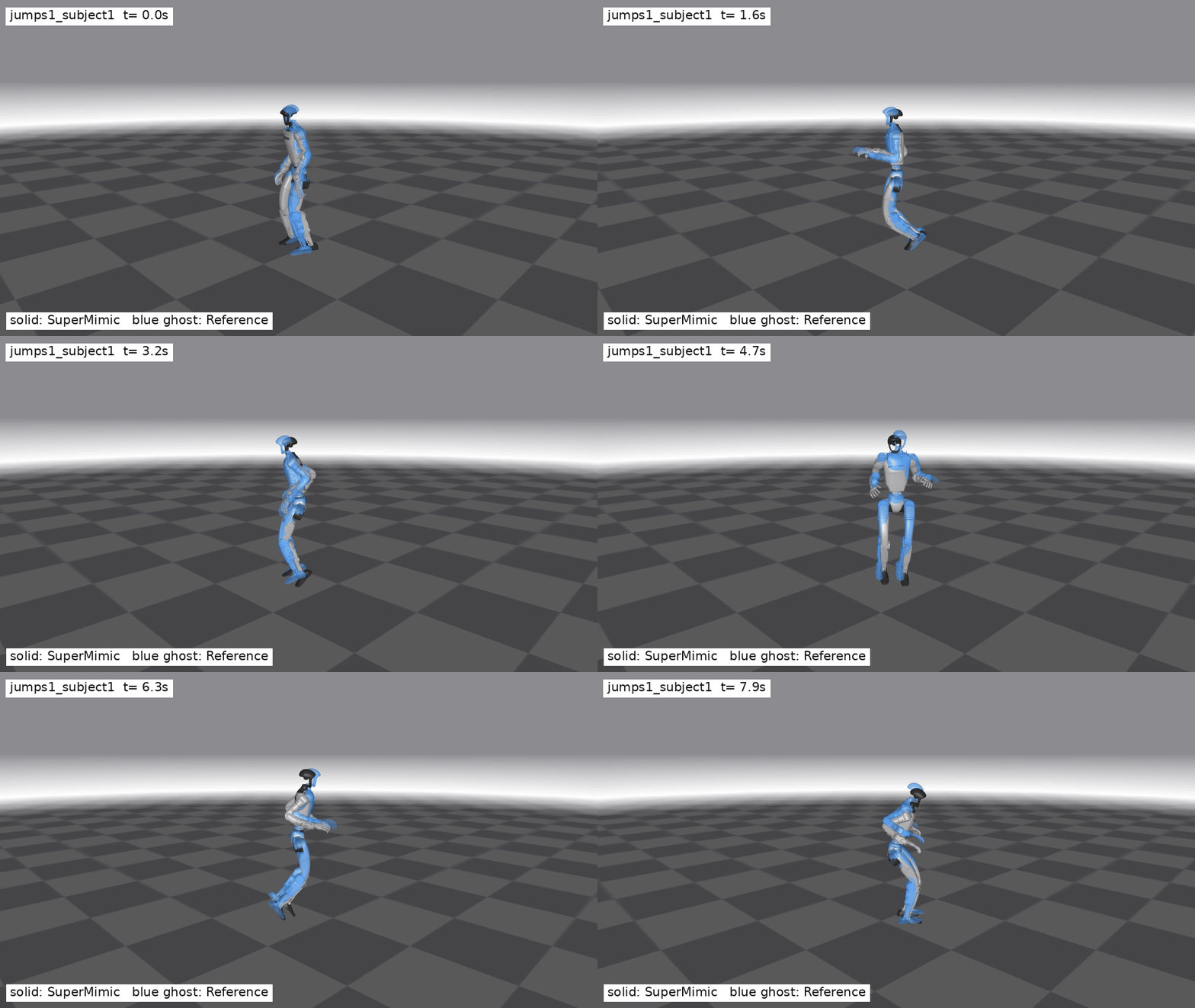
Simulation · G1 jump tracking
⭐ MorphMimic
Repository · Setup · Method differences
- By Lizhi Yang et al. Shares a world model, policy, or both across G1, X2 Ultra and T2 in mjlab / MuJoCo Warp. v0.1 adds a 24-joint / five-point human interface that consumes PICO body tracking directly, without first retargeting it to robot motion.
- Upstream report: Releases a unified 60,000-iteration ONNX policy for
g1_amber, X2 Ultra and T2 with motion and human interfaces. The authors tested it on their real G1 and provide onboard teleoperation. X2 Ultra and T2 have only run in simulation; aggregate success rates and training duration are not reported. - Useful context: The released
g1_amberconfiguration adapts to the authors’ weak G1 waist motors; it is not validation on every G1. Later checkpoints from 78k onward swayed while standing on hardware despite apparently normal training metrics. Default interfaces do not need robot world pose; optional robot-anchor mode still needs pose estimation. Source snapshot.
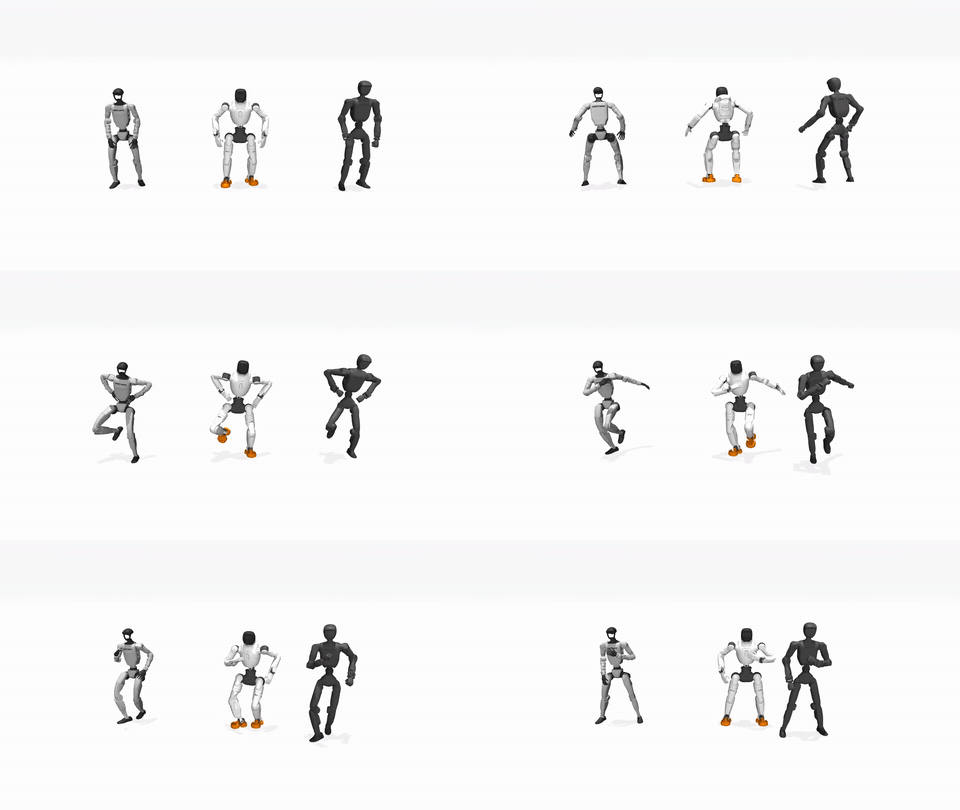
Simulation · one shared policy for G1 / X2 Ultra / T2
⭐ InstantTrack
Repository · Setup · Results and ablations · Training presets · Changelog
- By Huy-Quang-Dao. Trains G1 on the mjlab port of supermimic_vibed with EMA, failure-focused resets and a contact reward. v1.2 adds Muon, CUDA-graph world-model and policy updates, batched goal encoding and a smaller policy.
- Update — v1.2.0 (released 2026-11-01; checked 2026-11-03): On one RTX 5090, 0.12 h (~7 minutes) on average across 5 seeds to return ≥ 0.82 and 0 / 40 failed LAFAN1 clips, held for three checkpoints. Four seeds take about 0.10 h and one 0.18 h; the author reports 4.7× over their same-machine SuperMimic + EMA baseline. Current results.
- Useful context: Training time includes compilation and checkpoint writing, excluding offline evaluation. These are simulation results on training motions; difficult clips can regress after first meeting the target. No larger-library or SuperMimic hardware results are reported. The earlier 15-minute result is retained below as a previous version.

Upstream simulation · same 6-minute budget, seed 0; left to right: SuperMimic + EMA, InstantTrack v1.1, v1.2; this checkpoint fails 15, 6 and 0 of all 40 clips, respectively
Earlier results · reviewed 2026-10-29: ~15 minutes, three seeds and the original demo
Repository · Setup · Results and ablations · Training presets
- By Huy-Quang-Dao. Builds on the mjlab port of supermimic_vibed for G1, combining GPU training-loop optimizations, EMA policy weights, a smaller world model and failure-focused resets; the main preset also adds a contact reward during imagined rollouts.
- Upstream report: On one RTX 5090, all three seeds reach return ≥ 0.82 and 0 / 40 failed LAFAN1 clips in about 15 minutes, with mean return 0.831 at that point. The reported 2.2× speed-up is against the author's SuperMimic + EMA baseline on the same machine; the 6× figure uses their plain reimplementation.
- Useful context: Time marks the first of three consecutive qualifying checkpoints, excludes offline evaluation and is not an end-to-end setup time. Evaluation covers the training clips in simulation; no larger motion library or real-robot results are reported. Model size, update count and training reward differ from the baseline; this is not a cross-project speed ranking. Source snapshot.

Upstream simulation · same 15-minute training budget; SuperMimic + EMA (left), InstantTrack (right), fall-and-get-up motion
⭐ BlinkMimic
Repository · Setup · Results
- By Fuyi Chen. Builds on supermimic_vibed and InstantTrack for G1 in mjlab, adding resets at the points where the current policy fails, a smaller imagined batch with a larger learning rate, and a world model that predicts velocity changes.
- Update (checked 2026-11-03): On the same RTX 4090, with 3 seeds each, return ≥ 0.82 and 0 / 40 failures held for three checkpoints takes 3.38 min for BlinkMimic versus 7.36 min for InstantTrack v1.2. Requiring six consecutive qualifying checkpoints leaves only 2 / 3 BlinkMimic seeds successful; these are simulation results on 40 training clips. Same-GPU comparison.
- Upstream report: On 40 LAFAN1 clips (one RTX 4090, mean of 3 seeds), return ≥ 0.82 after 2.9 minutes, and ≥ 0.82 with 0 / 40 failures at three consecutive checkpoints after 3.4 minutes.
- Useful context: Training wall-clock on an otherwise idle GPU, excluding start-up and offline evaluation; evaluated in simulation on the training clips. Source snapshot.

Upstream simulation · after 3.1 minutes of training on one RTX 4090, fall-and-get-up motion; blue: reference. Click for the three-method comparison
⭐ allmimic
Repository · Install · Results
- By Shimingyi. Builds on supermimic_vibe for G1 in mjlab, mixing residual upper-body actions with absolute leg actions, weighting world-model losses and balancing motion sampling.
- Upstream report: With the recommended preset on one RTX 4090, full-length LAFAN1 evaluation reports 0 / 40 failures and return 0.91 after 0.83 hours; training time excludes evaluation.
- Useful context: The recommended preset changes the method and data sampling. The 306-hard-motion-only run and full BONES-SEED training are separate experiments. Source snapshot.
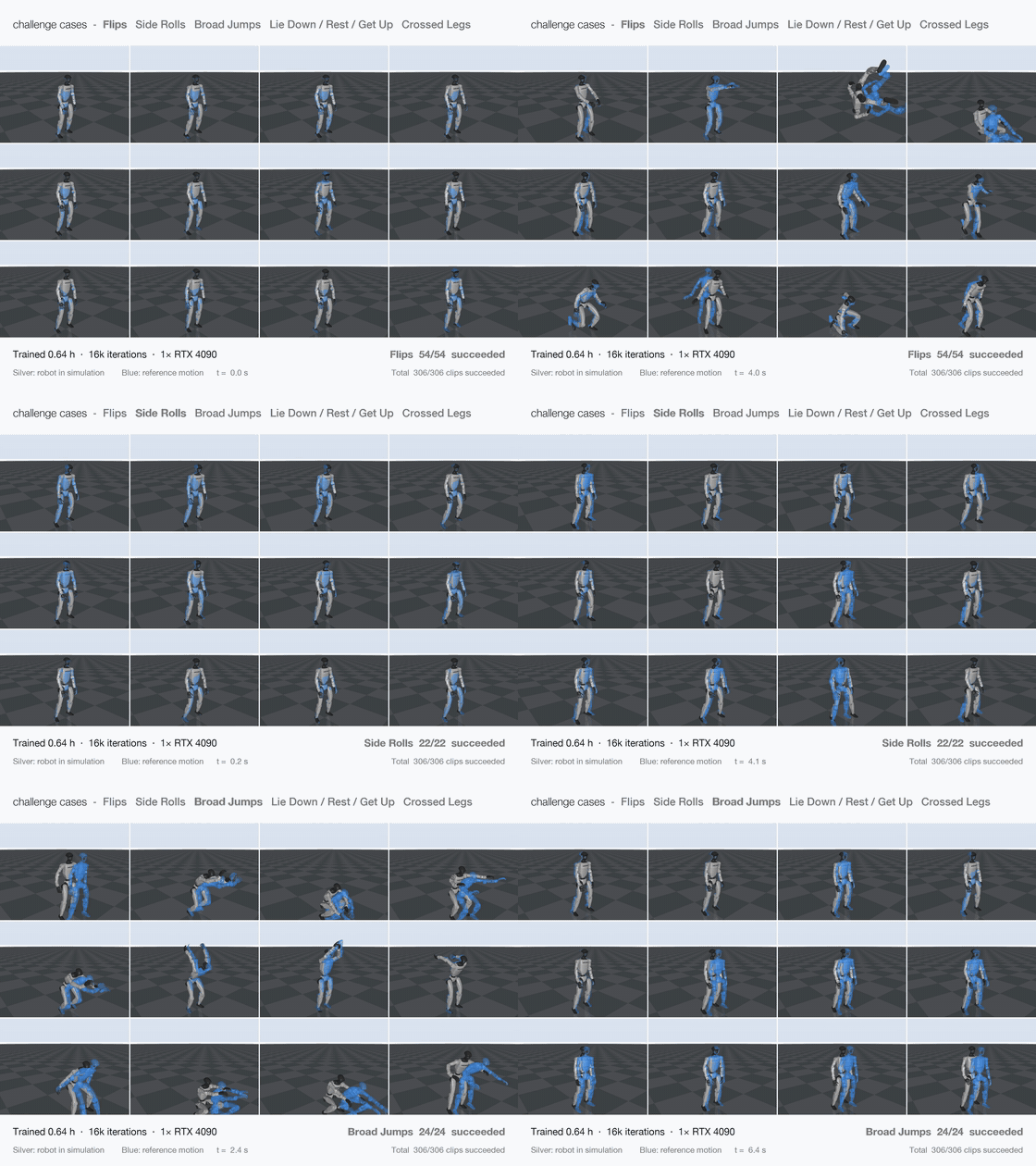
Simulation · challenging motion clips
⭐ ScaleBFM_Plus · SuperMimic
Repository · Training and results · Released checkpoint
- By Hxxxz0, building on ScaleBFM. Integrates SuperMimic-style world-model learning and 32-step BPTT into ScaleTrack for G1 in IsaacLab / RSL-RL, retaining the humanoid transformer and tracking modes, with PPO-compatible policy export and playback.
- Upstream report: Training on 309 h / 138k clips from BONES-SEED, any4hdmi and LAFAN1 for 8.3 h on 16 RTX 5090s yields 99.5% tracking success on 2,575 held-out motions. On 386 dynamic test motions, both this policy and the official ScaleBFM-M checkpoint succeed on 376 / 386, with mean global body-position errors of 6.35 cm and 6.43 cm, respectively.
- Useful context: This is a community extension of ScaleBFM. The reported 26× per-step speedup compares 0.65 s on 16 RTX 5090s with PPO's 17.0 s on 8 RTX 5090s; it is not a matched-compute or time-to-quality comparison. Source snapshot.

Simulation · official ScaleBFM-M (left) and SuperMimic (right), unseen LAFAN dance · Source: Hxxxz0 / ScaleBFM_Plus
Rethinking SuperMimic 
Repository · Installation · Implementation comparison
- By btx0424. Studies goal conditioning for G1 in mjlab: concatenating the goal with proprioception versus using FiLM to modulate the policy layers. The latest revision adds an HL-Gauss critic, gradient checks and selectable heading- or pelvis-frame world-model coordinates.
- Update (checked 2026-11-03): Adds Weave / Weave XHand hand–object tasks and a ∇Mimic/PODS-style policy update that turns world-model action gradients into target actions, then regresses the policy onto them, sharing the world model and critic with SuperMimic. Gradients still come from the learned model; no new success-rate or training-speed benchmark is reported for these additions. Update source.
- Useful context: Provides configurable observations, anchor choices and Viser playback. Its implementation table explains differences from the paper and supermimic_vibed, including self-collisions and observation inputs. Source snapshot.
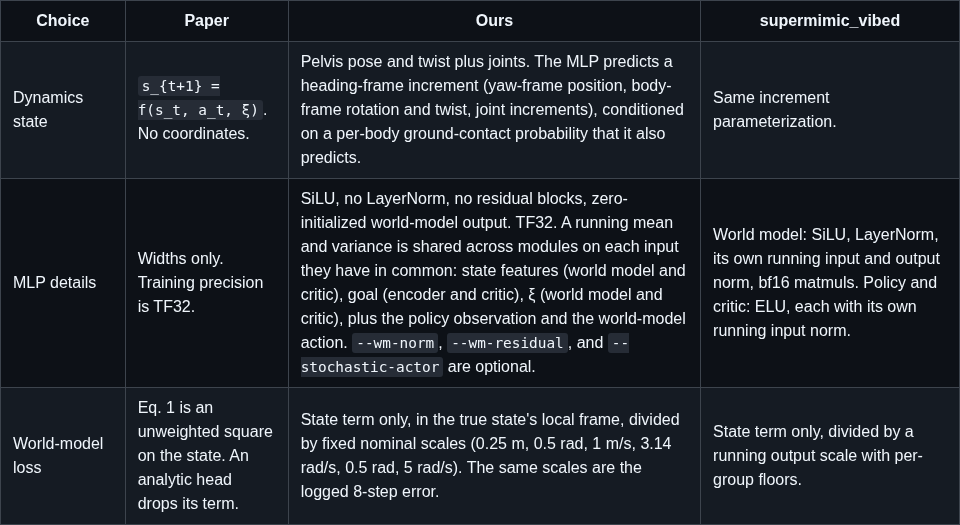
Historical implementation table excerpt · 2026-10-26 snapshot; current comparison linked above
Standing MBRL vs PPO 
Repository · Experiment details · Reproduction notes
- By JackMin7. Adapts SuperMimic's differentiable world-model loop to a static G1 standing task and compares it with an RSL-RL PPO baseline derived from BeyondMimic.
- Upstream report: With the same 29-DoF G1, task, reward and about one hour of training on 256 environments, MBRL succeeds 32 / 32 times in both the 20-second and 60-second tests; PPO succeeds 12 / 32 and 16 / 32. Mean 20-second joint RMSE is 0.144 versus 0.415 rad.
- Useful context: Single training seed, shared GPU, no disturbances, and the 32 rollouts are copies rather than independent seeds. The project does not claim training-speed or real-robot gains. Source snapshot.
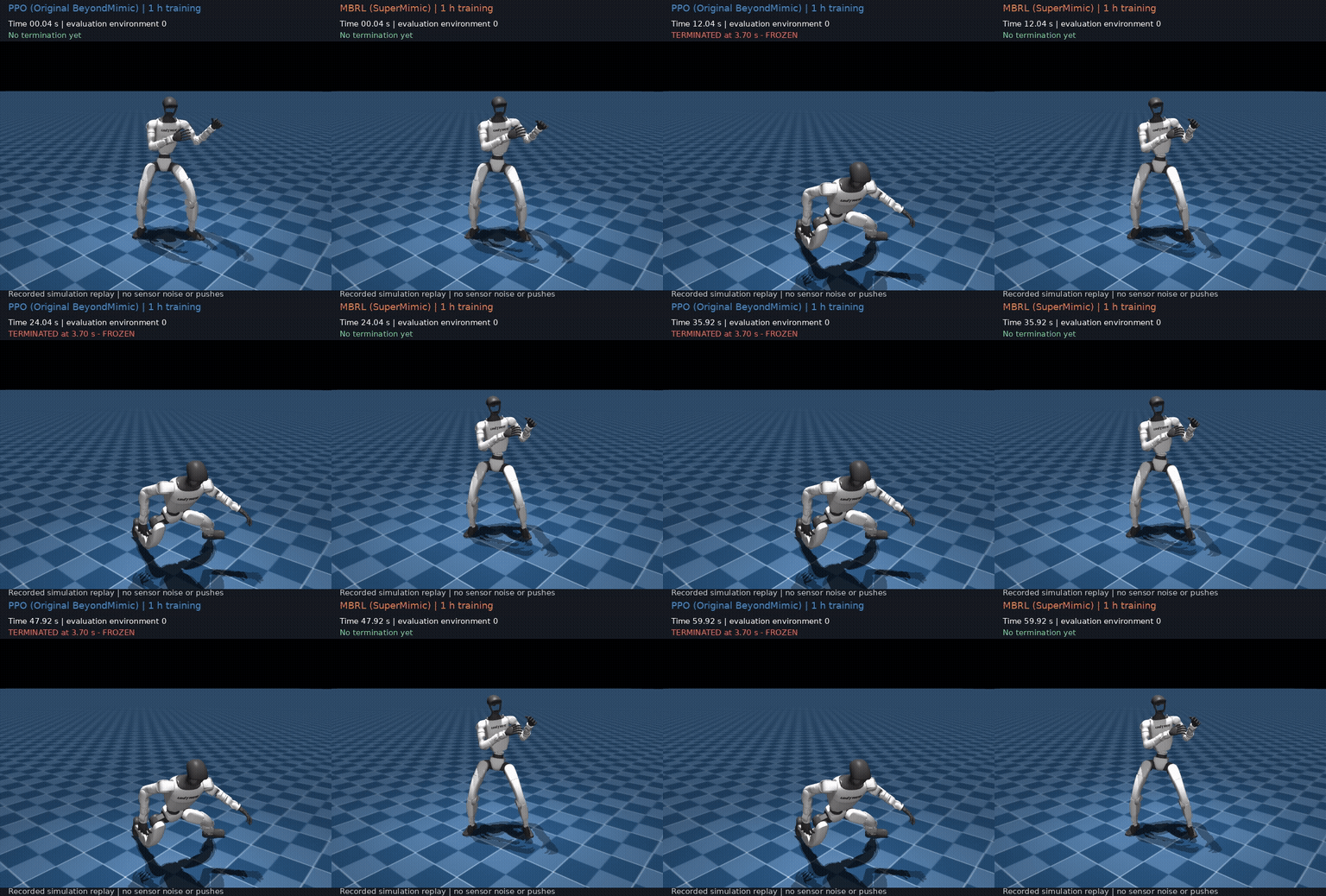
Simulation · 60-second PPO / MBRL comparison at normal speed; PPO freezes after termination
TrackerLab SuperMimic 
Repository · Install · Results and limits
- By Renforce Dynamics. Provides a shared Isaac Lab / PhysX workflow for retargeting, training, full-clip evaluation and export across G1, Go2, A3, T1, Bumi and Pi+, plus Go2 task policies.
- Update (checked 2026-11-03): Adds 18 velocity-commanded terrain tasks: stairs, mountain and parkour for six robots, using MuJoCo-Warp, 187 idealized height samples and the SuperMimic update path. Documentation provides task, training-queue and validation entrypoints, but no completed terrain-policy success rates; the PhysX tracking results below do not validate these new tasks. Update source.
- Upstream report: Re-evaluation of the 32,000-iteration G1 parent checkpoint reports normalized return 0.8694663 and 0 / 40 LAFAN1 failures.
- Useful context: Results use PhysX, while supermimic_vibed uses MuJoCo Warp. Robot-specific motion libraries and training histories differ; held-out motion generalization remains unmeasured. A separate G1 MuJoCo-Warp entrypoint and motion-tail/normalizer fixes are now available. The Warp integration has CPU regression coverage but still needs target-GPU qualification; it does not inherit the historical PhysX score above. Source snapshot.
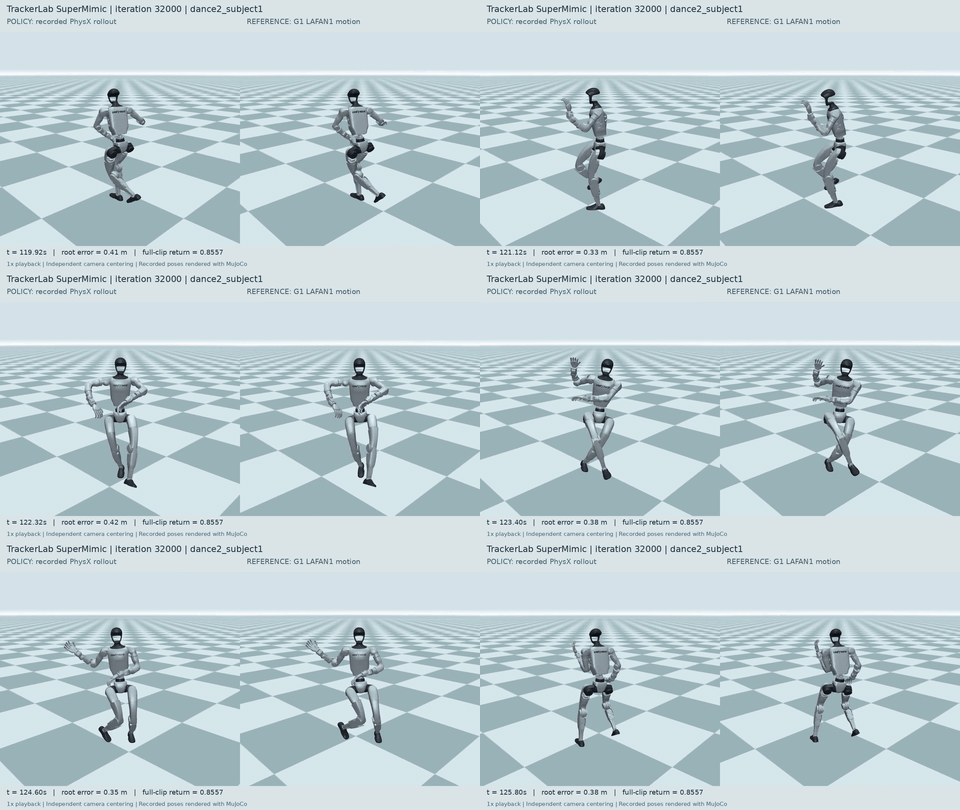
Simulation · G1 policy / reference dance
⭐ SuperMimic Mjlab
Repository · Setup · Ablations and checkpoint
- By Breezewrf. An independent SuperMimic reproduction for Unitree G1 in mjlab, with a complete performance-improvement ablation study, multi-motion and velocity training, OOD playback, video-to-motion export, full-clip evaluation and released policy/world-model checkpoints.
- Upstream report: On all 40 LAFAN motions, the selected checkpoint achieves 40 / 40 successful motions, 100% mean completion and 0.8528 normalized return in fixed-start, full-clip deterministic evaluation. Training for 15,000 iterations takes approximately 4 hours on one RTX A6000 48 GB, with 4,096 environments and FP32 networks.
- Useful context: Documents the full progression from Actor/Critic input normalization through a torso-frame motion orientation anchor, world-model normalization and a corrected cosine learning-rate schedule: mean normalized return 0.6016 → 0.8130 → 0.8504 → 0.8526 at 15,000 iterations over all 40 motions. The final rerun mean is distinct from the selected checkpoint score above. Updated documentation adds the RoboJuDo-Plus SuperMimic deployment route; the authors report 23DoF G1 hardware use, with velocity tracking still in development. Source snapshot.

Simulation · 12-second excerpt from the 60.8-second playback demo; click for the full upstream GIF
supermimic_vibe 
Repository · Setup · Results log
- By dhmbb2. An independent G1 reproduction in mjlab / MuJoCo Warp, with claim-by-claim PPO-Sim/PPO-WM, critic, horizon, push-recovery, velocity-control, BONES-SEED scaling and SONIC comparisons.
- Upstream report: One RTX A6000 reaches LAFAN1 return 0.833 at 1.34 h; its best checkpoint scores 0.947 with 0 / 40 failures at 11.4 h. On 128,904 BONES-SEED clips, a modified configuration collecting without exploration noise in half the environments reaches 0.923 and 45 / 128,904 failures at 14.4 h. Times exclude evaluation.
- Useful context: The noise-free collection fraction is an addition to the paper. The paper-faithful BONES-SEED run collapses after roughly six hours, and the two-GPU zero-failure result was not reproduced; these negative results are documented alongside ablations. A6000 and paper H100 timings are not equivalent; hardware transfer is out of scope. Source snapshot.
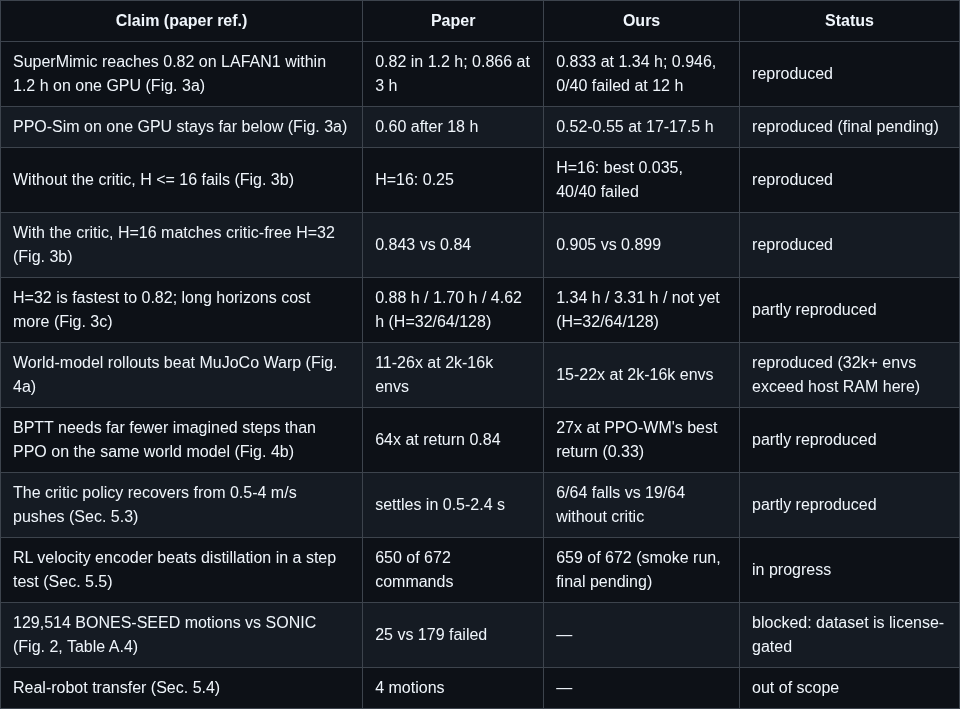
Historical report screenshot · earlier A6000 experiments; updated results above
SuperMimic on LocoMuJoCo 
Repository · Setup · Results
- By Alchedata. Ports the method to H1 with JAX and LocoMuJoCo, adding a full-state ODE world model and anti-saturation regularization alongside the MLP, residual-expert, action-sensitivity and trust-aware variants.
- Upstream report: With fixed 5,000-iteration checkpoints and 160 initial states, adding anti-saturation to the Euler ODE model reduces aggregate failures from 15 / 480 to 1 / 480 over three seeds. Seed 43 improves from 878.71 / 15 failures to 935.38 / 0 failures, while seed 42 becomes slightly worse, so this is not a uniform score increase.
- Useful context: The reward is LocoMuJoCo episode return, not the G1 normalized tracking score. Midpoint ODE acceleration runs are still in progress and are not included as completed results. Source snapshot.

Upstream training curves · ODE and anti-saturation variants at fixed 5k evaluation checkpoints
SuperMimicKit 
Repository · Preview release · Evaluation and limits
- By OMEGA-i. An independent MuJoCo Warp implementation for G1, H2 and A3, with motion retargeting, policy/world-model ONNX export and WebGPU browser previews.
- Upstream report: Publishes separate train40 and held-out val37 evaluations for G1/H2. The G1 55.5k preview reports 0.7990, 3 / 40 failures on train40 and 0.3103, 31 / 37 failures on val37; A3 100k full-clip evaluation is pending.
- Useful context: An experimental preview with limited held-out tracking and documented later-checkpoint regressions. Supply licensed motion data; no top-level code license was found at the reviewed revision. Source snapshot.
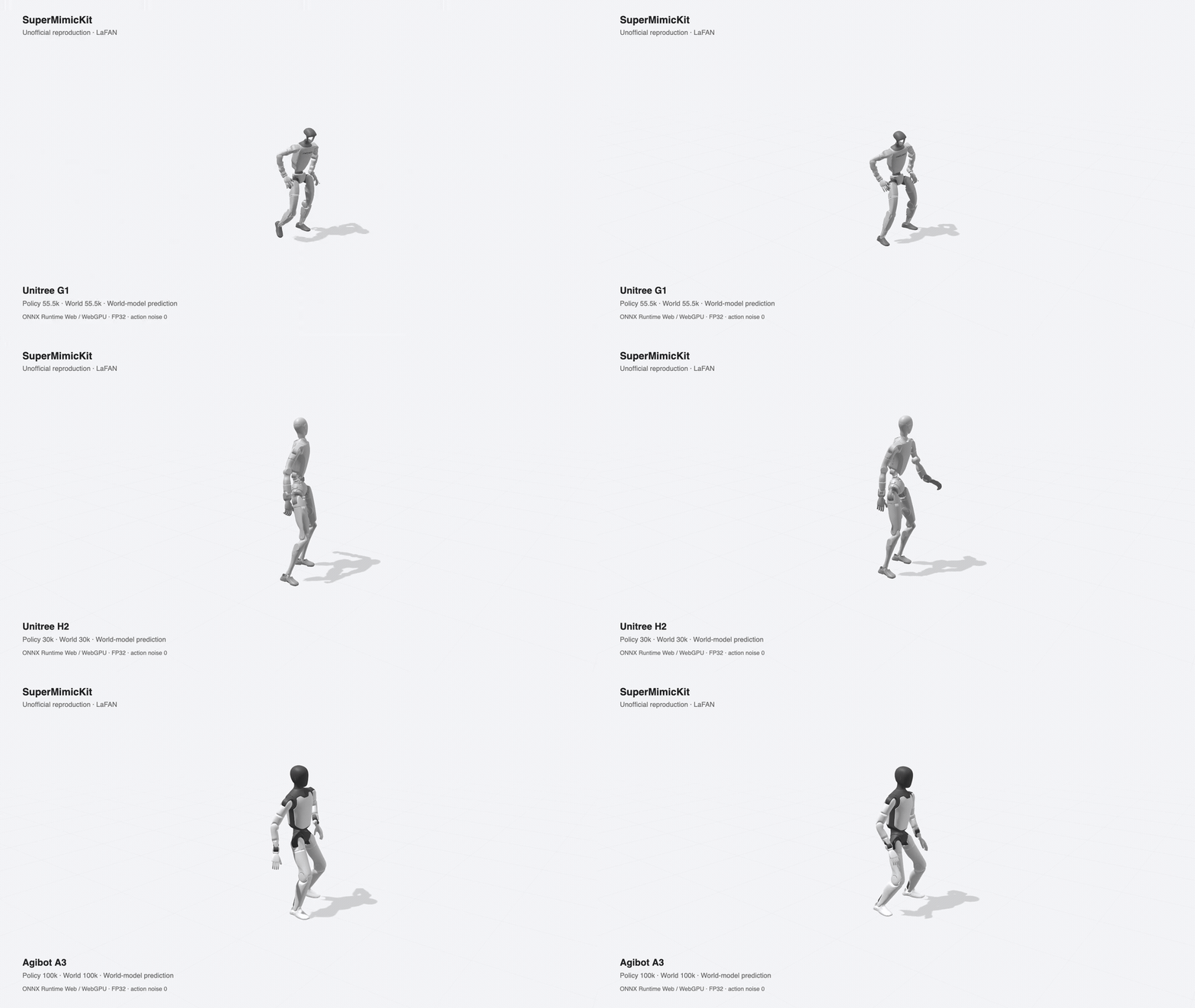
Browser preview · G1 / H2 / A3
SuperMimic Lab 
Repository · Setup · Custom-task guide
- By chu-fa. Packages a reusable SuperMimic learner and runner for Isaac Lab custom tasks, with a separately installable AGIBOT A3 example.
- What it provides: Provides task contracts, setup instructions and backend validation records. A custom task must supply differentiable state, observation, reward and termination functions.
- Useful context: Targets the Isaac Lab 3 development API. The A3 preview uses separately initialized segments; convergence, backend equivalence and hardware deployment are not established. Source snapshot.
A3 reference / policy · separately initialized segments
SuperMimic on RTX 5080 
Repository · Reproduction analysis · Evaluation videos
- By rzc156. An independent mjlab reproduction derived from CuboiLeo, configured for one 16 GB RTX 5080 with 2,048 training environments and additional anchor-relative observations.
- Update (checked 2026-11-03): Adds a six-motion GIF gallery for the existing 40k checkpoint, covering walking, sprinting, dancing, boxing and getting up. Demos excerpt long clips; benchmark evaluation still starts at frame zero and runs the complete clip. This is a presentation update, with the original training results retained below. Update source.
- Upstream report: The 40k checkpoint reaches 0.8515 mean / 0.8608 step-weighted return with 2 / 40 failures after 2.7 hours. The 48k checkpoint averages 0.8375, 4–6 / 40 failures, after 3.3 hours over three evaluations.
- Useful context: This is a single training seed, and the extra anchor observations make it non-equivalent to the paper-observation protocol. The author highlights 40k as the preferred checkpoint but notes that 40k/44k/48k differences still require multiple seeds. Source snapshot.
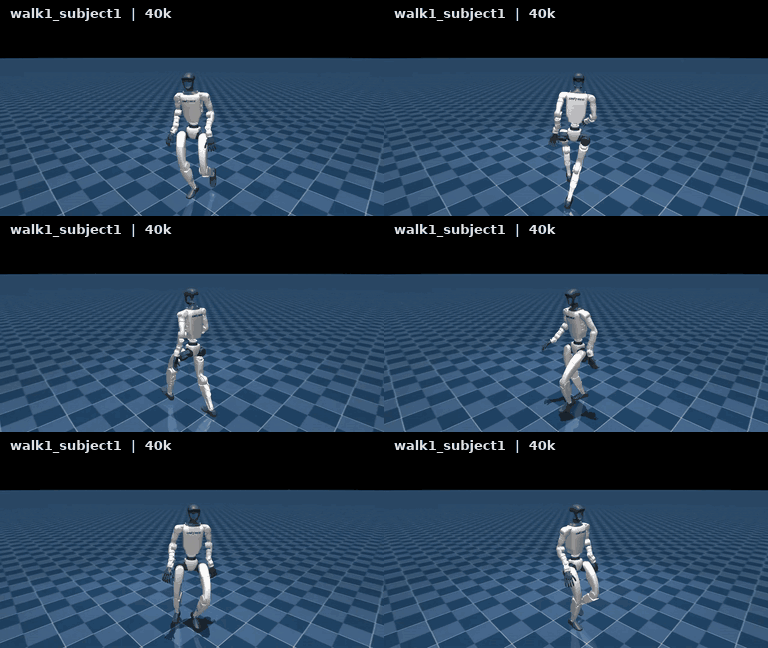
Simulation · 40k checkpoint on a 15-second LAFAN1 walk clip; click for all seven videos
BlinkMimic 2 
Repository · Setup · Results · Weights (v1.0.0)
- By Jiayu Li. Builds on BlinkMimic for G1 in mjlab and takes SuperMimic-style world-model training to the full BONES-SEED library. Its starting point: training usually practises 10-second pieces, but evaluation plays each clip from its first frame to its end, so small errors carry the robot into states it never practised. It adds exams (some robots play whole clips from the first frame, as the evaluation does, and imagined rollouts start from the states they reach), practice at failures (restarting 1 s before each exam failure) and free exams (clips played inside the learned world model, at no simulator cost).
- Upstream report: One policy tracks all 129,491 BONES-SEED clips (one RTX 4090, mean of 3 seeds): after 15.5 minutes of training, only 17 clips fail (99.987% tracked to the end), with tracking score 0.946. In the same time, the learner without these changes fails about 55 clips.
- Useful context: Time from program start, including compilation; evaluated in simulation on the training clips, with no hardware results. Weights and per-clip results of all three seeds are released (CC BY-NC 4.0). Source snapshot.
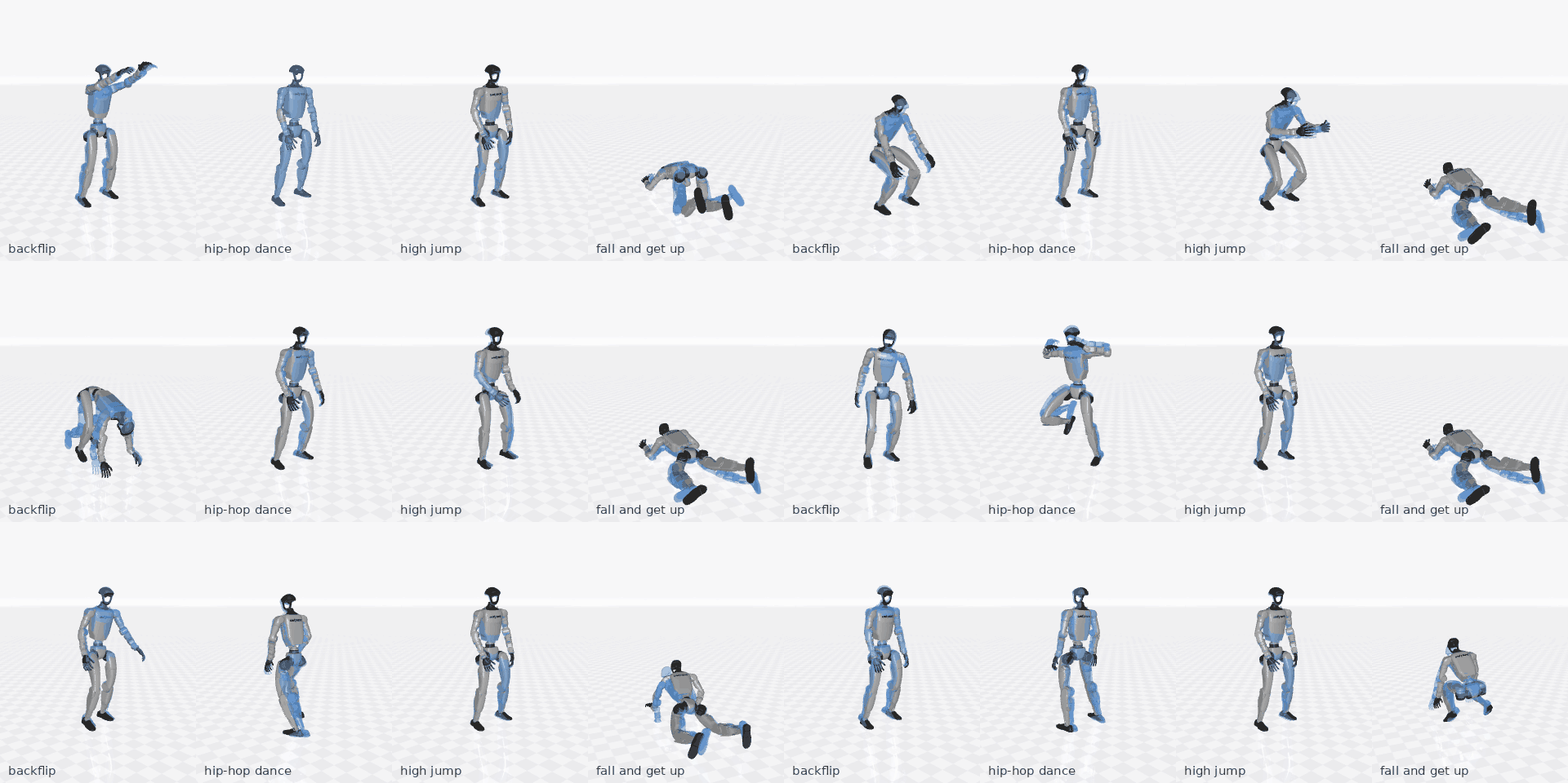
Upstream simulation · seed-1 policy after 15.6 minutes of training on one RTX 4090; backflip, hip-hop dance, high jump, fall and get up, each from its first frame; translucent blue: reference
Perception, terrain and quadrupeds
Vision, height-scan, terrain and quadruped task adaptations.
⭐ InstinctMJ · SuperMimic
Repository · Method and results · Releases
- By Project Instinct. Implements perceptive G1 terrain tracking in mjlab / instinct_rl with two routes: Render ray-casts depth from predicted robot state; Latent predicts the depth encoder's features. Both feed stop-gradient encoder features to the actor; the encoder learns from reconstruction, with an annealed value head in Render.
- Upstream report: One RTX 3090, 1,024 training environments and 8,000 iterations, on 10 motions: Render 94.9% success, Latent 96.9%. Render takes about 2.7 h, evaluated with 3 seeds × 256 environments; the report has one training seed, and Latent uses 128 evaluation environments from the original pre-merge run.
- Useful context: Use the supermimic branch. Render without the value head reaches 91.0%; the removed policy-gradient-only encoder variant degraded below a random encoder. The two results have different evaluation setups. Rendering uses known scene meshes, not unknown real environments. Licensed CC BY-NC 4.0. Source snapshot.

Method comparison · Render and Latent vision routes
⭐ Go2-SuperMimic
Repository · Quickstart · Pretrained policies
- By Zhengtianjin. Adapts SuperMimic to Unitree Go2 chase-and-dodge tasks in mjlab, covering flat ground, obstacles and terrain with LiDAR or height-scan inputs.
- What it provides: Publishes separate flat, obstacle and terrain actors, plus evaluation and recording tools. Actor-only downloads support playback; resuming training also needs the world model and critic.
- Useful context: Simulation only, with ground-truth target perception. The released terrain policy still has falls and bar collisions under the hardest settings. Source snapshot.
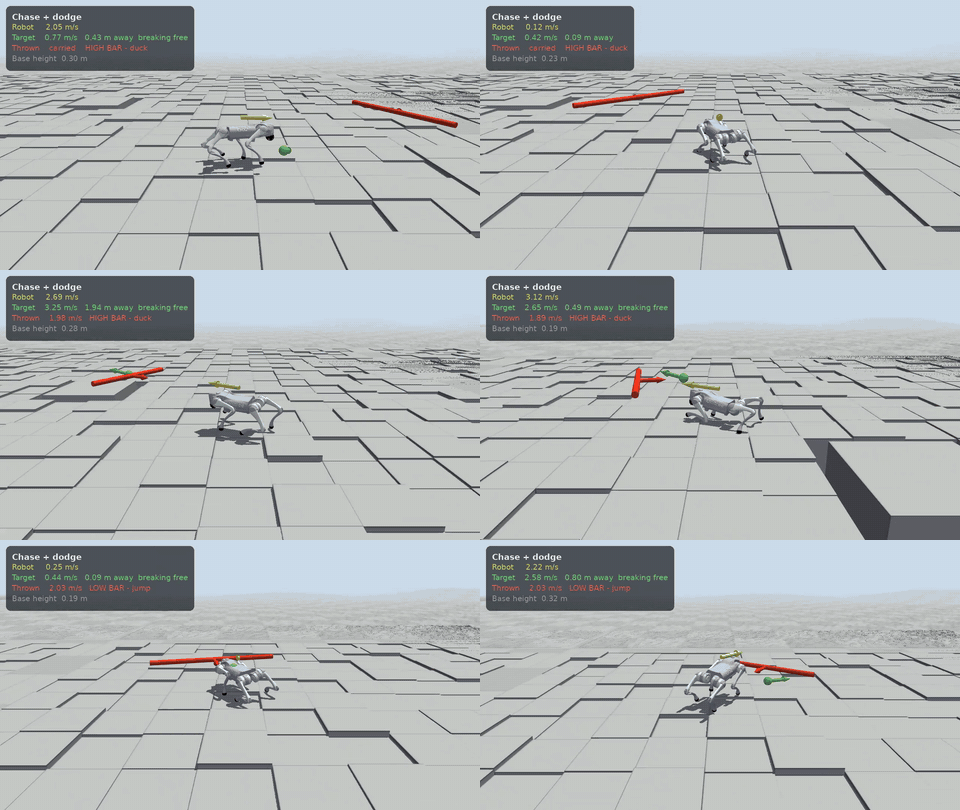
Simulation · Go2 terrain chase and dodge
⭐ Terrain-Grounded Imagination
Repository · Training · Results
- By Matthias Heyrman. Method extension for perceptive G1 locomotion over stairs, gaps and stepping stones in Isaac Lab 3, applying the SuperMimic training style to the foothold-gated perception of Watch Your Step. The world model learns only the robot's dynamics; terrain, rewards and perception are read from the simulator heightmap through differentiable lookups.
- Upstream report: Successful locomotion over sparse and rough terrain in simulation after 40k iterations in 5.4 h on one RTX 4090.
- Useful context: Velocity-commanded locomotion, not motion tracking. Tested on hardware, with a first hardware clip in the README. Includes a MuJoCo sim2sim script and ONNX export. MIT license. Source snapshot.

Simulation · G1 on tilted slabs, stairs and stepping stones
SuperMimic Parkour 
Repository · Data setup · Checkpoint
- By yhx1203. A five-skill G1 parkour adaptation built on mjlab and PHP Parkour motion-matching data, using a shared differentiable world model and BPTT policy learning.
- Upstream report: Trains a policy to clear a 130 cm obstacle in just over 4 hours on one GPU, ships the resulting checkpoint and provides browser-based playback.
- Useful context: The PHP motion bundles are not distributed with the repository and must be supplied separately. This is one upstream demonstration and training-time claim, not an independent benchmark against PPO or SuperMimic. Source snapshot.

Simulation · five-skill PHP parkour policy; 11.5-second upstream demo
SuperMimic-perceptive 
Repository · Method · Progress
- By mode1223345. Builds on supermimic_vibed in Isaac Lab 3, pretraining a heightmap autoencoder and freezing one shared encoder for the actor, critic and world model.
- What it provides: Documents four flat-ground/step-terrain control experiments and separate reconstruction checks; the published control comparisons remain in progress.
- Useful context: Maps come from simulator ground truth. Real-depth reconstruction and hardware perception are not integrated, and inherited baseline scores do not establish gains from the encoder. Source snapshot.

Training curves · 2026-10-24 snapshot; control comparisons in progress
Manipulation and dexterous hands
Arm, hand and object-interaction tasks, with dexterous manipulation grouped here.
⭐ Dex SuperMimic
Repository · Installation · Demos · Checkpoints
- By CumulusAlpha. Adapts world-model-based policy training to Wuji Hand 1/Hand 2 cube reorientation and Wuji Hand 2 pen spinning, using mjlab / MuJoCo Warp and the InstinctMJ task framework.
- What it provides: Three task configurations, bundled hand and cube assets, Viser playback, and three 8,000-iteration checkpoints in the
pretrained-wuji-v2release. - Useful context: This is a dexterous-manipulation adaptation with a different task and reward from humanoid motion tracking. Source snapshot.
 Wuji Hand 1 · cube reorientation |
 Wuji Hand 2 · pen spinning |
⭐ SuperMimic for Robot Manipulation
Repository · Install · Results · Square / Drawer
- By Zhiqiang Zhou (emoPointer). Five state-based ARX5 manipulation tasks in mjlab / MuJoCo Warp, with SuperMimic, a PPO baseline and staged reset banks.
- Update (checked 2026-11-03): Adds Square nut insertion and Drawer placement-and-closing. Selected checkpoints train for 16k / 10.5 h and 4k / 3.4 h, respectively, on one shared A100 80 GB; overall held-out reset-bank success is 95.0% / 90.2%, with 64 episodes per category across 5 / 7 categories. The original Lemon, BoxInBin and MugHang results remain below. Evaluation source.
- Useful context: Overall scores mix full-task and intermediate starts; category-0 full-task success is 95% / 81%. Second training seeds reach 93.8% / 75.9%, with checkpoint instability on Drawer. The two new checkpoints and reset banks are not released; collection, training and evaluation commands are available. GPU sharing affects the reported times.

Upstream simulation · Square; held-out objects/targets from the home pose, first two episodes

Upstream simulation · Drawer; same home-pose protocol, first two episodes, 2x speed
Earlier results · before the 2026-11-03 update: Lemon / BoxInBin / MugHang, released weights and demo
Repository · Setup · Results
- By Zhiqiang Zhou (emoPointer). Adapts SuperMimic to state-based manipulation with a simulated ARX5 arm in mjlab / MuJoCo Warp across the Lemon, BoxInBin and MugHang tasks.
- Upstream report: Held-out reset banks with 256 complete episodes per task at 4,000 iterations reach 100.0% Lemon, 94.9% BoxInBin and 96.9% MugHang success; the runs take 1.8 / 1.9 / 2.8 hours on one A100 80 GB while sharing the GPU.
- Useful context: OmniReset-style reset categories shorten the effective horizon, and contact-based success tests use differentiable geometric surrogates during imagination. The policy observes low-dimensional state only; released checkpoints and reset banks are on Hugging Face. Source snapshot.
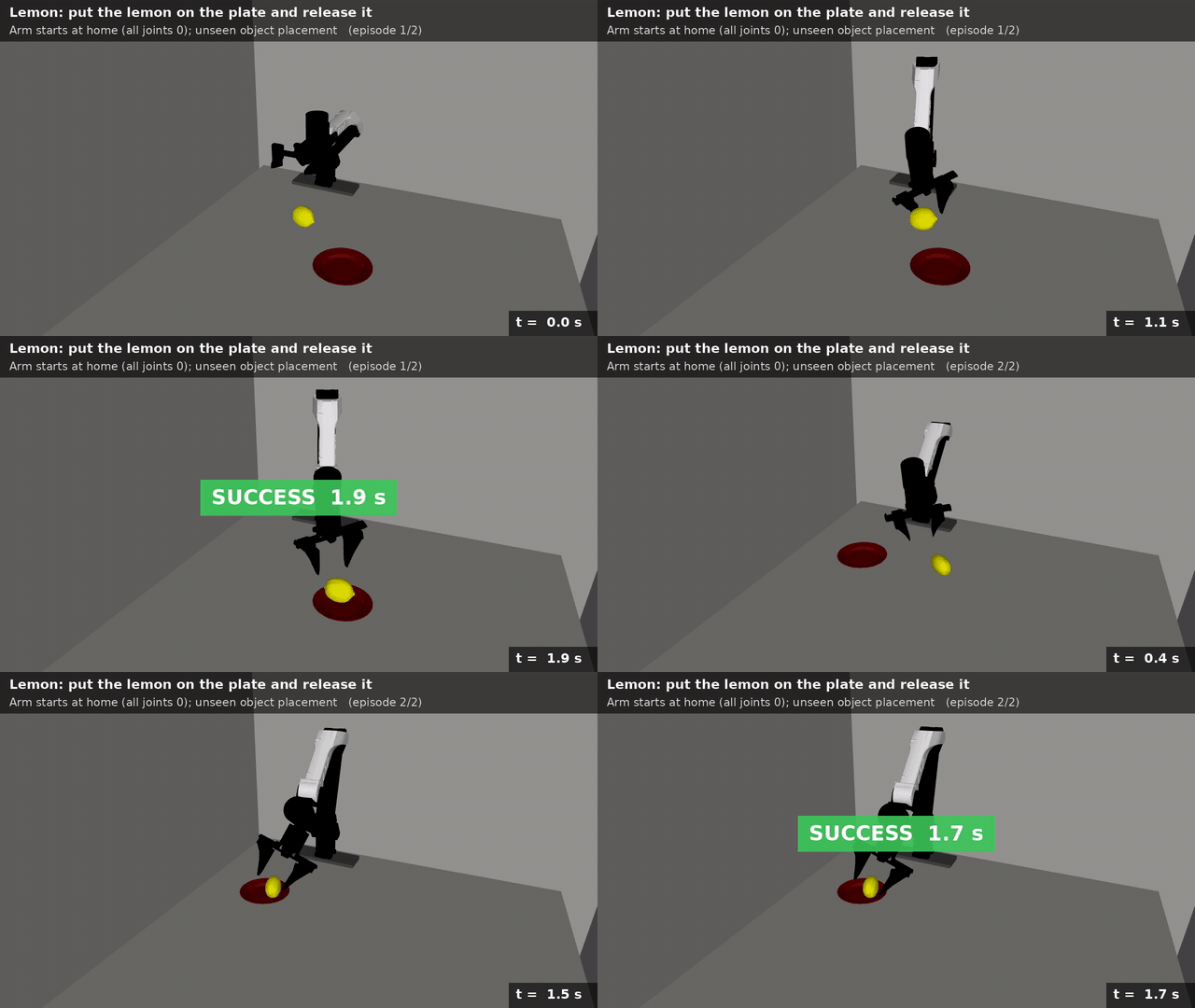
Simulation · ARX5 Lemon task · two held-out resets
⭐ In-Hand Rotation mjlab
Repository · Install · Results · Checkpoints
- By Msornerrrr. Applies SuperMimic-style world-model policy learning (an MLP world model refit online, backpropagation through imagined rollouts, a TD(λ) critic and weight averaging) to the LEAP Hand in mjlab / MuJoCo Warp, next to PPO baselines on the same environments: palm-up cube yaw, SO(3) cube reorientation (PPO only) and palm-down fingertip rotation of 22 objects, on a servo model identified on the real hand. Checkpoints for both methods are released.
- Upstream report: On cube yaw, the world-model policy reaches PPO's level (≈0.26 reward/s) after 25 minutes and 18M env steps, where PPO needs 6.5 hours and 262M, and ends at 0.292 vs 0.261. On palm-down fingertip rotation (64 rollouts per object, 60 s, randomized pad friction 0.25–1.2), a joints-only world-model policy reaches 933° rewarded yaw with 4.0% drops, against 675° / 10.4% for the deployed PPO student distilled from a teacher, and 944° / 2.1% for the privileged PPO teacher.
- Useful context: World-model results are in simulation; the real-robot videos (yaw and SO(3)) show PPO policies. Fingertip numbers use the repository's own evaluation (rotation reward capped at 0.3 rad/s; a drop is 30 mm of drift). Single runs per configuration; wall-clock times are on one RTX 4090. Source snapshot.
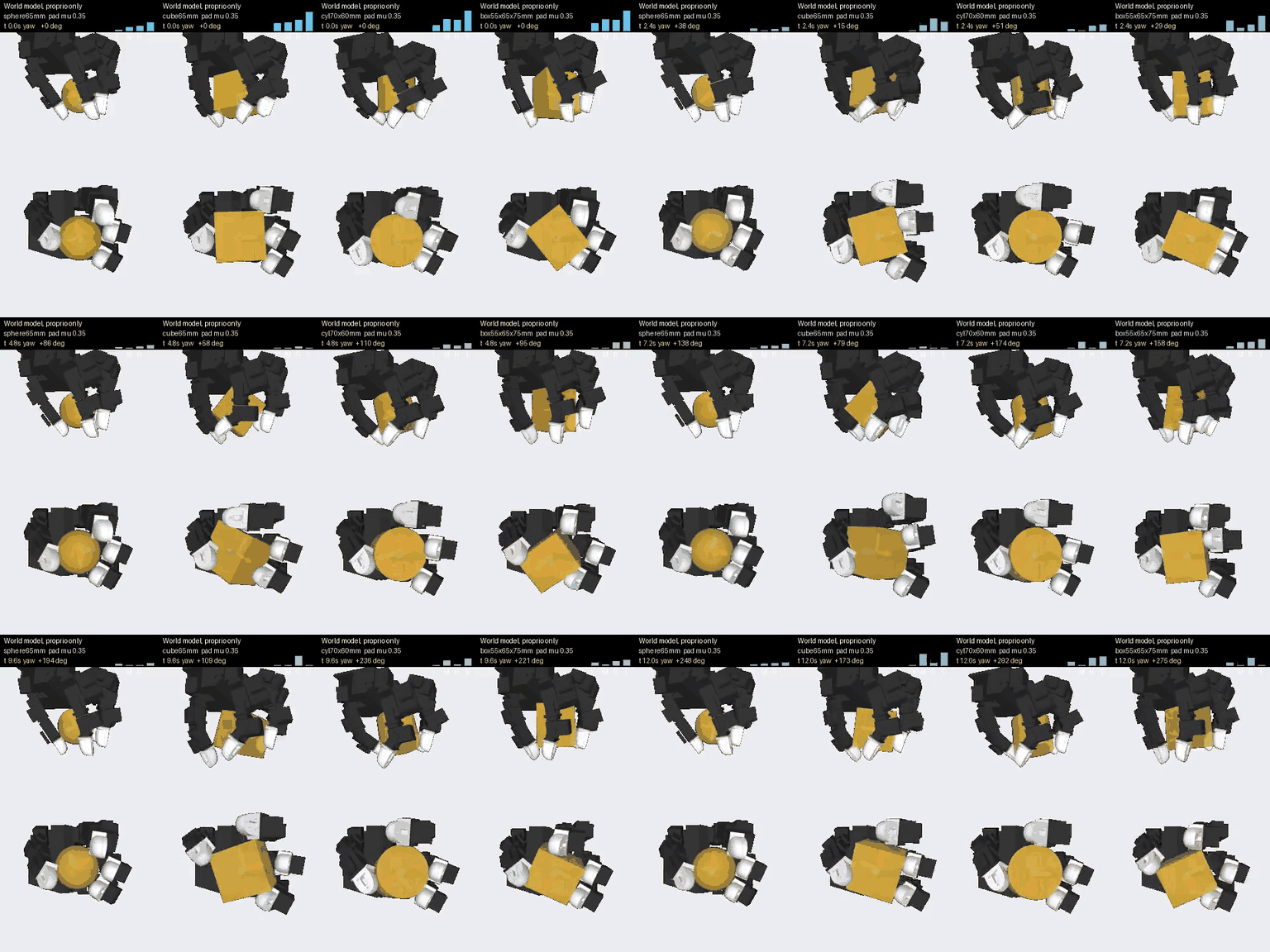
Simulation · palm-down fingertip rotation, joints-only world-model policy
Humanoid Mimic · SuperMimic 
Repository · Quickstart · Results and protocol
- By shuayyy. Compares SuperMimic and PPO-Sim on shared G1 walking, squatting and box-lifting tasks in mjlab; the repository also contains a separate AMP-PPO stack.
- Upstream report: Box-lift success reaches 100% at 31 million environment steps, reported for two SuperMimic seeds with 64 randomized evaluation episodes; success means finishing within 10 cm of the reference box height.
- Useful context: Those SuperMimic scores used clean observations. The newer evaluation adds observation noise, and the published checkpoints have not been re-evaluated under that setting. Source snapshot.
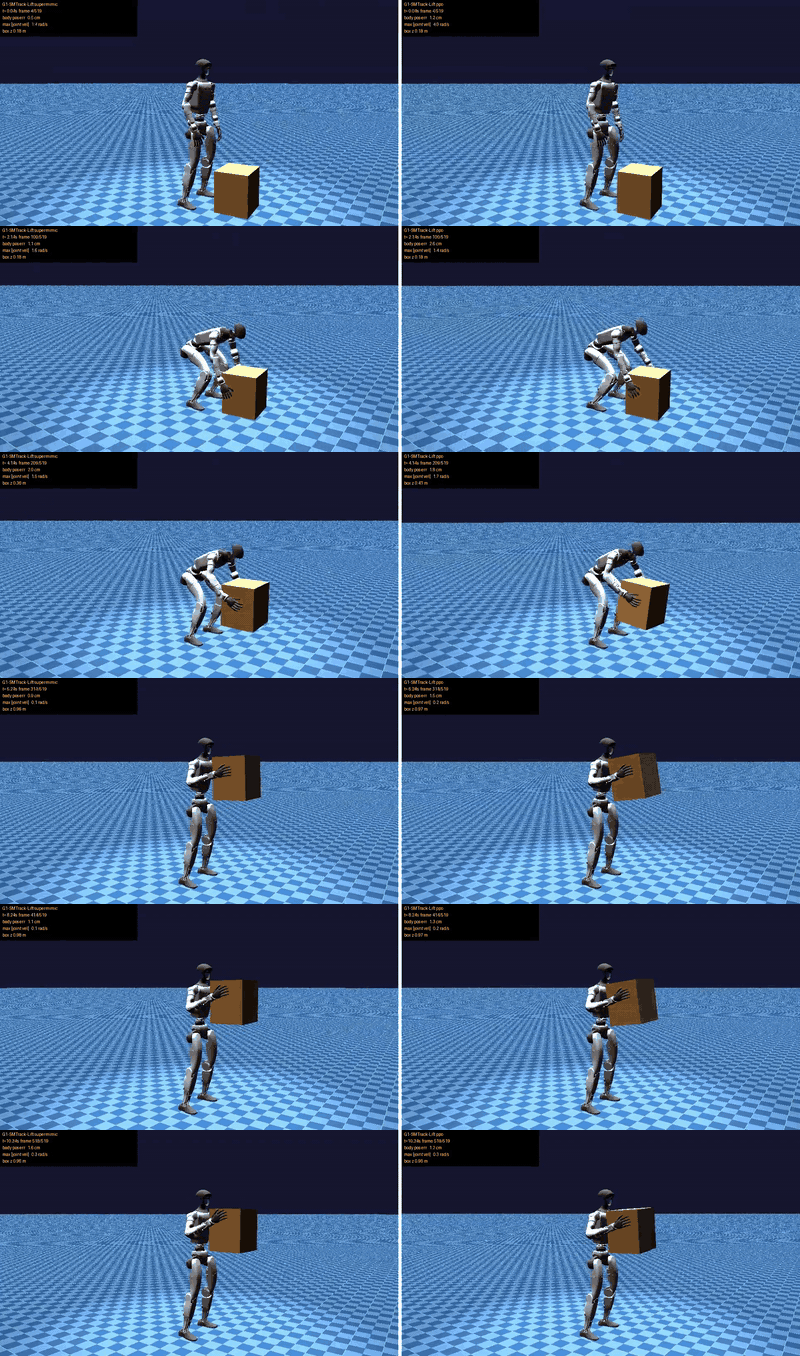
Box lift · SuperMimic 12k / PPO-Sim 6k iterations
⭐ Sharpa SuperMimic · UniLab
Repository · Current results · Training
- By Mingrui Yu. A 22-DoF Sharpa Wave cylinder-rotation task in UniLab on MuJoCo / MJWarp / MotrixSim, shared by SuperMimic, PPO, APPO and FlashSAC, retaining the HORA teacher-to-student pipeline.
- Update (checked 2026-11-03): SuperMimic is now on main, with a single-stage observation-only actor. On one RTX 4090 / MJWarp: 3,000 iterations, 686 s, 3,971,072 transitions. In fixed 240-scene × 20 s simulation evaluation, the direct actor reaches 43.59 return, 0.671 rad/s fixed-window rotation and 2.08% drops, versus 45.33, 0.784 rad/s and 1.25% for the privileged teacher. Result source.
- Useful context: The actor uses 147-dimensional observation history while its training critic retains privileged state. This fixed-scene comparison does not establish multi-seed generalization or hardware validation of the SuperMimic actor. The old feature branch is unavailable; the historical record below uses a pinned commit.

Upstream simulation · single-stage SuperMimic cylinder rotation; not evidence of hardware deployment
Historical record · 2026-10-31: 223 checks and a short train–evaluate–distill smoke run
Repository · Installation · Training · Validation
- By Mingrui Yu. Builds an independent UniLab task package for a 22-DoF Sharpa Wave hand rotating a free cylinder. SuperMimic is the default teacher: a learned world model is fitted on replay transitions, then the shared HORA policy is optimized through imagined rollouts.
- What it provides: A teacher-to-student distillation pipeline, MJWarp and MuJoCo entrypoints, tactile history, privileged critic observations, eight object scales, and PPO / APPO / FlashSAC comparison baselines.
- Validation and limits: The October 31 validation record reports 223 tests passing on one RTX 4090, including slow/CUDA tests and a short SuperMimic train–evaluate–distill smoke run. This establishes pipeline integration, not a full policy-quality comparison. At that snapshot, the SuperMimic work was on
feat/supermimic-trainingand was not yet onmain. Source snapshot.
Muscle, interaction and diagnostics
Muscle-actuated bodies, physical interaction and contact-focused diagnostics.
⭐ Muscle SuperMimic
Repository · Setup · Status
- By Kaibo He (kaibohex). Extends SuperMimic to muscle-driven whole-body tracking on MS-Human-700 (700 muscles) and MyoFullBody (354 muscles) in mjlab / MuJoCo Warp.
- Update (checked 2026-11-03): On one RTX 5090, MyoFullBody reaches 0.90 return and 108 / 108 held-out KIT clips completed at 16k iterations / 9.6 h. Its earlier 10k / 6.0 h, 101/108 result remains below. Both bodies now have released 10k and 16k checkpoints; MS-Human-700 still completes 104/108 at 16k. Results and weights.
- Upstream report: On MuscleMimic's 108 held-out KIT clips with 4,096 environments on one RTX 5090, MS-Human-700 reaches 0.91 normalized return after 10.1 hours (iteration 16k, 104 / 108 tracked); MyoFullBody reaches 0.83 after 6.0 hours (iteration 10k, 101 / 108 tracked).
- Useful context: The policy controls muscle excitation at 100 Hz, and the project provides a differentiable torch muscle model plus retargeting tools. The retargeted KIT data is gated and subject to AMASS terms; MS-Human-700 is provided as a Git submodule. Source snapshot.
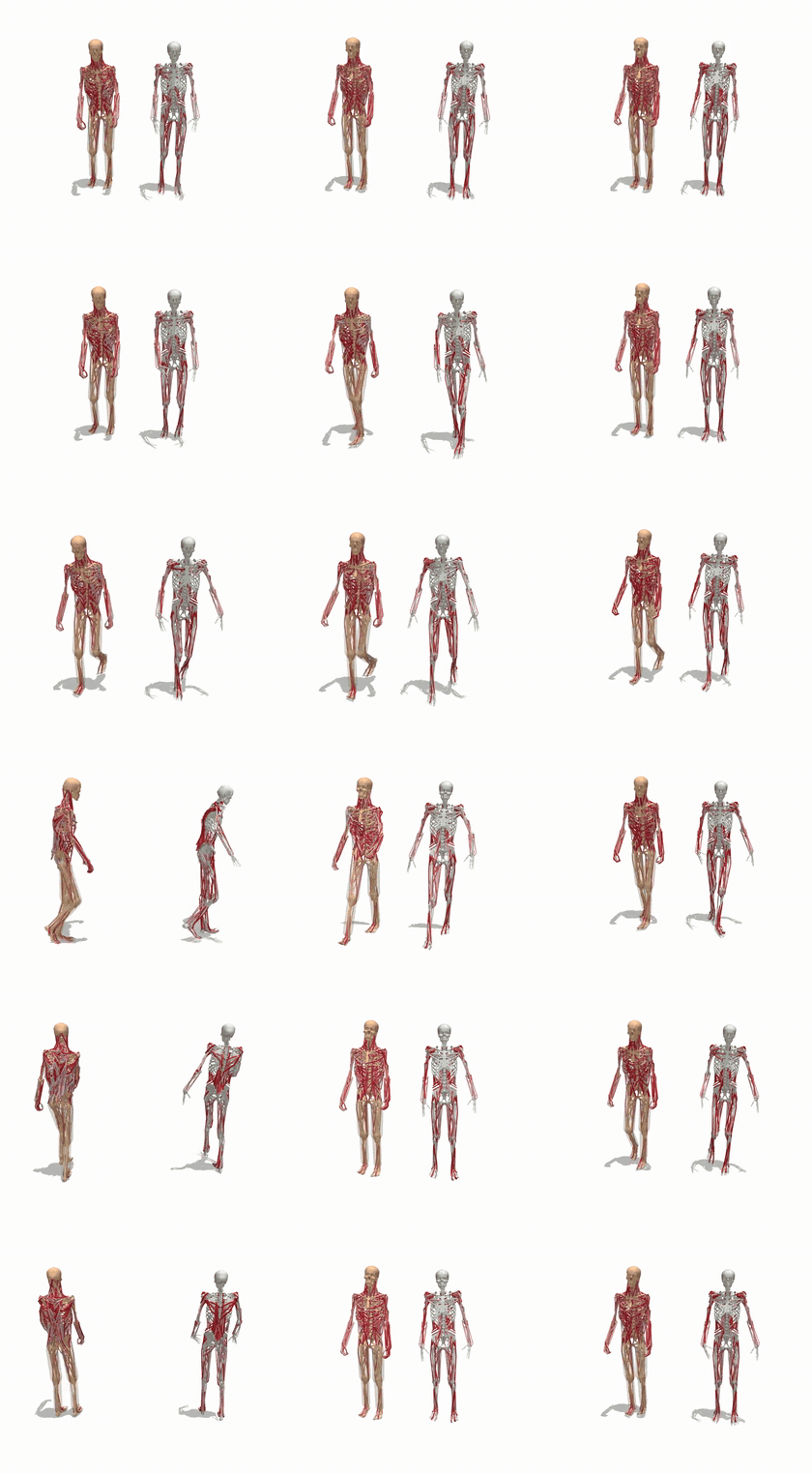
Simulation · MS-Human-700 and MyoFullBody · iteration 10000
SuperMimic Backflip Diagnostics 
Repository · Results · Quickstart
- By liudi159. A focused G1 backflip study on Isaac Lab 3 and one RTX 5090, tracking leg symmetry, contact forces, penetration and landing stability.
- Upstream report: The final V14 checkpoint completes the rotation and landing hold, but the original strict evaluation records one frame of non-foot penetration and fails acceptance.
- Useful context: An independent rerun changes the borderline contact outcome. Both records are retained, so the clip should not be read as robust success or reproduction of all paper experiments. Source snapshot.
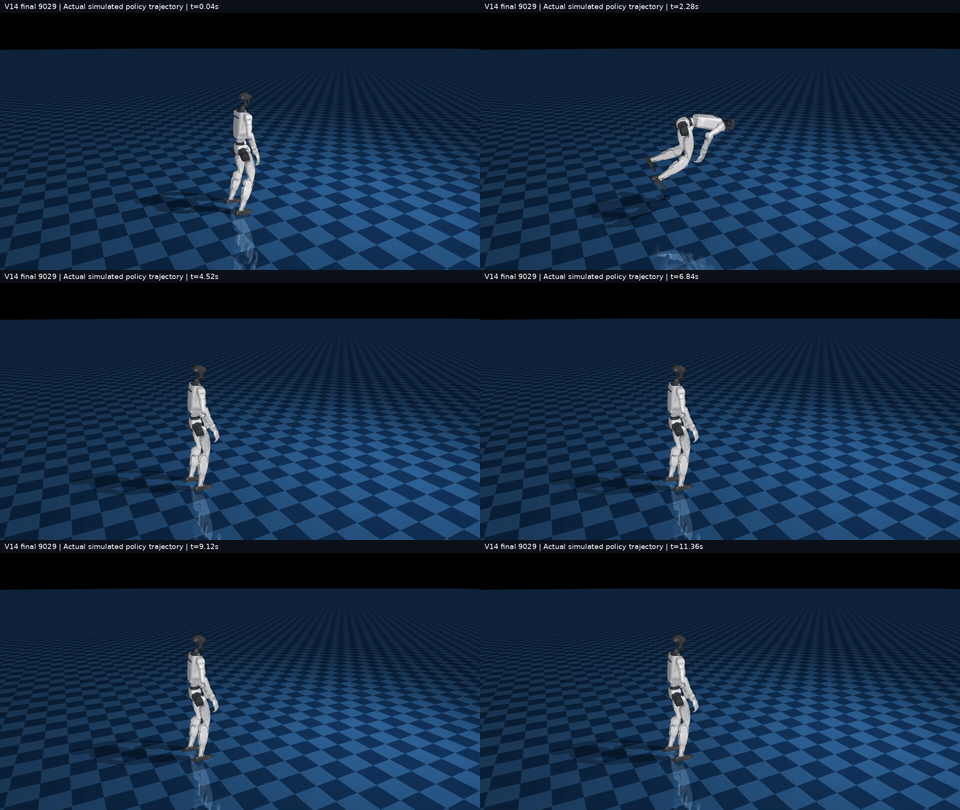
Simulation · final V14 policy; strict evaluation failed
SuperMimic-PERA 
Repository · Current status · Skateboarding report
- By shangchaohu718. Builds on UniSuperMimic for G1 interaction experiments, retaining a frozen tracker while developing separate interaction policies in UniLab / MuJoCo.
- Upstream report: A separate skateboarding policy completes 30-second simulated runs from one standard and eight held-out perturbed initial states, traveling 39.87–42.13 m.
- Useful context: Tracking and skateboarding are selected as separate branches. A shared world-model-driven interaction actor is not established; box handling and stairs remain unsuccessful in the reported prototype. Source snapshot.
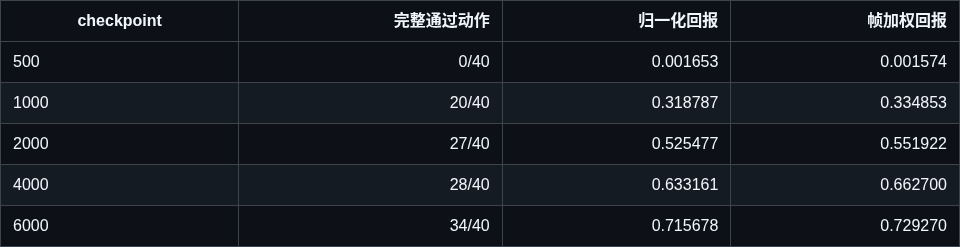
Report screenshot · tracking checkpoints 500–6000; separate from skateboarding
Robot porting and retargeting
Robot-, simulator- and hardware-specific ports, together with motion-retargeting tools.
SuperMimic-MuJoCo 
Repository · Setup · Evaluation
- By panhainan2020. A standalone mjlab / CPU MuJoCo port of supermimic_vibed for G1, with observation-compatibility profiles, inference weights and held-out 100STYLE evaluation.
- Update (checked 2026-11-03): Adds separate from-scratch, self-collision-enabled LAFAN1 and hard-motion runs; the latter uses only a 514-clip BONES-SEED subset. Preliminary evaluation: one LAFAN dance, 0.8590 return, no failure; six hard clips, 0.8120 mean return, three failures. Both runs stopped short of their planned training budget. These differ from the older 98k policy and its 40/40 and 100STYLE results below. New demos and evaluation.
- Upstream report: The fixed 98k policy completes 40 / 40 LAFAN training motions at return 0.8713, and 3,569 / 3,573 unseen 100STYLE clips at 0.8045, without fine-tuning.
- Useful context: Mean clip duration is 18.77 s for 100STYLE versus 220.55 s for LAFAN; retargeting also differs. Completion only means no termination, not accurate tracking. Cross-source semantic duplicates were not checked. The inference checkpoint does not resume full training. Source snapshot.
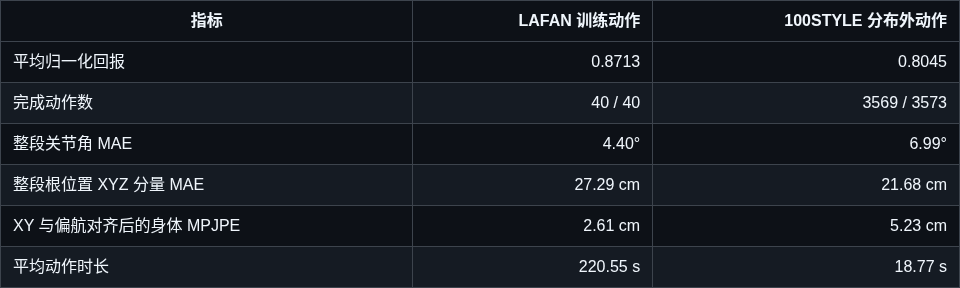
Report screenshot · LAFAN training motions and unseen 100STYLE clips
SuperMimic Wheel-Legged (wheelbipe) 
Repository · Setup · Results
- By RadiantForever. Downstream port of SuperMimic to the wheeled-legged wheelbipe V14_2. The humanoid motion library is replaced by a velocity-command library; a 6-DoF action policy (four leg targets plus two wheel speeds) is optimised inside the differentiable world model, with PhysX / Isaac Lab as the data source and no PPO in the loop.
- Upstream report: On a 16-command grid the unified checkpoint reaches 0 / 16 falls and normalized return 0.983; a speed-focused checkpoint tracks 1.40 m/s at 0.01 error, and yaw reaches 10.21 rad/s (1.62 rev/s) with a 0.20-0.28 m leg cycle. Single RTX 4090, 4096 environments, 3.72 h cumulative over resumed runs; one run, no seed sweep.
- Useful context: A pretrained PPO policy for the same robot is mixed into the world-model buffer for the first 800 iterations only, and no teacher-free ablation was run, so these numbers are not attributable to the method alone. The port requires the robot USD asset from the upstream repository; there is no URDF. Source snapshot.
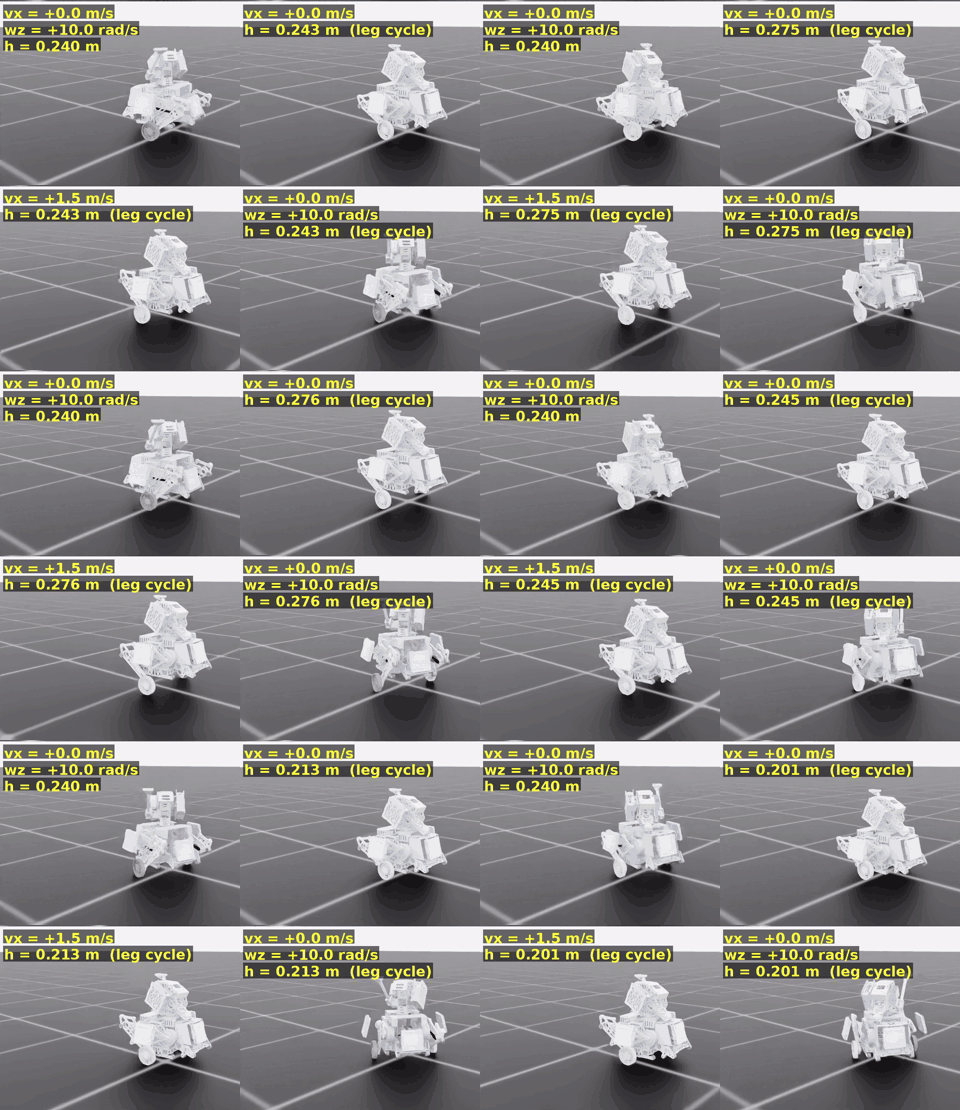
Simulation · four commanded conditions: 10 rad/s yaw (top-left), 0.20-0.28 m leg cycle (top-right), 1.5 m/s forward with leg cycle (bottom-left), yaw with leg cycle (bottom-right)
SuperMimic-Quadruped 
Repository · Quick start · Results · Joystick planner · Pretrained models
- By Houserz. Ports SuperMimic motion tracking to the Dobot Rover X1 quadruped (12 DoF) in mjlab / MuJoCo Warp, building on the CuboiLeo baseline, and adds SONIC-style joystick walking: a kinematic planner turns keyboard input into reference motion that the same tracker follows. Public dog motion capture is retargeted for any 12-DoF quadruped described by one YAML file.
- Upstream report: One policy tracks all 665 library clips with 0 failed clips (mean normalized return 0.937 / 0.854 / 0.891 for train /
hard/ held-out; deterministic, no noise; 50k iterations, about 4.6 h on one H200). Planner + tracker under a random joystick, 125 robots × 60 s: 0 falls with and without domain randomization; without it, robot velocity is 0.97 / 0.99 / 0.98 of the stick (vx / vy / yaw rate). - Useful context: Results are in simulation. Tracker and planner weights and 99 extra training clips are released for non-commercial research use; the other 566 clips are rebuilt from public sources at pinned revisions. Source snapshot.
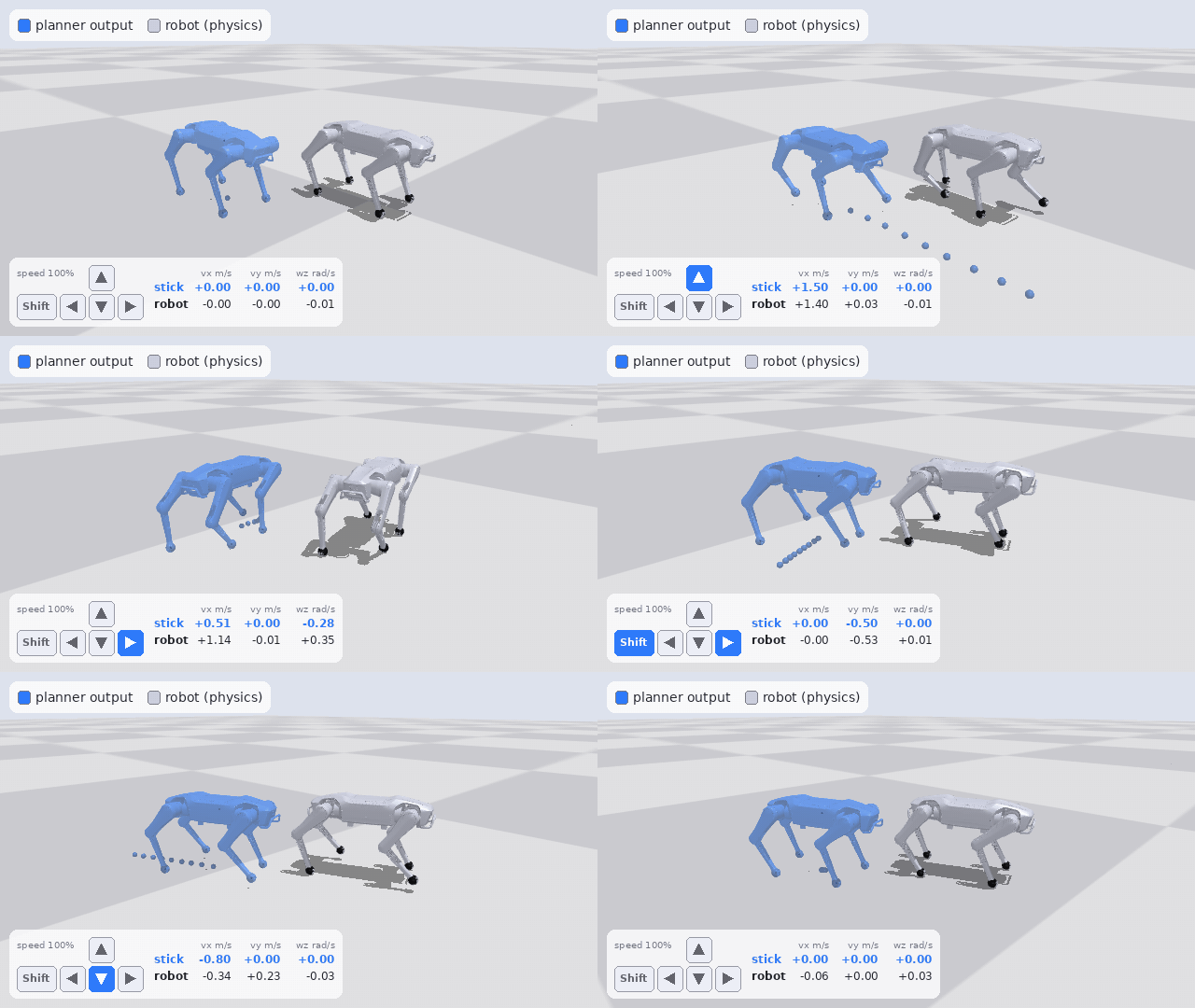
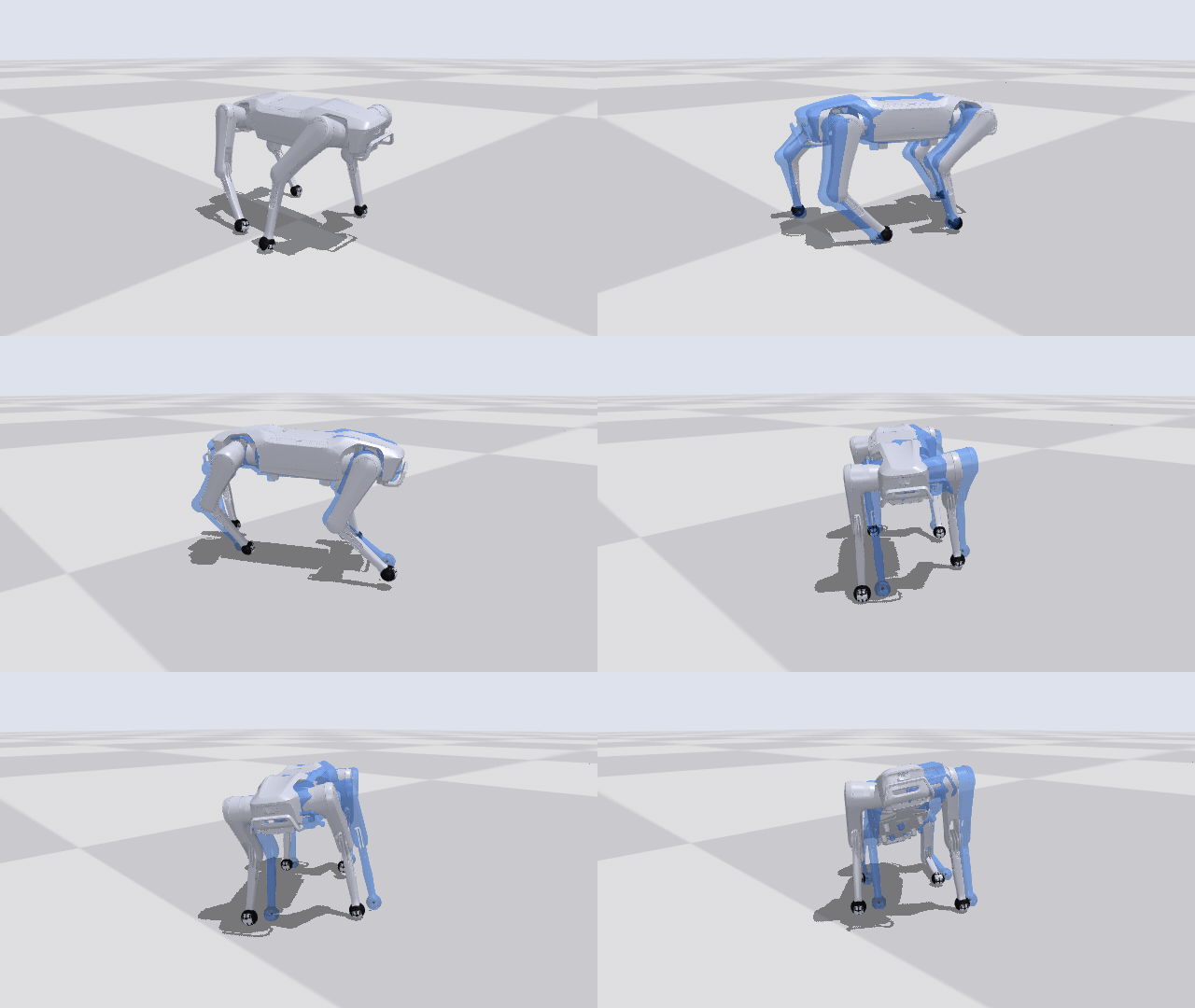
Simulation · Rover X1: keyboard joystick → planner (blue, beside the robot) → tracker; zig-zag turns from dog motion capture (blue marks deviations from the reference)
⭐ SuperMimic Retargeted
Repository · Quickstart · Data guide
- By tianshuwu. Extends the CuboiLeo mjlab baseline to G1, A3 and X2 Ultra, adding robot-specific kinematics, SOMA retargeting, coordinate corrections and foot-contact checks.
- What it provides: Publishes LAFAN1/BONES-SEED preparation workflows and historical evaluation records. Training weights are not distributed, and motion data must be prepared separately.
- Useful context: The reported policies use extra anchor-relative observations computed from simulator truth. These require corresponding state estimation on hardware; real-robot transfer is not validated. Source snapshot.
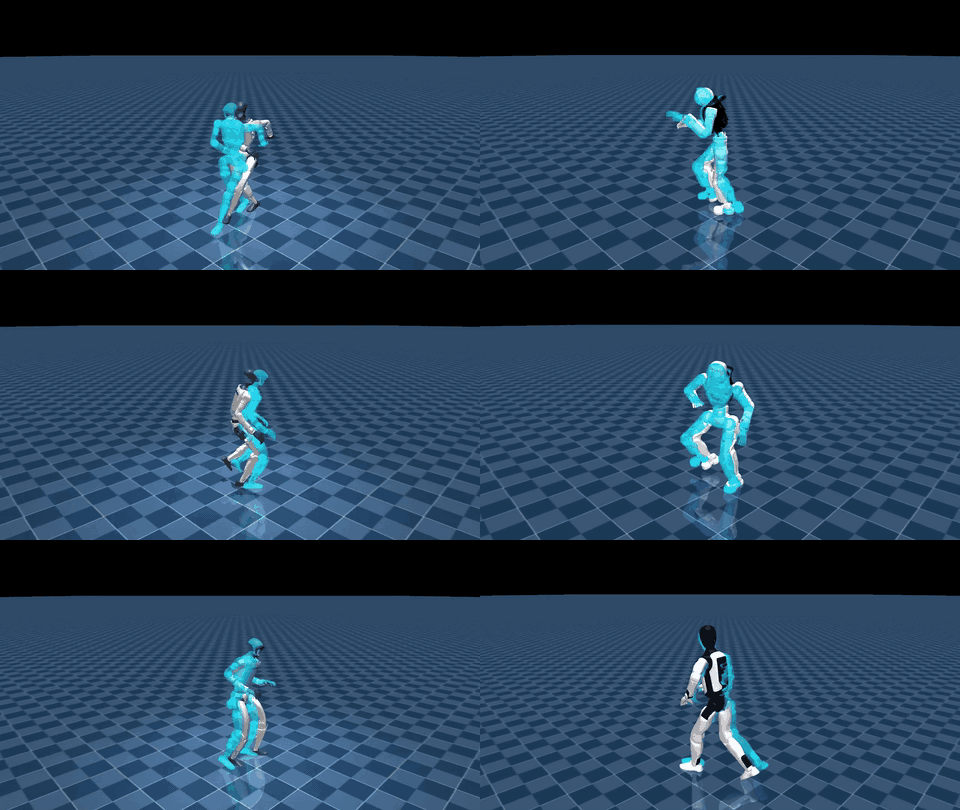
Simulation · G1 / X2 Ultra / A3
SuperMimic E1 
Repository · Setup · Results
- By wenconggan. Adapts the Isaac Lab 3 implementation to the 21-DoF DroidUp E1, with standalone native-MuJoCo sim-to-sim playback and evaluation.
- Upstream report: The 164k checkpoint completes 40 / 40 training motions, return 0.8559, in Isaac Lab. A separate 168k checkpoint completes 10 / 10 sampled eight-second segments in native MuJoCo.
- Useful context: Complete-clip evaluation and independently initialized short segments use different protocols. Neither result measures unseen-motion generalization or hardware transfer. Source snapshot.
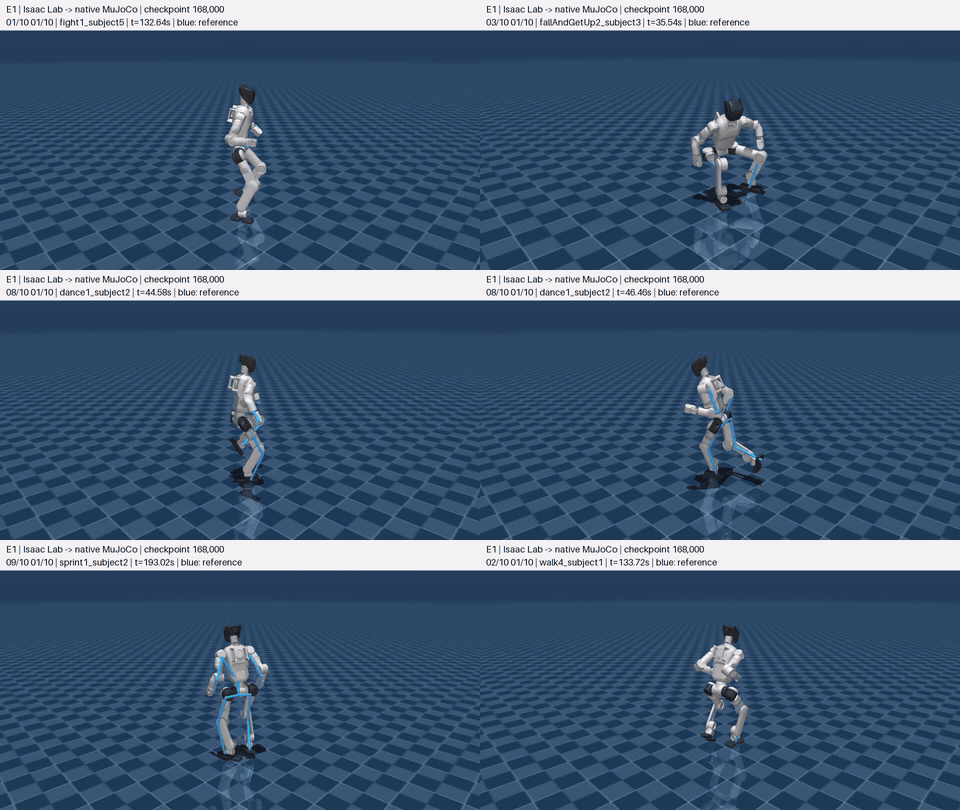
E1 sim-to-sim · native MuJoCo
SuperMimic Oli 
Repository · Setup · Results
- By liuskywalkerjskd. Ports supermimic_vibed to the 31-DoF LimX Oli in Isaac Lab 3, adding motion retargeting, robot kinematics and full-motion video export.
- Upstream report: At iteration 18,000, the original 40-motion LAFAN1 evaluation reports return 0.6783 and 36 / 40 completed clips, after about 2.20 hours on one RTX 4090.
- Useful context: The displayed walking clip is a selected excerpt. Use the full-library evaluation when judging tracking coverage. Source snapshot.
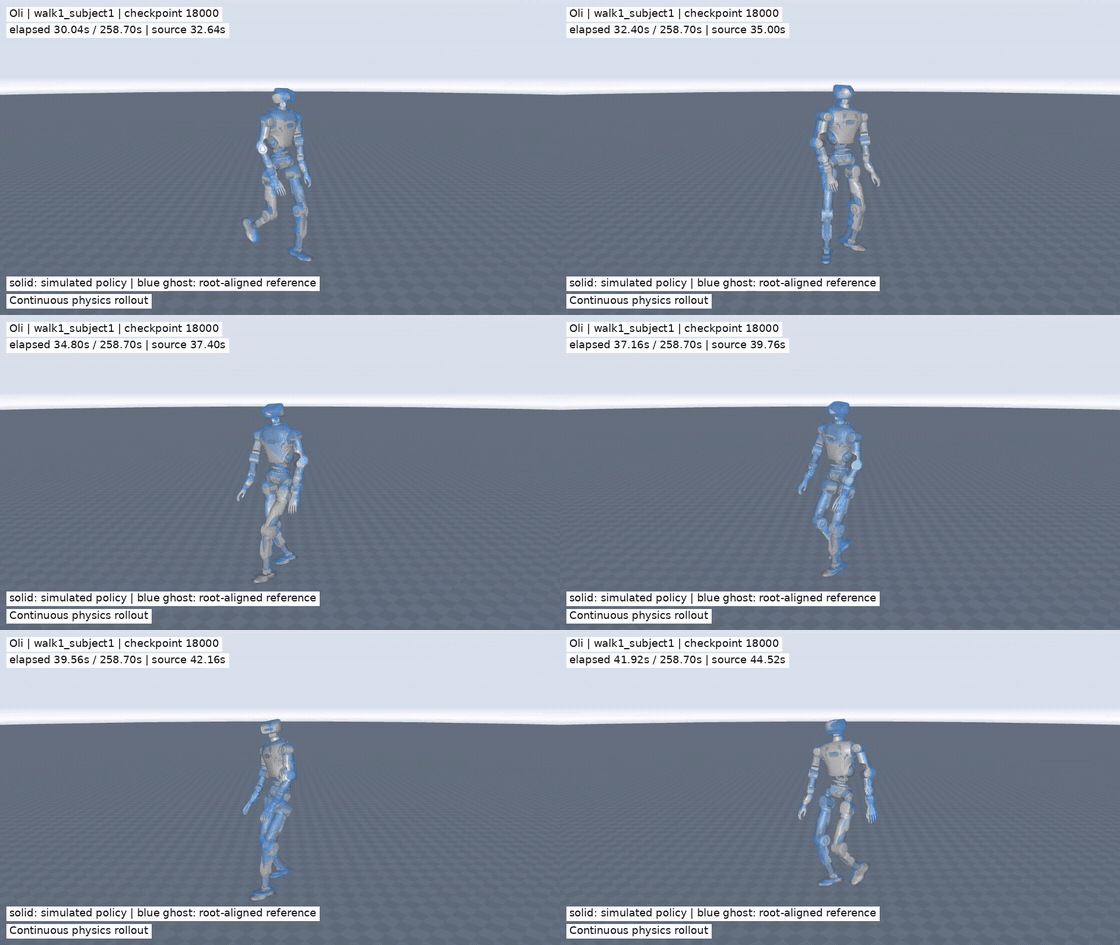
Simulation · selected Oli walking excerpt
SuperMimic on Apple M5 
Repository · Run the released model · Results
- By WXyuany. Adapts the CuboiLeo G1 baseline to Apple Silicon, using CPU MuJoCo for physics and PyTorch MPS for learning, with released weights and playback tools.
- Upstream report: For the released 21k checkpoint on a 24 GB Apple M5, seed 0, the original 40-motion evaluation reports return 0.7081 and 25 / 40 completed clips; a fresh-environment check completes 26 / 40.
- Useful context: Return is normalized by executed steps without zero-padding after failure, and the actor uses nine extra anchor-observation dimensions. Read return together with completion; held-out generalization is untested. Source snapshot.
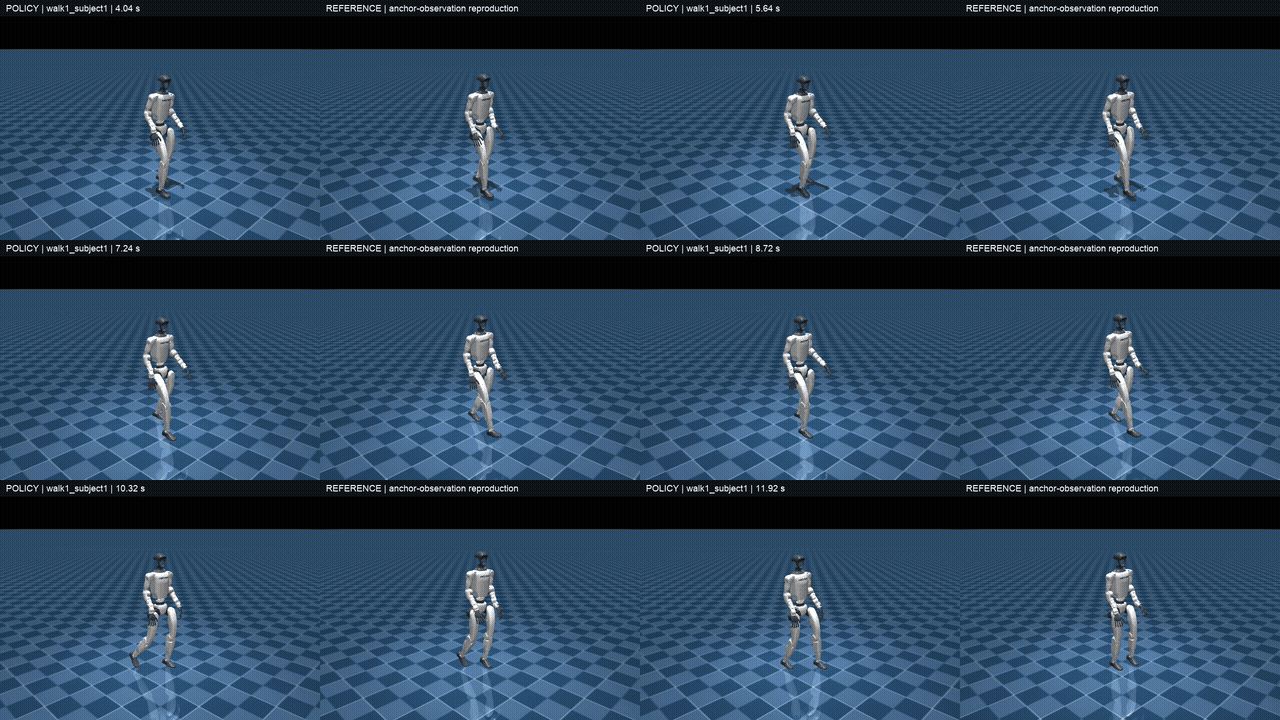
Simulation · G1 walking on Apple M5
Real-robot deployment and Sim2Real
Real-robot runtimes and sim-to-real transfer paths.
⭐ SuperMimic-Repro-Sim2Real
Repository · Quickstart · v1.1 field notes · G1 deployment
- By NJU R&L Group Embodied Lab. Extends the CuboiLeo mjlab baseline with custom dance/video-motion tools, clip-specific fine-tuning, ONNX export and G1 deployment through native MuJoCo and the Unitree SDK.
- Upstream report: v1.0 publishes a roughly 46-second real-G1 dance assembled from four motion segments. In v1.1, the clip-specific
e24_0355000policy completed a roughly 22-second dance twice on the real G1, including two rapid turns and a one-foot landing jump; nine earlier models had failed this clip. Both v1.1 runs used a slack safety tether, and repeating one model is not an ablation. - Useful context: The v1.1 checkpoint is specialized to that single dance, not general motion tracking. Paper-style observations and anchor-augmented training remain separate configurations. Source snapshot.
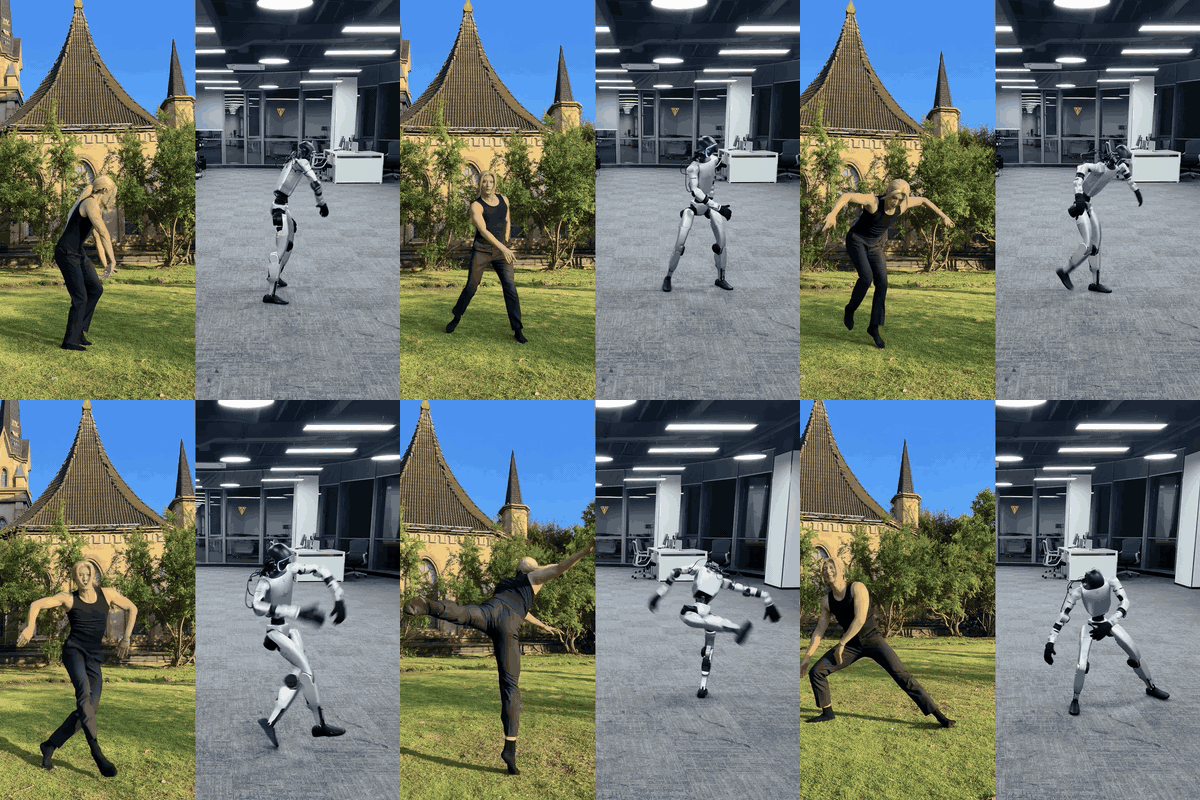
Real G1 · v1.1 clip-specific dance; human reference on the left, robot on the right
SuperMimic G1 Deployment 
Repository · MuJoCo guide · Real-G1 guide
- By KyrieYoung926. A deployment runtime for a SuperMimic-Reproduced policy on the 29-DoF G1, using ONNX Runtime, MuJoCo and Unitree SDK2.
- What it provides: Provides both simulation and real-G1 demos, with separate guides for fetching deployment assets and running the policy on each target.
- Useful context: This repository covers deployment, not a new training benchmark. Motion data, model weights and robot assets retain their own terms beyond the code license. Source snapshot.
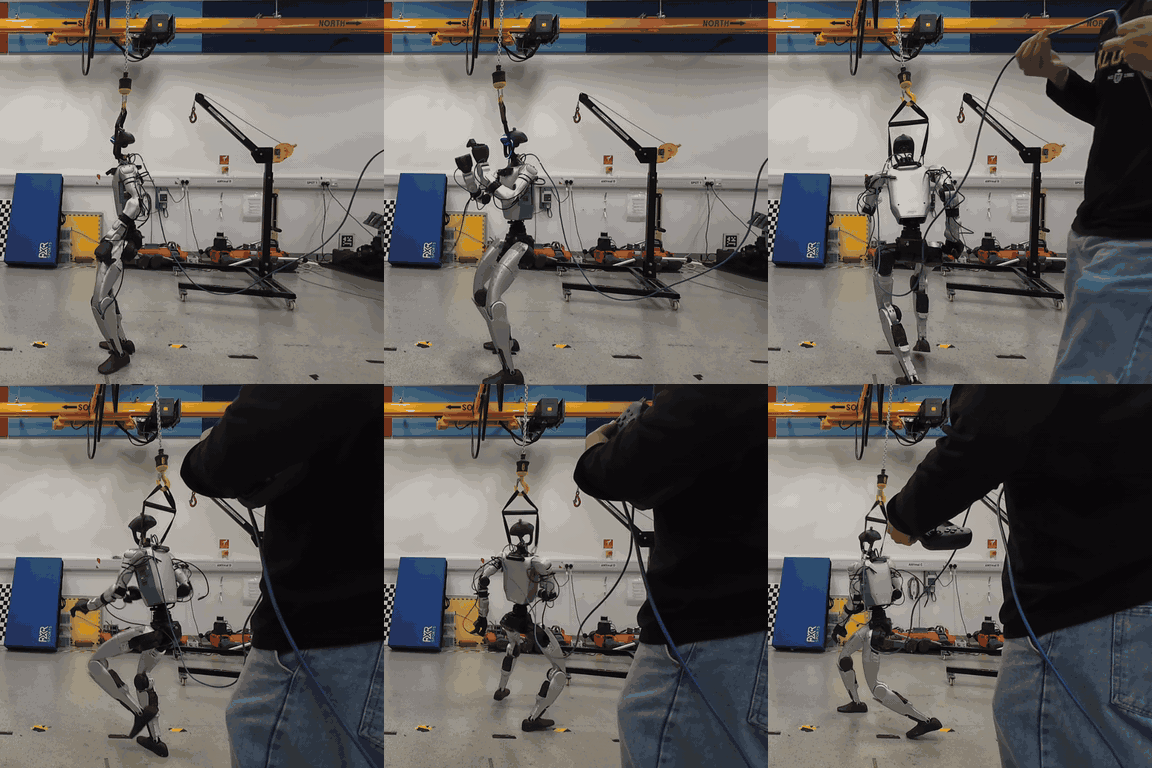
Real G1 · upstream deployment demo
Inspired experiments
Ideas transferred to other control settings, with different tasks and evaluation protocols.
⭐ FlatWorld · SuperMimic-2D
Repository · Quickstart · Reference motions
- By swaggyliu. Recreates the shared-world-model and imagined-policy-learning loop in FlatWorld with an eight-joint 2D humanoid and motion-tracking tasks.
- What it provides: Provides training, reference baking, per-skill rendering and a 33.3-second multi-skill promo covering walking, running, jumping, dancing, fighting, crouching and fall/get-up.
- Useful context: References are procedural, LAFAN-like 2D motions, not the LAFAN1 dataset. The character also uses a mild root assist, so this is an illustrative adaptation rather than a G1 benchmark. Source snapshot.

2D simulation · full 33.3-second multi-skill promo
G0.5 · SuperMimic-style Steering 
- By azizkhadraoui. Transfers SuperMimic-style gradient-based learning to G0.5 VLA steering on LIBERO: a noise policy is trained through a frozen flow sampler using world-model and critic gradients.
- Useful context: This is one task-specific steering experiment within a broader VLA stack. The linked script identifies the relevant method; the repository’s other planning and memory results are separate experiments. Source snapshot.

Code index screenshot · world-model / critic steering experiment
Related methods and baselines
These works provide methodological background or comparison points; they are separate research projects.
| Work | Connection | Primary resources |
|---|---|---|
| SuperTrack (2021) | Earlier character motion tracking through a learned differentiable world model and gradient-based control learning. | Author explanation · Paper |
| BeyondMimic (2025) | Humanoid motion tracking and guided diffusion control; supermimic_vibed references its actuator and task conventions. |
Project · Paper |
| SONIC (2025) | Large-scale humanoid motion tracking; the original SuperMimic work compares against a released SONIC checkpoint. | Project · Paper · Code |
Data and learning resources
- LAFAN1 retargeting dataset — G1 motion assets used by
supermimic_vibed, UniSuperMimic, and SuperMimic-Reproduced. Follow each repository's preparation instructions and the dataset's own terms. - BONES-SEED — the motion-data source used for the original paper's large-scale benchmark. The raw dataset and paper-filtered evaluation set have different counts. Access requires accepting the dataset's terms on Hugging Face.
- Official interactive demo — explore the original policy in the browser before choosing a training stack.
- Official method explanation — simulator collection, model fitting, and policy learning.
- InstinctMJ releases — upstream distribution of task data and model assets; check the release description for the relevant branch and task.
Contributing
Have a new implementation, extension, tutorial, or demo? Open a pull request using the contribution guide. Include the original source, the relationship to SuperMimic, the relevant branch, and evidence for any result you quote.
Citation
When building on the method, cite the original SuperMimic paper and credit the implementation you use. BibTeX below follows the official project:
@inproceedings{liao2026supermimic,
  title     = {{SuperMimic}: Scaling Humanoid Whole-Body Control
               with One Differentiable World Model},
  author    = {Liao, Qiayuan and Shao, Yiyang and Long, Junfeng and
               Zakka, Kevin and Horowitz, Roberto and Abbeel, Pieter and
               Sreenath, Koushil},
  booktitle = {Conference on Robot Learning (CoRL)},
  year      = {2026}
}
Acknowledgements and license
Thanks to the original SuperMimic authors and all community maintainers. The presentation of this list is inspired by Awesome Nano Banana Images and Awesome World Models.
The original curation text in this collection is released under CC0 1.0. Third-party code, papers, datasets, and media retain their respective rights and terms. This includes the original paper figure, official video previews, and CoRL 2026 talk stored in this repository; they are not covered by this collection's CC0 dedication. Community media previews and credits follow the same attribution rule.
Star History
If this list helps you, consider starring the repository so more people can discover it.