
marsilid/suveren
marsilid/suveren has 74 GitHub stars and 5 forks. GitHot measured +29 stars in 24 hours. Last checked 2026-11-11 13:58 UTC. Last push 2026-11-09.
Аудит сайта и компании для РФ: иностранные сервисы, 152-ФЗ, блокировки РКН, ЕГРЮЛ и санкционные списки
Measured star growth
- in 24h
- +29
- in 7 days
- Collecting history
- in 15 days
- Collecting history
- in 1 month
- Collecting history
Net star changes over overlapping periods, not daily totals. Missing measurements are left blank. Stars measure attention, not software quality.
README.en.md
Original
Website and company audit for doing business in Russia
foreign dependencies · personal-data law (152-FZ) · blocking · mail spoofing · web security · company registry and sanctions




Give it a website and in about a minute you get a report: what on the site depends on foreign services, which legal requirements are broken and what fine that can mean, whether mail can be forged in the company's name, and what to fix first. Every finding comes with its evidence: a DNS record, a response header, a quote from the privacy policy, a script address.
The tool, its reports and the guide are in Russian: the audience is Russian businesses.
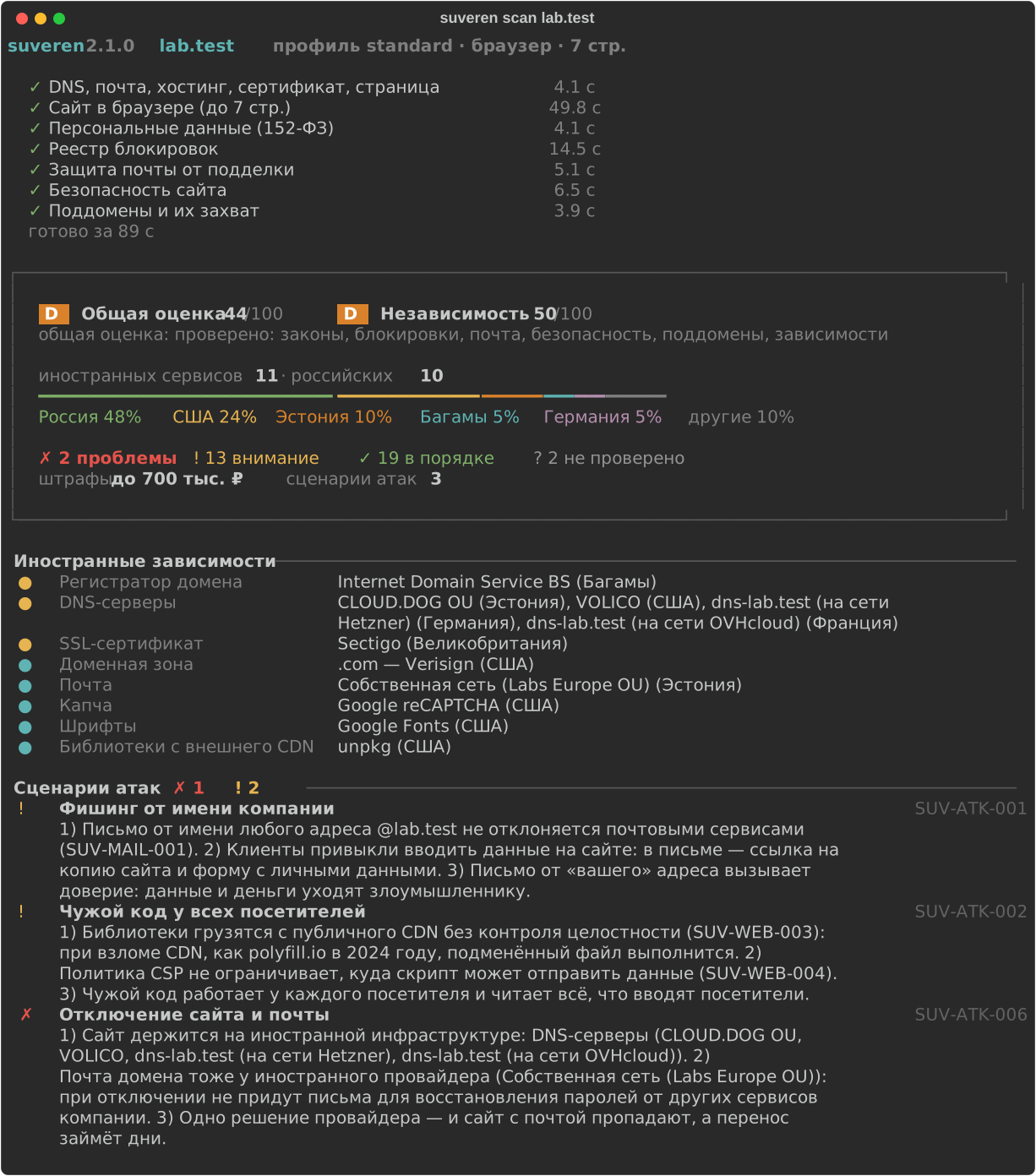
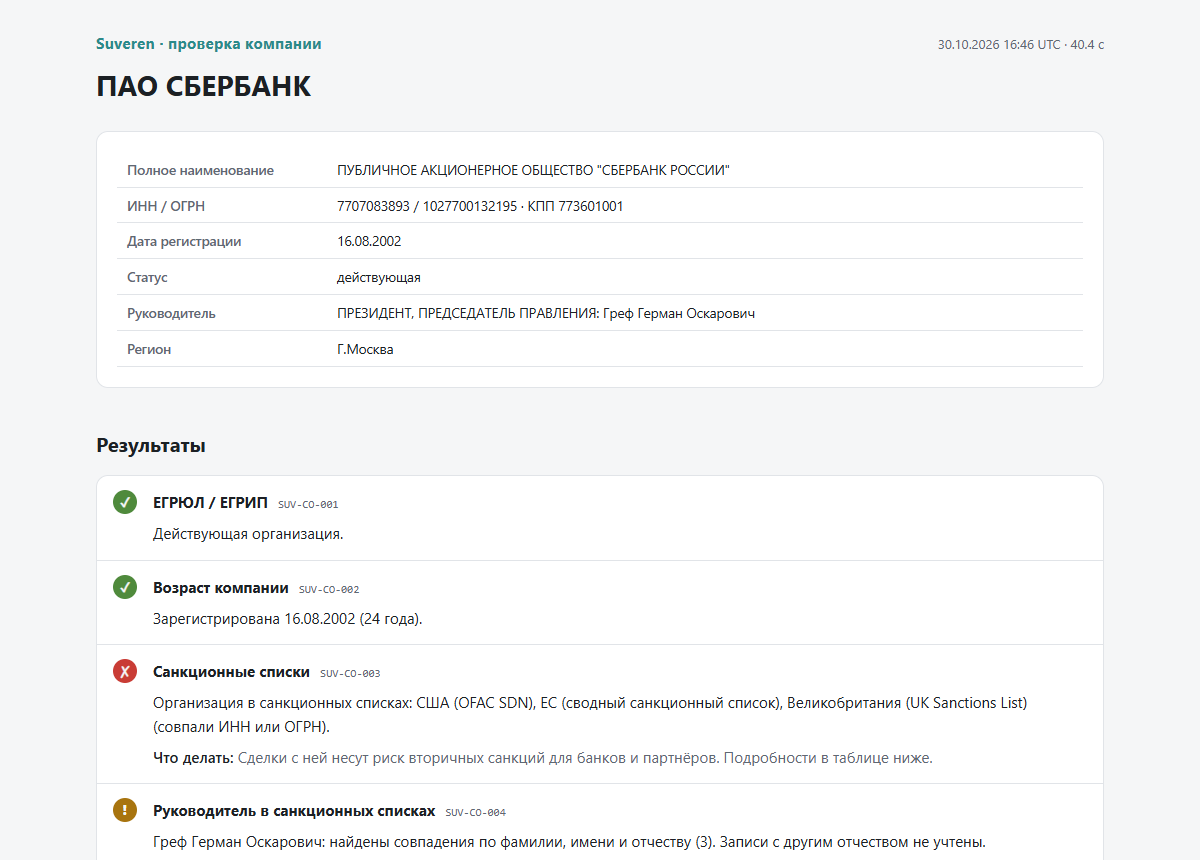
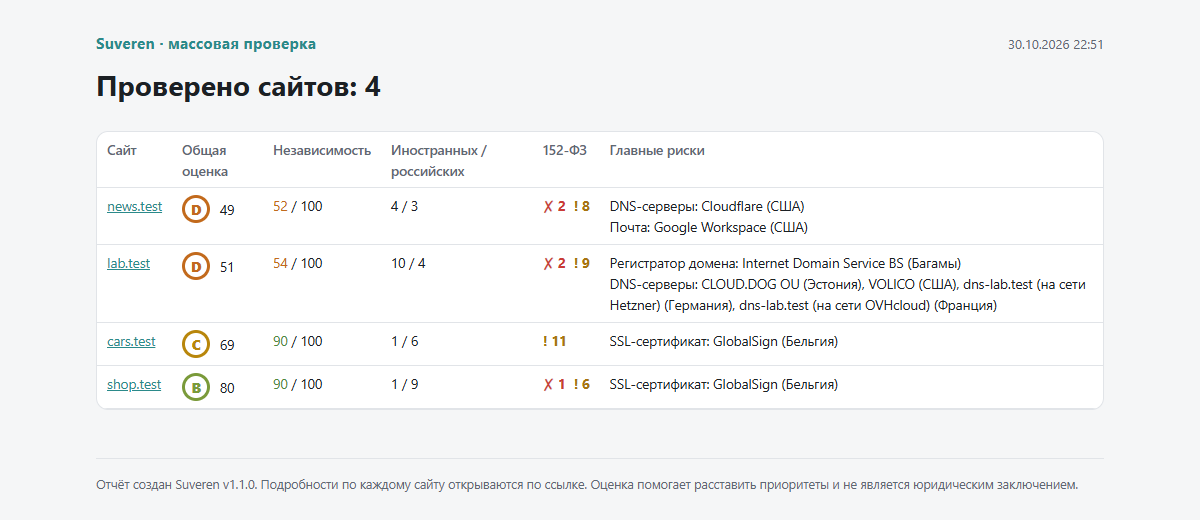
The pictures show made-up sites in the reserved .test zone: real audit data with names,
addresses and IPs replaced so as not to expose other companies.
Quick start
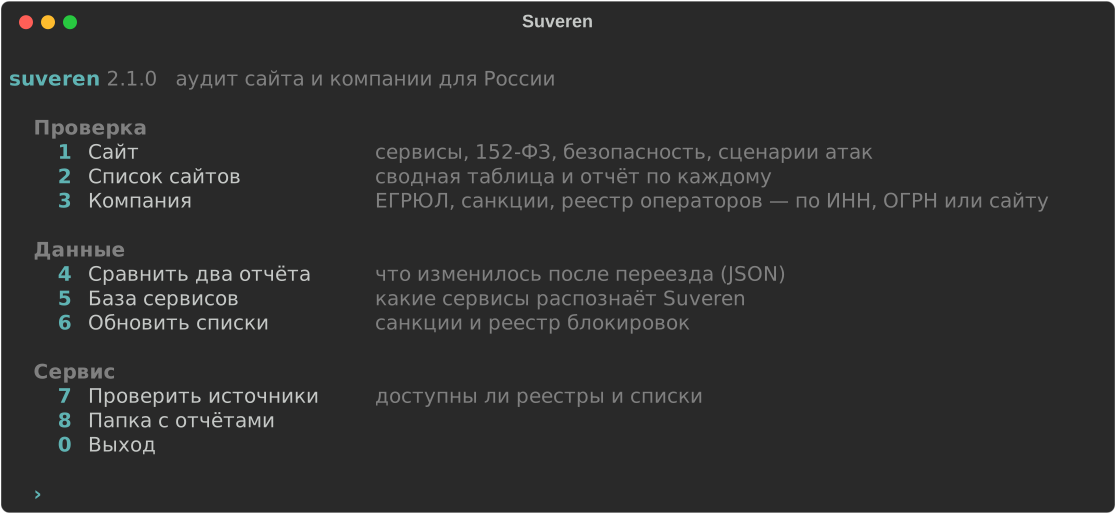
Windows. Download Suveren.exe from the
latest release and run it: a menu opens, no
command line and no Python needed. Windows may warn about an unknown publisher — "More info" →
"Run anyway".
Any system (Python 3.11+):
pip install "suveren[browser]"
suveren scan example.ru
If pip says Could not find a version that satisfies the requirement suveren
("from versions: none"), your Python is older than 3.11: check python --version and upgrade
it, or download the ready exe.
Other ways: from source and Docker
From source, Suveren.bat opens the same menu: download the repository (Code → Download ZIP),
unpack it and run the batch file — on first launch it installs everything it needs.
docker build -t suveren https://github.com/marsilid/suveren.git
docker run --rm -v "$PWD:/work" suveren scan example.ru
What it checks
- What breaks with the next round of sanctions? DNS, mail, hosting, CDN, site builder, registrar, certificate, scripts and widgets. An independence grade from A to F and a migration plan.
- Does the site comply with 152-FZ? The privacy policy and its contents, consent in forms, cookies, cross-border transfer, the register of personal-data operators, Google and Apple sign-in, Instagram and Facebook links without the note that Meta is banned. The total of possible administrative fines.
- Does the site open in Russia? The domain and IPs in the block list, blocked services on the pages.
- Can mail be forged in the company's name? SPF, DMARC, DKIM, MTA-STS and a plain answer: yes, partly or no.
- Are there forgotten subdomains that can be taken over?
- Whose code runs on the site? Third-party and abandoned scripts, vulnerable libraries, keys in the code, security headers, cookies, TLS, CAA and DNSSEC.
- Who are we dealing with? The company in the state register (EGRUL), US, EU, UK and UN sanctions lists, the Rosfinmonitoring list.
About 70 checks with permanent IDs (list) and a database of 300+ services. Findings from different sections combine into attack scenarios: "mail can be forged" + "the site takes payments" = phishing in the company's name.
The report
The report is saved to reports/ and opens in the browser. On top: grades, fines and what to fix
first; under each problem — the evidence, the article of law and how to fix it. It can also be
saved as PDF or Word, as a one-page summary for management, or under your studio's brand.
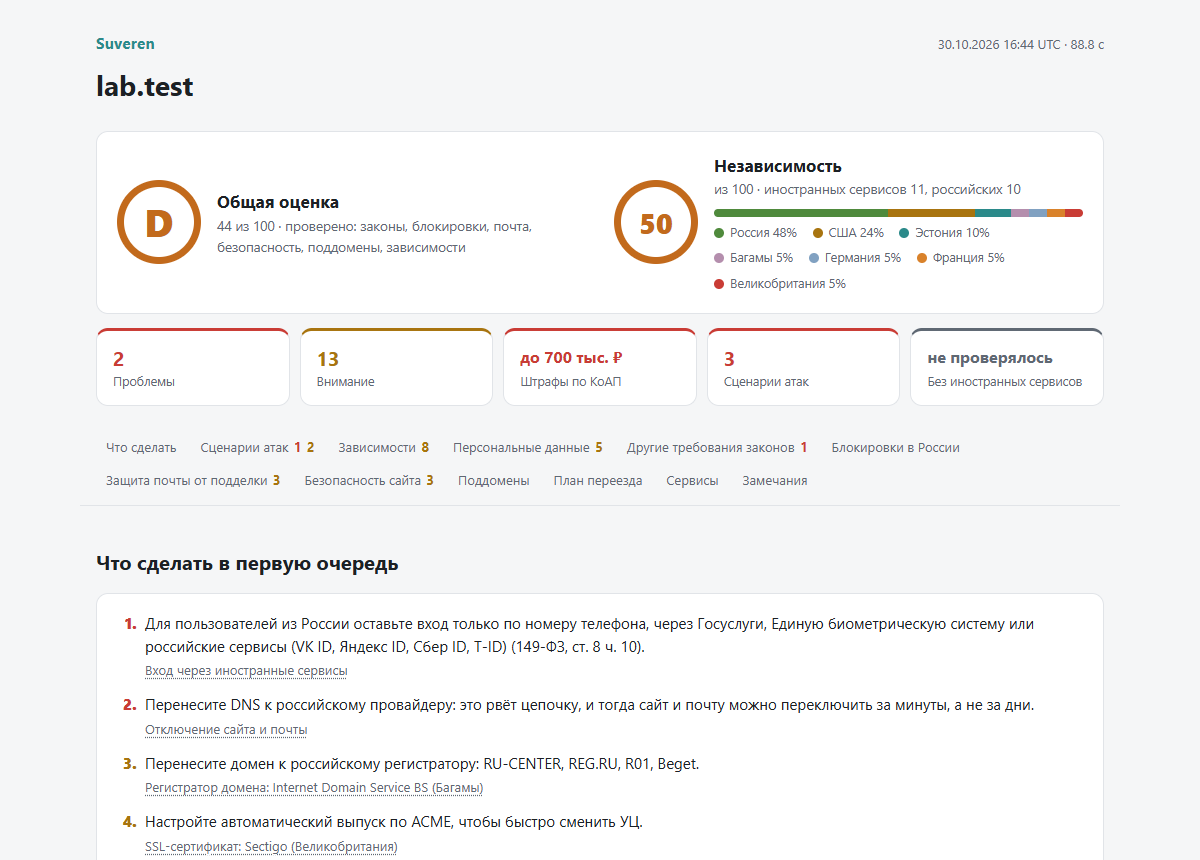
The 152-FZ section, the company check and a summary over a list of sites
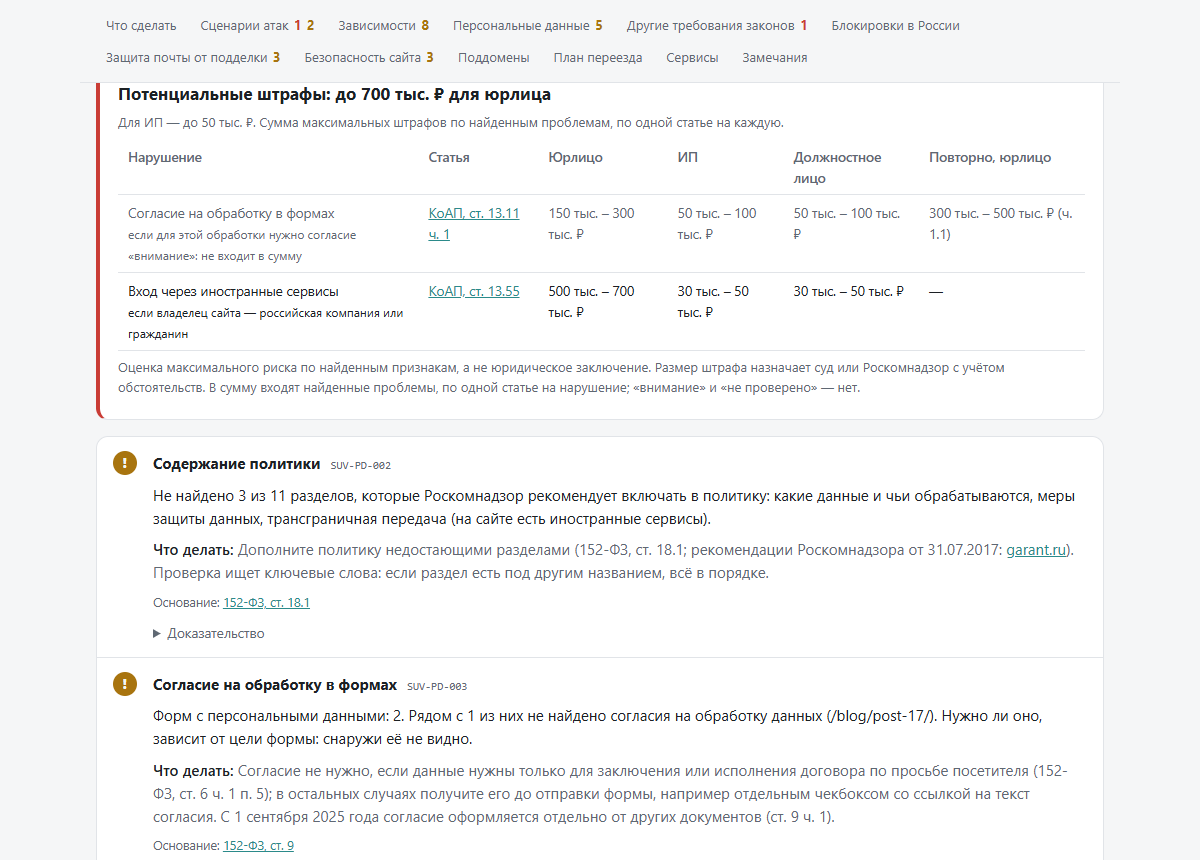
Main commands
suveren scan site.ru                    # regular audit, about 20 seconds
suveren scan site.ru --profile deep     # deep: browser, up to 12 pages, service cut-off
suveren scan site.ru --pdf report.pdf   # plus PDF; --docx for Word, --summary for management
suveren company 7707083893              # a company by INN, OGRN or website
suveren batch sites.txt                 # a list of sites: summary table, CSV, a report each
suveren watch sites.txt --every 24h     # watch sites; changes can go to Telegram
suveren research sites.txt             # a study: only the share of sites with each finding
suveren scan site.ru -v                 # every network step with timings: see where it hangs
suveren scan site.ru --dkim-selector ew # also check your own DKIM selector, not just common ones
All commands and options are in the guide (in Russian) and in
suveren --help and suveren scan --help.
What Suveren does to the site
Mostly Suveren looks at what any visitor sees: public DNS records, open registers and the site's pages. No port scanning, no password guessing.
companyby INN or OGRN never contacts the site: only the state register, other registers and sanctions lists. Given a website, it opens the home page to find the INN there.scanopens the home page and up to 6 inner pages. In two places it probes: it tries the outdated TLS 1.0 and 1.1 and opens pages of subdomains that point to external services. The site sees your IP, as with a normal visit.--browserand--profile deepopen pages in a browser, so the site's JavaScript runs on your computer. The browser is sandboxed and cannot reach your network or download files.--own-sitegoes deeper on your own site:.gitand.envfiles, TLS ciphers, mail servers, and with--form-leaksdata leaking from forms. It runs only after ownership is proven (suveren verify).
For every check, docs/checks.md says what it does to the site and what the
person running it risks. Where data goes with --dns ru is in the
guide; the risks of plugins are in
docs/plugins.md.
In CI
suveren scan example.ru --no-open --sarif suveren.sarif --fail-on fail
SARIF is read by GitHub and GitLab code scanning and DefectDojo. A finding you decided not to fix
yet can be accepted in .suveren-ignore with a reason, an author and a deadline: it stays in the
report but does not fail the build, and counts again after the deadline. More in the
guide.
Data sources and limitations
All sources are open and free, no API keys: DNS, RDAP and WHOIS, the state register, the register
of personal-data operators, the block list export by antifilter.download, certificate
transparency logs, sanctions lists, the retire.js vulnerability database. suveren doctor checks
that they all answer.
The report helps set priorities and is not a legal opinion: every 152-FZ check links to the article of law. Where a check could not be done, Suveren says "not checked" rather than a false "OK". All limitations are in the guide.
Contributing
Adding a service to the database needs no programming: it is the data file
services.json, described in the
guide. Or just open an "Add a service" issue. How the
code is organised and how to run the tests is in CONTRIBUTING.md;
vulnerabilities go by the rules in SECURITY.md.
License
GNU AGPL-3.0 or later, from version 1.1: the code is open, and any modified version, including one run as a service, must be open too. A commercial license is available for closed products and SaaS — see COPYRIGHT. Versions up to 1.0.x remain under MIT.
Related project: ReconLens — passive OSINT reconnaissance of a domain with a security score.
Explore related projects
trimstray/the-book-of-secret-knowledge
A collection of inspiring lists, manuals, cheatsheets, blogs, hacks, one-liners, cli/web tools and more.
257,704 starsHack-with-Github/Awesome-Hacking
A collection of various awesome lists for hackers, pentesters and security researchers
125,254 starsswisskyrepo/PayloadsAllTheThings
A list of useful payloads and bypass for Web Application Security and Pentest/CTF
82,583 starscaddyserver/caddy
Fast and extensible multi-platform HTTP/1-2-3 web server with automatic HTTPS
78,959 stars