
mahimailabs/voicegateway
mahimailabs/voicegateway has 59 GitHub stars and 14 forks. GitHot measured 0 stars in 24 hours. Last checked 2026-11-18 13:00 UTC. Last push 2026-11-16.
What you can do
- Call inspection: transcript, turns, LiveKit events, the agent's spans and reported usage, in one drawer. Opt-in recordings play beside the transcript.
- Turn diagnosis: speech to text, turn detection, model first token, tools and voice first audio on the turn's own clock. Overlapping stages are shown as overlapping, never added up.
- Issues: problems found on many calls become one issue, with the calls as evidence. Resolve, ignore, tag or archive them; a resolved issue that comes back shows as regressed.
- Every LiveKit layer: media server rooms and participants, SIP trunks and call legs, egress and ingress jobs, and agent workers with jobs, load, CPU and memory.
Measured star growth
- in 24h
- 0
- in 7 days
- Collecting history
- in 15 days
- Collecting history
- in 1 month
- Collecting history
Net star changes over overlapping periods, not daily totals. Missing measurements are left blank. Stars measure attention, not software quality.
About
The One Dashboard every Voice Agent needs
AIREADME.md
Original

One call. The whole story.
The open-source profiler for LiveKit voice agents, from the phone line to the model.


VoiceGateway profiles LiveKit voice calls from the phone line to the model. Every call gets one view: the transcript and recording, each turn's timings, the agent's spans, and the media server, SIP, egress and agent workers around it. You see where a call slowed down or went wrong, and which layer did it.
[!NOTE] V1 preview. Self-host the Go backend and console against your own LiveKit project today. Alert delivery and capacity tests are still being built (roadmap). VoiceGateway Cloud, the same product hosted, opens at voicegateway.dev.
Features
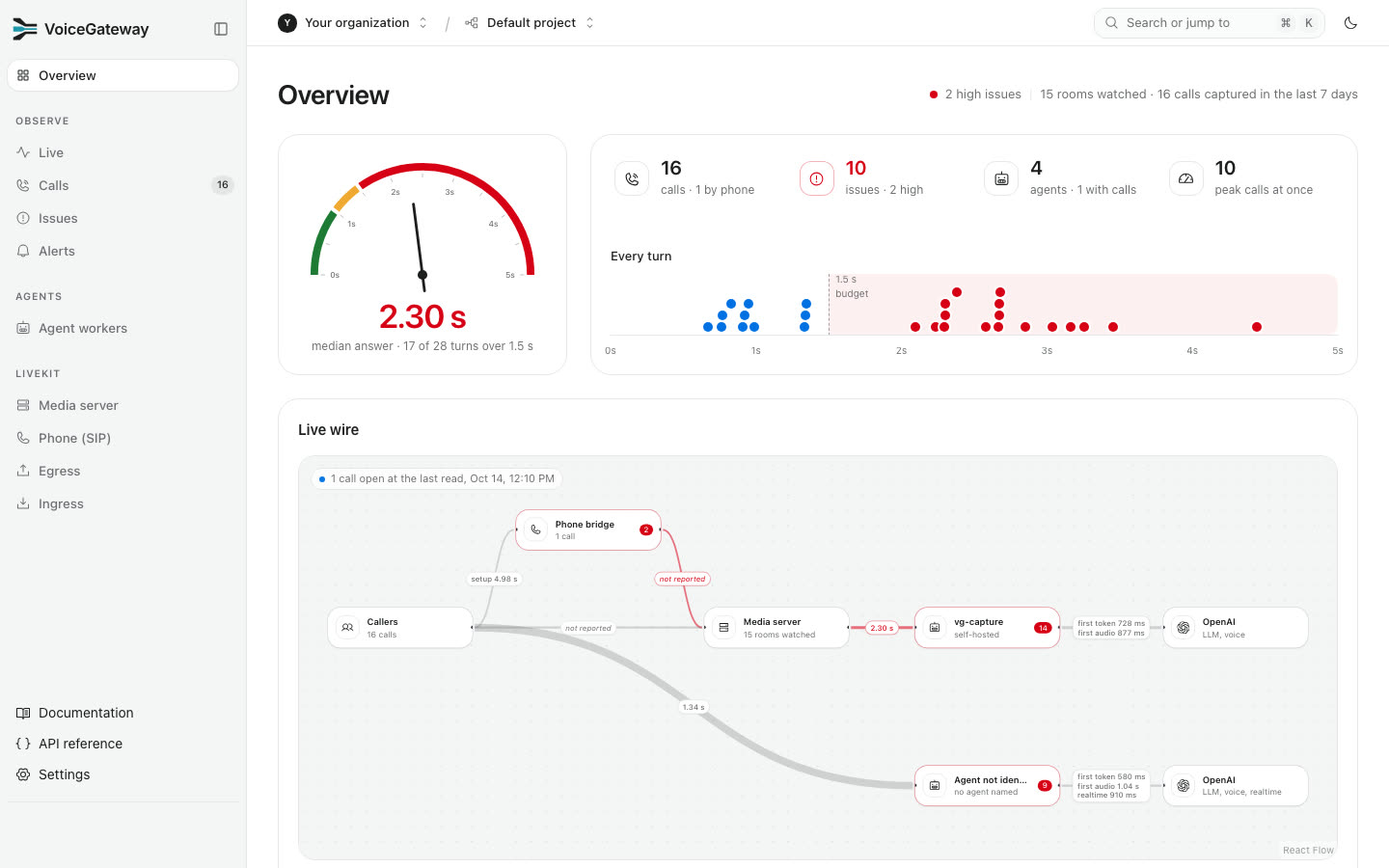
- Call inspection: transcript, turns, LiveKit events, the agent's spans and reported usage, in one drawer. Opt-in recordings play beside the transcript.
- Turn diagnosis: speech to text, turn detection, model first token, tools and voice first audio on the turn's own clock. Overlapping stages are shown as overlapping, never added up.
- Issues: problems found on many calls become one issue, with the calls as evidence. Resolve, ignore, tag or archive them; a resolved issue that comes back shows as regressed.
- Every LiveKit layer: media server rooms and participants, SIP trunks and call legs, egress and ingress jobs, and agent workers with jobs, load, CPU and memory.
- Live: a project-scoped feed pushed from the worker, with stale and disconnected sources marked as such.
- For your team and tools: organisations, roles and invites, Google, GitHub or Auth0 sign-in, project API keys, an MCP server for coding agents, signed embeds for your own pages, and a Python SDK for custom call fields.
- Alerts: seven rules preview on your real calls today; delivery by email and webhook is next.
Unreported measurements stay unknown, never zero. Traces, usage and recordings appear only when the agent sends them.
How it fits
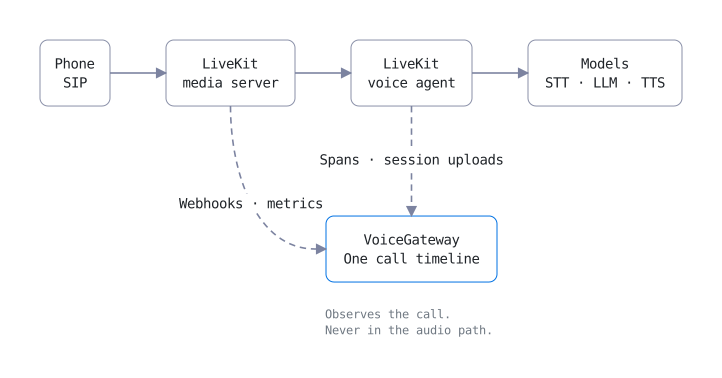
VoiceGateway stays outside the audio path. The V1 platform joins LiveKit webhooks, server metrics, agent spans and session uploads into one call view. If the profiler is unavailable, the agent's call must carry on. See the architecture and capture design.
Components
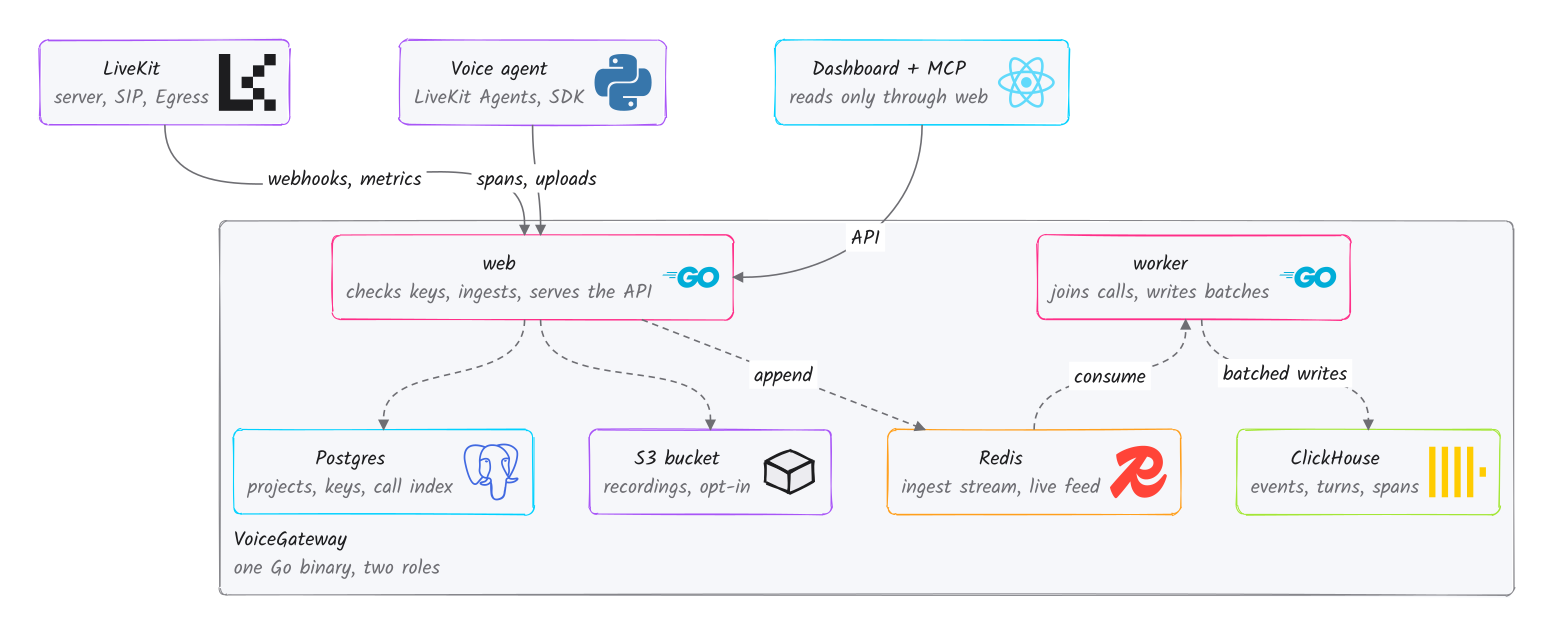
One Go binary runs as web (checks keys, takes data in, serves the API and dashboard) and worker (joins events into calls, writes to ClickHouse). A Redis stream is their only link. Postgres holds projects and keys, ClickHouse everything measured, and your own S3 bucket any recordings. make up starts all six. See ARCHITECTURE.md.
Quickstart
Self-host with Docker, git and make. The installer clones the release, starts the six services and runs the preflight checks:
curl -fsSL https://voicegateway.dev/install.sh | bash
cd voicegateway
make user-add [email protected]
make project-add NAME="Production"   # with LIVEKIT_URL, LIVEKIT_API_KEY and LIVEKIT_API_SECRET set
Sign in at localhost:8080. The Connect your agent panel gives the one variable your agent needs, LIVEKIT_OBSERVABILITY_URL, and the webhook URL for LiveKit. Start the agent session with record=True and place a call. Read the self-hosting guide or try the example agent.
Look around without LiveKit
Run the console on captured LiveKit sessions with Node.js 24 and npm:
git clone https://github.com/mahimailabs/voicegateway.git
cd voicegateway
npm --prefix dashboard ci
make dev
Open localhost:5180, choose Calls and open a call.
Inspect a real turn
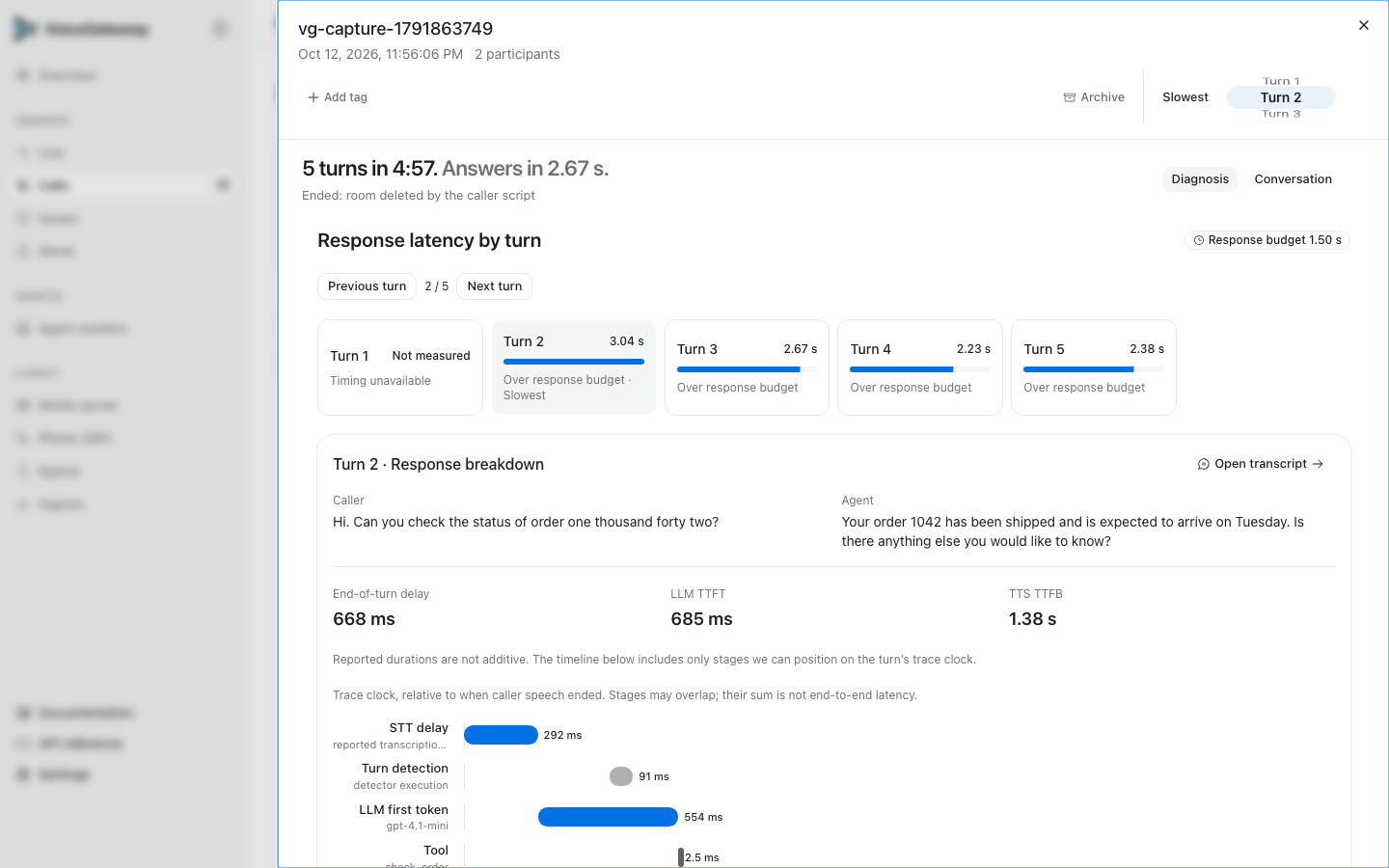
In this captured call, the caller asks for the status of order 1042. Every measured answer is over the 1.5 s budget, and turn 2 is the slowest at 3.04 s. Its breakdown shows where the time went: 1.38 s to the voice's first audio, against 685 ms to the model's first token and a 668 ms end-of-turn delay. That makes the next step specific: the text-to-speech provider before the prompt.
Upgrading from the API token
VOICEGATEWAY_API_TOKEN is gone. Create a key per project with voicegateway key create --org <org> --project <project> --name <name> (or in Settings, Access, API keys), send it as Authorization: Bearer <key>, then delete the variable.
The road to V1
V1 is 32 of 39 tasks done; the roadmap issue lists each one and what is left.
- Self-hosted: runs on your infrastructure today as a preview. Follow Self-hosting.
- VoiceGateway Cloud: the same product hosted, with self-serve sign-up and checkout. Follow voicegateway.dev.
- Next: alert evaluation and delivery, more alert channels, the capacity test runner and a 1,000-call load test.
Current progress · Product scope · Decisions
Contribute
Pick an open issue, agree on scope and open a focused PR against main. Start with CONTRIBUTING.md.
From the repository root:
make test
make lint
These run the Go tests (container tests need Docker) and lint, plus the dashboard tests, lint and TypeScript checks. make up starts the six-service stack.
Community and security
Discord · Report a bug · Contributor code of conduct
Please report vulnerabilities privately using SECURITY.md.
License
Free to self-host. Code outside ee/ uses the MIT license; code inside it uses the Enterprise license. VoiceGateway Cloud hosts the same product. Read the boundary.