
lxa9867/ControlVAR
lxa9867/ControlVAR has 127 GitHub stars and 7 forks. GitHot measured 0 stars in 24 hours, 0 in 7 days, and 0 in 15 days. Last checked 2026-11-17 02:14 UTC. Last push 2024-12-10.
Measured star growth
- in 24h
- 0
- in 7 days
- 0
- in 15 days
- 0
- in 1 month
- Collecting history
Net star changes over overlapping periods, not daily totals. Missing measurements are left blank. Stars measure attention, not software quality.
About
This is the official implementation for ControlVAR.
Creative & MediaREADME.md
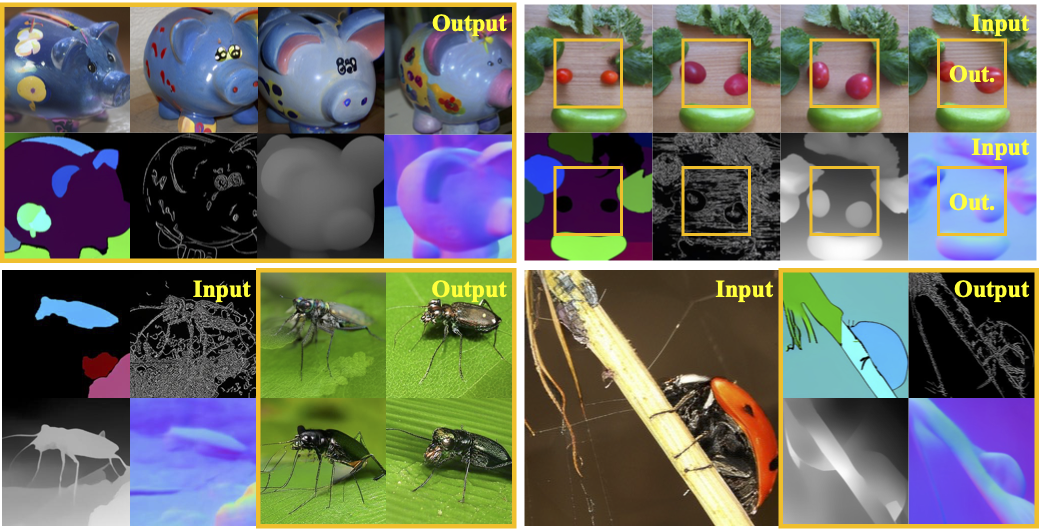
OriginalControlVAR: Exploring Controllable Visual Autoregressive Modeling
Xiang Li, Kai Qiu, Hao Chen, Jason Kuen, Zhe Lin, Rita Singh, Bhiksha Raj

Updates
- (2024-10-10) Try our new image tokenizer ImageFolder🚀 for faster speed🔥, shorter length🔥 and better FID🔥!
- (2024-08-23) We released pretrained checkpoints.
- (2024-07-28) We begin to upload the dataset (~400G) to hugging-face 🤗.
- (2024-07-26) We released the code for Intel HPU training (GPU version is compatible).
- (2024-07-25) Repo created. The code and datasets will be released in two weeks.
Setup
Get pre-trained VQVAE from VAR.
mkdir pretrained
cd pretrained
wget https://huggingface.co/FoundationVision/var/resolve/main/vae_ch160v4096z32.pth
Install required packages.
pip install -r requirements.txt
Dataset
The pseudo-labeled ImageNet dataset (mask, canny, depth, and normal) is available at hugging-face 🤗. Please download the original ImageNet2012 dataset from official website and arrange the files in the following format.
ImageNet2012
├── train
├── val
├── train_canny
├── train_mask
├── train_normal
├── train_depth
├── val_canny
├── val_mask
├── val_normal
└── val_depth
We provide the example function to convert parquet to data for our dataset in huggingface:
# Function to convert Parquet to images or JSON files
def convert_parquet_to_images_or_json(parquet_file_path, output_dir):
    # Read the Parquet file into a DataFrame
    df = pd.read_parquet(parquet_file_path)

    # Iterate over each row in the DataFrame
    for index, row in df.iterrows():
        # Extract the filename and check if it's image or JSON data
        filename = row['filename']

        # Check if 'image_data' column exists in the DataFrame
        if 'image_data' in df.columns:
            image_data = row['image_data']

            # Convert the binary data back to an image
            image = Image.open(io.BytesIO(image_data))

            # Determine the full output path
            full_output_path = os.path.join(output_dir, filename)

            # Create directories if they do not exist
            os.makedirs(os.path.dirname(full_output_path), exist_ok=True)

            # Save the image using the original filename
            image.save(full_output_path)
            print(f"Saved image: {full_output_path}")

        # Check if 'json_data' column exists in the DataFrame
        elif 'json_data' in df.columns:
            json_data = row['json_data']
            json_data = convert_numpy_to_list(json_data)
            # Determine the full output path
            full_output_path = os.path.join(output_dir, filename)

            # Create directories if they do not exist
            os.makedirs(os.path.dirname(full_output_path), exist_ok=True)

            # Save the JSON data to a file
            with open(full_output_path, 'w') as json_file:
                json.dump(json_data, json_file)
            print(f"Saved JSON: {full_output_path}")

        else:
            print(f"Unknown data format in {parquet_file_path}. Skipping row {index}.")

def convert_numpy_to_list(obj):
    """
    Recursively convert numpy arrays in a nested dictionary or list to lists.
    """
    if isinstance(obj, dict):
        return {k: convert_numpy_to_list(v) for k, v in obj.items()}
    elif isinstance(obj, list):
        return [convert_numpy_to_list(elem) for elem in obj]
    elif isinstance(obj, np.ndarray):
        return convert_numpy_to_list(obj.tolist())
    else:
        return obj

# Example usage
parquet_dir = "./downloaded_parquet_files"
output_image_dir = "."
os.makedirs(output_image_dir, exist_ok=True)

# List all Parquet files in the directory
parquet_files = [f for f in os.listdir(parquet_dir) if f.endswith('.parquet')]

# Convert all Parquet files back to images or JSON
for parquet_file in parquet_files:
    parquet_file_path = os.path.join(parquet_dir, parquet_file)
    print(f"Processing {parquet_file_path}...")
    convert_parquet_to_images_or_json(parquet_file_path, output_image_dir)
Pretrained models
| ID | Depth | Joint |
|---|---|---|
| 1 | 12 | d12.pth |
| 2 | 16 | d16.pth |
| 3 | 20 | d20.pth |
| 4 | 24 | d24.pth |
| 5 | 30 | d30.pth |
Train
python3 train_control_var_hpu.py
--batch_size $bs
--dataset_name imagenetC
--data_dir $path_to_ImageNetC
--gpus $gpus
--output_dir $output_dir
--multi_cond True
--config configs/train_mask_var_ImageNetC_d12.yaml
--var_pretrained_path pretrained/var_d12.pth
Inference
python3 train_control_var_hpu.py
--batch_size $bs
--dataset_name imagenetC
--data_dir $path_to_ImageNetC
--gpus $gpus
--output_dir $output_dir
--multi_cond True
--val_only True
--resume $ckpt_path
Citation
If our work assists your research, feel free to give us a star ⭐ or cite us using:
@article{li2024controlvar,
  title={ControlVAR: Exploring Controllable Visual Autoregressive Modeling},
  author={Li, Xiang and Qiu, Kai and Chen, Hao and Kuen, Jason and Lin, Zhe and Singh, Rita and Raj, Bhiksha},
  journal={arXiv preprint arXiv:2406.09750},
  year={2024}
}