
lizhuoq/WeatherLearn
lizhuoq/WeatherLearn has 99 GitHub stars and 25 forks. GitHot measured 0 stars in 24 hours and 0 in 7 days. Last checked 2026-11-18 08:56 UTC. Last push 2026-09-28.
Measured star growth
- in 24h
- 0
- in 7 days
- 0
- in 15 days
- Collecting history
- in 1 month
- Collecting history
Net star changes over overlapping periods, not daily totals. Missing measurements are left blank. Stars measure attention, not software quality.
About
Implementation of the PyTorch version of the Weather Deep Learning Model Zoo.
Machine LearningREADME.md
OriginalWeatherLearn

Dependencies
python = "^3.11"
torch = ">=2.1.0"
timm = ">=0.9.10"
numpy = ">=1.23.5"
cdsapi = ">=0.6.1"
Install (editable):
pip install -e .
# or with Poetry after `poetry lock` / `poetry install`
Run unit tests (skips full Pangu() unless WEATHERLEARN_RUN_HEAVY=1):
python -m unittest discover -s tests -v
Model-zoo
Pangu-Weather
Model Architecture
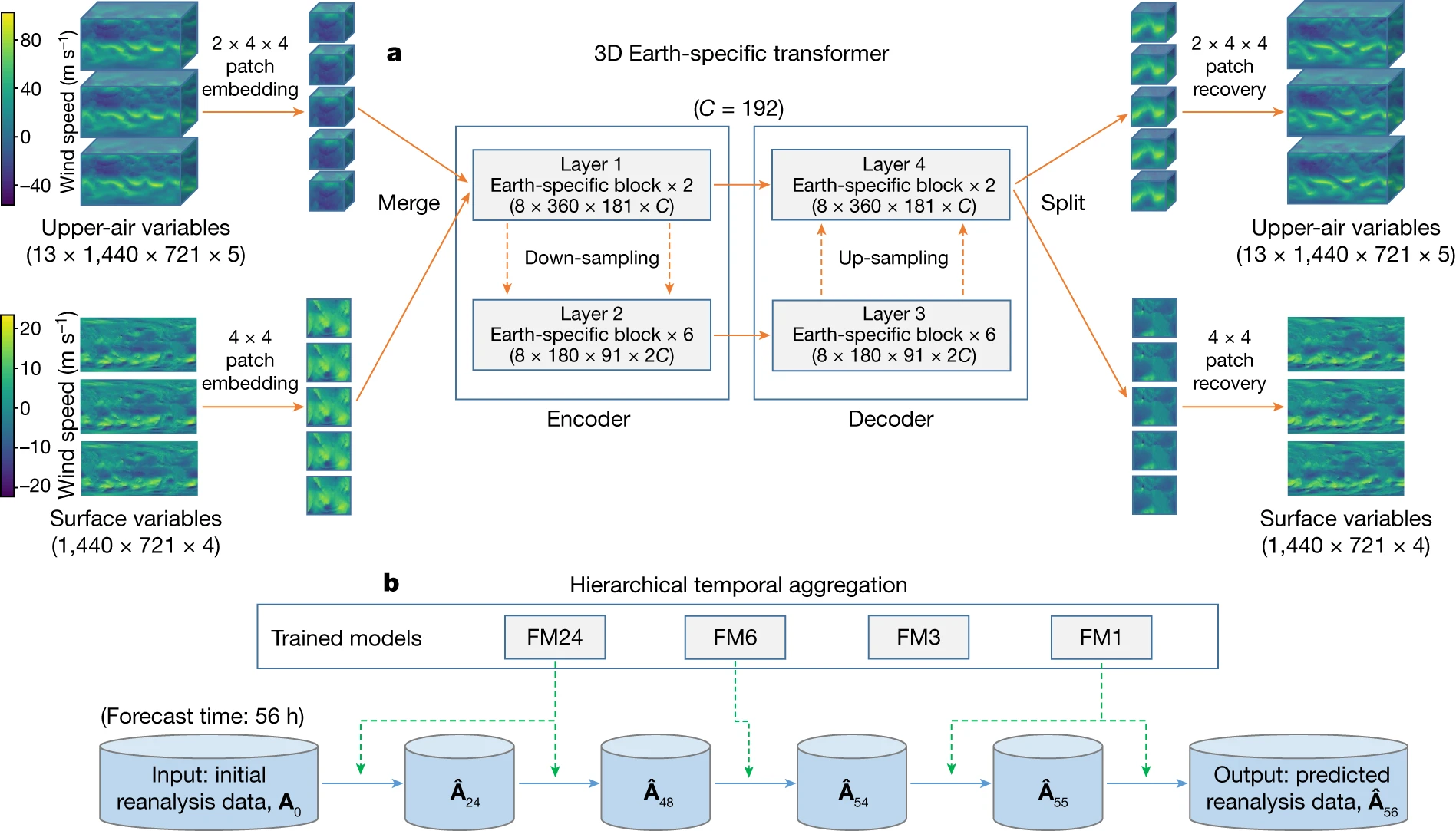
Example
# Pangu
from weatherlearn.models import Pangu

import torch

if __name__ == '__main__':
    B = 1  # batch_size
    surface = torch.randn(B, 4, 721, 1440)  # B, C, Lat, Lon
    surface_mask = torch.randn(3, 721, 1440)  # topography mask, land-sea mask, soil-type mask
    upper_air = torch.randn(B, 5, 13, 721, 1440)  # B, C, Pl, Lat, Lon

    pangu_weather = Pangu()

    output_surface, output_upper_air = pangu_weather(surface, surface_mask, upper_air)
# Pangu_lite
from weatherlearn.models import Pangu_lite

import torch

if __name__ == '__main__':
    B = 1  # batch_size
    surface = torch.randn(B, 4, 721, 1440)  # B, C, Lat, Lon
    surface_mask = torch.randn(3, 721, 1440)  # topography mask, land-sea mask, soil-type mask
    upper_air = torch.randn(B, 5, 13, 721, 1440)  # B, C, Pl, Lat, Lon

    pangu_lite = Pangu_lite()

    output_surface, output_upper_air = pangu_lite(surface, surface_mask, upper_air)
References
@article{bi2023accurate,
  title={Accurate medium-range global weather forecasting with 3D neural networks},
  author={Bi, Kaifeng and Xie, Lingxi and Zhang, Hengheng and Chen, Xin and Gu, Xiaotao and Tian, Qi},
  journal={Nature},
  volume={619},
  number={7970},
  pages={533--538},
  year={2023},
  publisher={Nature Publishing Group}
}
@article{bi2022pangu,
  title={Pangu-Weather: A 3D High-Resolution Model for Fast and Accurate Global Weather Forecast},
  author={Bi, Kaifeng and Xie, Lingxi and Zhang, Hengheng and Chen, Xin and Gu, Xiaotao and Tian, Qi},
  journal={arXiv preprint arXiv:2211.02556},
  year={2022}
}
Fuxi
Model Architecture
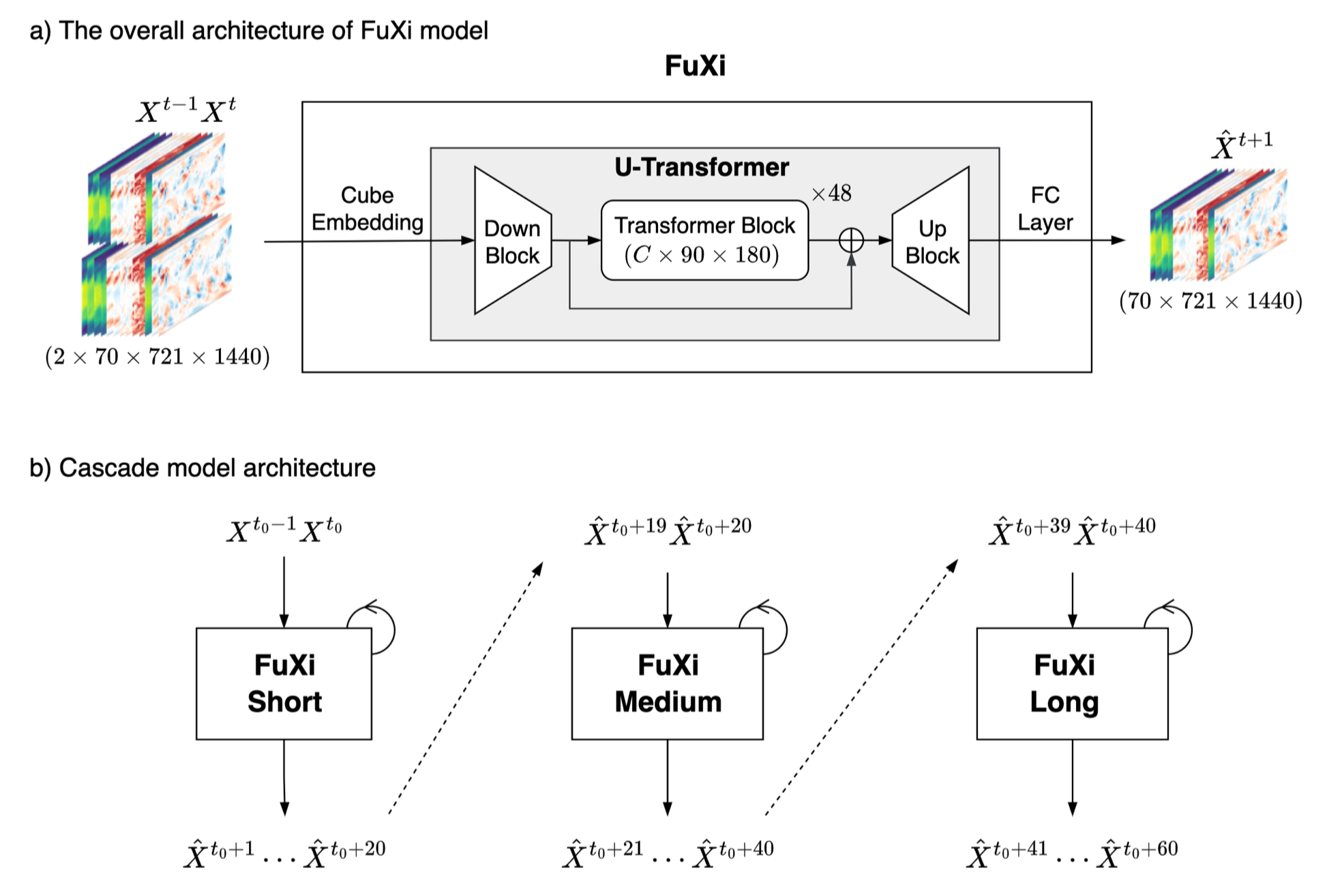
Example
from weatherlearn.models import Fuxi

import torch

if __name__ == '__main__':
    B = 1  # batch_size
    in_chans = out_chans = 70  # number of input channels or output channels
    input = torch.randn(B, in_chans, 2, 721, 1440)  # B C T Lat Lon

    fuxi = Fuxi()
    # patch_size : Default: (2, 4, 4)
    # embed_dim : Default: 1536
    # num_groups : Default: 32
    # num_heads : Default: 8
    # window_size : Default: 7
    # depth : Default: 48  (U-Transformer Swin blocks; reduce for lite smoke)

    output = fuxi(input)  # B C Lat Lon
Last layer matches the paper: Linear patch FC → reshape to 720×1440 → bilinear interpolate to 721×1440. See docs/fuxi_last_layer.md (clarifies Issue #8).
References
FuXi: A cascade machine learning forecasting system for 15-day global weather forecast
Published on npj Climate and Atmospheric Science: FuXi: a cascade machine learning forecasting system for 15-day global weather forecast
by Lei Chen, Xiaohui Zhong, Feng Zhang, Yuan Cheng, Yinghui Xu, Yuan Qi, Hao Li
FengWu
Multi-modal encode–fuse–decode (arXiv:2304.02948). Default 13 levels / 69 channels (OpenEarthLab practical); paper 37 levels / 189 channels via n_levels=37.
from weatherlearn.models import FengWu, FengWu_lite
import torch

# Lite (smoke / small grid). ARCO 128x64 zarr is transposed to Lat×Lon (64, 128).
model = FengWu_lite()  # img_size=(64, 128), n_levels=13 → C=69
x = torch.randn(1, 69, 64, 128)
y = model(x)  # [1, 69, 64, 128]

# Optional uncertainty head (mean, log_var)
model_u = FengWu_lite(predict_uncertainty=True)
mean, log_var = model_u(x)
Train smoke (public GCS ERA5): python examples/fengwu/train_smoke_gcs.py
TODO
- FengWu Model (https://arxiv.org/pdf/2304.02948v1.pdf) — see
weatherlearn/models/fengwu,examples/fengwu/ - FuXi Model (https://arxiv.org/pdf/2306.12873v3.pdf)
- Set a separate window_size for longitude and latitude in the Fuxi model.
- Add more unittest.
- Infer the Pangu model using the pre-trained weights provided by the official Pangu repository.