
liuruoze/mini-AlphaStar
liuruoze/mini-AlphaStar has 371 GitHub stars and 63 forks. GitHot measured 0 stars in 24 hours. Last checked 2026-11-10 03:08 UTC. Last push 2026-11-04.
(JAIR'2022) A mini-scale reproduction code of the AlphaStar program. Note: the original AlphaStar is the AI proposed by DeepMind to play StarCraft II. JAIR = Journal of Artificial Intelligence Research.
Measured star growth
- in 24h
- 0
- in 7 days
- Collecting history
- in 15 days
- Collecting history
- in 1 month
- Collecting history
Net star changes over overlapping periods, not daily totals. Missing measurements are left blank. Stars measure attention, not software quality.
README.md
Originalmini-AlphaStar
Introduction
The mini-AlphaStar (mini-AS, or mAS) project is a mini-scale version of the AlphaStar (AS) program. AlphaStar is the intelligent AI proposed by DeepMind to play StarCraft II. Note the mini-AS is a research project. It is not an official product of DeepMind.
The "mini-scale" means making the original AS's hyper-parameters adjustable so that we can train mini-AS on a small scale, e.g., in a single common commercial server machine.
We referred to the "Occam's Razor Principle" when designing the mini-AS: simple is good. Therefore, we build the mini-AS from scratch. Unless the function significantly impacts speed and performance, we shall omit it. Meanwhile, we also try not to use too many dependency packages so that mini-AS should only depend on the PyTorch. In this way, we simplify the learning cost of the mini-AS and make the architecture of mini-AS relatively easy.
The Chinese shows a simple readme in Chinese; it now also carries a Chinese version of the 2026-11 branch note below (section 「2026-11 改进(评估分支说明)」).
Branch note (2026-11): two evaluation campaigns on this branch
This tree is an evaluation branch. It carries (a) the earlier batch acting experiment and (b) a four-day SL/RL improvement campaign. Both produced results that are partly positive and partly negative; both are reported as measured, not as claims.
Part 1 — batch acting (earlier work)
The performance result is negative. At the default production configuration (15 Workers x 2 actors, 3x RTX 4090), batch acting is 6.3% slower than local inference: 107.03 vs 100.69 step/s, measured over 1800 s each, with the model mode (
eval) and every other knob held identical. Batching only pays off when the actor count is large: ~0.96x at 2 actors, ~2.55x at 24 actors.One correctness result is positive and independent of performance. The distillation term in
alphastarmini/core/rl/rl_algo.py::klwas a masked partial sum over the common support, not a KL: it can be negative, and onaction_typeit is 23.6x larger than the true KL (0.4999 vs 0.0212 on one real batch). A corrected, renormalized implementation is available viaMAS_KL_MODE=renorm; the default deliberately stayslegacyuntil an ablation decides it.Part 2 — SL/RL improvement campaign (2026-11-02 → 11-04)
Result in one line. SL was raised from "0% win rate, collects 2,676 resources" to "4.3% win rate, collects 9,010 resources (95% of the official 2021 SL model)". It did not reach the official SL win rate (17.5%). The RL loop was then brought up from "never executed" to "runs, collects trajectories, trains, and logs every loss", but its win rate did not move within the one-hour budget.
Stage Model n Win rate (Wilson 95%) Collected Killed Army baseline old SL (1/60 data silently) 20 0.0% 2,676 145 — SL (this branch) SOUP_prior3230 4.3% [2.4, 7.8] 9,010 1,439 21.2 reference official SL sl_21-12-2980 17.5% [10.7, 27.3] 9,494 1,811 14.0 reference official RL rl_22-02-0928 21.4% 9,533 1,787 — Two reference numbers were themselves corrected during this work: the official SL win rate had been quoted as 7.1% for many rounds; re-measuring the same checkpoint over 80 games gives 17.5% [10.7, 27.3]. The old 7.1% was a 28-game point estimate. Every "we caught up" claim made against 7.1% was therefore void — see the errata list in the local working notes (not shipped with this repository, see the note below).
Three structural defects were found and fixed (each one explained a symptom that had been mis-attributed to hyper-parameters for several rounds):
- Silent data down-scaling.
SIMPLE_TEST = not P.on_serverplusreplay_files[:2]meant that forgetting one environment variable made a 2.5-hour training run use 1 replay out of 60 (train_set = 120sequences). Fixed by making smoke mode explicit (MAS_SL_SMOKE=1) and printing[SL-config] files=… smoke=…on the first screen.- Action distribution distorted by frame sampling. The converter samples by a fixed frame stride (~every 20 frames) while the agent issues one command every 8 frames, so most sampled frames are labelled
no_op: the training data is 81.0%no_op, 2.7%Build_Pylon, 1.1%Train_Probe, while the official model plays with 0%no_op, 29.8%Build_Pylon, 21.1%Train_Probe. The model was a faithful mirror of its data: it idled 99.9% of the time. Fixed by action re-weighting (importance weightsw[a] = clip((target[a]/data[a])**1.0, 0.1, 50)on theaction_typehead), which brought liveno_opfrom 37% to 6.7%.- Weight checkpoint selection by validation accuracy was inverted.
val action accrewards conservatism: epoch 3 had val 0.44 but idled only 50% of the time, epoch 10 had val 0.83 but idled 96.8%. Model selection must use behaviour (killed, idle ratio, win rate), not action-classification accuracy.One zero-cost trick that worked twice: weight-space averaging. Averaging the weights of adjacent epochs from the same run (
experiments/_avg_models.py) raised the kill ceiling from 2,550 to 6,900 and the win rate from 1.9% to 5.1% at n=158 (and 4.3% at n=230 after more samples). Averaging more snapshots (5 instead of 3) is worse: the aggressive epoch gets diluted.Negative results are listed too, because they cost the most time: more data (3.7x) hurt the army; training longer made the policy conservative again; attack re-weighting (1.5x and 3.0x),
units/locationre-weighting (10x/5x), filtering replays by combat density, and fine-tuning from the averaged model all failed. Seedoc/IMPROVEMENTS_2026_11.md§5 for the complete table, and the local working notes (ERRATA.md— not shipped with this repository) for every claim that was later withdrawn.Part 3 — RL loop status: runs, and the bug that looked like a deadlock
The A3C loop (
rl_vs_inner_bot_mp) had never been executed before this campaign. Bringing it up required eight fixes:MAS_RL_INIT_MODEL(it silently loaded a deliberately-broken SL checkpoint), a configurable win-rate window, a zero-row statistics crash, a heartbeat, a spawn/subprocess constants mismatch, un-gated debug prints, a per-episode frame cap that shrank with the time budget, and — the decisive one — the result consumer killing itself.What a clean run looks like now (soak #5):
1503.9 s (25 min)   4/4 processes alive   12 episodes completed
[agent_4] steps=5720 | 吞吐 3.80 step/s (mode=local)
Parameter_Server end:
== done ==                                 <- exits on its own at the wall clock

tensorboard:
  loss/learner_0                     n=204   last=-0.0028
  learner_0/loss_upgo_               n=204   -0.0029 ~ 0.1799
  learner_0/all_kl_loss_action_type_ n=204    0 ~ 0.0009
  winrate/every_2_episodes           n=3      0.0 / 0.0 / 0.0
  meanpoints/every_2_episodes        n=3      0.0344 -> 0.1781 -> 0.1750
The decisive bug (#57) was not a lock and not CUDA.
Parameter_Serverwas written asoutcome = q_winloss.get(timeout=600) # queue.Empty -> fall through to `except` -> exitAn episode takes 800–1300 s (2250 env steps at ~2–4 steps/s). So the only consumer of results declared itself dead after 10 minutes, while the actors kept playing. Results piled up (
q_winloss = 6, 7, 8 …) and nothing was ever written to tensorboard. On the surface this is indistinguishable from a deadlock — which is why the first two diagnoses went to locks and shared memory and were both wrong. Fixed by treatingqueue.Emptyas "this episode has not finished yet" and continuing as long as the parent process is alive; the real exit conditions are the sentinel from the reaper thread and parent death.Two observation bugs made this hard to see, and both are worth recording:
- #53 —
python run_rl.py > log.txtgives the Python parent and 6–8 SC2 children the same file descriptor with independent offsets, so they overwrite each other. "The heartbeat stopped at t = N" was partly an artefact. Use>>or one file per process.- #54/#55/#56 — the diagnosis only converged after adding three channels that share no fd: a heartbeat file, a per-actor step trace, and
faulthandler. The actor trace is what proved "the actors are fine, the consumer is gone";faulthandlerwriting zero stacks is what ruled out a C-level crash.Soak status at hand-off — one clean run, one regression, stated together:
- soak #5: 25 minutes clean — 1503.9 s, 4/4 processes, 12 episodes,
q_winlossnever accumulated,== done ==on its own.- soak #6 (the 50-minute follow-up): froze at step 200. All six actor traces stopped at the same step, the heartbeat file stopped at t = 60 s, all 5 processes were still alive and
faulthandlerrecorded zero stacks. That is a genuine global stall, not a logging artefact, and it is a different failure from #57 (there the producers kept running while the consumer had died; here the producers stopped too).So a 30–60 minute soak is not proven. What is proven is that the algorithm chain is correct and that a 25-minute run can now complete end-to-end with full statistics. The next diagnostic step is
py-spy dumpon the stalled process group — that was the one tool missing here, and it would identify the blocked frame in seconds.Win rate did not move (0/12). With a 4.3% starting policy, 12 losses are expected 59% of the time, so this is not evidence of failure — but it is not evidence of learning either.
meanpointsrising 0.034 → 0.178 over the same 12 episodes is a live reward signal, not a proven improvement.
How this was done (human-in-the-loop, multiple agents)
This campaign was run by one human supervisor directing several LLM agents, not by a single autonomous model:
Role Who What they actually did Supervisor / repository owner Ruo-Ze Liu ( liuruoze)Set the goal each round, supplied the official 2021/2022 checkpoints and the missing 30 replays, corrected wrong directions (e.g. pointed at the official model release when an agent was guessing), enforced a "reflection → plan → log" discipline, and rejected claims that were not backed by measurements Executor (this campaign) DeepSeek-V4.1-Flash Ran the experiments end-to-end: static audits, training/evaluation jobs, instrumentation, and the write-ups numbered #23–#52 in BATCH_ACTING_EXECUTION_LOG_DS12.mdCode review (earlier rounds) GLM (#1–#22), Kimi 3.1 Pro, MiniMax H3.1, space-bunny Reviewed diffs, challenged conclusions, and in several cases caught errors that the executor had already written down as conclusions (see ERRATA.md, a local working note not shipped here: 78 entries, including 5 that were withdrawn by the executor itself)Two habits made the difference, and both came from the supervisor: (a) every claim must carry a falsifiable criterion and a measured number, and (b) every withdrawn claim goes into an errata file rather than being quietly deleted. Most of the "discoveries" in this branch were preceded by a wrong guess that the errata records.
The working notes — 30+ documents of run logs, plans, reviews and
ERRATA.md(the errata list cited above) — are deliberately kept out of this repository; they contain machine-specific paths. AnyERRATA.md/BATCH_ACTING_EXECUTION_LOG_*.mdreference in this branch points to those unpublished notes, not to a file you can open here. Treat every number above as one measured snapshot on one machine (4x RTX 4090, 128 cores), not as a reproduced benchmark.Acceptance tests / benchmarks / soak orchestration live in
experiments/and are not part of the library.Reproducing the reported SL number
# 1) train: 20 replay files x 2 epochs, action re-weighting on, 30 replay-epochs total
MAS_ON_SERVER=1 MAS_SL_MAX_FILES=20 MAS_SL_WORKERS=0 MAS_SL_EPOCHS=2 \
MAS_SL_ACTION_REWEIGHT=1 MAS_SL_PRIOR_EXP=1.0 \
CUDA_VISIBLE_DEVICES=0 python run_sl.py --path1 ./data/replay_data_v3/

# 2) average the checkpoints of the same run (zero extra training)
python experiments/_avg_models.py \
  --a model/<run>_ep01.pth --b model/<run>_ep02.pth --more model/<other-run>_ep03.pth \
  --out model/BEST_SL.pth

# 3) evaluate, 4 shards x N games, native outcome only
MAS_ON_SERVER=1 python experiments/_eval_winrate.py \
  --model model/BEST_SL.pth --games-per-shard 15 --shards 4 --gpus 0,1,2,3
Reproducing the RL loop
# one hour, 8 actors, explicit SL initialisation, heartbeat every 60 s
MAS_ON_SERVER=1 MAS_RL_INIT_MODEL=model/BEST_SL.pth \
MAS_MAX_TIME=3000 MAS_ACTOR_NUMS=2 MAS_PARALLEL=4 \
MAS_STATIC_NUM=4 MAS_HEARTBEAT_SEC=60 MAS_QUEUE_TIMEOUT=900 \
MAS_GPU_LIST=1,2,3 CUDA_VISIBLE_DEVICES=0,1,2,3 python -u run_rl.py
MAS_RL_INIT_MODELis not optional in practice: without it the loader picks the lexicographically lastsl_*.pthinmodel/, which during this campaign was a deliberately broken checkpoint.
Below 4 GIFs are mini-AS' trained performance on Simple64, supervised learning on 50 expert replays.

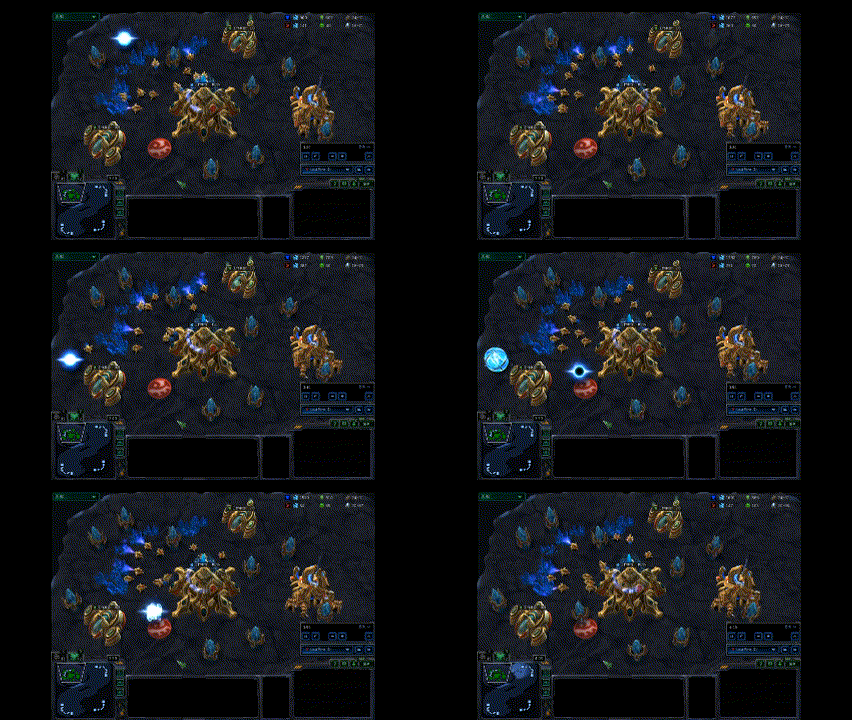
Left: At the start of the game. Right: In the middle period of the game.
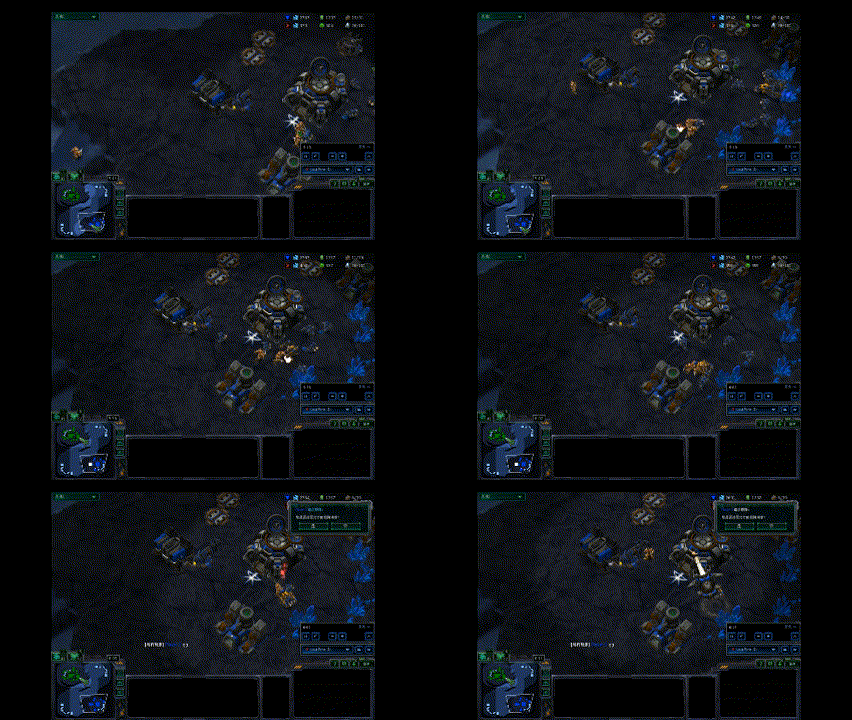
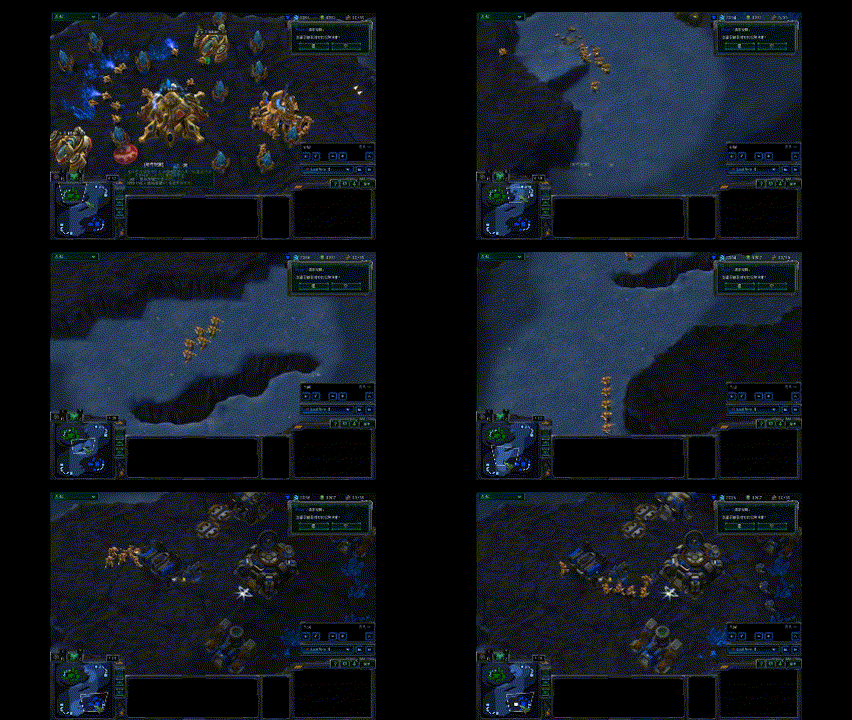
Left: The agent's 1st attack. Right: The agent's 2nd Attack.
Update
This release is the "v_1.09" version. The main changes are as follows:
- Fixed some known bugs and issues;
- Improve to a new SL setting to train a good SL model more likely;
- Change STEP_MUL to 8 to gain more good RL training results;
- Add logs for all the losses in the RL training to gain better information about the process;
- Increase the win rate against level-1 bot to 0.85 (the best so far);
- For the first time, provide the pre-trained SL model for RL training to use;
- For the first time, provide the final RL model for others to reproduce the results easily;
Hints
Warning: SC2 is extremely difficult, and AlphaStar is also very complex. Though our project is a mini-AlphaStar, it has almost the similar technologies as AS, and the training resource also costs very high. We can hardly train mini-AS on a laptop. The recommended way is to use a commercial server with a GPU card plus large memory and disk space. For someone interested in this project for the first time, we recommend you collect (star) this project. Devolve deeply into researching it only when you have enough free time and training resources.
Location
We store the codes and show videos in two places.
| Codes location | Result video location | Usage |
|---|---|---|
| Github | Youtube | for global users |
| Gitee | Bilibili | for users in China |
Contents
The table below shows the corresponding packages in the project.
| Packages | Content |
|---|---|
| alphastarmini.core.arch | deep neural architecture |
| alphastarmini.core.sl | supervised learning |
| alphastarmini.core.rl | reinforcement learning |
| alphastarmini.core.ma | multi-agent league traning |
| alphastarmini.lib | lib functions |
| alphastarmini.third | third party functions |
Requirements
PyTorch >= 1.5, others please see requirements.txt.
Install
The SCRIPT Guide gives some commands to install PyTorch by conda (this will automatically install CUDA and cudnn, which is convenient).
E.g., like (to install PyTorch 1.5 with accompanied CUDA and cudnn):
conda create -n th_1_5 python=3.7 pytorch=1.5 -c pytorch
Next, activate the conda environment, like:
conda activate th_1_5
Then you can install other python packages by pip, e.g., the command in the below line:
pip install -r requirements.txt
Usage
After you have done all requirements, run the below python file to run the program:
python run.py
You may use comments and uncomments in "run.py" to select the training process you want.
The USAGE Guide provides answers to some problems and questions.
You should follow the following instructions to get similar or better results than the provided gifs on the main page.
We summarised the usage sequences as the following:
- Transform replays: download the replays for training, then use the script in mAS to transform the replays to trainable data;
- Supervised learning: use the trainable data to supervise learning an initial model;
- Evaluate SL model: the trained SL model should be evaluated on the RL environment to make sure it behaves right;
- Reinforcement learning: use the trained SL model to do reinforcement learning in the SC environment, seeing the win rate starts growing.
We give detailed descriptions below.
Transofrm replays
In supervised learning, you first need to download SC2 replays.
The REPLAY Guide shows a guide to download these SC2 replays.
The ZHIHU Guide provides Chinese users who are not convenient to use Battle.net (outside China) a guide to download replays.
After downloading replays, you should move the replays to "./data/Replays/filtered_replays_1" (you can change the name in transform_replay_data.py).
Then use transform_replay_data.py to transform these replays to pickles or tensors (you can change the output type in the code of that file).
You don't need to run the transform_replay_data.py directly. Only run "run.py" is OK. Make the run.py has the following code
    # from alphastarmini.core.sl import transform_replay_data
    # transform_replay_data.test(on_server=P.on_server)
uncommented. Then you can directly run "run.py".
Note: To get the effect of the trained agent in the gifs, use the replays in Useful-Big-Resources. These replays are generatedy by our experts, to get an agent having the ability to win the built-in bot.
Supervised learning
After getting the trainable data (we recommend using tensor dat). Make the run.py has the following code
    # from alphastarmini.core.sl import sl_train_by_tensor
    # sl_train_by_tensor.test(on_server=P.on_server)
uncommented. Then you can directly run "run.py" to do supervised learning.
The default learning rate is 1e-4, and the training epochs should best be 10 (more epochs may cause the training effect overfitting).
From the v_1.05 version, we support multi-GPU supervised learning (not recommended now) training for mini-AS, improving the training speed. The way to use multi-GPU training is straightforward, as follows:
python run_multi-gpu.py
Multi-GPU training has some unstable factors (caused because of PyTorch). If you find your multi-GPU training has training instability errors, please switch to the single-GPU training.
We currently support four types of supervised training, which all reside in the "alphastarmini.core.sl" package.
| File | Content |
|---|---|
sl_train_by_pickle.py |
pickle (data not preprocessed) training: Slow, but need small disk space. |
sl_train_by_tensor.py |
tensor (data preprocessed) training: Fast, but cost colossal disk space. |
sl_multi_gpu_by_pickle.py |
multi-GPU, pickle training: It has a requirement need for large shared memory. |
sl_multi_gpu_by_tensor.py |
multi-GPU, tensor training: It needs both large memory and large shared memory. |
You can use the load_pickle.py to transform the generated pickles (in "./data/replay_data") to tensors (in "./data/replay_data_tensor").
From the v_1.06 version, we still recommend using single-GPU training.
The newest training ways (e.g., in v_1.07) are still in the single GPU type due to multi-GPU training cost too much memory.
Evaluate SL model
After getting the supervised learning model, we should test the model's performance in the SC2 environment. The reason is that there is a domain shift from the SL data to the RL environment.
Make the run.py has the following code
    # from alphastarmini.core.rl import rl_eval_sl
    # rl_eval_sl.test(on_server=P.on_server)
uncommented. Then you can directly run "run.py" to do an evaluation of the SL model.
The evaluation is similar to RL training, but the updating is closed. The running is also in single-thread, to make the randomness due to multi-thread not affect the evaluation.
Reinforcement learning
After ensuring the supervised learning model is OK and suitable for RL training, we can do RL based on the learned supervised learning model.
Make the run.py has the following code
    # from alphastarmini.core.rl import rl_vs_inner_bot_mp
    # rl_vs_inner_bot_mp.test(on_server=P.on_server, replay_path=P.replay_path)
uncommented. Then you can directly run "run.py" to do reinforcement learning.
Note RL training uses a multi-process plus multi-thread manner (to accelerate the learning speed), so make sure to run these codes on a high-performance computer.
E.g., we run 15 processes, and each has two actor threads and one learner thread. If your computer is not strong, reduce the parallel nums.
The learning rate should be low (below 1e-5 because you are training on an initially trained model). The training iterations should be as long as best (more training iterations can reduce the instability of RL training).
If you find the training result is not good as you imagine, please open an issue to ask us or discuss with us (though we can not make sure to respond to it in time or there is any solution to every problem).
Pre-trained Models
You can find the pre-trained models here.
The "sl_21-12-29_08-15-43.pth" is the supervised learning pre-trained model by our method.
The "rl_22-02-07_16-26-48.pth" is the reinforcement learning trained model by our method based on the previous model.
The "rl_22-02-09_19-16-39.pth" is the reinforcement learning (more time) final model by our method based on the previous supervised learning model.
Results
Here are some illustration figures of the SL training process below:

We can see the loss (one primary loss and six argument losses) fall quickly.
We provide more curves (like the accuracy curve) for the SL training process after the v_1.05 version.
The trained behavior of the agents shows in the gifs on this page.
Our later paper will provide a more detailed illustration of the experiments (such as the effects of different hyper-parameters).
History
The HISTORY is the historical introduction of the previous versions of mini-AS.
Citing
If you find our repository useful, please cite our project or the below technical report:
@misc{liu2021mAS,
  author = {Ruo{-}Ze Liu and Wenhai Wang and Yang Yu and Tong Lu},
  title = {mini-AlphaStar},
  year = {2021},
  publisher = {GitHub},
  journal = {GitHub repository},
  howpublished = {\url{https://github.com/liuruoze/mini-AlphaStar}},
}
The An Introduction of mini-AlphaStar is a technical report introducing the mini-AS (not full version).
@article{liu2021mASreport,
  author    = {Ruo{-}Ze Liu and
               Wenhai Wang and
               Yanjie Shen and
               Zhiqi Li and
               Yang Yu and
               Tong Lu},
  title     = {An Introduction of mini-AlphaStar},
  journal   = {CoRR},
  volume    = {abs/2104.06890},
  year      = {2021},
}
Rethinking
The Rethinking of AlphaStar is our thinking of the advantages and disadvantages of AlphaStar.
Paper
We present detailed experiments and evaluations using the mini-AS in this paper.
Explore related projects
tensorflow/tensorflow
An Open Source Machine Learning Framework for Everyone
201,427 starshuggingface/transformers
🤗 Transformers: the model-definition framework for state-of-the-art machine learning models in text, vision, audio, and multimodal models, for both inference and training.
168,711 starsAUTOMATIC1111/stable-diffusion-webui
Stable Diffusion web UI
165,274 starsComfy-Org/ComfyUI
The most powerful and modular diffusion model GUI, api and backend with a graph/nodes interface. The fastest local inference engine in the world.
146,024 stars