
litedb-org/LiteDB
litedb-org/LiteDB has 9,492 GitHub stars and 1,324 forks. GitHot measured 0 stars in 24 hours. Last checked 2026-11-05 23:12 UTC. Last push 2026-10-28.
LiteDB - A .NET NoSQL Document Store in a single data file
Measured star growth
- in 24h
- 0
- in 7 days
- Update delayed
- in 15 days
- Update delayed
- in 1 month
- Update delayed
Net star changes over overlapping periods, not daily totals. Missing measurements are left blank. Stars measure attention, not software quality.
README.md
OriginalLiteDB - A .NET NoSQL Document Store in a single data file


LiteDB is a small, fast and lightweight .NET NoSQL embedded database.
- Serverless NoSQL Document Store
- Simple API, similar to MongoDB
- 100% C# code for .NET 4.5 / NETStandard 1.3/2.0 in a single DLL (less than 450kb)
- Thread-safe
- ACID with full transaction support
- Data recovery after write failure (WAL log file)
- Datafile encryption using DES (AES) cryptography This implemention is currently not secure, DO NOT USE.
- Map your POCO classes to
BsonDocumentusing attributes or fluent mapper API - Store files and stream data (like GridFS in MongoDB)
- Single data file storage (like SQLite)
- Index document fields for fast search
- LINQ support for queries
- SQL-Like commands to access/transform data
- LiteDB Studio - Nice UI for data access
- Open source and free for everyone - including commercial use
- Install from NuGet:
Install-Package LiteDB
New v5
- New storage engine
- No locks for
readoperations (multiple readers) Writelocks per collection (multiple writers)- Internal/System collections
- New
SQL-Like Syntax - New query engine (support projection, sort, filter, query)
- Partial document load (root level)
- and much, much more!
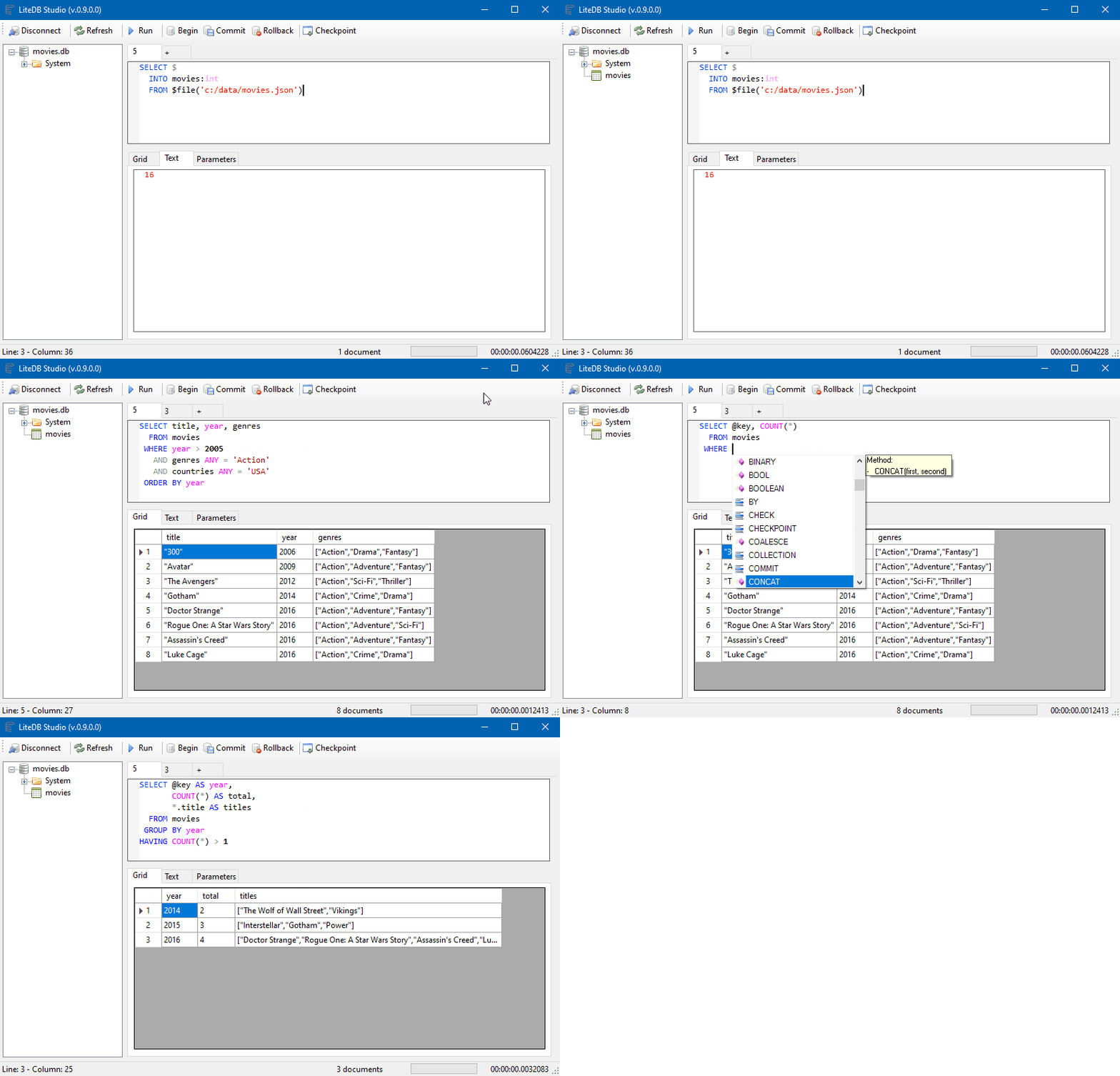
Lite.Studio
New UI to manage and visualize your database:
Documentation
Visit the Wiki for full documentation. For simplified chinese version, check here.
LiteDB Community
Help LiteDB grow its user community by answering this simple survey
How to use LiteDB
A quick example for storing and searching documents:
// Create your POCO class
public class Customer
{
    public int Id { get; set; }
    public string Name { get; set; }
    public int Age { get; set; }
    public string[] Phones { get; set; }
    public bool IsActive { get; set; }
}

// Open database (or create if doesn't exist)
using(var db = new LiteDatabase(@"MyData.db"))
{
    // Get customer collection
    var col = db.GetCollection<Customer>("customers");

    // Create your new customer instance
    var customer = new Customer
    {
        Name = "John Doe",
        Phones = new string[] { "8000-0000", "9000-0000" },
        Age = 39,
        IsActive = true
    };

    // Create unique index in Name field
    col.EnsureIndex(x => x.Name, true);

    // Insert new customer document (Id will be auto-incremented)
    col.Insert(customer);

    // Update a document inside a collection
    customer.Name = "Joana Doe";

    col.Update(customer);

    // Use LINQ to query documents (with no index)
    var results = col.Find(x => x.Age > 20);
}
BSON serialization
If you need direct access to raw BSON, BsonSerializer exposes overloads that write into caller-supplied Memory<byte> or IBufferWriter<byte> instances. This allows applications to reuse buffers from pools without forcing an intermediate array allocation. The Memory<byte> must be backed by a managed array. The IBufferWriter<byte> overload is available in the net8.0 and net10.0 builds, but is omitted from the netstandard2.0 API.
var writer = new ArrayBufferWriter<byte>();
var written = BsonSerializer.Serialize(document, writer);

// written now contains the BSON length and writer.WrittenSpan holds the bytes
Using fluent mapper and cross document reference for more complex data models
// DbRef to cross references
public class Order
{
    public ObjectId Id { get; set; }
    public DateTime OrderDate { get; set; }
    public Address ShippingAddress { get; set; }
    public Customer Customer { get; set; }
    public List<Product> Products { get; set; }
}

// Configure the global template. Mapper-less databases clone this configuration.
var mapper = BsonMapper.Global;

// "Products" and "Customer" are from other collections (not embedded document)
mapper.Entity<Order>()
    .DbRef(x => x.Customer, "customers")   // 1 to 1/0 reference
    .DbRef(x => x.Products, "products")    // 1 to Many reference
    .Field(x => x.ShippingAddress, "addr"); // Embedded sub document

using(var db = new LiteDatabase("MyOrderDatafile.db"))
{
    var orders = db.GetCollection<Order>("orders");

    // When query Order, includes references
    var query = orders
        .Include(x => x.Customer)
        .Include(x => x.Products) // 1 to many reference
        .Find(x => x.OrderDate <= DateTime.Now);

    // Each instance of Order will load Customer/Products references
    foreach(var order in query)
    {
        var name = order.Customer.Name;
        ...
    }
}
Where to use?
- Desktop/local small applications
- Application file format
- Small web sites/applications
- One database per account/user data store
Plugins
- A GUI viewer tool: https://github.com/falahati/LiteDBViewer (v4)
- A GUI editor tool: https://github.com/JosefNemec/LiteDbExplorer (v4)
- Lucene.NET directory: https://github.com/sheryever/LiteDBDirectory
- LINQPad support: https://github.com/adospace/litedbpad
- F# Support: https://github.com/Zaid-Ajaj/LiteDB.FSharp (v4)
- UltraLiteDB (for Unity or IOT): https://github.com/rejemy/UltraLiteDB
- OneBella - cross platform (windows, macos, linux) GUI tool : https://github.com/namigop/OneBella
- LiteDB Studio - Fork of OneBella with bug fixes, updates and migrated to C# - https://github.com/MelnikovIG/LiteDB.Studio.Avalonia
- LiteDB.Migration: Framework that makes schema migrations easier: https://github.com/JKamsker/LiteDB.Migration/
Changelog
Change details for each release are documented in the release notes.
Code Signing
LiteDB is digitally signed courtesy of SignPath

Explore related projects
Asabeneh/30-Days-Of-Python
The 30 Days of Python programming challenge is a step-by-step guide to learn the Python programming language in 30 days. This challenge may take more than 100 days. Follow your own pace. These videos may help too: https://www.youtube.com/channel/UC7PNRuno1rzYPb1xLa4yktw
78,236 starsgrafana/grafana
The open and composable observability and data visualization platform. Visualize metrics, logs, and traces from multiple sources like Prometheus, Loki, Elasticsearch, InfluxDB, Postgres and many more.
77,724 starsredis/redis
For developers, who are building real-time data-driven applications, Redis is the preferred, fastest, and most feature-rich cache, data structure server, and document and vector query engine.
77,201 starsapache/superset
Apache Superset is a Data Visualization and Data Exploration Platform
75,420 stars