
linora-u/AgentLoom
linora-u/AgentLoom has 169 GitHub stars and 17 forks. GitHot measured 0 stars in 24 hours and 0 in 7 days. Last checked 2026-11-09 21:59 UTC. Last push 2026-10-23.
Simple, flexible workflow orchestration for multi-agent AI apps, with YAML configuration, runtime safety, observability, and resume support.
Measured star growth
- in 24h
- 0
- in 7 days
- 0
- in 15 days
- Update delayed
- in 1 month
- Update delayed
Net star changes over overlapping periods, not daily totals. Missing measurements are left blank. Stars measure attention, not software quality.
README.md
OriginalAgentLoom
Build and run multi-agent applications from YAML.
Typed Workers, permissioned edits, resumable Runs, explicit Goal completion, and review-gated memory share one runtime truth.



AgentLoom treats a multi-agent system as an Application with an execution contract. YAML defines the Supervisor, typed Workers, models, tools, Skills, Hooks, permissions, and runtime policy. Run Applications through the CLI or Python API and inspect structured execution evidence.
Why AgentLoom
Workers become typed tools
A Supervisor explicitly selects Workers through worker_agents; each selected
Worker becomes a callable tool named and described by that Worker. Simple Workers
use an empty Tool argument object and text output; each Worker's task comes from its YAML. Complex Workers declare
Draft 2020-12 input_schema and output_schema, which runtimes validate as
executable contracts rather than prompt conventions.
Runs produce evidence, not terminal guesses
Every allocated Run receives an immutable run_id, manifest, and versioned
lifecycle events, with bounded file logs when enabled plus audit records and
artifacts. A logical task_id survives resume. The CLI JSON/JSONL and
Python API read the same canonical state. Preflight rejection occurs before a
Run or its storage is allocated.
Long-running work has an explicit owner
Goal Mode keeps one root Supervisor objective active across continuation segments and Worker delegation. Only that Supervisor can mark the Goal complete with evidence. Checkpointing preserves the Goal and completed work across interruptions and resume.
Memory has review boundaries
Self-Learning v6 stores searchable history and evidence-gated memory separately. Fact and experience candidates pass evidence gates and the configured scope-approval policy; promotion to Project scope is always initiated by a person.
Extensions do not silently gain authority
Skills are model-context packages loaded on demand. Hooks are separately and explicitly authorized runtime code. Built-in tool metadata is discoverable without importing implementations, while actual tool, file, Shell, and MCP access remains governed by Agent configuration and permissions.
Quick start
The source installer uses uv to create an isolated Python environment with locked
dependencies and installs the agentloom and loom commands for this checkout:
git clone https://github.com/linora-u/AgentLoom.git
cd AgentLoom
./install
It currently supports macOS and Linux shells and requires Git and Bash. It
installs missing uv through its official installer, then places the environment
in this checkout's .venv and the launchers/install records in .agentloom.
The project pins its managed Python version in .python-version; ./install
uses that version even when another Python is available on PATH.
No environment activation is needed. Set AGENTLOOM_INSTALL_DIR=/path/to/install
for a custom installation with its environment in /path/to/install/venv.
Open a new terminal and verify it:
agentloom --help
loom --help
The source installer defaults to smol plus professional code tools. For Pi
without smol, use ./install --runtime pi with Node 22.19+ and npm available;
it automatically downloads the pinned SDK and builds AgentLoom's bridge. See
runtime installation profiles for locked
checkout/release commands and clean Application verification.
Create the local model configuration:
cp config/model.example.yaml config/model.yaml
model:
  default_model_type: powerful
  powerful:
    model: "openai/<model-id>"
    api_key: "<api-key>"
    base_url: "https://<openai-compatible-endpoint>"  # optional for OpenAI
    tool_choice: "auto"
  fast:
    model: "openai/<fast-model-id>"
    api_key: "<api-key>"
    base_url: "https://<openai-compatible-endpoint>"
    tool_choice: "auto"
config/model.yaml is ignored by Git and provides the project's model catalog.
Applications can also define their own catalog in config/model.yaml under the
Application directory. Select models in the Agent YAML with model_type.
Define an Application
An Application keeps its Supervisor, Workers, prompts, optional tools, and outputs together:
applications/release_review/
├── workflows/
│   ├── release_review_agent.yaml
│   └── worker_agents/
│       ├── api_reviewer.yaml
│       └── test_reviewer.yaml
├── config/system.yaml          # optional Application overlay
├── skills/                     # optional private Skills
└── sysprompt/                  # optional prompt templates
Backend-specific execution settings belong only in runtime_options. Historical top-level smol fields are silently ignored without conversion or rejection.
A Supervisor references Worker definitions:
name: "release_review"
agent_runtime: "smolagents"
description: "Review an API release and its test evidence."
model_type: "powerful"

worker_agents:
  - path: "workflows/worker_agents/api_reviewer.yaml"
  - path: "workflows/worker_agents/test_reviewer.yaml"

task: |
  Ask both Workers for evidence, reconcile conflicts, and return one release decision.

tools: []
runtime_options:
  max_steps: 12
goal:
  enabled: true
Each Worker has its own YAML task. Without input_schema, its Tool takes no
arguments. Declare schemas when the Supervisor passes typed call data or needs
structured output:
name: "api_reviewer"
agent_runtime: "smolagents"
description: "Review API compatibility risks."
model_type: "fast"

input_schema:
  type: object
  properties:
    request:
      type: string
      description: "Release scope and API diff."
  required: [request]
  additionalProperties: false

output_schema:
  type: object
  properties:
    decision:
      type: string
      enum: [compatible, incompatible]
    findings:
      type: array
      items:
        type: string
  required: [decision, findings]
  additionalProperties: false

task: |
  Review the request, cite evidence, and return prioritized findings.

tools: []
worker_agents: []
runtime_options:
  max_steps: 8
Run the Supervisor directly:
uv run --locked --extra smol --extra code loom run applications/release_review/workflows/release_review_agent.yaml
Or ask a Skill-aware coding assistant to read
agentloom-framework-skill/SKILL.md, create
the files, validate them, run the Application, and inspect .agentloom evidence.
Persistent Worker queues
The optional durable extra uses DBOS 3.2.0 for persistent queues, admission,
retries, and recovery. Its default storage is a local SQLite file. Declare each
Worker's shared queue capacity in the Application's config/system.yaml:
worker_execution:
  workers:
    workflows/research.yaml:
      concurrency: 4
Submit through an Application Run, using a stable namespace root and an explicit business revision:
from agentloom.app import Application
from agentloom.execution.concurrency import WorkItem

with Application.open(application, project_root=project_root) as app:
    with app.durable(root=namespace_root) as execution:
        handles = execution.worker("workflows/research.yaml").submit_many(
            [WorkItem("research-1", {"query": "Investigate the release."})],
            revision="1",
        )
Start one dedicated consumer for that namespace. Other processes can submit to
the same queues; they share the declared capacities. Finite worker.map() calls
retain their separate per-call limits.
uv run --locked --extra durable loom durable serve APPLICATION \
  --worker workflows/research.yaml --root NAMESPACE_ROOT
An existing task with different immutable input is rejected. Each invocation runs a complete Application under macOS launchd, and resource exit is checked before replacement. Generic execution requires explicit host authorization to replay work; applications that commit business side effects can supply a trusted host with completion receipts. The current OS adapter supports macOS; Linux and actual PostgreSQL or multi-host execution have not been validated. See the execution contract.
Runtime model
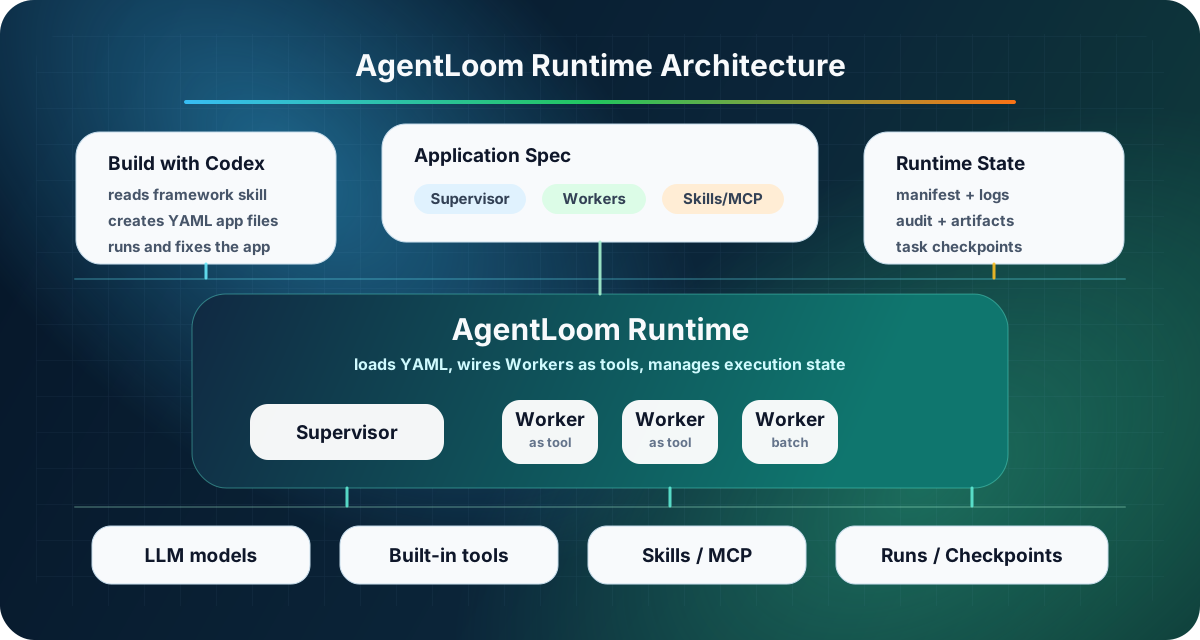
The Python runtime owns model routing, Worker-tool generation, concurrency, permissions, Hooks, checkpoints, and evidence. Deterministic preprocessing, validation, caching, and output writing remain ordinary Python code.
Runtime storage separates attempts from recoverable tasks:
.agentloom/
├── runs/<application_id>/<run_id>/
│   ├── manifest.json
│   ├── logs/runtime.log
│   ├── audit/
│   └── artifacts/
├── checkpoints/<application_id>/<task_id>/
│   ├── checkpoint.json
│   ├── workers/<worker>/calls/<index>/checkpoint.json
│   ├── todos.json
│   ├── goal.json
│   ├── context_store/
│   └── file-history/
└── workspaces/agents/<application_id>/<agent_path>/
    ├── insights.md
    └── tasks/<task_id>/{context.md,trace.md}
Goal, Todo, context-store, file-history, and Recall files appear only when the corresponding feature is configured or used.
Run and integrate
Run the included code-review Application without creating a new Application:
uv run --locked --extra smol --extra code loom run applications/ai_quality_analysis/workflows/code_review_agent.yaml
Use machine-readable lifecycle events when another program owns execution:
uv run --locked --extra smol --extra code loom run applications/ai_quality_analysis/workflows/code_review_agent.yaml --output-format json
uv run --locked --extra smol --extra code loom run applications/ai_quality_analysis/workflows/code_review_agent.yaml --output-format jsonl
For programmatic execution, execute_app() returns an ApplicationRunResult
with output, timestamps, structured Goal state, and a RunInfo receipt:
from agentloom.app.runner import execute_app

result = execute_app("applications/release_review/workflows/release_review_agent.yaml")
print(result.output, result.run.run_id)
Framework source lives directly in src/app/, src/execution/,
src/integrations/, and the other responsibility modules. Installation maps src/
to the Python package name agentloom: the import above loads
src/app/runner.py. There is no extra agentloom source directory.
Use uv sync --managed-python --locked --all-groups --extra smol --extra code to install the checkout before
calling Python APIs. The old src.* imports and module commands are removed;
supported commands are agentloom, loom, and python -m agentloom. See the
architecture and migration map
for module ownership and migration details.
Post-allocation failures carry the same receipt; preflight rejection emits
run.rejected before storage exists. See
Structured Run API.
For finite parallel work, use app.worker(path).map(items). For persistent
tasks, install the durable extra and submit through the public DBOS adapter:
from agentloom.app import Application

with Application.open("applications/release_review", project_root=".") as app:
    with app.durable(root=".agentloom/release-review-queue") as execution:
        handles = execution.worker("workflows/research.yaml").submit_many(items, revision="1")
Consume the same namespace with
loom durable serve applications/release_review --worker workflows/research.yaml --root .agentloom/release-review-queue.
DBOS 3.2.0 owns queues and recovery; SQLite is the default. Each invocation
runs under macOS launchd. Linux durable execution and remote database operation
have not been validated. See the execution specification
and full-day acceptance.
Durable schedules use the same Application contract and Run lifecycle. Their automatic firing is handled by an explicit foreground service:
agentloom schedules --project /path/to/project serve
Example Applications
| Application | Demonstrates |
|---|---|
ai_quality_analysis |
Twelve specialized Workers coordinated into staged code review |
repo_map |
Deterministic preprocessing, bottom-up Agent analysis, batching, and progress persistence |
goal_mode_validation |
Explicit Goal completion, continuation, and checkpoint resume |
self_learning_smoke |
Session history, memory proposals, evidence, and review boundaries |
Documentation
| Document | Covers |
|---|---|
| Configuration Overview | Configuration layers, merging, and isolation |
| Agent Configuration | Supervisor and Worker YAML fields |
| Tool Catalog | Lazy implementation loading, toolsets, metadata, and extension rules |
| Skills | Discovery, on-demand activation, and permission boundaries |
| Hooks | Explicit authorization, events, transforms, and failure semantics |
| Goal Mode | Continuation, completion ownership, resume, and schedules |
| Checkpoint and Runtime Storage | Run/task identity, evidence, recovery, and retention |
| Self-Learning v6 | History, candidates, review, approval, and promotion |
| Structured Run API | Python receipts, typed failures, JSON, and JSONL |
Development and support
# Framework
uv run --locked --extra smol --extra code pytest tests -q
- Issues: github.com/linora-u/AgentLoom/issues
- Contact: [email protected]
If AgentLoom helps your project, consider starring the repository or contributing a focused Application, fix, or validation case.
Explore related projects
affaan-m/ECC
The agent harness performance optimization system. Skills, instincts, memory, security, and research-first development for Claude Code, Codex, Opencode, Cursor and beyond.
300,798 starsNousResearch/hermes-agent
The agent that grows with you
262,443 starsmultica-ai/andrej-karpathy-skills
A single CLAUDE.md file to improve Claude Code behavior, derived from Andrej Karpathy's observations on LLM coding pitfalls.
231,856 starsfirecrawl/firecrawl
Supercharge your AI agents with data from the web and beyond. Building the library for superintelligence. 🔥
200,444 stars