
lindsey98/Phishpedia
lindsey98/Phishpedia has 361 GitHub stars and 55 forks. GitHot measured 0 stars in 24 hours. Last checked 2026-11-11 17:48 UTC. Last push 2026-06-05.
Official Implementation of "Phishpedia: A Hybrid Deep Learning Based Approach to Visually Identify Phishing Webpages" USENIX'21
Measured star growth
- in 24h
- 0
- in 7 days
- Collecting history
- in 15 days
- Collecting history
- in 1 month
- Collecting history
Net star changes over overlapping periods, not daily totals. Missing measurements are left blank. Stars measure attention, not software quality.
README.md
OriginalPhishpedia A Hybrid Deep Learning Based Approach to Visually Identify Phishing Webpages


Paper • Website • Video • Dataset • Citation
This is the official implementation of "Phishpedia: A Hybrid Deep Learning Based Approach to Visually Identify Phishing Webpages" USENIX'21 link to paper, link to our website, link to our dataset.
Existing reference-based phishing detectors:
- :x: Lack of interpretability, only give binary decision (legit or phish)
- :x: Not robust against distribution shift, because the classifier is biased towards the phishing training set
- :x: Lack of a large-scale phishing benchmark dataset
The contributions of our paper:
- :white_check_mark: We propose a phishing identification system Phishpedia, which has high identification accuracy and low runtime overhead, outperforming the relevant state-of-the-art identification approaches.
- :white_check_mark: We are the first to propose to use consistency-based method for phishing detection, in place of the traditional classification-based method. We investigate the consistency between the webpage domain and its brand intention. The detected brand intention provides a visual explanation for phishing decision.
- :white_check_mark: Phishpedia is NOT trained on any phishing dataset, addressing the potential test-time distribution shift problem.
- :white_check_mark: We release a 30k phishing benchmark dataset, each website is annotated with its URL, HTML, screenshot, and target brand: https://drive.google.com/file/d/12ypEMPRQ43zGRqHGut0Esq2z5en0DH4g/view?usp=drive_link.
- :white_check_mark: We set up a phishing monitoring system, investigating emerging domains fed from CertStream, and we have discovered 1,704 real phishing, out of which 1133 are zero-days not reported by industrial antivirus engine (Virustotal).
Framework
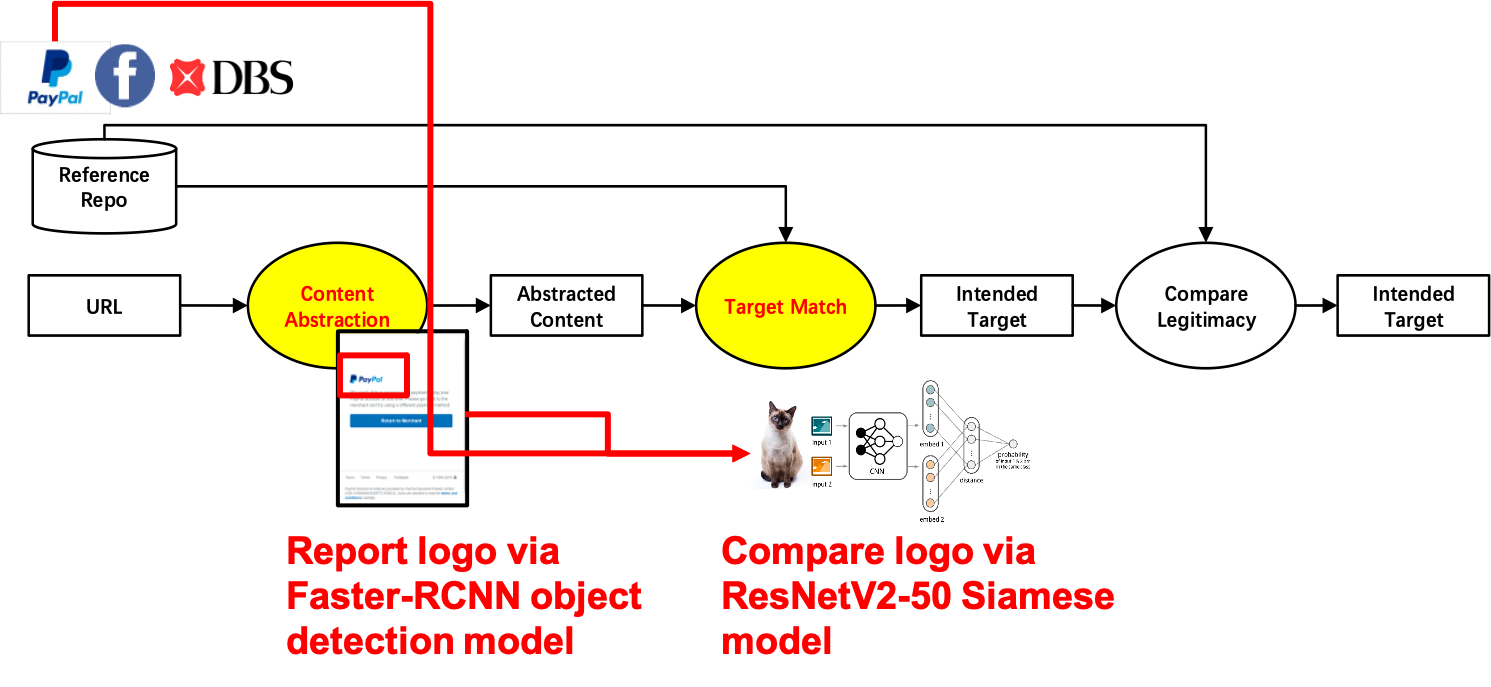
Input: A URL and its screenshot Output: Phish/Benign, Phishing target
Step 1: Enter Deep Object Detection Model, get predicted logos and inputs (inputs are not used for later prediction, just for explanation)
Step 2: Enter Deep Siamese Model
- If Siamese report no target,
Return Benign, None - Else Siamese report a target,
Return Phish, Phishing target
- If Siamese report no target,
Setup
Prerequisite: Pixi installed
For Linux/Mac,
export KMP_DUPLICATE_LIB_OK=TRUE
git clone https://github.com/lindsey98/Phishpedia.git
cd Phishpedia
pixi install
chmod +x setup.sh
./setup.sh
For Windows, in PowerShell,
git clone https://github.com/lindsey98/Phishpedia.git
cd Phishpedia
pixi install
setup.bat
Running Phishpedia from Command Line
pixi run python phishpedia.py --folder <folder you want to test e.g. ./datasets/test_sites>
The testing folder should be in the structure of:
test_site_1
|__ info.txt (Write the URL)
|__ shot.png (Save the screenshot)
test_site_2
|__ info.txt (Write the URL)
|__ shot.png (Save the screenshot)
......
Running Phishpedia as a GUI tool (web-browser-based)
See WEBtool/
Install Phishpedia as a Chrome plugin
Project structure
- models/
|___ rcnn_bet365.pth
|___ faster_rcnn.yaml
|___ resnetv2_rgb_new.pth.tar
|___ expand_targetlist/
  |___ Adobe/
  |___ Amazon/
  |___ ......
|___ domain_map.pkl
- logo_recog.py: Deep Object Detection Model
- logo_matching.py: Deep Siamese Model
- configs.yaml: Configuration file
- phishpedia.py: Main script
Miscellaneous
- In our paper, we also implement several phishing detection and identification baselines, see here
- The logo targetlist described in our paper includes 181 brands, we have further expanded the targetlist to include 277 brands in this code repository
- For the phish discovery experiment, we obtain feed from Certstream phish_catcher, we lower the score threshold to be 40 to process more suspicious websites, readers can refer to their repo for details
- We use Scrapy for website crawling
Citation
If you find our work useful in your research, please consider citing our paper by:
@inproceedings{lin2021phishpedia,
  title={Phishpedia: A Hybrid Deep Learning Based Approach to Visually Identify Phishing Webpages},
  author={Lin, Yun and Liu, Ruofan and Divakaran, Dinil Mon and Ng, Jun Yang and Chan, Qing Zhou and Lu, Yiwen and Si, Yuxuan and Zhang, Fan and Dong, Jin Song},
  booktitle={30th $\{$USENIX$\}$ Security Symposium ($\{$USENIX$\}$ Security 21)},
  year={2021}
}
Contacts
If you have any issues running our code, you can raise an issue or send an email to [email protected], [email protected], and [email protected]
Explore related projects
trimstray/the-book-of-secret-knowledge
A collection of inspiring lists, manuals, cheatsheets, blogs, hacks, one-liners, cli/web tools and more.
257,750 starsHack-with-Github/Awesome-Hacking
A collection of various awesome lists for hackers, pentesters and security researchers
125,254 starsswisskyrepo/PayloadsAllTheThings
A list of useful payloads and bypass for Web Application Security and Pentest/CTF
82,583 starscaddyserver/caddy
Fast and extensible multi-platform HTTP/1-2-3 web server with automatic HTTPS
78,959 stars