
letox4/netpwn
letox4/netpwn has 73 GitHub stars and 19 forks. GitHot measured +2 stars in 24 hours. Last checked 2026-11-16 20:59 UTC. Last push 2026-11-05.
Measured star growth
- in 24h
- +2
- in 7 days
- Collecting history
- in 15 days
- Collecting history
- in 1 month
- Collecting history
Net star changes over overlapping periods, not daily totals. Missing measurements are left blank. Stars measure attention, not software quality.
About
Suite grafica de auditoria de redes (pentesting) con interfaz web: descubrimiento, escaneo, MITM, Wi-Fi y camaras IP. Como bettercap, con un clic.
SecurityREADME.en.md
Original⚡ NetPwn
Graphical network security auditing suite with a web UI. Discover the network, scan, set up a MITM, capture traffic and audit — all from your browser, like bettercap but one-click.



Español · Responsible use · Test checklist
[!WARNING] Dual-use tool: only use it on networks you own or have explicit written authorization to test. Intercepting traffic or capturing credentials without permission is illegal. Read the disclaimer.
⚡ Try it in 10 seconds
python netpwn.py --demo
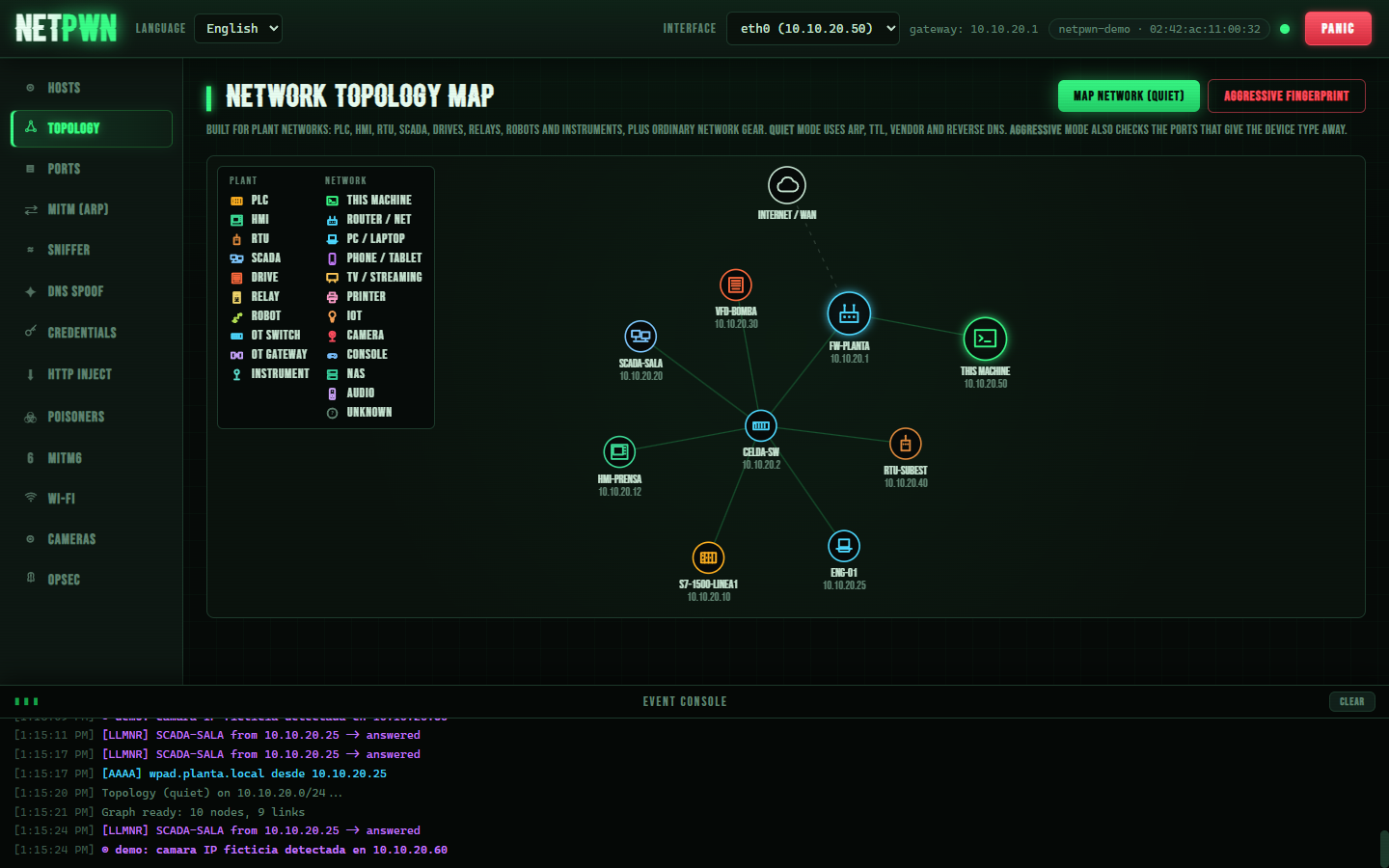
Boots with a fictional network (a small industrial plant) and live events: hosts, ports, topology and simulated activity — no root, no real network, any OS. Perfect for a quick look before setting up your own lab.
✨ Features
| Module | What it does |
|---|---|
| Hosts | ARP sweep + OS fingerprinting (TTL, vendor, ports) |
| Ports | TCP connect or SYN stealth (half-open) + low noise jitter mode |
| Topology | Interactive network graph with per-node evidence |
| MITM (ARP) | ARP spoofing + IP forwarding to audit traffic |
| Sniffer | Live packet capture with optional BPF filter |
| DNS Spoof | Answers DNS queries with controlled IPs |
| Credentials | Basic, forms, cookies, Bearer, API keys, FTP, NTLMSSP; memory-only + export |
| HTTP Inject | Transparent proxy injecting JS/HTML + sslstrip-lite |
| Poisoners | LLMNR / NBT-NS / mDNS (Responder style) |
| WPAD | Rogue PAC + proxy logging hosts/URLs/plaintext creds |
| mitm6 | Router Advertisements + IPv6 DNS (mitm6 style) |
| Wi-Fi | 802.11 scan, (low-noise) deauth, EAPOL handshakes and PMKID → hashcat |
| Cameras | IP camera auditing: creds, RTSP, ONVIF, firmware |
| OPSEC | Identity profiles (hostname + real-OUI MAC) to audit YOUR network inventory posture |
| 🆘 PANIC | Kill switch: stop everything, flush iptables rules, restore identity |
Typical audit flow: scan hosts → pin a target → start MITM → enable Sniffer / DNS / Credentials.
📸 Screenshots
| Discovery & ports | Wi-Fi |
|---|---|
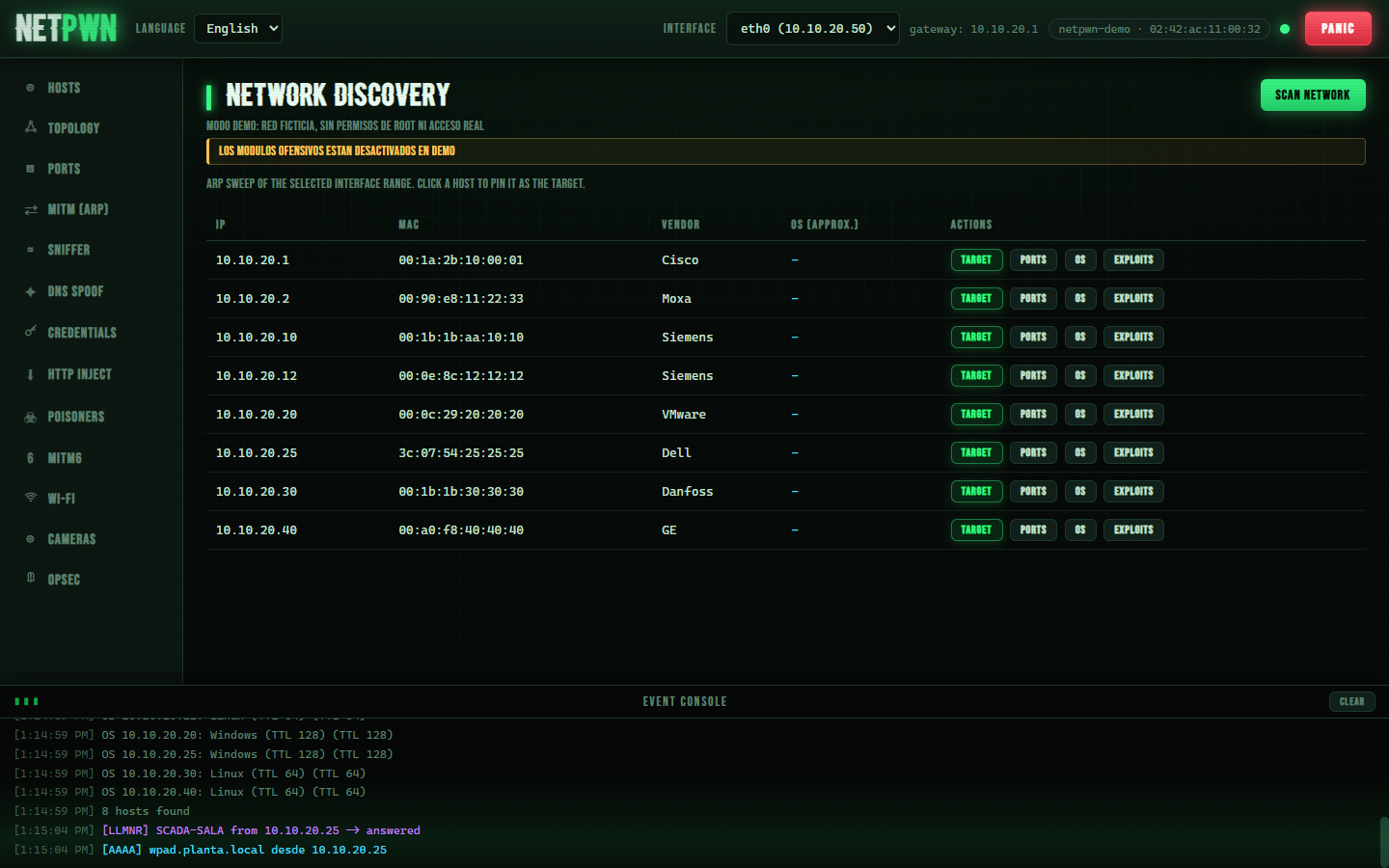 |
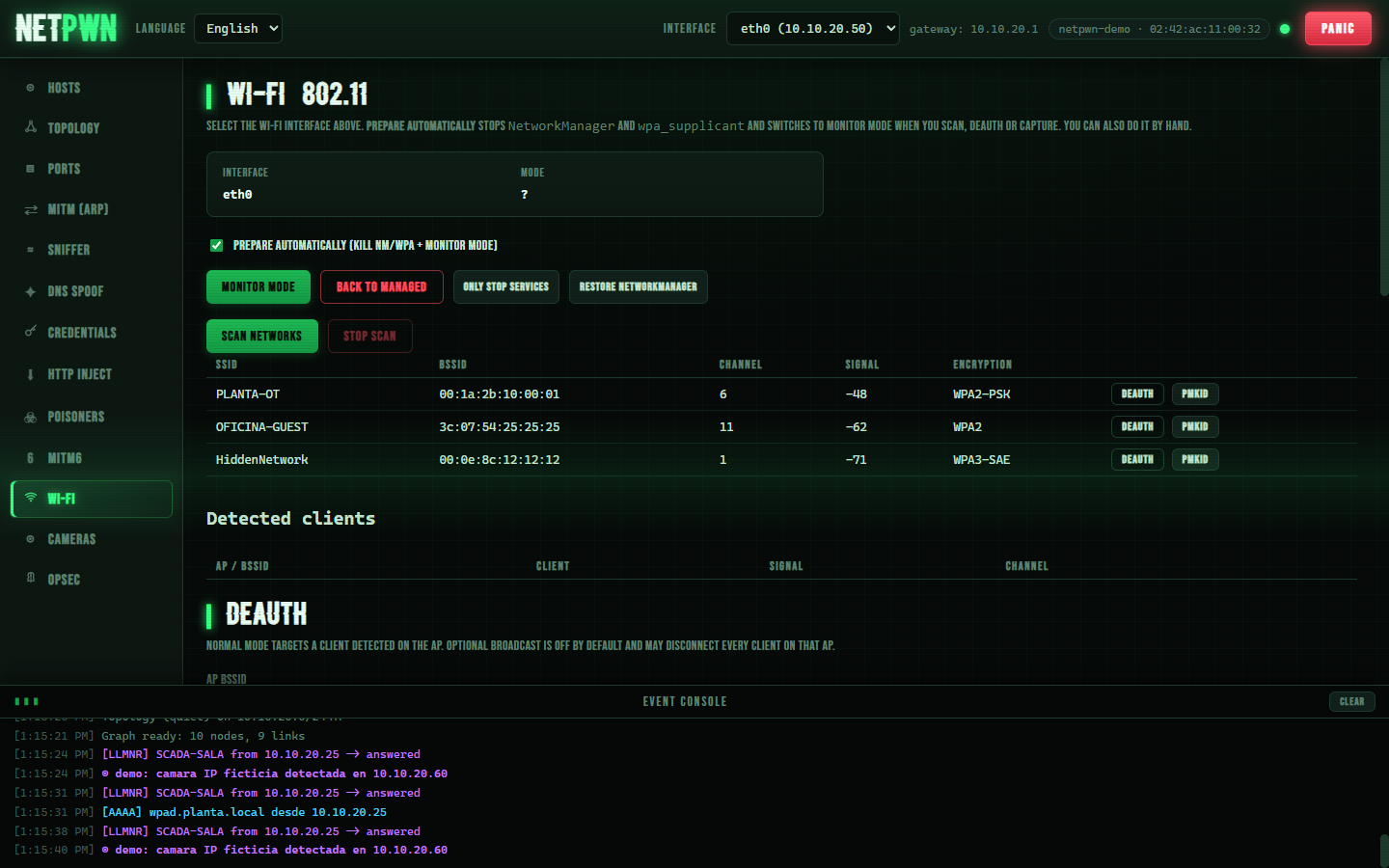 |
🚀 Installation (Kali Linux)
git clone https://github.com/letox4/netpwn
cd netpwn
chmod +x run.sh
./run.sh          # creates the venv, installs deps, starts with sudo
Open http://127.0.0.1:8000. Root is required for raw sockets (the script
calls sudo itself).
Manual
python3 -m venv venv && source venv/bin/activate
pip install -r requirements.txt
python netpwn.py --host 127.0.0.1 --port 8000
Optional dependency for hashcat conversion: sudo apt install hcxtools.
🧠 How it works inside
app/
  main.py            # REST API + WebSocket (FastAPI)
  core/              # event bus, tagged firewall rules, snapshot/restore,
                     # automatic cleanup (atexit/signals), demo mode
  modules/           # discovery, portscan, arp, sniff, dns, creds, httpinject,
                     # poison, wpad, mitm6, wifi, opsec, topology, cameras
  static/            # web UI (vanilla JS, bilingual)
tests/               # unit tests (pytest, no network needed)
- Backend: FastAPI + scapy. A thread-safe event bus pushes everything to the UI over a WebSocket in real time.
- Frontend: dependency-free HTML/CSS/JS served by the backend itself.
- Hygiene: every firewall rule is tagged with the
netpwncomment; cleanup (PANIC,atexit,SIGINT/SIGTERM) removes only our rules, even after a crash. Orphaned rules are detected and reported at startup. - Demo mode:
NETPWN_DEMO=1replaces the system with a fictional network, so it runs on Windows/macOS and CI.
📝 Module notes
HTTP Inject
Requires ARP MITM active. Installs an iptables REDIRECT rule to divert
TCP/80 to the proxy, injects your payload before </body> and, with
sslstrip, rewrites https:// → http:// and strips HSTS/CSP. It does not
decrypt HTTPS; it only prevents the TLS upgrade from cleartext pages. The
rule is removed on stop.
Poisoners (LLMNR / NBT-NS / mDNS) + WPAD
Answers multicast name queries the DNS can't resolve, without touching ARP: quieter, and the classic way to demonstrate how easily credentials leak on a misconfigured Windows network. With WPAD enabled, the proxy logs hosts, URLs and cleartext credentials.
mitm6 (IPv6)
Announces your machine as IPv6 router and DNS via Router Advertisements — the classic way to prove that a well-watched IPv4 isn't enough when nobody watches IPv6. Aggressive: use on a lab segment.
Credentials
Everything stays in memory only (never written to disk), with JSON export
and a clear button. Detects HTTP Basic, forms, session cookies, Bearer, API
keys, FTP and NTLMSSP (for ntlmrelayx in the audit workflow).
Wi-Fi
Managed monitor mode (NetworkManager + interferers), 802.11 scanning,
low-noise deauth (short bursts + jitter), EAPOL handshake capture
(parallel deauth forces reconnection) and client-less PMKID. Automatic
conversion to hashcat format 22000 with hcxpcapngtool.
OPSEC & PANIC
The OPSEC panel lets you verify from the other side what gives away a
novice auditor (a kali hostname, a locally-administered MAC bit, telltale
profiles) and apply clean identities with real-vendor OUIs. Everything is
recorded so the PANIC button restores hostname, MAC, ip_forward and
firewall rules in one click.
🤝 Contributing & testing
- Full test checklist (includes what can only be tested with real hardware on Kali).
- Contributing guide and security policy.
📄 License
GPL-3.0 © letox4. See DISCLAIMER.md before use.