
leaderj1001/Attention-Augmented-Conv2d
About
Implementing Attention Augmented Convolutional Networks using Pytorch
Machine LearningMeasured star growth
- in 24h
- 0
- in 7 days
- 0
- in 15 days
- Collecting history
- in 1 month
- Collecting history
Net star changes over overlapping periods, not daily totals. Missing measurements are left blank. Stars measure attention, not software quality.
README.md
OriginalImplementing Attention Augmented Convolutional Networks using Pytorch
- In the paper, it is implemented as Tensorflow. So I implemented it with Pytorch.
Update (2019.05.11)
Fixed an issue where key_rel_w and key_rel_h were not found as learning parameters when using relative=True mode.
In "relative = True" mode, you can see that "key_rel_w" and "key_rel_h" are learning parameters. In "relative = False" mode, you do not have to worry about the "shape" parameter.
Example, relative=True, stride=1, shape=32
import torch

from attention_augmented_conv import AugmentedConv

use_cuda = torch.cuda.is_available()
device = torch.deivce('cuda' if use_cuda else 'cpu')

tmp = torch.randn((16, 3, 32, 32)).to(device)
augmented_conv1 = AugmentedConv(in_channels=3, out_channels=20, kernel_size=3, dk=40, dv=4, Nh=4, relative=True, stride=1, shape=32).to(device)
conv_out1 = augmented_conv1(tmp)
print(conv_out1.shape) # (16, 20, 32, 32)

for name, param in augmented_conv1.named_parameters():
    print('parameter name: ', name)
As a result of parameter name, we can see "key_rel_w" and "key_rel_h".
Example, relative=True, stride=2, shape=16
import torch

from attention_augmented_conv import AugmentedConv

use_cuda = torch.cuda.is_available()
device = torch.deivce('cuda' if use_cuda else 'cpu')

tmp = torch.randn((16, 3, 32, 32)).to(device)
augmented_conv1 = AugmentedConv(in_channels=3, out_channels=20, kernel_size=3, dk=40, dv=4, Nh=4, relative=True, stride=2, shape=16).to(device)
conv_out1 = augmented_conv1(tmp)
print(conv_out1.shape) # (16, 20, 16, 16)
- This is important, when using the "relative = True" mode, the stride * shape should be the same as the input shape. For example, if input is (16, 3, 32, 32) and stride = 2, the shape should be 16.
Update (2019.05.02)
I have added padding to the "AugmentedConv" part.
You can use it as you would with nn.conv2d.
I will attach the example below as well.
Example, relative=False, stride=1
import torch

from attention_augmented_conv import AugmentedConv

use_cuda = torch.cuda.is_available()
device = torch.deivce('cuda' if use_cuda else 'cpu')

temp_input = torch.randn((16, 3, 32, 32)).to(device)
augmented_conv = AugmentedConv(in_channels=3, out_channels=20, kernel_size=3, dk=40, dv=4, Nh=1, relative=False, stride=1).to(device)
conv_out = augmented_conv(tmp)
print(conv_out.shape) # (16, 20, 32, 32), (batch_size, out_channels, height, width)
- Example, relative=False, stride=2
import torch

from attention_augmented_conv import AugmentedConv

use_cuda = torch.cuda.is_available()
device = torch.deivce('cuda' if use_cuda else 'cpu')

temp_input = torch.randn((16, 3, 32, 32)).to(device)
augmented_conv = AugmentedConv(in_channels=3, out_channels=20, kernel_size=3, dk=40, dv=4, Nh=1, relative=False, stride=2).to(device)
conv_out = augmented_conv(tmp)
print(conv_out.shape) # (16, 20, 16, 16), (batch_size, out_channels, height, width)
- I added an assert for parameters (dk, dv, Nh).
assert self.Nh != 0, "integer division or modulo by zero, Nh >= 1"
assert self.dk % self.Nh == 0, "dk should be divided by Nh. (example: out_channels: 20, dk: 40, Nh: 4)"
assert self.dv % self.Nh == 0, "dv should be divided by Nh. (example: out_channels: 20, dv: 4, Nh: 4)"
assert stride in [1, 2], str(stride) + " Up to 2 strides are allowed."
I posted two versions of the "Attention-Augmented Conv"
Reference
Paper
- Attention Augmented Convolutional Networks Paper
- Author, Irwan Bello, Barret Zoph, Ashish Vaswani, Jonathon Shlens
- Quoc V.Le Google Brain
Wide-ResNet
- Github URL
- Thank you :)
Method
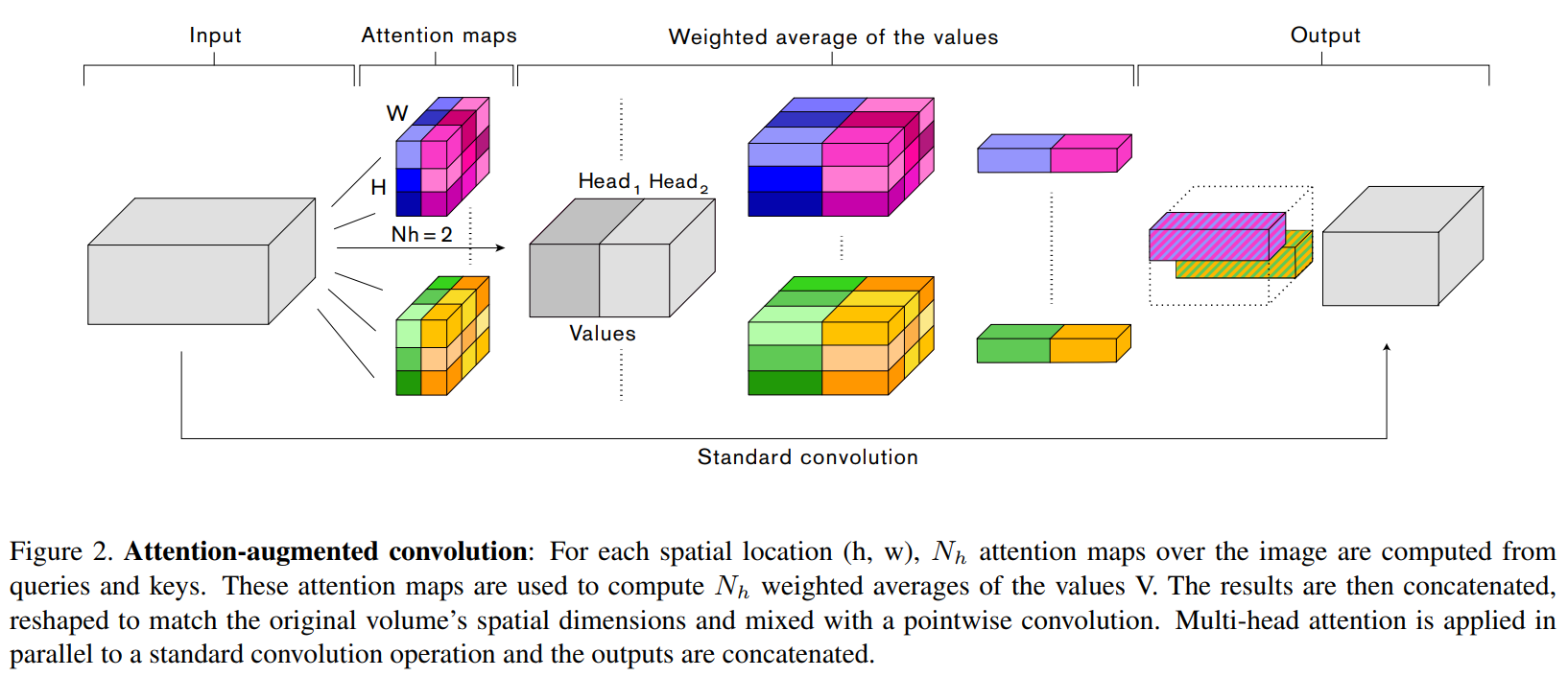
Input Parameters
In the paper,
 and
 are obtained using the following equations.
 ,

Experiments of parameters in paper

Experiments
- In the paper, they said that We augment the Wide-ResNet-28-10 by augmenting the first convolution of all residual blocks with relative attention using Nh=8 heads and κ=2, υ=0.2 and a minimum of 20 dimensions per head for the keys.
| Datasets | Model | Accuracy | Epoch | Training Time |
|---|---|---|---|---|
| CIFAR-10 | Wide-ResNet 28x10(WORK IN PROCESS) | |||
| CIFAR-100 | Wide-ResNet 28x10(WORK IN PROCESS) | |||
| CIFAR-100 | Just 3-Conv layers(channels: 64, 128, 192) | 61.6% | 100 | 22m |
| CIFAR-100 | Just 3-Attention-Augmented Conv layers(channels: 64, 128, 192) | 59.82% | 35 | 2h 23m |
- I don't have enough GPUs. So, I have many difficulties in training.
- I just want to see feasibility of this method(Attention-Augemnted Conv layer), I'll try about ResNet.
- The above results show that there are many time differences. I will think about this part a bit more.
- I have seen the issue that the torch.einsum function is slow. Link
- When I execute the example code in the link, the result was:

- using cuda

Time complexity
- I compared the time complexity of "relative = True" and "relative = False".
- I'll compare the performance of the two different values(relative=True, relative=False).
- In addition, I will consider ways to reduce time complexity in "relative = True".

Requirements
- tqdm==4.31.1
- torch==1.0.1
- torchvision==0.2.2
Explore related projects
Loading…