
kohonda/mppi_playground
kohonda/mppi_playground has 238 GitHub stars and 28 forks. GitHot measured 0 stars in 24 hours. Last checked 2026-11-19 21:41 UTC. Last push 2026-05-15.
Measured star growth
- in 24h
- 0
- in 7 days
- Collecting history
- in 15 days
- Collecting history
- in 1 month
- Collecting history
Net star changes over overlapping periods, not daily totals. Missing measurements are left blank. Stars measure attention, not software quality.
About
Model Predictive Path Integral Control (MPPI) with PyTorch
Machine LearningREADME.md
OriginalMPPI Playground
A PyTorch implementation of Model Predictive Path Integral Control (MPPI).
Key Features:
- 🚀 GPU-accelerated parallel computation
- 🧠 Differentiable implementation in PyTorch
- ⚙️ Flexible definitions of dynamics and cost functions
- 🔧 Additional useful features, including automatic temperature tuning and Savitzky–Golay trajectory smoothing
- 🤖 Example applications
Tested Environment
- Ubuntu 20.04 or higher
- [Optional] GPU with NVIDIA Driver (510 or later, tested with 550)
- uv
Run Examples
To run the example applications, install with additional dependencies:
# Clone repository
git clone https://github.com/kohonda/mppi_playground.git
cd mppi_playground
uv sync --extra example # Install with extra dependencies for examples
# uv run pre-commit install  # (optional) install pre-commit hooks for code formatting
# uv run pre-commit run --all-files  # (optional) format code
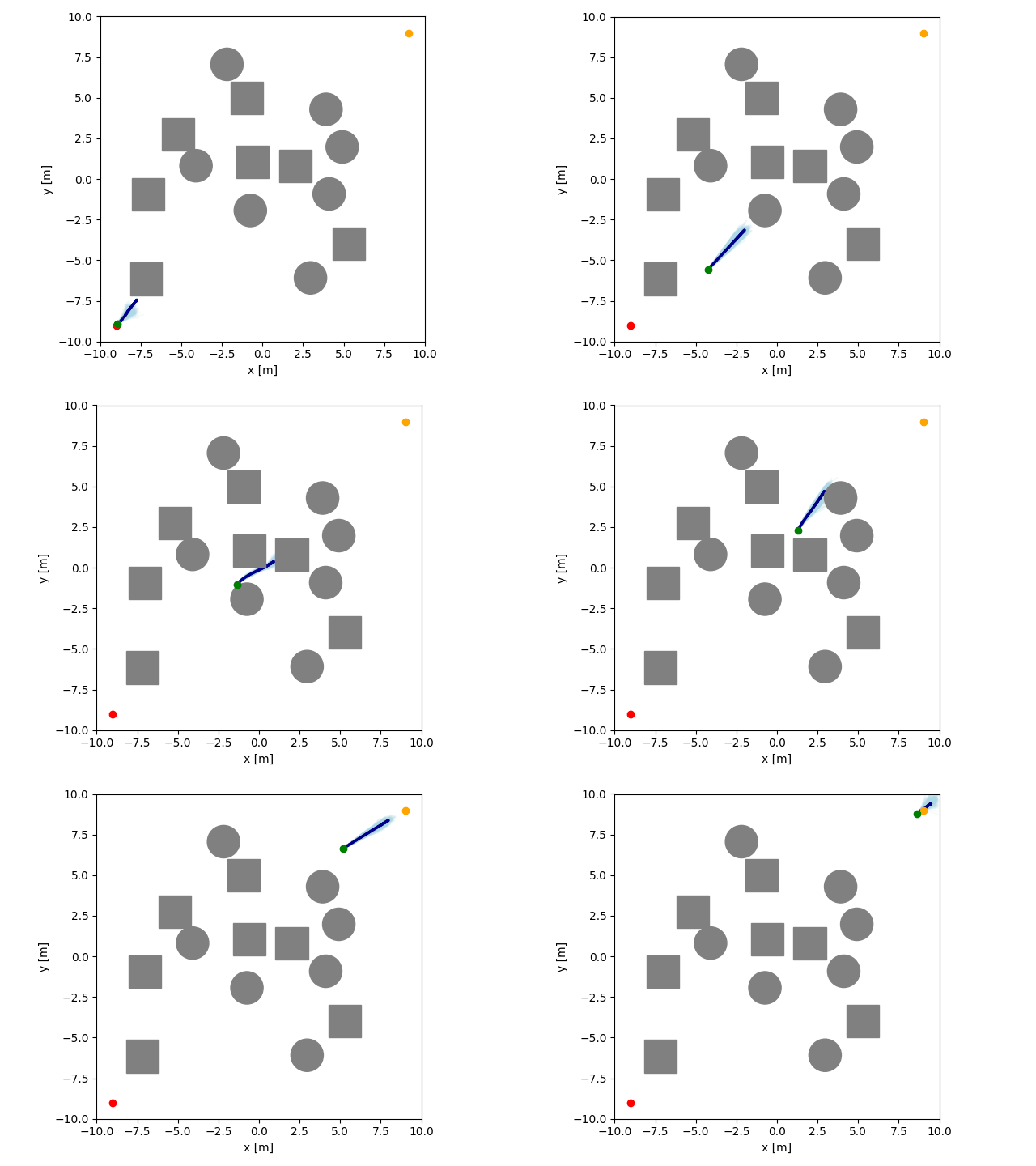
Navigation 2D
uv run python example/navigation2d.py
Racing
uv run python example/racing.py
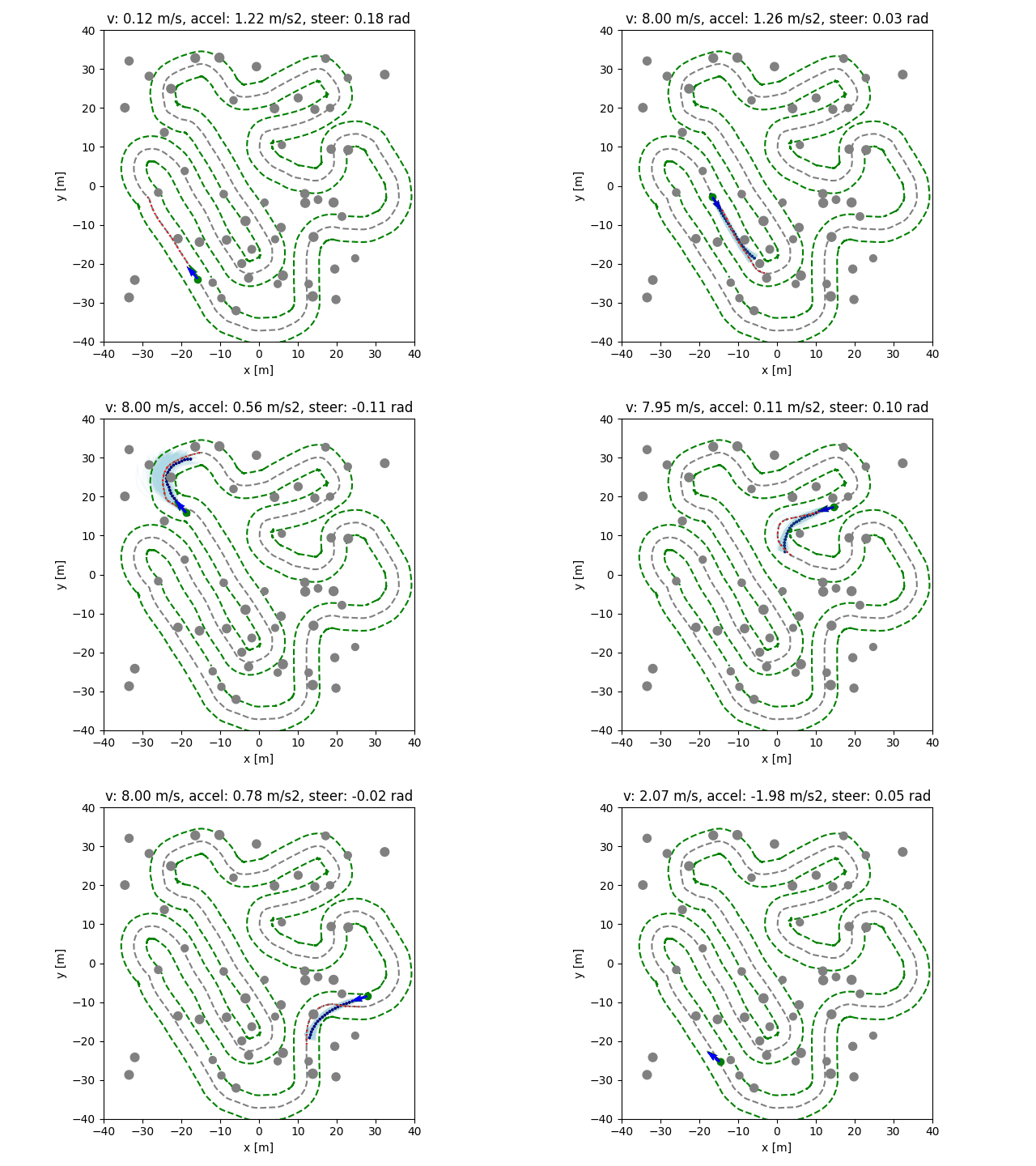
circuit course information (Japan Automotive AI Challenge 2024)
Pendulum
uv run python example/pendulum.py

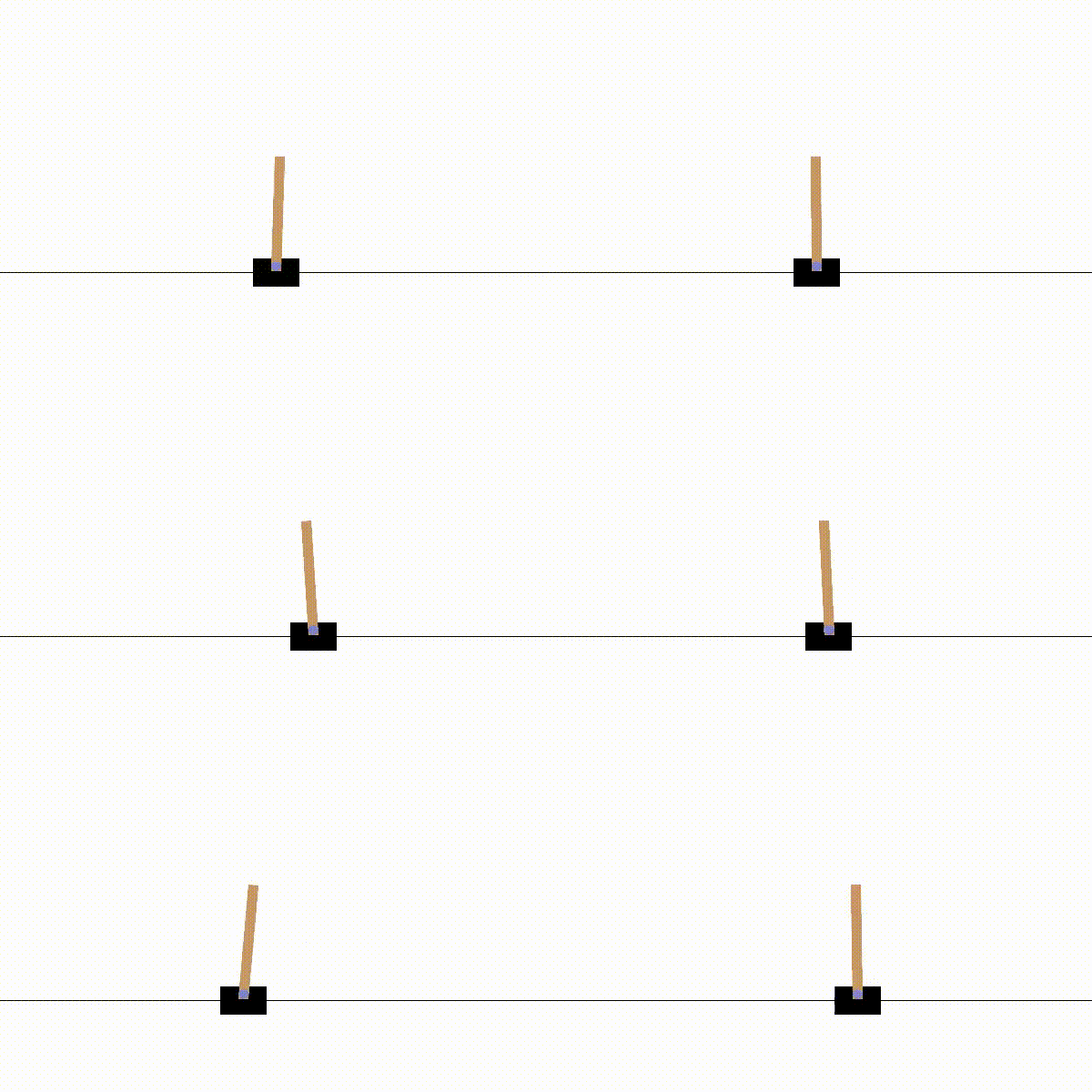
Cartpole
uv run python example/cartpole.py
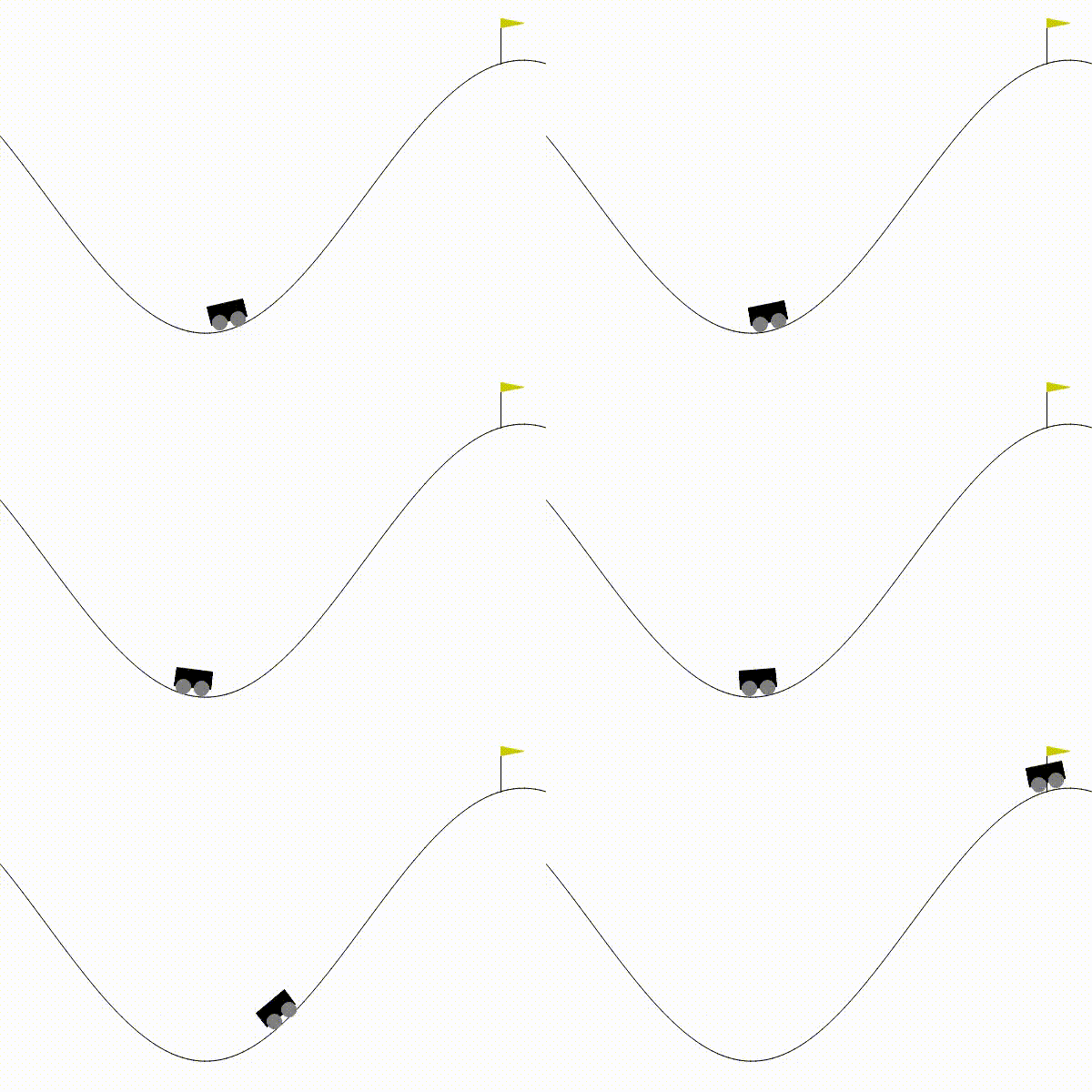
Mountain car
uv run python example/mountaincar.py
Usage in Your Project
Add dependency to your pyproject.toml and uv sync:
dependencies = [
    "pi-mpc"
]

[tool.uv.sources]
pi-mpc = {git = "https://github.com/kohonda/mppi_playground.git"}
Or install via pip:
pip install git+https://github.com/kohonda/mppi_playground
Minimal code example
import torch
from pi_mpc.mppi import MPPI

# Define dynamics function (batch processing: state [N, dim_state], action [N, dim_control])
def dynamics(state: torch.Tensor, action: torch.Tensor) -> torch.Tensor:
    # Example: simple integrator
    next_state = state + action
    return next_state

# Define cost function (batch processing)
def cost_func(state: torch.Tensor, action: torch.Tensor, info: dict) -> torch.Tensor:
    # Example: distance to goal
    goal = torch.tensor([1.0, 1.0], device=state.device)
    return torch.sum((state - goal) ** 2, dim=1)

# Create MPPI controller
controller = MPPI(
    horizon=50,
    num_samples=1000,
    dim_state=2,
    dim_control=2,
    dynamics=dynamics,
    cost_func=cost_func,
    u_min=torch.tensor([-1.0, -1.0]),
    u_max=torch.tensor([1.0, 1.0]),
    sigmas=torch.tensor([0.5, 0.5]),
    lambda_=1.0,
)

# Solve for optimal action sequence
current_state = torch.tensor([0.0, 0.0])
action_seq, state_seq = controller(current_state)
print(f"Optimal first action: {action_seq[0]}")
Configurations
MPPI Parameters
| Parameter | Type | Default | Description |
|---|---|---|---|
horizon |
int | required | Prediction horizon length |
num_samples |
int | required | Number of trajectory samples |
dim_state |
int | required | State dimension |
dim_control |
int | required | Control dimension |
dynamics |
Callable | required | Dynamics model: (state, action) -> next_state |
cost_func |
Callable | required | Cost function: (state, action, info) -> cost |
u_min |
Tensor | required | Minimum control bounds, shape (dim_control,) |
u_max |
Tensor | required | Maximum control bounds, shape (dim_control,) |
sigmas |
Tensor | required | Noise std for each control dim, shape (dim_control,) |
lambda_ |
float / str | required | Temperature or auto-tuning method ("MPO", "LBPS", "ESSPS") |
Auto-Lambda Parameters
| Parameter | Type | Default | Description |
|---|---|---|---|
lbps_delta |
float | 0.01 | Confidence parameter for LBPS (0 < δ < 1) |
essps_target_ess |
float | num_samples/10 | Target effective sample size for ESSPS |
lambda_min |
float | 0.01 | Minimum lambda bound for optimization |
lambda_max |
float | 10.0 | Maximum lambda bound for optimization |
Sampling & Filtering Parameters
| Parameter | Type | Default | Description |
|---|---|---|---|
exploration |
float | 0.0 | Fraction of purely random samples (0 to 1) |
use_sg_filter |
bool | False | Enable Savitzky-Golay smoothing |
sg_window_size |
int | 5 | Window size for SG filter (must be odd) |
sg_poly_order |
int | 3 | Polynomial order for SG filter |
Automatic Temperature Tuning (Auto-Lambda)
The temperature parameter λ is a hyperparameter that controls the exploration-exploitation trade-off. Three auto-tuning methods are available:
MPO: Gradient-based optimization: https://arxiv.org/abs/1806.06920LBPS: Lower-Bound Policy Search: https://openreview.net/forum?id=HbGgF93PpoyESSPS: Effective Sample Size Policy Search: https://openreview.net/forum?id=HbGgF93Ppoy
# Example: Enable auto-lambda with LBPS
controller = MPPI(..., lambda_="LBPS", lbps_delta=0.01)
Trajectory Smoothing
- Savitzky-Golay Filter: Optional smoothing to reduce control jitter (https://arxiv.org/abs/1707.02342)
# Example: Enable smoothing
controller = MPPI(..., use_sg_filter=True, sg_window_size=5, sg_poly_order=3)
Citation
If you use this repo in your work, please cite this paper (https://arxiv.org/abs/2511.08019) as:
@article{honda2026model,
  title={Model Predictive Control via Probabilistic Inference: A tutorial and survey},
  author={Honda, Kohei},
  journal={Annual Reviews in Control},
  volume={61},
  pages={101052},
  year={2026},
  publisher={Elsevier}
}