
kmkrworks/LiteGPT
kmkrworks/LiteGPT has 34 GitHub stars and 5 forks. GitHot measured 0 stars in 24 hours and 0 in 7 days. Last checked 2026-11-18 16:01 UTC. Last push 2026-11-10.
What you can do
- A modern architecture, implemented from scratch: RoPE, RMSNorm with QK-norm, SwiGLU and grouped-query attention, 28 layers × 768.
- Its own tokenizer: a 32,768-token byte-level BPE, trained on the project's own data mix.
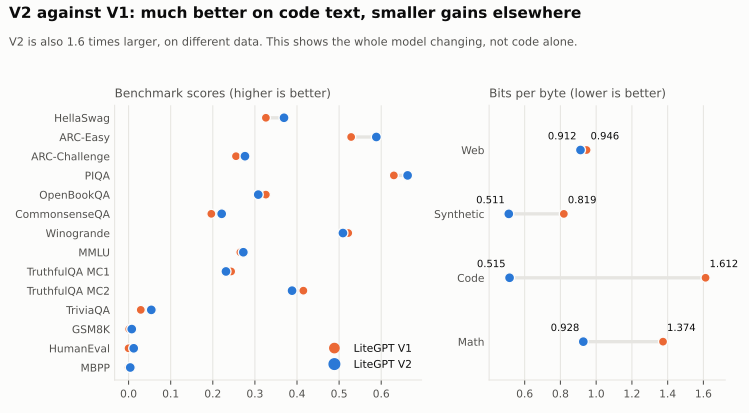
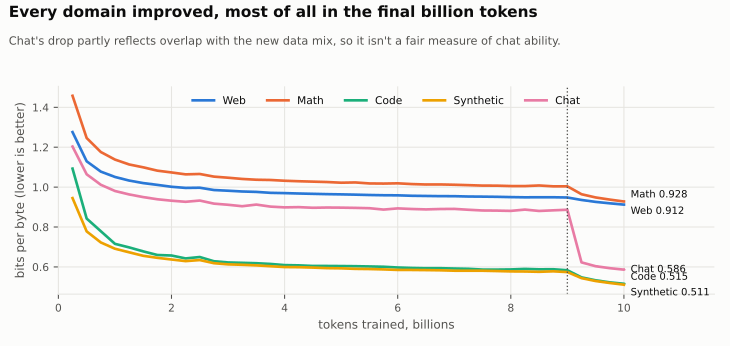
- A big step up from V1: clearly better on five benchmarks and clearly worse on none. On code text it is about three times better (bits per byte 1.612 → 0.515).
- Strong code modelling for its size: the lowest code bits per byte of every model under 300M parameters we measured.
Measured star growth
- in 24h
- 0
- in 7 days
- 0
- in 15 days
- Collecting history
- in 1 month
- Collecting history
Net star changes over overlapping periods, not daily totals. Missing measurements are left blank. Stars measure attention, not software quality.
About
LiteGPT: Open-source Small Language Model (SLM) with the full training pipeline
AIREADME.md
OriginalLiteGPT
A small language model built from scratch, with every step on record.
LiteGPT V2 is a 201M-parameter model with its own architecture implementation, its own trained tokenizer and its own weights. It was designed on an RTX 4090 Laptop GPU and pretrained in 37 hours on a single rented A100. Every experiment was registered before it ran, and every result is published with the run records behind it.
| Model | What it is |
|---|---|
| LiteGPT-V2-Base | The pretrained model, 4,096-token context |
| LiteGPT-Llama-V2-Instruct | The chat version |
Why this project
LiteGPT V1 was built on nanoGPT. The aim of V2 was to leave that behind and build the whole training pipeline ourselves: architecture, tokenizer, data preparation, training loop, evaluation and release tooling. Then train a model end to end with it and see what comes out. Topping benchmarks was never the goal. Understanding the complexities along the way was.
Built on a laptop GPU
Most of V2 was designed and tested on a laptop with an RTX 4090 Laptop GPU (16 GB). Getting sustained training out of a mobile GPU took real work:
- Windows to WSL2: on Windows the full model managed about 15.6k tokens per second over 30 minutes, and the GPU was thermally throttled 98% of that time at 89 °C. WSL2 made
torch.compilepossible, which added 23.9% speed and freed 2.9 GiB of GPU memory. Flash attention added another 12%. - A measured operating point: with both, the full 28-layer model sustained about 30k tokens per second for 30 minutes, with no thermal throttling.
- A thermal investigation: the design experiments were at first throttled 95 to 98% of the time, because the GPU sat at its temperature limit well below its power limit. The CPU and GPU share heat pipes, so CPU heat costs GPU headroom. A tuned power profile fixed it: GPU capped at 120 W, CPU at 55 W sustained with a 93 °C limit, and fans at maximum. Complete runs then showed 0% thermal slowdown, at 81 to 83 °C on average, so the GPU was limited by power rather than heat.
- Living with a laptop: WSL updated itself mid-run, Windows Update rebooted the machine twice, and a loose charger let it sleep. Every run resumes exactly from its last checkpoint, and a watchdog flags stalls, so the worst loss was about 10 minutes.
Why the final training moved to an A100: full pretraining means days of continuous full load, and running a mobile GPU like that for long stretches shortens its life. So the 37-hour pretraining run and the chat fine-tuning ran on a rented A100 instead. It is still achievable on the laptop: at the measured 30k tokens per second, the same pretraining would take about four days (estimate).
Highlights
- A modern architecture, implemented from scratch: RoPE, RMSNorm with QK-norm, SwiGLU and grouped-query attention, 28 layers × 768.
- Its own tokenizer: a 32,768-token byte-level BPE, trained on the project's own data mix.
- A big step up from V1: clearly better on five benchmarks and clearly worse on none. On code text it is about three times better (bits per byte 1.612 → 0.515).
- Strong code modelling for its size: the lowest code bits per byte of every model under 300M parameters we measured.
- Light to run: 0.59 GiB of GPU memory at batch 8 with its own engine, the lowest of the 11 base models we measured, and 1.66 GiB of RAM on CPU.
- Good at structured output once fine-tuned: 91.4% accuracy on Banking77 intents, and valid JSON on 99.99% of MASSIVE requests.
- Easy to use: loads in Hugging Face Transformers with no remote code, and ships with an offline Python API and command line.
- Open and on record: every dataset revision, threshold, decision and result is in the repository, with 32 charts generated from the run records.
How it compares
V2 doesn't reach the top score in these comparisons. What it brings is the combination above: a model built entirely from scratch, light enough for a laptop, and open down to every run record.
Text-to-data, after fine-tuning each model the same way (mean of 3 seeds, higher is better):
| Model | Parameters | Score | Banking77 | MASSIVE | CUAD | Peak RAM on CPU |
|---|---|---|---|---|---|---|
| Qwen3-0.6B | 596M | 0.851 | 0.931 | 0.812 | 0.809 | 4.27 GiB |
| Gemma 3 270M | 268M | 0.822 | 0.919 | 0.778 | 0.768 | 2.62 GiB |
| SmolLM2-135M | 135M | 0.817 | 0.920 | 0.787 | 0.745 | 1.61 GiB |
| LiteGPT V2 | 201M | 0.800 | 0.914 | 0.775 | 0.711 | 1.66 GiB |
As a base model (higher is better, except bits per byte and memory):
| Model | Zero-shot mean, 10 tasks | Code bits per byte | GPU memory, batch 8 |
|---|---|---|---|
| Qwen3-0.6B-Base | 0.489 | 0.372 | 2.72 GiB |
| SmolLM2-135M | 0.403 | 0.559 | 0.73 GiB |
| Gemma 3 270M | 0.393 | 0.617 | 2.59 GiB |
| LiteGPT V2 | 0.383 | 0.515 | 0.59 GiB |
| LiteGPT V1 | 0.371 | 1.612 | 0.78 GiB |
As a chat model (IFEval, higher is better): Qwen3-0.6B 0.564, Gemma 3 270M-it 0.251, SmolLM2-135M-Instruct 0.220, LiteGPT V2 Instruct 0.129, LiteGPT V1 Instruct 0.083.
V2's memory figures use its own engine and the others use Transformers. Every model, every task and the charts: docs/results.md.
Use it
With Transformers:
from transformers import AutoModelForCausalLM, AutoTokenizer

name = "kmkrworks/LiteGPT-Llama-V2-Instruct"
tokenizer = AutoTokenizer.from_pretrained(name)
model = AutoModelForCausalLM.from_pretrained(name)
inputs = tokenizer.apply_chat_template([{"role": "user", "content": "Name three colours."}], add_generation_prompt=True, return_tensors="pt", return_dict=True)
output = model.generate(**inputs, max_new_tokens=48)
print(tokenizer.decode(output[0, inputs["input_ids"].shape[1]:], skip_special_tokens=True))
With LiteGPT's own engine, from this repository (Python 3.12, uv), after downloading a model folder:
uv sync --locked
uv run litegpt chat --model LiteGPT-Llama-V2-Instruct
import litegpt

m = litegpt.load("LiteGPT-V2-Base")
print(litegpt.generate(m, "The capital of France is", max_new_tokens=32))
Once downloaded, everything runs offline. More in docs/inference.md.
How it was built
| Stage | What happened |
|---|---|
| Design | Each architecture change tested one at a time on small proxy models, on the laptop GPU |
| Data | Web, synthetic textbooks, math and code, with benchmark text filtered out and licences audited |
| Pretraining | 37 hours on one rented A100, with no restarts and no skipped steps |
| Chat fine-tuning | 3 epochs on curated conversations, passing its registered quality gate |
| Evaluation | One suite for V2 and 16 other models, plus a fine-tuned text-to-data benchmark |
Every benchmark is in docs/results.md, and every chart is in docs/figures.
What's next
Work is now starting on a fresh tokenizer.
What's here
| Folder | What it holds |
|---|---|
litegpt/ |
The package: model, tokenizer, inference, training, evaluation, export, API and CLI |
docs/ |
Results, charts, architecture, data, training, decisions and the specification |
benchmarks/ |
Run configs and benchmark tools |
scripts/ |
Data preparation, training, scoring, release and rented-server tools |
tests/ |
The test suite |
runs/ |
Run records behind every reported number |
V1
V1 is GPT-2 Small (124M), trained on FineWeb-Edu and fine-tuned on Alpaca, published as koganrath/LiteGPT-Base and koganrath/LiteGPT-Instruct. Its code is preserved in scripts/legacy_v1/.
Licence
Code: MIT (LICENSE). Weights: Apache-2.0. Each model ships a notice file listing its data sources and their terms.
Acknowledgements
- PyTorch, flash-attn, Hugging Face
tokenizersandtransformers, and lm-evaluation-harness - nanoGPT by Andrej Karpathy, the starting point for V1's initial design
- SmolLM corpus, FineMath and SmolTalk by Hugging Face
- github-code-clean by CodeParrot
- CUAD, MASSIVE, Banking77 and BillSum
Built with Qwen. Built with Llama. The models were trained in part on data generated by Qwen2.5-72B-Instruct, and the chat model on data generated by Llama-3.1-405B-Instruct. See each model's notice file.