
kevinzakka/mink has 1,603 GitHub stars and 127 forks. GitHot measured +9 in 7 days. Last checked 2026-11-10 02:18 UTC. Last push 2026-11-02.
Python inverse kinematics based on MuJoCo.
What you can do
- Pose of a frame, in the world or relative to a different frame (FrameTask, RelativeFrameTask)
- Center of mass (ComTask) and joint posture (PostureTask)
- Direction of a frame axis, toward a point or along a vector (LookAtTask, AxisAlignTask)
- Closed kinematic chains, from MuJoCo equality constraints (EqualityConstraintTask)
Measured star growth
- in 24h
- Update delayed
- in 7 days
- +9
- in 15 days
- Update delayed
- in 1 month
- Update delayed
Net star changes over overlapping periods, not daily totals. Missing measurements are left blank. Stars measure attention, not software quality.
README.md
Originalmink


mink is a Python library for differential inverse kinematics, built on MuJoCo.
You give mink tasks (objectives, such as a target pose for a frame), limits (inequalities, such as a joint range), and constraints (equalities that must hold, such as a foot that stays flat on the floor). At each step, mink solves a quadratic program for a velocity: the one that best reduces the task errors while it satisfies every limit and constraint. Integrate it over a short time step to get the next configuration, and repeat to move the robot toward the goal. mink works with any MuJoCo model, from a single arm to a humanoid with a floating base.
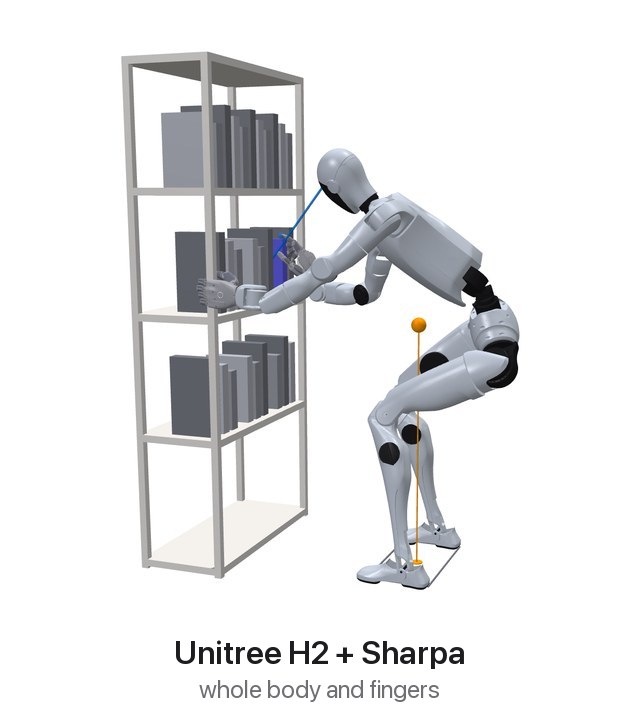
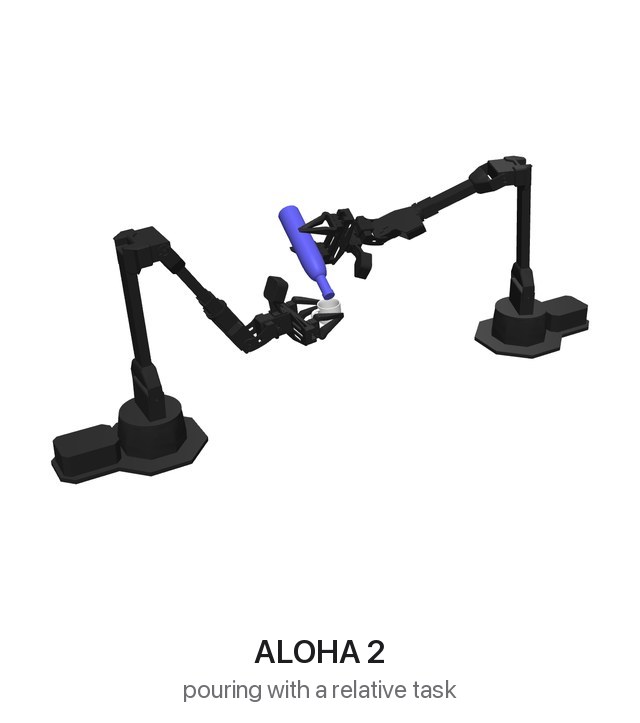
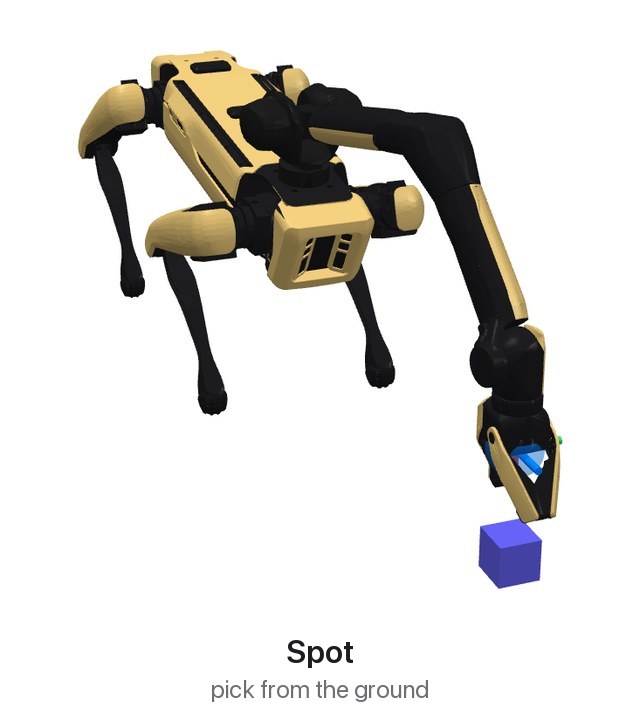
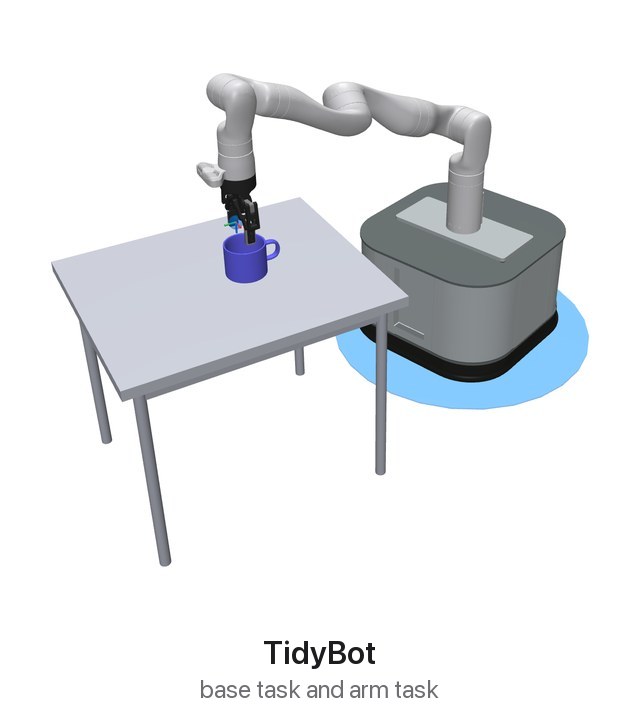
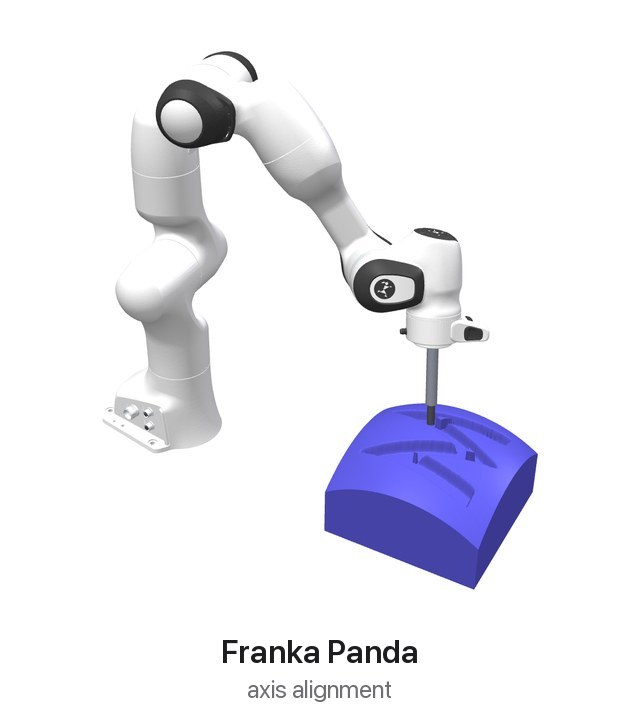
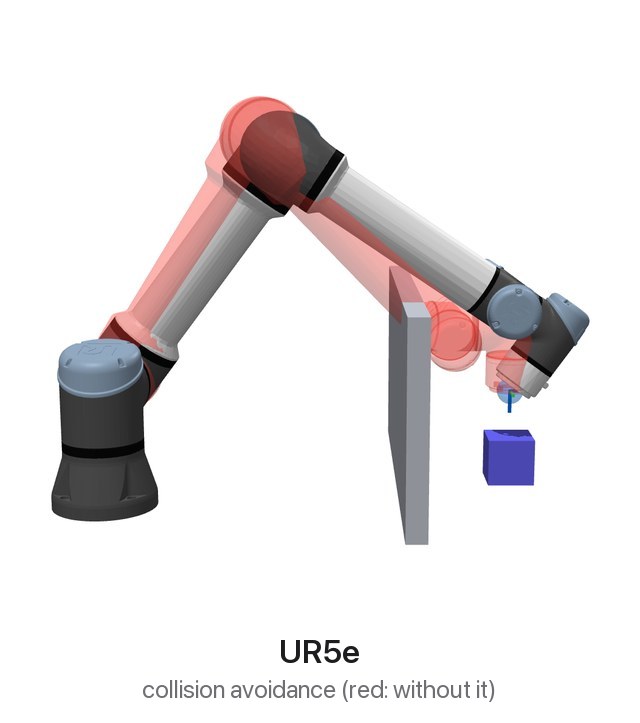
Each image links to a related example.
Installation
uv add mink
Quickstart
This example moves the Panda hand 20 cm forward (+x) and 20 cm down. A posture task keeps the arm near its home configuration.
import mujoco
import numpy as np
import mink
from robot_descriptions import panda_mj_description

model = mujoco.MjModel.from_xml_path(panda_mj_description.MJCF_PATH)
configuration = mink.Configuration(model)
configuration.update_from_keyframe("home")

hand = mink.FrameTask("hand", "body", position_cost=1.0, orientation_cost=1.0)
start = configuration.get_transform_frame_to_world("hand", "body")
hand.set_target(mink.SE3.from_translation(np.array([0.2, 0.0, -0.2])) @ start)

posture = mink.PostureTask(model, cost=1e-2)
posture.set_target_from_configuration(configuration)

dt = 0.01
for _ in range(200):
    vel = mink.solve_ik(configuration, [hand, posture], dt, "daqp")
    configuration.integrate_inplace(vel, dt)
Each loop iteration is one step: solve_ik returns a velocity, and integrate_inplace integrates it over dt to update the configuration.
You can also pass a task as a constraint. A hard constraint must hold exactly. If the problem has no feasible solution, solve_ik raises NoSolutionFound. An Elastic constraint replaces the equality with an L1 penalty. It holds exactly while the penalty is large enough and otherwise yields, so the problem stays feasible.
vel = mink.solve_ik(
    configuration, [posture], dt, "daqp",
    constraints=[mink.Elastic(hand, penalty=1e3)],
)
The documentation explains tasks, limits, and the underlying formulation.
Features
Tasks. mink minimizes the task errors in a weighted least-squares sense.
- Pose of a frame, in the world or relative to a different frame (
FrameTask,RelativeFrameTask) - Center of mass (
ComTask) and joint posture (PostureTask) - Direction of a frame axis, toward a point or along a vector (
LookAtTask,AxisAlignTask) - Closed kinematic chains, from MuJoCo equality constraints (
EqualityConstraintTask) - Regularization and DOF freezing (
DampingTask,KineticEnergyRegularizationTask,DofFreezingTask)
Limits. mink applies limits as inequalities.
- Joint position and velocity limits (
ConfigurationLimit,VelocityLimit) - Velocity limits on a floating base (
FreeJointVelocityLimit) - Collision avoidance between pairs of geoms (
CollisionAvoidanceLimit)
Constraints. mink applies constraints as equalities.
- A task held exactly (hard constraint)
- A task wrapped in
Elastic, which yields through an L1 penalty instead of making the problem infeasible
Frame transforms and the errors and Jacobians of frame tasks use native C code.
Examples
To run an example:
git clone https://github.com/kevinzakka/mink.git && cd mink
uv sync

uv run examples/arm_ur5e.py           # Linux
./fix_mjpython_macos.sh               # macOS, once
uv run mjpython examples/arm_ur5e.py  # macOS
More examples:
- Elastic constraints: three Pandas follow a target that they cannot reach, using a task, a hard constraint, and an
Elasticconstraint (arm_panda_elastic.py) - Look-at: a UR5e points a wrist camera at a moving target (arm_ur5e_wrist_cam_lookat.py)
- Closed chains:
EqualityConstraintTaskmodels the leg linkages of Agility Cassie, which MuJoCo defines as equality constraints (biped_cassie.py) - DOF freezing:
DofFreezingTask, passed as a constraint, holds a subset of the joints fixed (arm_panda_dof_freezing.py) - Actuators: a simulated UR5e receives each IK configuration as position actuator targets (arm_ur5e_actuators.py)
- Dual arms: Dual Panda, Dual iiwa14, Flying Dual UR5e
- More robots: Unitree G1, Shadow Hand, iiwa14 + Allegro, Franka Panda, KUKA iiwa14, Apptronik Apollo, xArm7 + LEAP, Unitree Go1, Hello Robot Stretch, Kinova Gen3 + LEAP
Citation
If you use mink in your research, cite it as follows:
@software{Zakka_Mink_Python_inverse_2026,
  author = {Zakka, Kevin},
  title = {{Mink: Python inverse kinematics based on MuJoCo}},
  year = {2026},
  month = oct,
  version = {1.4.0},
  url = {https://github.com/kevinzakka/mink},
  license = {Apache-2.0}
}
Contributing
Report bugs in the issue tracker. To submit a pull request, read the contributing guidelines.
Acknowledgements
mink is a direct port of Pink, which is built on Pinocchio. Stéphane Caron, the author of Pink, is a role model for open-source software in robotics. This library would not have been possible without his work and assistance throughout this project.
mink also adapts code from these libraries:
- The Lie group code for the transforms comes from jaxlie.
- The collision avoidance limit comes from the LSQP controller in dm_robotics.
References
The Lie group code refers to numbered equations in A micro Lie theory for state estimation in robotics, Joan Solà, Jérémie Deray, and Dinesh Atchuthan, arXiv:1812.01537 (2018).
Explore related projects
codecrafters-io/build-your-own-x
Master programming by recreating your favorite technologies from scratch.
561,712 starspublic-apis/public-apis
A collective list of free APIs
498,130 starsmorluto/rea
Reverse engineer anything with agents, from app behavior down to native binaries.
451,371 starsopenclaw/openclaw
The AI that really does things. Any OS. Any Platform. The lobster way. 🦞
394,324 stars