
kazuto1011/deeplab-pytorch
kazuto1011/deeplab-pytorch has 1,101 GitHub stars and 280 forks. GitHot measured 0 stars in 24 hours. Last checked 2026-11-09 10:17 UTC. Last push 2022-10-14.
PyTorch re-implementation of DeepLab v2 on COCO-Stuff / PASCAL VOC datasets
Measured star growth
- in 24h
- 0
- in 7 days
- Update delayed
- in 15 days
- Update delayed
- in 1 month
- Update delayed
Net star changes over overlapping periods, not daily totals. Missing measurements are left blank. Stars measure attention, not software quality.
README.md
OriginalDeepLab with PyTorch
This is an unofficial PyTorch implementation of DeepLab v2 [1] with a ResNet-101 backbone.
- COCO-Stuff dataset [2] and PASCAL VOC dataset [3] are supported.
- The official Caffe weights provided by the authors can be used without building the Caffe APIs.
- DeepLab v3/v3+ models with the identical backbone are also included (not tested).
torch.hubis supported.
Performance
COCO-Stuff
| Train set | Eval set | Code | Weight | CRF? | Pixel Accuracy |
Mean Accuracy |
Mean IoU | FreqW IoU |
|---|---|---|---|---|---|---|---|---|
| 10k train † | 10k val † | Official [2] | 65.1 | 45.5 | 34.4 | 50.4 | ||
| This repo | Download | 65.8 | 45.7 | 34.8 | 51.2 | |||
| ✓ | 67.1 | 46.4 | 35.6 | 52.5 | ||||
| 164k train | 164k val | This repo | Download ‡ | 66.8 | 51.2 | 39.1 | 51.5 | |
| ✓ | 67.6 | 51.5 | 39.7 | 52.3 |
† Images and labels are pre-warped to square-shape 513x513
‡ Note for SPADE followers: The provided COCO-Stuff 164k weight has been kept intact since 2019/02/23.
PASCAL VOC 2012
| Train set | Eval set | Code | Weight | CRF? | Pixel Accuracy |
Mean Accuracy |
Mean IoU | FreqW IoU |
|---|---|---|---|---|---|---|---|---|
| trainaug | val | Official [3] | - | - | 76.35 | - | ||
| ✓ | - | - | 77.69 | - | ||||
| This repo | Download | 94.64 | 86.50 | 76.65 | 90.41 | |||
| ✓ | 95.04 | 86.64 | 77.93 | 91.06 |
Setup
Requirements
Required Python packages are listed in the Anaconda configuration file configs/conda_env.yaml.
Please modify the listed cudatoolkit=10.2 and python=3.6 as needed and run the following commands.
# Set up with Anaconda
conda env create -f configs/conda_env.yaml
conda activate deeplab-pytorch
Download datasets
Download pre-trained caffemodels
Caffemodels pre-trained on COCO and PASCAL VOC datasets are released by the DeepLab authors. In accordance with the papers [1,2], this repository uses the COCO-trained parameters as initial weights.
- Run the follwing script to download the pre-trained caffemodels (1GB+).
$ bash scripts/setup_caffemodels.sh
- Convert the caffemodels to pytorch compatibles. No need to build the Caffe API!
# Generate "deeplabv1_resnet101-coco.pth" from "init.caffemodel"
$ python convert.py --dataset coco
# Generate "deeplabv2_resnet101_msc-vocaug.pth" from "train2_iter_20000.caffemodel"
$ python convert.py --dataset voc12
Training & Evaluation
To train DeepLab v2 on PASCAL VOC 2012:
python main.py train \
    --config-path configs/voc12.yaml
To evaluate the performance on a validation set:
python main.py test \
    --config-path configs/voc12.yaml \
    --model-path data/models/voc12/deeplabv2_resnet101_msc/train_aug/checkpoint_final.pth
Note: This command saves the predicted logit maps (.npy) and the scores (.json).
To re-evaluate with a CRF post-processing:
python main.py crf \
    --config-path configs/voc12.yaml
Execution of a series of the above scripts is equivalent to bash scripts/train_eval.sh.
To monitor a loss, run the following command in a separate terminal.
tensorboard --logdir data/logs
Please specify the appropriate configuration files for the other datasets.
| Dataset | Config file | #Iterations | Classes |
|---|---|---|---|
| PASCAL VOC 2012 | configs/voc12.yaml |
20,000 | 20 foreground + 1 background |
| COCO-Stuff 10k | configs/cocostuff10k.yaml |
20,000 | 182 thing/stuff |
| COCO-Stuff 164k | configs/cocostuff164k.yaml |
100,000 | 182 thing/stuff |
Note: Although the label indices range from 0 to 181 in COCO-Stuff 10k/164k, only 171 classes are supervised.
Common settings:
- Model: DeepLab v2 with ResNet-101 backbone. Dilated rates of ASPP are (6, 12, 18, 24). Output stride is 8.
- GPU: All the GPUs visible to the process are used. Please specify the scope with
CUDA_VISIBLE_DEVICES=.
- Multi-scale loss: Loss is defined as a sum of responses from multi-scale inputs (1x, 0.75x, 0.5x) and element-wise max across the scales. The unlabeled class is ignored in the loss computation.
- Gradient accumulation: The mini-batch of 10 samples is not processed at once due to the high occupancy of GPU memories. Instead, gradients of small batches of 5 samples are accumulated for 2 iterations, and weight updating is performed at the end (
batch_size * iter_size = 10). GPU memory usage is approx. 11.2 GB with the default setting (tested on the single Titan X). You can reduce it with a smallbatch_size. - Learning rate: Stochastic gradient descent (SGD) is used with momentum of 0.9 and initial learning rate of 2.5e-4. Polynomial learning rate decay is employed; the learning rate is multiplied by
(1-iter/iter_max)**powerat every 10 iterations. - Monitoring: Moving average loss (
average_lossin Caffe) can be monitored in TensorBoard. - Preprocessing: Input images are randomly re-scaled by factors ranging from 0.5 to 1.5, padded if needed, and randomly cropped to 321x321.
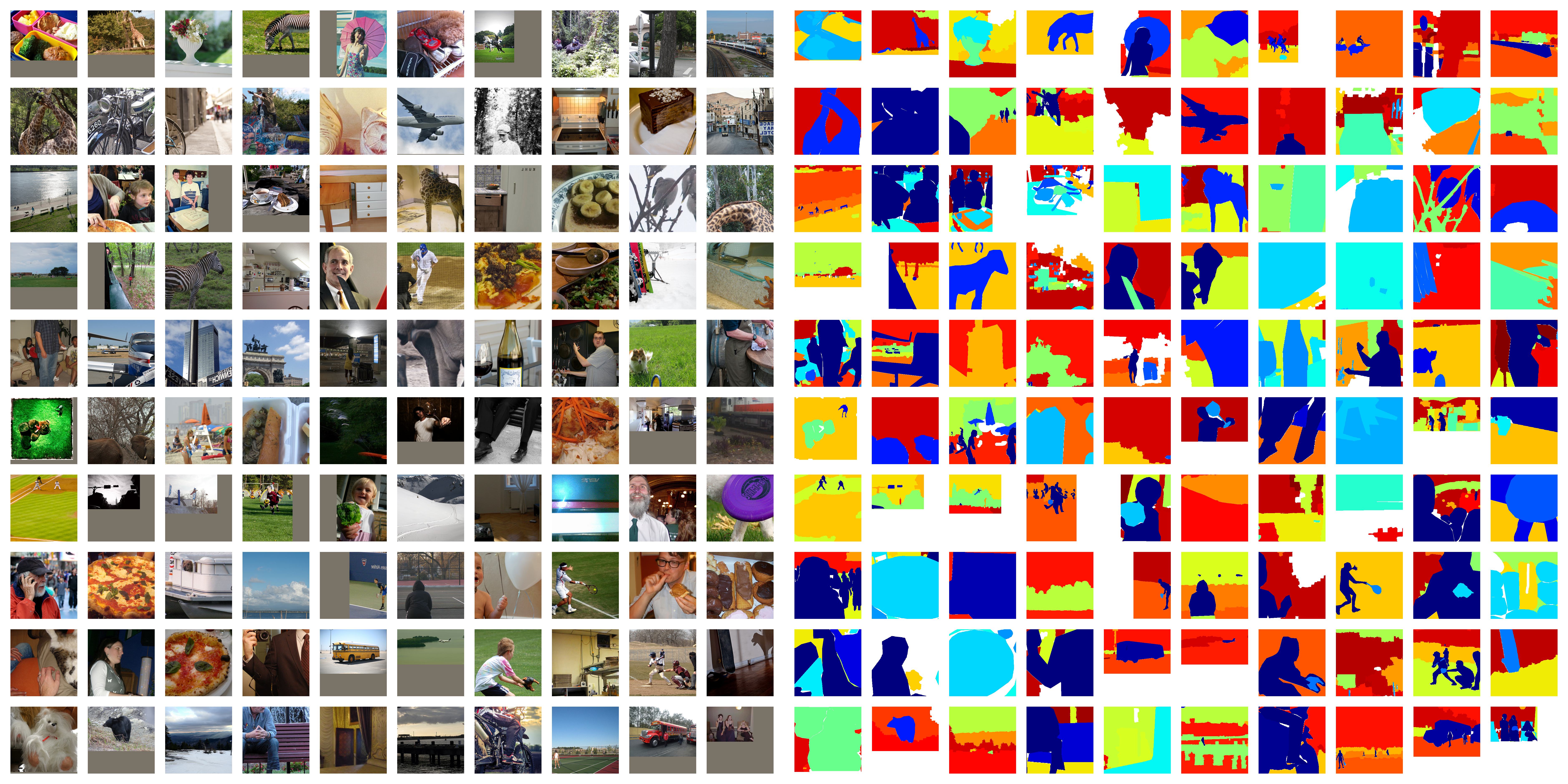
Processed images and labels in COCO-Stuff 164k:
Inference Demo
You can use the pre-trained models, the converted models, or your models.
To process a single image:
python demo.py single \
    --config-path configs/voc12.yaml \
    --model-path deeplabv2_resnet101_msc-vocaug-20000.pth \
    --image-path image.jpg
To run on a webcam:
python demo.py live \
    --config-path configs/voc12.yaml \
    --model-path deeplabv2_resnet101_msc-vocaug-20000.pth
To run a CRF post-processing, add --crf. To run on a CPU, add --cpu.
Misc
torch.hub
Model setup with two lines
import torch.hub
model = torch.hub.load("kazuto1011/deeplab-pytorch", "deeplabv2_resnet101", pretrained='cocostuff164k', n_classes=182)
Difference with Caffe version
- While the official code employs 1/16 bilinear interpolation (
Interplayer) for downsampling a label for only 0.5x input, this codebase does for both 0.5x and 0.75x inputs with nearest interpolation (PIL.Image.resize, related issue). - Bilinear interpolation on images and logits is performed with the
align_corners=False.
Training batch normalization
This codebase only supports DeepLab v2 training which freezes batch normalization layers, although v3/v3+ protocols require training them. If training their parameters on multiple GPUs as well in your projects, please install the extra library below.
pip install torch-encoding
Batch normalization layers in a model are automatically switched in libs/models/resnet.py.
try:
    from encoding.nn import SyncBatchNorm
    _BATCH_NORM = SyncBatchNorm
except:
    _BATCH_NORM = nn.BatchNorm2d
References
L.-C. Chen, G. Papandreou, I. Kokkinos, K. Murphy, A. L. Yuille. DeepLab: Semantic Image Segmentation with Deep Convolutional Nets, Atrous Convolution, and Fully Connected CRFs. IEEE TPAMI, 2018.
Project / Code / arXiv paperH. Caesar, J. Uijlings, V. Ferrari. COCO-Stuff: Thing and Stuff Classes in Context. In CVPR, 2018.
Project / arXiv paperM. Everingham, L. Van Gool, C. K. I. Williams, J. Winn, A. Zisserman. The PASCAL Visual Object Classes (VOC) Challenge. IJCV, 2010.
Project / Paper
Explore related projects
tensorflow/tensorflow
An Open Source Machine Learning Framework for Everyone
201,427 starshuggingface/transformers
🤗 Transformers: the model-definition framework for state-of-the-art machine learning models in text, vision, audio, and multimodal models, for both inference and training.
168,711 starsAUTOMATIC1111/stable-diffusion-webui
Stable Diffusion web UI
165,274 starsComfy-Org/ComfyUI
The most powerful and modular diffusion model GUI, api and backend with a graph/nodes interface. The fastest local inference engine in the world.
146,024 stars