
jrgilbertson/networked-thinking
jrgilbertson/networked-thinking has 156 GitHub stars and 17 forks. GitHot measured 0 in 7 days. Last checked 2026-11-10 23:19 UTC. Last push 2026-09-21.
An Obsidian companion vault for putting Networked Thinking into practice, with the notes, templates, and folder structure from the book.
Measured star growth
- in 24h
- Update delayed
- in 7 days
- 0
- in 15 days
- Collecting history
- in 1 month
- Collecting history
Net star changes over overlapping periods, not daily totals. Missing measurements are left blank. Stars measure attention, not software quality.
README.md
OriginalNetworked Thinking


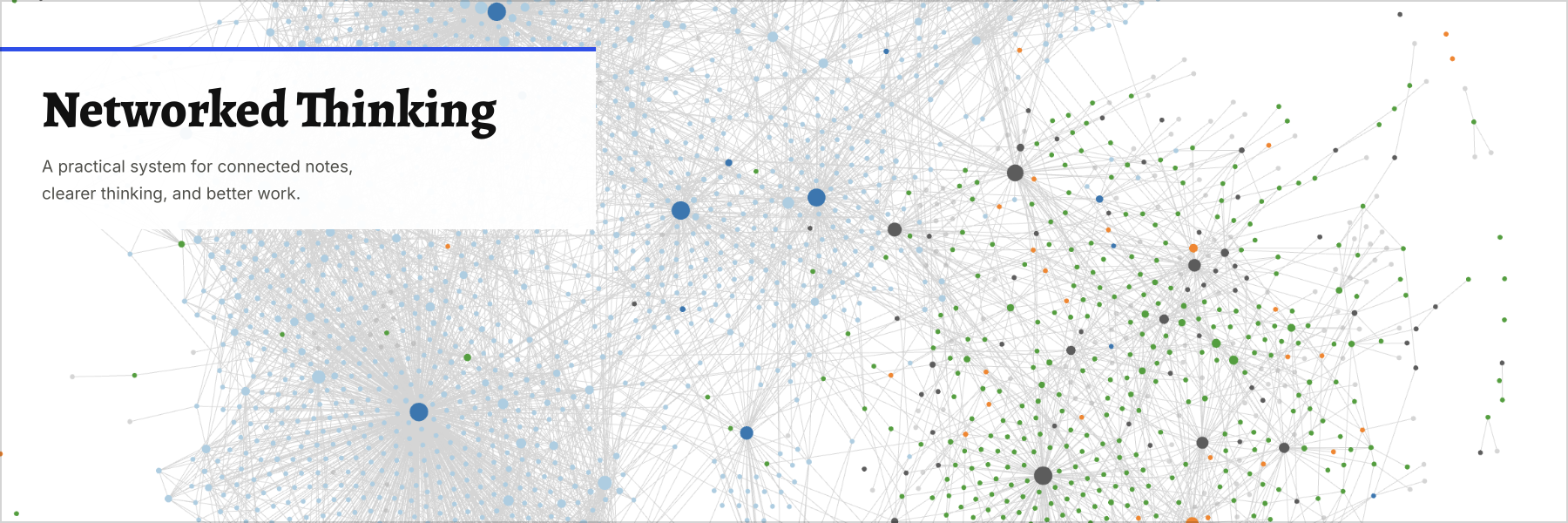
Networked Thinking is a book and practical system for turning saved articles, highlights, and notes into a living knowledge system for writing, decisions, and work.
Purpose
I built the original setup in 2022 after realizing I confused saving information with learning from it. AI has made that mistake easier to make. The system protects the useful friction of writing down what I know, what connects, and what I still need to figure out. Then when I bring in AI, I'm asking it to work with my thinking instead of replacing it.
This vault is the companion to Networked Thinking, the forthcoming book by Jason Gilbertson and Terri Yeh. Every note type, template, and folder the book describes is built out and linked here, so you can see the system running instead of reading about it in the abstract.
Quickstart
Install Obsidian, the free local-first app this vault is built for. Then either click "Use this template" on this repository to create your own version-controlled copy, or download the latest release ZIP from the Releases page for a plain folder. Open that folder as a vault in Obsidian (File > Open Vault), then read GETTING-STARTED.md for the full folder map, template inventory, and linking mechanics.
Structure
Content is organized by workflow state, with links and structure notes carrying the topic organization instead of folders. The essential folders:
Atomic Notes/     Single-concept notes, one idea each (YYYYMMDDHHMM filenames)
Structure Notes/  Topic maps that link related atomic notes together
Reference Notes/  Notes on external sources, kept before they're synthesized
Templates/        Starting points for every note type
Inbox/            Raw capture, sorted during weekly review
Reviews/          Daily, weekly, and quarterly reflections, plus decision records
People, Meetings, Projects, Vocabulary Notes, and Places and Things are optional workflow folders. Attachments/ holds media and Bases/ holds the saved view definitions that templates embed. GETTING-STARTED.md has the complete folder map, the full template inventory, and the wikilink and alias mechanics.
For agentic assistants working directly in the vault, the companion Networked Thinking Skills project adds atomic-note and atomic-note-audit skills.
Status
This is active, pre-launch material for the book, due in 2026. The atomic notes, structure notes, and templates are worked examples to open and read. Capture and review folders are left mostly empty for your own material.
Learn more and join the waitlist at networkedthinking.ai. For beta reading or early-access questions, email [email protected] or [email protected].
License
CC BY 4.0. See LICENSE.
Explore related projects
n8n-io/n8n
Fair-code workflow automation platform with native AI capabilities. Combine visual building with custom code, self-host or cloud, 400+ integrations.
210,070 starslanggenius/dify
Build Agentic workflows, RAG pipelines, with rich AI model and tool support on one collaborative workspace. Deploy on cloud, VPC, or self-hosted, so teams move from prototype to production without rebuilding the stack.
160,773 starsmicrosoft/PowerToys
Microsoft PowerToys is a collection of utilities that supercharge productivity and customization on Windows
140,833 starsstablyai/orca
Orca is the place for working with a fleet of agents (e.g. Grok Bot, Claude Code). Run any coding agent with your own subscription. Available on desktop, mobile and remote runtime.
121,719 stars