
jiaweizzhao/GaLore
jiaweizzhao/GaLore has 1,714 GitHub stars and 167 forks. GitHot measured +1 stars in 24 hours. Last checked 2026-11-06 05:16 UTC. Last push 2024-10-28.
GaLore: Memory-Efficient LLM Training by Gradient Low-Rank Projection
Measured star growth
- in 24h
- +1
- in 7 days
- Update delayed
- in 15 days
- Update delayed
- in 1 month
- Update delayed
Net star changes over overlapping periods, not daily totals. Missing measurements are left blank. Stars measure attention, not software quality.
README.md
OriginalGaLore
This repo contains the pre-release version of GaLore algorithm, proposed by GaLore: Memory-Efficient LLM Training by Gradient Low-Rank Projection.
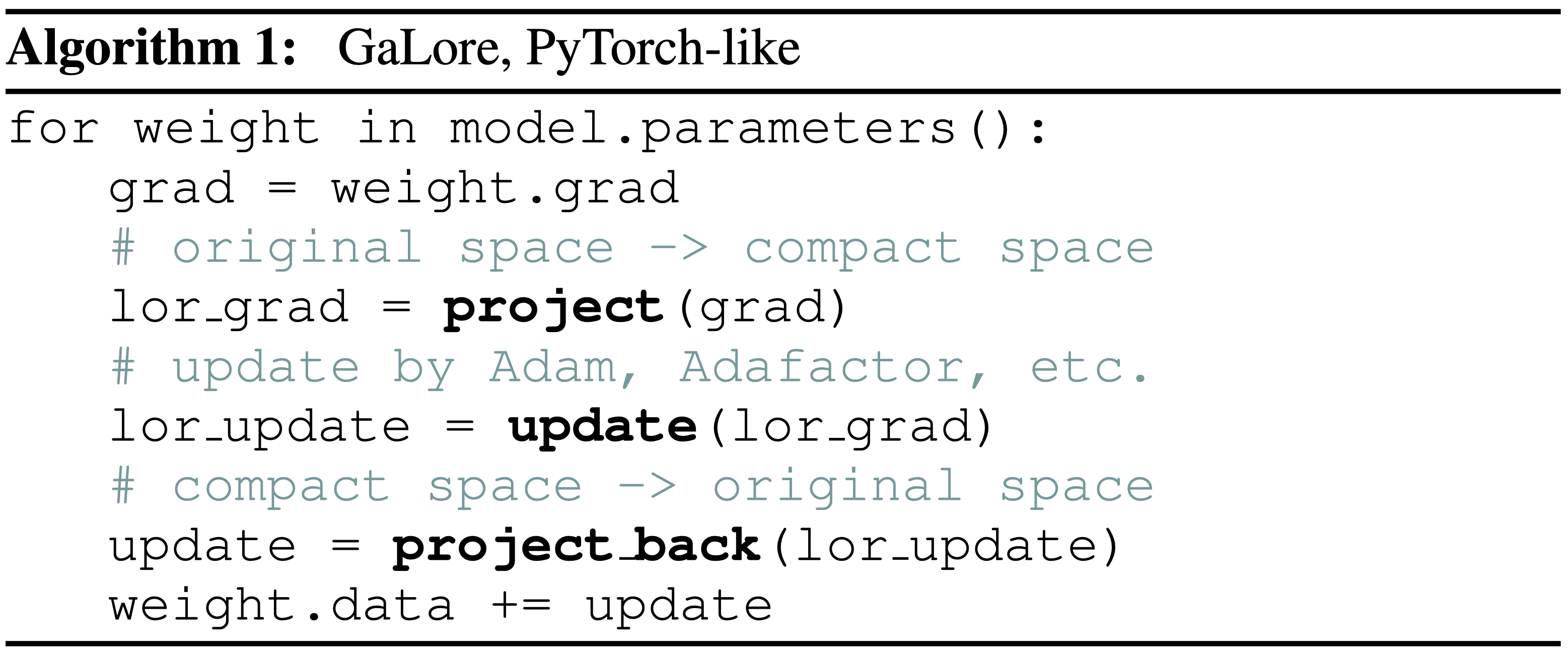
Gradient Low-Rank Projection (GaLore) is a memory-efficient low-rank training strategy that allows full-parameter learning but is more memory-efficient than common low-rank adaptation methods, such as LoRA. As a gradient projection method, GaLore is independent of the choice of optimizers and can be easily plugged into existing ones with only two lines of code, as shown in Algorithm 1 below.
News
2024-09-01: We are working on GaLore 2, which is a more efficient and accessible version of GaLore. Please stay tuned!
2024-07-11: We release Q-GaLore: Quantized GaLore with INT4 Projection. [paper] [code]
2024-07-01: GaLore is accepted to ICML 2024 as Oral!
2024-04-20: Please join our Slack workspace GaLore-Social to discuss with us and the community.
Installation
Install GaLore optimizer
Install from pip:
pip install galore-torch
or if you want to install from source:
git clone [email protected]:jiaweizzhao/GaLore.git
cd GaLore
pip install -e .
Install experiment dependencies
pip install -r exp_requirements.txt
Our experiment scripts are tested on Python 3.8 with PyTorch 2.1.
Usage
Save optimizer memory using GaLore optimizers
from galore_torch import GaLoreAdamW, GaLoreAdamW8bit, GaLoreAdafactor
# define param groups as galore_params and non_galore_params
param_groups = [{'params': non_galore_params},
                {'params': galore_params, 'rank': 128, 'update_proj_gap': 200, 'scale': 0.25, 'proj_type': 'std'}]
optimizer = GaLoreAdamW(param_groups, lr=0.01)
Save weight gradient memory using per-layer weight updates
We use register_post_accumulate_grad_hook provided by PyTorch (torch>=2.1.0) to enable per-layer weight updates. An example is shown below:
# define an optimizer for each parameter p, and store them in optimizer_dict
for p in model.parameters():
    if p.requires_grad:
        optimizer_dict[p] = GaLoreAdamW([{'params': p, 'rank': 128, 'update_proj_gap': 200, 'scale': 0.25, 'proj_type': 'std'}], lr=0.01)

# define a hook function to update the parameter p during the backward pass
def optimizer_hook(p):
    if p.grad is None:
        return
    optimizer_dict[p].step()
    optimizer_dict[p].zero_grad()

# Register the hook onto every parameter
for p in model.parameters():
    if p.requires_grad:
        p.register_post_accumulate_grad_hook(optimizer_hook)
More details can be found in torchrun_main.py.
Benchmark 1: Pre-Training LLaMA on C4 dataset
torchrun_main.py is the main script for training LLaMA models on C4 with GaLore. Our benchmark scripts for various sizes of models are in scripts/benchmark_c4 folder.
For example, to train a 60m model on C4, do the following:
# LLaMA-60M, GaLore-Adam, 1 A100, 1 Node
torchrun --standalone --nproc_per_node 1 torchrun_main.py \
    --model_config configs/llama_60m.json \
    --lr 0.01 \
    --galore_scale 0.25 \
    --rank 128 \
    --update_proj_gap 200 \
    --batch_size 256 \
    --total_batch_size 512 \
    --num_training_steps 10000 \
    --warmup_steps 1000 \
    --weight_decay 0 \
    --dtype bfloat16 \
    --eval_every 1000 \
    --optimizer galore_adamw
Train 7B model with a single GPU with 24GB memory
To train a 7B model with a single GPU such as NVIDIA RTX 4090, all you need to do is to specify --optimizer=galore_adamw8bit_per_layer, which enables GaLoreAdamW8bit with per-layer weight updates.
With activation checkpointing, you can maintain a batch size of 16 tested on NVIDIA RTX 4090.
# LLaMA-7B, 8-bit GaLore-Adam, single GPU, activation checkpointing
# bsz=16, 22.8G,
torchrun --standalone --nproc_per_node 1 torchrun_main.py \
    --model_config configs/llama_7b.json \
    --lr 0.005 \
    --galore_scale 0.25 \
    --rank 1024 \
    --update_proj_gap 500 \
    --batch_size 16 \
    --total_batch_size 512 \
    --activation_checkpointing \
    --num_training_steps 150000 \
    --warmup_steps 15000 \
    --weight_decay 0 \
    --grad_clipping 1.0 \
    --dtype bfloat16 \
    --eval_every 1000 \
    --single_gpu \
    --optimizer galore_adamw8bit_per_layer
Currently per-layer weight updates technique is only supported for single GPU training (--single_gpu) without using nn.parallel.DistributedDataParallel. We are working on supporting multi-GPU training with per-layer weight updates.
Benchmark 2: Fine-Tuning RoBERTa on GLUE tasks
run_glue.py is the main script for fine-tuning RoBERTa models on GLUE tasks with GaLore. An example script is shown below:
python run_glue.py \
    --model_name_or_path roberta-base \
    --task_name mrpc \
    --enable_galore \
    --lora_all_modules \
    --max_length 512 \
    --seed=1234 \
    --lora_r 4 \
    --galore_scale 4 \
    --per_device_train_batch_size 16 \
    --update_proj_gap 500 \
    --learning_rate 3e-5 \
    --num_train_epochs 30 \
    --output_dir results/ft/roberta_base/mrpc
Citation
@misc{zhao2024galore,
      title={GaLore: Memory-Efficient LLM Training by Gradient Low-Rank Projection},
      author={Jiawei Zhao and Zhenyu Zhang and Beidi Chen and Zhangyang Wang and Anima Anandkumar and Yuandong Tian},
      year={2024},
      eprint={2403.03507},
      archivePrefix={arXiv},
      primaryClass={cs.LG}
}
Explore related projects
affaan-m/ECC
The agent harness performance optimization system. Skills, instincts, memory, security, and research-first development for Claude Code, Codex, Opencode, Cursor and beyond.
298,613 starsNousResearch/hermes-agent
The agent that grows with you
261,225 starsmultica-ai/andrej-karpathy-skills
A single CLAUDE.md file to improve Claude Code behavior, derived from Andrej Karpathy's observations on LLM coding pitfalls.
230,306 starsfirecrawl/firecrawl
Supercharge your AI agents with data from the web and beyond. Building the library for superintelligence. 🔥
199,027 stars