
jfkirk/tensorrec
jfkirk/tensorrec has 1,298 GitHub stars and 218 forks. GitHot measured 0 stars in 24 hours. Last checked 2026-11-07 08:13 UTC. Last push 2023-05-22.
A TensorFlow recommendation algorithm and framework in Python.
Measured star growth
- in 24h
- 0
- in 7 days
- Update delayed
- in 15 days
- Update delayed
- in 1 month
- Update delayed
Net star changes over overlapping periods, not daily totals. Missing measurements are left blank. Stars measure attention, not software quality.
README.md
OriginalTensorRec
A TensorFlow recommendation algorithm and framework in Python.


NOTE: TensorRec is not under active development
TensorRec will not be receiving any more planned updates. Please feel free to open pull requests -- I am happy to review them.
Thank you for your contributions, support, and usage of TensorRec!
-James Kirk, @jfkirk
For similar tools, check out:
What is TensorRec?
TensorRec is a Python recommendation system that allows you to quickly develop recommendation algorithms and customize them using TensorFlow.
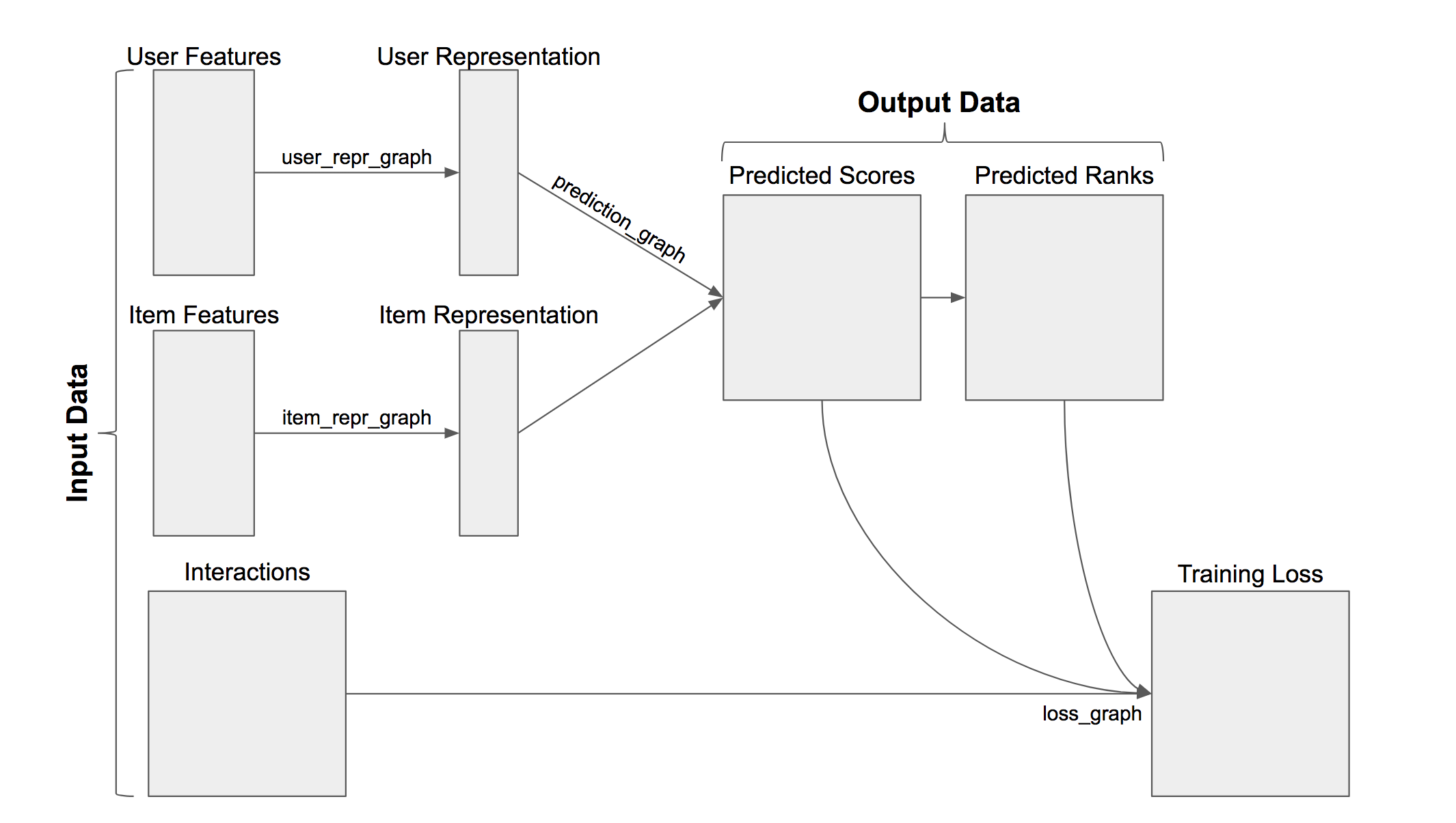
TensorRec lets you to customize your recommendation system's representation/embedding functions and loss functions while TensorRec handles the data manipulation, scoring, and ranking to generate recommendations.
A TensorRec system consumes three pieces of data: user_features, item_features, and interactions. It uses this data to learn to make and rank recommendations.
For an overview of TensorRec and its usage, please see the wiki.
For more information, and for an outline of this project, please read this blog post.
For an introduction to building recommender systems, please see these slides.
Example: Basic usage
import numpy as np
import tensorrec

# Build the model with default parameters
model = tensorrec.TensorRec()

# Generate some dummy data
interactions, user_features, item_features = tensorrec.util.generate_dummy_data(
    num_users=100,
    num_items=150,
    interaction_density=.05
)

# Fit the model for 5 epochs
model.fit(interactions, user_features, item_features, epochs=5, verbose=True)

# Predict scores and ranks for all users and all items
predictions = model.predict(user_features=user_features,
                            item_features=item_features)
predicted_ranks = model.predict_rank(user_features=user_features,
                                     item_features=item_features)

# Calculate and print the recall at 10
r_at_k = tensorrec.eval.recall_at_k(predicted_ranks, interactions, k=10)
print(np.mean(r_at_k))
Quick Start
TensorRec can be installed via pip:
pip install tensorrec
Explore related projects
tensorflow/tensorflow
An Open Source Machine Learning Framework for Everyone
201,367 starshuggingface/transformers
🤗 Transformers: the model-definition framework for state-of-the-art machine learning models in text, vision, audio, and multimodal models, for both inference and training.
168,609 starsAUTOMATIC1111/stable-diffusion-webui
Stable Diffusion web UI
165,245 starsComfy-Org/ComfyUI
The most powerful and modular diffusion model GUI, api and backend with a graph/nodes interface. The fastest local inference engine in the world.
145,470 stars